Orforglipron (Foundayo): The GLP-1 Pill’s Top Dose Took Off 11.2% in 72 Weeks, Against 2.1% on a Dummy Pill

“Orforglipron” is searched about 27,100 times a month in the United States, the database’s figure for the past year (from a paid keyword database, pulled 23 October 2026). The months behind it climbed from 14,800 in October 2025 to 49,500 in April 2026, the month the drug was approved, and read 27,100 in September 2026 [1]. Most of those people want to know one thing: is this the weight-loss pill that works like Ozempic?
Here is what it is. Orforglipron is a GLP-1 drug, the class that includes Ozempic, Wegovy and Zepbound. GLP-1 is a gut hormone that helps regulate appetite and how much you eat, and GLP-1 drugs act on the same receptor it does [2]. The difference is the shape of the molecule. The injections are peptides, small proteins, which normally have to be injected because so little survives being swallowed; orforglipron is a small molecule that does survive it, so it comes as a once-a-day tablet with no rules about food or water [3]. The FDA approved it on 1 April 2026, as Foundayo, for weight management [4].
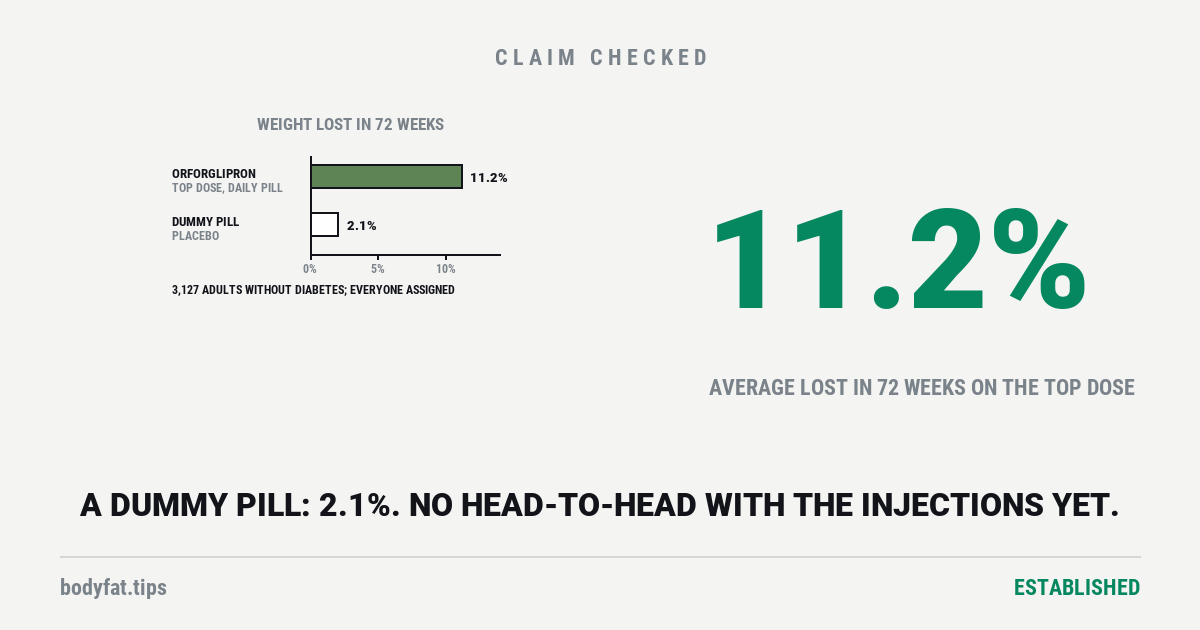
Does it work? Yes. In the larger of the two trials the approval rests on, 3,127 adults without diabetes, the top dose took off an average of 11.2% of body weight in 72 weeks, against 2.1% on a dummy pill. That is about 25 lb (11.3 kg) against about 5 lb (2.4 kg) [5] [6]. It is real weight loss, from a pill. Compared across trials, it is less than the injections have produced in theirs, by the FDA’s own reading [3], and no trial has yet put it against injected semaglutide or tirzepatide [7].
This is journalism, not medical advice. Orforglipron is a prescription medicine. Whether it suits you, at what dose, and alongside which of your other medicines, is a question for your prescriber. And do not buy a “GLP-1 pill” from anyone who will sell you one without a prescription: the FDA says unapproved versions of these drugs skip its review of safety, effectiveness and quality, and tells patients to get a prescription and fill it at a state-licensed pharmacy [8].
What is orforglipron approved for, and since when?
The FDA’s approval letter is dated 1 April 2026. It approves Foundayo tablets, alongside a reduced-calorie diet and more physical activity, “to reduce excess body weight and maintain weight reduction long term in adults with obesity or adults with overweight in the presence of at least one weight-related comorbid condition”, meaning a health problem linked to weight, such as high blood pressure [4]. That is the whole indication in the US label we read, revised in July 2026: weight, in adults. It is not approved there for type 2 diabetes, and the label says it should not be combined with another GLP-1 drug [2].
It was fast. The application arrived on 20 January 2026 [4], so the decision came about ten weeks later, by our arithmetic. The FDA says it was the first new molecular entity, a drug never approved before in any form, to be approved under the Commissioner’s National Priority Voucher pilot, a scheme for speeding reviews, and the fastest approval of a new molecular entity since 2002 [9]. It was not sent to an advisory committee, the letter says, because “there were no controversial issues” [4]. The same letter requires the maker to finish a heart-safety trial and report its liver data, and asks, for five years, for fast reports of any serious, unexpected liver injury attributed to the drug that leads to jaundice, liver failure, a transplant or death. Both come up below.
Orforglipron dosage: why the trials say 36 mg and the pharmacy says 17.2 mg
Read about orforglipron and you will meet two sets of doses. The trials used capsules: a top dose of 36 mg. The approved product is a tablet, and the tablets are bioequivalent, meaning they put the same amount of drug into the blood, at different milligram strengths: the trials’ 6, 12 and 36 mg correspond to tablets of 5.5, 9 and 17.2 mg [3]. So “36 mg” in a trial and “17.2 mg” on a prescription are the same dose.
The label starts at 0.8 mg once a day, moves to 2.5 mg after at least 30 days, then 5.5 mg, and after that may go up to 9, 14.5 or 17.2 mg, a step at a time, at least 30 days apart, depending on how well a person does and tolerates it; 17.2 mg is the maximum, and it can be taken with or without food [2]. The slow climb is there to soften the side effects on the gut. Which step is right is a prescriber’s call, not ours.
Does orforglipron work for weight loss? What ATTAIN-1 and ATTAIN-2 found
Two trials carry the approval, and both were run the way you would want: randomised, so chance decided who got the drug; double-blind, so neither the people nor their doctors knew who was on it; and against a placebo, a dummy pill [3].
ATTAIN-1 enrolled 3,127 adults with obesity or overweight and no diabetes, and ran 72 weeks. Average weight change: 7.5% down on the lowest dose, 8.4% on the middle one, 11.2% on the top dose, and 2.1% on the dummy pill [5]. The FDA did not just take the maker’s word for it. Its statisticians re-ran the analysis on the trial’s own data, disagreed with how the maker had filled in missing weights, and got the same answer at the top dose: 11.2% against 2.1%, a difference of 9.0 percentage points, with a confidence interval, the range the true average difference probably sits in, of 8.1 to 10.0 [3]. The FDA’s yardstick for a weight-loss drug is a 5-point average edge over placebo; all three doses cleared it [3].
Averages hide people, so here is the spread. On the top dose, 54.6% lost at least 10% of their body weight, 36.0% lost at least 15% and 18.4% lost at least 20%. On the dummy pill those shares were 12.9%, 5.9% and 2.8% [5].
ATTAIN-2 asked the same question in 1,613 adults with type 2 diabetes, for 72 weeks. People with diabetes lose less on every weight drug, and they did here: 9.6% on the top dose against 2.5% on the dummy pill, and 5.1% and 7.0% on the lower doses [10] [3]. The FDA called the lowest dose’s edge over placebo, 2.6 points, not clinically significant, and the middle dose’s, 4.5, borderline [3]. A smaller 72-week trial in 238 Japanese adults, posted on the US trials registry but not, that we could find, published, points the same way: 7.9% on the top dose, 8.7% on the middle one and 0.6% on the dummy pill, counting everyone who took at least one dose, whether or not they kept taking it [11].
One thing about counting, because it explains why you will see different numbers for the same trial. A trial can count everyone it assigned to the drug, whether or not they kept taking it; or it can estimate what would have happened if everyone had stayed on it. The first is the papers’ main analysis and the one the FDA used: 11.2% in ATTAIN-1. The second gives 12.4%, or 27.3 lb (12.4 kg), and it is the number the maker’s press release led with [6]. Neither is wrong. The first is closer to what happens to people who start the drug in real life, some of whom stop.
And people did stop. In ATTAIN-1, 24% of those on the top dose stopped taking the trial drug, and 30% of those on the dummy pill [2]; at 72 weeks the weight was missing for 23.9% of the dummy-pill group and 14.8% of the top-dose group, and had to be filled in by statistical estimate [3]. That is ordinary for an obesity trial, and it is why the counting method matters.
Here is every phase 3 trial with results that we read. They differ in who was in them and what they were asking, so read the right-hand columns for what each one tells you, not as one pooled number.
| Trial | Who, how many, how long | Compared with; first question asked | Weight, top dose against comparator | Stopped for side effects |
|---|---|---|---|---|
| ATTAIN-1 [5] | 3,127 adults with obesity or overweight, no diabetes; 72 weeks | Dummy pill; weight | −11.2% against −2.1%: 25.0 lb (11.3 kg) against 5.3 lb (2.4 kg) [6] | 5.3 to 10.3% across the doses, against 2.7% |
| ATTAIN-2 [10] | 1,613 adults with overweight and type 2 diabetes; 72 weeks | Dummy pill; weight | −9.6% against −2.5%: 21.2 lb against 5.9 lb (about 9.6 and 2.7 kg) [12] | 6.1 to 9.9%, against 4.1% |
| ATTAIN-J [11] | 238 Japanese adults with obesity; 72 weeks | Dummy pill; weight | −7.9% against −0.6%, counting everyone who took a dose; −8.7% on the middle dose; the record gives no pound or kilogram figure | 2 of 60 on the top dose, none of 60 on the dummy pill, left the trial for an adverse event |
| ACHIEVE-1 [13] | 559 adults with early type 2 diabetes, on diet and exercise only; 40 weeks | Dummy pill; blood sugar (HbA1c) | −7.6% against −1.7%; on the drug, 16.1 lb (7.3 kg) against 2.9 lb (1.3 kg) | 4.4 to 7.8%, against 1.4% |
| ACHIEVE-2 [14] | 962 adults with type 2 diabetes on metformin; 40 weeks; open-label | Dapagliflozin, a diabetes pill of another class; blood sugar | On the drug, −7.3%, 15.0 lb (6.8 kg), against −3.0%, 6.0 lb (2.7 kg) | Stopped the trial drug for any reason: 15 to 20%, against 6% |
| ACHIEVE-3 [15] | 1,698 adults with type 2 diabetes on metformin; 52 weeks; open-label | Oral semaglutide, 7 or 14 mg; blood sugar | On the drug, −9.2%, 19.6 lb (8.9 kg), against −5.3%, 11.0 lb (5.0 kg) on 14 mg semaglutide | 9 to 10%, against 4 to 5% |
| ACHIEVE-5 [16] | 546 adults with type 2 diabetes on insulin glargine; 40 weeks | Dummy pill; blood sugar | −5.4% against +0.2% | Not given in the summary |
| ACHIEVE-4 [17] | 2,749 adults with type 2 diabetes and heart or kidney disease; median 2 years; open-label | Insulin glargine; heart attacks, strokes, unstable angina and heart deaths | Not given in the summary | Not given in the summary; side effects of the gut were the commonest reason |
| ACHIEVE-J [18] | 401 Japanese adults with type 2 diabetes; 52 weeks; open-label, three doses, no comparison group | None; safety | Not its question | 5% on the lowest dose, 14% on the top dose |
| ATTAIN-MAINTAIN [19] | 376 adults who had just finished 72 weeks of tirzepatide or semaglutide injections; 52 weeks | Dummy pill; how much of the earlier weight loss was kept | Kept 74.7% (after tirzepatide) and 79.3% (after semaglutide) of the earlier loss, against 49.2% and 37.6%, in those whose weight had levelled off | 4.8 to 7.3% on orforglipron across the two groups |
The earlier, smaller trial behind all this, a 2023 phase 2 trial in 272 adults without diabetes, had found 9.4% to 14.7% weight loss over 36 weeks across four doses, the highest 45 mg, against 2.3% on a dummy pill [20]. The phase 3 trials stopped at 36 mg, and their numbers are lower.
How long does it take for orforglipron to work?
In ATTAIN-1 the weight loss on every dose was already significantly greater than on the dummy pill at week 4, the first time anyone was weighed, while people were still on the 1 mg starting step [3]. Then it kept going. Climbing to the top dose takes up to 20 weeks, and the FDA’s modelling found weight still falling at 72 weeks on the top dose, with no plateau in sight [3]. The drug itself reaches a steady level in the blood after about a week of daily tablets [2].
So: a little in the first month, most of it over the following year, and on the top dose still more coming at 72 weeks, if the trials are a guide. These are averages; they cannot tell anyone how fast it will work for them.
Orforglipron vs tirzepatide, and semaglutide
This is the comparison everyone wants, and the honest first sentence is that no trial has put orforglipron head to head against injected semaglutide (Wegovy, Ozempic) or tirzepatide (Zepbound, Mounjaro) [7]. It has been put against other drugs. ACHIEVE-3 put it against oral semaglutide, the tablet form, in 1,698 adults with type 2 diabetes, at 7 and 14 mg, below the 25 mg semaglutide tablet now sold for weight [3]. Orforglipron brought blood sugar down further, and on the drug the top dose took off 9.2% of body weight against 5.3% on 14 mg semaglutide [15]. It also had more side effects: more people stopped for them, 9 to 10% against 4 to 5% [15]. And an early diabetes trial included a weekly injection of dulaglutide, an older GLP-1 drug, as a yardstick [21].
Without a head-to-head trial, the comparisons are across trials, which means different people, different lengths and different placebo groups. With that warning, here is what they say. The FDA’s review set orforglipron’s 9.0-point edge over placebo in people without diabetes beside the figures in the other drugs’ labels: 17.8 points for tirzepatide at its top dose, 12.4 for injected semaglutide at the standard weight dose and 11.2 for the semaglutide tablet sold for weight [3]. In people with diabetes, its benefit-risk table gives 7.1 against 11.6 for tirzepatide and 6.2 for injected semaglutide, the injections’ figures taken at one year [3]. Set side by side, which is our reading of a table across trials, that puts the pill behind tirzepatide and slightly ahead of injected semaglutide in people with diabetes. Its words: a very effective drug, “though not as highly effective as semaglutide or tirzepatide” [3].
Not every comparison agrees about semaglutide. A 2026 network meta-analysis, a method that ranks drugs against each other across many trials at once, put orforglipron at 9.9% more weight loss than lifestyle advice alone at one year, beside 9.8% for injected semaglutide, 10.9% for oral semaglutide and 14.9% for tirzepatide [22]. A 2026 review of 38 trials gave placebo-subtracted losses of up to 12.4% for orforglipron, 14.8% for injected semaglutide and 19.0% for tirzepatide, without pooling them [23]. And an indirect comparison paid for by semaglutide’s maker, a competitor, put the 25 mg semaglutide tablet 3.2 points ahead of top-dose orforglipron, and put the odds of stopping for a side effect about four times higher on orforglipron [24]. Who paid for that one matters; so does who paid for every orforglipron trial on this page.
Put together: against tirzepatide, every comparison we read puts orforglipron behind, by a wide margin. Against injected semaglutide, the readings disagree: slightly ahead in people with diabetes, on the FDA’s table; level, in the network meta-analysis; and a few points behind in people without diabetes, on the FDA’s figures and in the review of 38 trials. If you want the tirzepatide-against-semaglutide question itself, our verdict on it covers the two head-to-head trials that ran it, one in obesity and one in type 2 diabetes.
One more, because it is a rising search: “tirzepatide pills”. Orforglipron is not tirzepatide in a pill. Tirzepatide is a weekly injection that acts on two hormone receptors, GLP-1 and a second one called GIP; orforglipron is a different molecule that acts on GLP-1 alone [3]. They share a maker and one receptor, not a molecule.
Is orforglipron “Wegovy in a pill”?
No, and the phrase now has a literal meaning that makes the mix-up easy. In December 2025 the FDA approved semaglutide itself, the drug in Wegovy, as a daily tablet for weight [3]. That tablet is semaglutide. Orforglipron is not. Semaglutide gets through the stomach only with help: by the FDA’s figure, roughly 1 to 2% of the swallowed dose reaches the blood, so the tablet comes with rules about an empty stomach and a little water [3]. About 77% of a 0.8 mg orforglipron dose reaches the blood, by the label, and it can be taken with or without food [2].
What is the molecular weight of orforglipron?
The label gives 902.0 grams per mole for orforglipron calcium, the form in the tablet [2]. Molecular weight is simply how heavy one molecule is, and it is the easiest way to see the difference that matters here. Semaglutide’s label gives 4,113.58 [25]. By our arithmetic, semaglutide is about four and a half times heavier. That is the structure question in one number: a large peptide built from amino acids, against a small synthetic molecule that a tablet can carry.
Orforglipron side effects
Mostly the gut, mostly early, mostly mild to moderate. Pooling the two weight trials, the label gives these for the top tablet dose against the dummy pill: nausea 35% against 10%, diarrhoea 25% against 11%, constipation 24% against 9%, vomiting 24% against 4% [2]. Nausea, vomiting and diarrhoea were most common while the dose was being raised and eased off after [2]. About 3% had a severe gut reaction, against 1% on the dummy pill [2].
Side effects made 8% of people on orforglipron stop for good, against 3% on the dummy pill, rising with the dose: 6%, 9% and 10% [2]. The FDA called that similar to the injections’ trials [3]. The network meta-analysis put orforglipron among the drugs with the most stopping for side effects [22], and in ACHIEVE-3 more people stopped it than stopped oral semaglutide [15].
The rest of the list, with the figures the label gives: hair loss in 7% of women and 0.9% of men on the drug, against 3% and 0.7% on the dummy pill, which the label ties to the weight loss; a faster heart rate, by 4 to 5 beats a minute on average; gallstones in 1% against 0.7%; low blood pressure in 2% against 0.5% [2]. In people with diabetes, blood sugar below 54 mg/dL in 2% against 0.2%, and in 7% of those also taking a sulfonylurea, an older diabetes drug [2].
The label’s warnings are the class’s warnings: pancreatitis, severe gut reactions, kidney injury from dehydration, low blood sugar, allergic reactions, worsening diabetic eye disease, gallbladder disease, and food in the lungs under anaesthesia, so anyone having a procedure should tell the team they take it [2]. The boxed warning about thyroid tumours comes from rodent studies of other GLP-1 drugs; orforglipron itself does not act on the rat or mouse receptor and did not cause tumours in rodents, and whether any of this applies to people has not been settled [2]. Eye questions about this class have their own verdict.
Three practical ones. Because it slows the stomach, it can change how other pills are absorbed: the label tells women on the contraceptive pill to switch method, or add a barrier method, for 30 days after starting and after each dose increase [2]. And it raised the level of simvastatin’s active form twofold, so the label caps simvastatin at 20 mg a day alongside it [2] (statins and blood sugar have their own verdict). And some medicines change how much of it reaches the blood, by blocking or speeding up CYP3A4, the liver enzyme that clears it. The antibiotic clarithromycin, a strong blocker, raised orforglipron’s level 3.5-fold, so the label caps the dose at 9 mg alongside a strong blocker and says to avoid the strong blockers, such as ritonavir, used in treating HIV, that also block OATP1B, a transporter that carries the drug too; it also says to avoid drugs that strongly speed the enzyme up [2]. It should be stopped in pregnancy [2].
Orforglipron and pancreatitis
Pancreatitis, inflammation of the pancreas, is on every GLP-1 drug’s label, and it is a related search here. In the two weight trials, a committee that reviewed each case confirmed acute pancreatitis in 6 people on orforglipron and 1 on the dummy pill, who had it twice: 0.14 people per 100 years of treatment against 0.04 [2]. Those are small numbers, and the groups were not the same size: more people were assigned the drug. The label also reports lipase, a pancreatic enzyme, up 26 to 31% on average on the drug against 4%, and says what that means without symptoms is unknown [2]. The warning’s advice is to stop the drug if pancreatitis is suspected: persistent, severe stomach pain, sometimes running through to the back [2].
The liver question
This is the risk that was specific to pills like this one, and it deserves a straight answer. Before orforglipron, the FDA says, four development programmes for small-molecule GLP-1 drugs were stopped over possible drug-induced liver injury in early trials; it names two, danuglipron and lotiglipron [3]. So the agency looked hard. Its liver team found no case of probable drug-induced liver injury in more than 3,000 people on orforglipron, and no case meeting Hy’s law, the pattern of liver enzymes and bilirubin that signals serious drug injury [3]. In ATTAIN-1, the liver enzyme ALT rose above ten times normal in 0.3% of people on the drug against 0.1% on the dummy pill, and the FDA called the differences negligible [3].
The maker’s own pooling of seven phase 3 trials, 11,220 people followed for up to 104 weeks, reports the same: high liver enzymes with high bilirubin in 0.1% of each group, and another cause for every case on orforglipron [26]. The FDA still wrote the caution into the approval: the liver data from the heart-safety trial are required, and the letter asks, for five years, for fast reports of any serious, unexpected liver injury attributed to the drug that leads to jaundice, liver failure, a transplant or death [4]. Its liver team wrote that with several million likely users, a clearer risk to the liver or bile ducts “may still arise post-market” [3].
Has a heart-outcomes trial reported?
One has, and it is mainly a safety trial, not a test of benefit. ACHIEVE-4 gave 2,749 adults with type 2 diabetes and heart or kidney disease either orforglipron or insulin glargine, openly, and followed them for a median of two years [17]. Heart attack, stroke, hospital stay for unstable angina or heart death: 4.2% on orforglipron, 5.0% on insulin, a hazard ratio, which compares how often something happens over time where 1.00 means no difference, of 0.84, with a range of 0.59 to 1.20 [17]. The trial was built to show orforglipron was not worse than insulin by more than a set margin, and it did; the range includes 1.00, so it does not show a benefit [17]. Deaths were 1.4% against 3.2%; the summary gives the counts without a statistical test [17]. The maker’s release gives more. Its key secondary heart measure, heart attack, stroke or heart death, was not significantly different from insulin: a hazard ratio of 0.77, with a range of 0.52 to 1.13. And in two analyses the release calls pre-planned, heart deaths were lower on orforglipron, 0.47 (range 0.25 to 0.90), and so were deaths from any cause, 0.43 (range 0.25 to 0.75) [27]. Read those two as a lead, not a finding. The release marks them as not adjusted for the number of comparisons the trial made, which raises the odds that one of them comes up by chance; neither is among the outcomes on the trial’s registry record; and a gap against insulin cannot tell you whether it comes from something orforglipron does or something insulin does [27] [17]. We read those figures in the release, not in the paper. The journal published a correction to the paper on 17 October 2026; we could not read it, so we cannot say which of the paper’s figures, if any, it changes; the release came out before it [17].
In the three weight trials together, the Japanese one included, heart and stroke events were rare and close: 0.84% on orforglipron against 0.79% on the dummy pill. Strokes and mini-strokes were 8 against 1, which the FDA examined case by case and judged most likely chance [3]. The FDA’s summary is plain: heart benefits in people with obesity are unknown, and so are benefits beyond 72 weeks [3]. A placebo-controlled heart-outcomes trial in people with heart or kidney disease, planned for 7,140 people, is recruiting, with its main results estimated for 2031 [28].
What happens when you stop orforglipron?
No trial has yet reported what happens to weight when orforglipron is stopped [7]. The weight trials ended with two weeks off the drug [2], and three registered trials take people off it for longer. The weight-management trial among them, ATTAIN-NOW, began in August 2026: about 2,000 adults with overweight, short of obesity, are randomised to stay on orforglipron, to switch from it to a dummy pill, or to switch the other way, and are weighed at two years. Its registry record does not say when the switch comes, and estimates the main results for 2029 [29]. ATTAIN-HYPERTENSION, a blood-pressure trial estimated to finish sooner, in September 2027, takes some people off the drug at random for 12 weeks, after 48 weeks on it. Its registered outcome for those weeks is blood pressure; its design paper also lists weight at week 60, the end of those weeks, without saying whether weight will be reported separately for the people who stopped [30]. And people with prediabetes in ATTAIN-1 stay on their pills for two more years and then stop for 14 weeks, so that their blood sugar can be measured off the drug [5] [3]. For the injections, the answer is known and unwelcome: most of the weight returns within a year, as our tirzepatide and semaglutide verdict sets out.
The nearest trial asks the reverse question: can the pill hold weight lost on an injection? ATTAIN-MAINTAIN took 376 adults who had just finished 72 weeks of tirzepatide or semaglutide and switched them to orforglipron or a dummy pill for a year [19]. Among those whose weight had levelled off on the injection, people on orforglipron kept 74.7% of the loss after tirzepatide and 79.3% after semaglutide; on the dummy pill, 49.2% and 37.6% [19]. The authors name its limits: no group stayed on the injection, and it ran one year [19]. It tells you the pill can hold most of an injection’s loss. It does not tell you what happens when the pill stops.
Does Foundayo help with diabetes?
It lowers blood sugar, clearly, in five trials of people with type 2 diabetes. In ACHIEVE-1, in early diabetes managed by diet and exercise, HbA1c, a blood test of average blood sugar over about three months, fell by 1.24 to 1.48 percentage points across the doses against 0.41 on the dummy pill [13]. It beat dapagliflozin, a diabetes pill of another class [14]; it beat oral semaglutide at the doses tested [15]; it added to insulin glargine [16]; and in ATTAIN-2 it lowered HbA1c by 0.8 to 1.2 points more than the dummy pill [3].
But the US approval we read is for weight management, not diabetes [4] [2]. If you have type 2 diabetes, whether it belongs in your treatment, and what happens to your other medicines, especially insulin or a sulfonylurea, is for your prescriber [2].
What is the safest GLP-1 to take?
Nobody can answer that for you from a table, and we will not pretend to. What the evidence does say: the drugs share their warnings, and the FDA judged orforglipron’s safety in its trials similar to the injections’ [3]. The differences run in both directions. Orforglipron appeared to cause fewer allergic reactions than the injected peptides tend to, the FDA notes, comparing across trials [3], and more stopping for side effects in the comparisons above [22] [15]. In the network meta-analysis, injected semaglutide was the only drug linked to fewer deaths and heart attacks, largely on the strength of heart-outcome trials in high-risk people [22]; orforglipron’s placebo-controlled heart trial is still recruiting [28], and its trial against insulin, above, gives only an early signal on deaths [27]. Which is safest for a given person depends on their heart, their gut, their other medicines and their history, which is why it is a prescriber’s question.
Who these trials were done on
Adults only. ATTAIN-1’s people averaged 45, ranged from 18 to 88, were 64% women, and averaged about 227 lb (103.2 kg) with a body-mass index of 37; 56% were white, 28% Asian and 9% Black [2]. ATTAIN-2’s averaged 57 and were 47% women [2]. Of those on the drug in the two, 13% were 65 or older and 1% 75 or older, and the label found no overall difference by age [2]. Children were not in these trials; the FDA has required trials in adolescents and younger children [4].
So read yourself against them. If you are an adult with obesity, or overweight with a weight-related condition, these trials are about people like you. If you have type 2 diabetes, the trial about people like you is ATTAIN-2, with its smaller numbers. If you are pregnant, the label says to stop it [2].
If the pill loses less than the injections, why is it the GLP-1 people are searching for?
This section is the desk’s own reasoning, and it is labelled as such. Across trials, orforglipron does less than tirzepatide, and against injected semaglutide it reads anywhere from slightly ahead to a few points behind. Its searches still peaked in the month it was approved. Here are three reasons those fit together, each rated.
Answer one: the needle, not the number. In a 2026 online survey of 800 US adults with obesity or overweight, the way a drug is taken topped the list of what mattered to them, ahead of average weight loss [31]. The same survey cuts against the pill’s main selling point: just 23.4% said taking a drug on an empty stomach and waiting 30 minutes would disrupt their lives, and most preferred a profile modelled on oral semaglutide [31]. It was paid for by semaglutide’s maker. That route matters is measured, once, by an interested party; that it explains the searches is our surmise.
Answer two: the molecule, and the supply. Most of an orforglipron dose survives being swallowed, against 1 to 2% of a semaglutide tablet’s [2] [3]; the tablets keep at room temperature, by the approval letter [4], where injected GLP-1 drugs need a fridge [8]. The FDA’s review notes, without judging it, that the maker “anticipates widespread use” for reasons including its business and market plans [3]. The absorption and storage figures are the regulator’s; that this makes the drug easier to supply widely is the maker’s argument, and this page did not measure it.
Answer three: an average hides a spread. On the top dose, 18.4% of ATTAIN-1’s people lost a fifth of their body weight or more, against 2.8% on the dummy pill [5]. For them, the pill did more than the average on injected semaglutide in its main placebo-controlled trial, 14.9% in 68 weeks [32], and about what tirzepatide’s top dose averaged in its own, 20.9% in 72 weeks [33]. Those are different trials, set side by side by us, and the injections have spreads too: on tirzepatide’s top dose, 57% lost a fifth or more [33]. The shares are measured; the inference that a pill’s lower average still serves many people well is ours, and a trial’s shares cannot say in advance who will be in which.
Put the three together and here is what we think is true, stated plainly so you can disagree with it: orforglipron trades some of the injections’ average weight loss for a pill with no fasting rules; it is a real weight-loss drug, short of tirzepatide, and not yet shown to equal injected semaglutide.
What we could not find, and would like to: a head-to-head trial in obesity against injected semaglutide or tirzepatide, ideally double-blind; the weight of people taken off orforglipron, which two trials now running may report, one estimated to finish in 2027 and the other with main results estimated for 2029; and the placebo-controlled heart-outcomes result, due around 2031 [7]. If you know of any of the first two, the corrections line on this site is open.
Where “basically Ozempic, but in pill form” came from
The research is real and dated. A 2023 phase 2 trial reported 9.4% to 14.7% weight loss in 36 weeks [20], and the two phase 3 weight trials followed [5] [10].
The framing came with the press releases. The maker’s release on the first obesity trial, on 7 August 2025, led with “27.3 lbs (12.4%)”, the figure that assumes everyone stayed on the pill; the trial’s main count, 11.2% or 25.0 lb, sat lower in the same release [6]. Both are true. Only one made the headline.
The headline we can date came earlier, from the first diabetes trial. On 17 April 2025 a news aggregator ran “It’s Basically Ozempic, but in Pill Form”, saying the pill “may be just as effective” for blood sugar and weight in type 2 diabetes [34]. In December 2025 an Australian regional paper had “Cheaper, just as effective Ozempic-style pill set to take on fat jabs next year”, and quoted the diabetes weight trial’s lead investigator on “double-digit weight loss” [35]. That matches the trial’s on-the-drug figure, 10.5% on its registry record, by our reading; the trial’s main count is 9.6% [10]. The cross-trial comparisons above do not support “just as effective” for weight against tirzepatide, and against injected semaglutide they conflict [3] [22].
And where it lives now. The brand’s own site calls Foundayo “the only GLP-1 pill that can be taken any time of day” [12]. A telehealth company’s menu lists the Foundayo pill beside the Wegovy pill and Ozempic, and its guide introduces “weight loss pills that offer benefits similar to injectable GLP-1 drugs” [36]. Google’s AI answer for “orforglipron” cites the brand’s site, a prescription-discount company, an encyclopedia, a drug-information site, a university newsroom, YouTube and a clinic’s drug page, beside the journal [1]. “Nature’s Ozempic” is what gets sold to people who cannot get any of these.
None of this is aimed at anyone taking a GLP-1 drug, or hoping to. Wanting a pill instead of a needle is a reasonable thing to want, and this pill does work. What no head-to-head trial has tested is whether it is “just as effective” as the injections [7].
What this is rated, and what the rating covers
Established — for the claim that orforglipron causes meaningful weight loss in adults with obesity or overweight.
It is rated Established because multiple good studies agree. Two large double-blind trials of 72 weeks, one in people without diabetes and one in people with it, found more weight loss on every dose than on a dummy pill [5] [10]; a third, in Japan, and the earlier phase 2 trial point the same way [11] [20]; the FDA re-ran the main analysis on the raw data and reached the same figure [3]; and two reviews by academic groups place it among the effective drugs [22] [23]. “Meaningful” has a limit: on the top dose, about 9 points more than placebo without diabetes and 7 with it, while the lowest dose in people with diabetes fell short of the FDA’s 5-point yardstick [3]. Every orforglipron trial was paid for by the maker, and the maker’s staff were among the authors of each; the regulator’s own re-analysis is the check that sponsor did not control.
Each narrower claim, rated alone, in words. That it lowers blood sugar in type 2 diabetes: Established, in five trials against a dummy pill or other drugs [13] [14] [15] [16] [10], though the US approval we read does not cover diabetes.
That it causes as much weight loss as tirzepatide: Unsupported, of the untested kind, though what evidence there is all points one way. It has never been tested head to head, and nothing tested supports it: every indirect comparison we read puts orforglipron well behind, and in the network meta-analysis the two drugs’ ranges do not even overlap [3] [22] [23]. That it matches injected semaglutide: Preliminary; the indirect comparisons conflict, from slightly ahead in people with diabetes, through level, to a few points behind without it [3] [22] [23]. The competitor-funded comparison does not bear on this rating: it was against the semaglutide tablet, not the injection [24].
That it is safe to take for years: Preliminary. The longest randomised follow-up reported so far is a median of two years, in people with diabetes, against insulin; heart events were not more common than on insulin beyond the trial’s margin, and the liver pooling found no sign of drug-caused injury [17] [26]; the FDA calls benefits beyond 72 weeks unknown and has required more studies [3] [4]. That it protects the heart: Preliminary, for now: it has not yet been tested against a dummy pill for heart outcomes, and the trial that will is recruiting [28] [7]. The one heart trial that has reported leans its way, weakly. It set the drug against insulin, openly, and was built mainly to show that orforglipron was not worse by more than a set margin; both of its heart composites came out not significantly different from insulin [17] [27]. Fewer heart deaths and fewer deaths overall (hazard ratios of 0.47 and 0.43, ranges 0.25 to 0.90 and 0.25 to 0.75) turned up only in further analyses, not adjusted for the number of comparisons and not on the trial’s registry record [27] [17]. Early, partly conflicting and against insulin rather than a dummy pill: that is what Preliminary means here.
What is not rated here: price and supply; sleep apnoea, blood pressure, knee pain and the other conditions it is being tested for; and the frame in the section above, which is this desk’s reasoning from the evidence rather than a result the evidence delivered. It is marked as ours so that you can weigh it as ours.
This is journalism, not medical advice. Whether to start, stop or change orforglipron, and at what dose, belongs with the prescriber who knows your history. How we read a study, and what each tier means, is set out here.
- Does Finasteride Lower Testosterone? No. It Rose About 8 to 10% in Two Large Trials. What Falls, by About 70%, Is DHT, the Hormone Made From It.
unsupported - Does Alcohol Lower Testosterone? A Heavy Night Can, for Hours. Three Beers a Day Cut It 6.8% in 10 Men; in 7,938 Men, Drinkers’ Levels Were No Lower.
preliminary - Does Ozempic Cause Vision Loss? In Diabetes, Europe’s Regulator Says a Rare Optic-Nerve Stroke Shows Up About Twice as Often on It: Roughly 1 Extra Case per 10,000 a Year. The Trials Are Too Small to Tell.
preliminary