Japanese Walking: It Beat Steady Walking in 2007. Later Trials Split.

“Japanese walking” is searched about 8,100 times a month in the United States, by the database’s figure for the past year (from a paid keyword database, pulled 23 October 2026) [1]. That is an average over a trend that has cooled: the searches peaked at 18,100 in October 2025 and ran at 4,400 in August 2026 and 3,600 in September [1]. The pitch is simple. Walk fast for three minutes, slow for three, five times over, and 30 minutes does more for you than 10,000 steps [2].
Fitter than a steady stroll? In the trial behind it, yes. Better than ordinary walking at everything it is sold for? Not shown. In the 2007 Japanese trial the method comes from, people who walked in fast-and-slow intervals for five months gained more leg strength and aerobic fitness, and saw a bigger fall in blood pressure, than people who walked steadily [3]. A Danish trial in type 2 diabetes found a similar edge for fitness, with 12 people in each walking group [4]. But the 2007 trial analysed 42 of its 87 interval walkers, and the smaller trials run since by other universities found intervals ahead on some measures and level on others.
Before the detail, the caution. The trials enrolled people who had been screened, most of them without heart or lung disease; one excluded blood pressure above 160/90 and problems that stopped people walking [3] [4] [5]. If you have heart disease, chest pain or breathlessness when you exert yourself, blood pressure that is not under control, or bad knees or hips, these trials do not describe you, and a clinician should decide whether fast intervals are for you; in one trial, knee and hip pain was more common with intervals [6]. And if you get chest pain, feel dizzy or are unusually short of breath while walking, stop and get checked. An American Heart Association statement lists those among the warning symptoms reported before sudden deaths during exercise, notes that few of the people who had them sought medical attention, and says exercising adults should know them and get prompt care [7].
This is journalism, not medical advice.
What is Japanese walking?
It is a nickname for interval walking training, a programme built at Shinshu University in Matsumoto, Japan [8]. As the researchers wrote it down: five or more rounds of three minutes of slow walking at about 40% of your peak aerobic capacity for walking, then three minutes fast at 70% or more of it, at least four days a week [3] [8]. Peak aerobic capacity, written VO2peak, is the most oxygen your body can use in a minute of all-out effort, the standard laboratory measure of aerobic fitness. So 70% of it is not a feeling. It is a measured number, and a different one for each person.
People also ask “what is a Japanese workout?”, which tells you the name is doing some of the work. No research paper we found calls it Japanese walking [9]. A fitness creator whose video spread the routine told a Los Angeles newspaper in 2025 that he rebranded it that way because “people don’t like fitness jargon” [10].
Where it came from: a 10,000-step programme that did not work
The origin story is better than the trend. In 1997 the Shinshu group began a health programme for people over 40 in Matsumoto and, as was widely recommended, told them to walk 10,000 steps a day [8]. From 1997 to 2001 the participants averaged about 6,000 steps, and even those who did as they were told showed no marked rise in aerobic fitness, the researchers wrote [8]. So they changed the question from how far to how hard. Where the 10,000 came from is a story of its own, and our steps verdict tells it.
The answer was intervals, set to each person’s measured fitness and kept honest by a box on the hip. Each walker first walked slowly, moderately and fast for three minutes each while a device on the waist estimated their oxygen use; their peak set their targets [8]. During training the device beeped when it was time to switch, and sounded again when the fast walking reached the target; every two weeks the walkers took it to a community office, the data went to a server, and trainers sent advice back [8].
The 2007 trial, read in full
This is the study every article cites. In 2004, 246 healthy, non-smoking adults aged 44 to 78 in Matsumoto, 186 of them women, were divided into three groups for five months: no training, steady walking and interval walking [3]. The steady walkers were told to take 8,000 steps or more a day at about 50% of their peak, at least four days a week, and checked themselves with a pedometer [3]. On the trial’s own records they averaged roughly 9,700 to 10,600 steps a day [3]. That is where “better than 10,000 steps” comes from.
The before-and-after numbers are good. In the interval group, the strength of the muscles that straighten the knee rose 13% and of those that bend it 17%; peak aerobic capacity rose 9% measured walking and 8% on a bike [3]. Systolic blood pressure, the top number, fell 9 mmHg and diastolic, the bottom number, 5 [3]. All but the diastolic fall were significantly bigger than the steady walkers’; the diastolic fall was significantly bigger only than in the people who did not train [3]. The steady walkers’ fitness and knee-straightening strength did not change significantly; their knee-bending strength rose about 7%, against 17% with intervals, and their systolic pressure fell about 3 mmHg on the paper’s tables [3].
Now the parts the coverage leaves out. All three are in the paper itself.
The randomisation bent. The researchers meant to split people at random, then moved some: married couples who wanted to be in the same group, and people living far from the centre who asked for the interval group because it met near their homes [3].
About half the interval walkers were not counted. Of 87 people in the interval group, 42 were analysed; the rest did not come back for testing or did not meet the training targets [3]. The steady group kept 51 of 75 and the no-training group 46 of 84 [3]. The authors say they set out to test the programme “when performed as initially directed”, and that their findings may be influenced by selection bias [3]. In plain terms, the trial compared the people who managed the interval programme with the people who managed the steady one. That answers “does it work if you do it?” better than “does it work if you try it?”
The two groups were not treated alike. Every interval walker carried a device that measured their effort; only 18 of the 75 steady walkers did, because there were not enough to go round [3]. The interval walkers met in small groups and visited the centre about 18 times, the steady walkers about 11 [3]. The authors judged it unlikely that this changed the main results [3]. A cardiologist quoted by the Los Angeles newspaper called the monitoring difference “a major bias”, pointing to the Hawthorne effect, people changing what they do because they know they are being watched [10].
Japanese walking benefits: what the trials since have found
Has anyone repeated it? Partly. Here are the randomised trials we read that put interval walking directly against steady walking.
| Trial | Who, and for how long | What intervals did that steady walking did not |
|---|---|---|
| Matsumoto, Japan, 2007 [3] | 246 adults aged 44 to 78, split into no training (84), steady walking (75) and intervals (87), with some moved between groups; 5 months; 51 steady and 42 interval walkers analysed | More aerobic fitness (up 9%), knee strength (up 13% and 17%) and a bigger fall in systolic blood pressure (9 mmHg, against about 3) |
| Copenhagen, 2013 [4] | 27 adults with type 2 diabetes, on average about 57 to 61 years old; 12 per walking group, some of them re-drawn from the control group; 4 months, an hour a session | More aerobic fitness (up 16%) and more weight lost, 9.5 lb (4.3 kg) against 1.5 lb (0.7 kg); blood-sugar peaks on a sensor fell with intervals and not with steady walking, though the two groups were not significantly different from each other; blood pressure did not change in any group |
| Perth, Australia, 2010 [5] | 44 adults with obesity on a strict diet, 26 analysed; 12 weeks; two minutes easy, one minute hard | No significant difference on anything measured except one blood fat |
| Thailand, 2014 [11] | 43 adults with type 2 diabetes in three groups, one of them not exercising; treadmill walking three times a week (recorded by the 2017 pooling as walking or running [12]), the steady and interval sessions matched for energy burned; 12 weeks | By its abstract, which reports no test between the two groups: a bigger rise in aerobic fitness, and long-term blood sugar fell with intervals and not with steady training |
| Italy, 2014 [13] | 32 women past menopause, outdoor walking; the length is not given in the abstract we read | By its abstract, the same benefits from both, among them aerobic fitness and lower blood sugar and insulin |
| Tokyo, 2019 [14] | 68 adults around 70 years old, 46 of them analysed; 20 weeks | Two timed tests of attention improved alike in both groups; arterial stiffness fell more with intervals |
| Canada, 2021 [15] | 30 older women with type 2 diabetes; 12 weeks; 75 minutes a week of walking intervals against 150 minutes of steady walking | By its abstract: aerobic fitness rose to a similar extent in both; distance in a six-minute walking test and grip strength improved more with intervals, on half the walking time; in a second paper on the same women, fasting blood sugar fell more with steady walking [16] |
| Seoul, 2024 [17] | 26 adults aged 65 and over; 8 weeks, 30 minutes three times a week, paced by a smartwatch’s heart-rate reading | Better on a two-minute stepping test and a flexibility test; no significant difference in weight, body fat, blood pressure, grip or chair stands |
| Tokushima, Japan, 2025 [6] | 50 adults with diabetes and weak legs, 46 analysed; 5 months | No significant difference in leg strength (the main outcome), fitness, body-mass index or long-term blood sugar; faster walking speed and better self-rated physical health; more knee and hip pain |
The Danish trial is the strongest support after the original. People with type 2 diabetes walked an hour a session, five times a week, for four months, the interval and steady groups matched for the energy they burned and, on average, for how hard they worked: the steady walkers averaged 72.7% of their peak rate of energy use and the interval walkers 70.5% [4]. The interval walkers’ peak oxygen uptake rose 16%, or 4.4 mL/kg/min, the millilitres of oxygen used per kilogram of body weight per minute; the steady walkers’ did not change significantly [4]. It was small, 12 people per walking group, and some of them came from the control group, offered a second draw after their control months; the authors repeated the analysis without them and found the same pattern [4]. Note the dose, too: they actually walked about 59 minutes a day on four or five days a week [4], well over twice the 30 minutes in the videos.
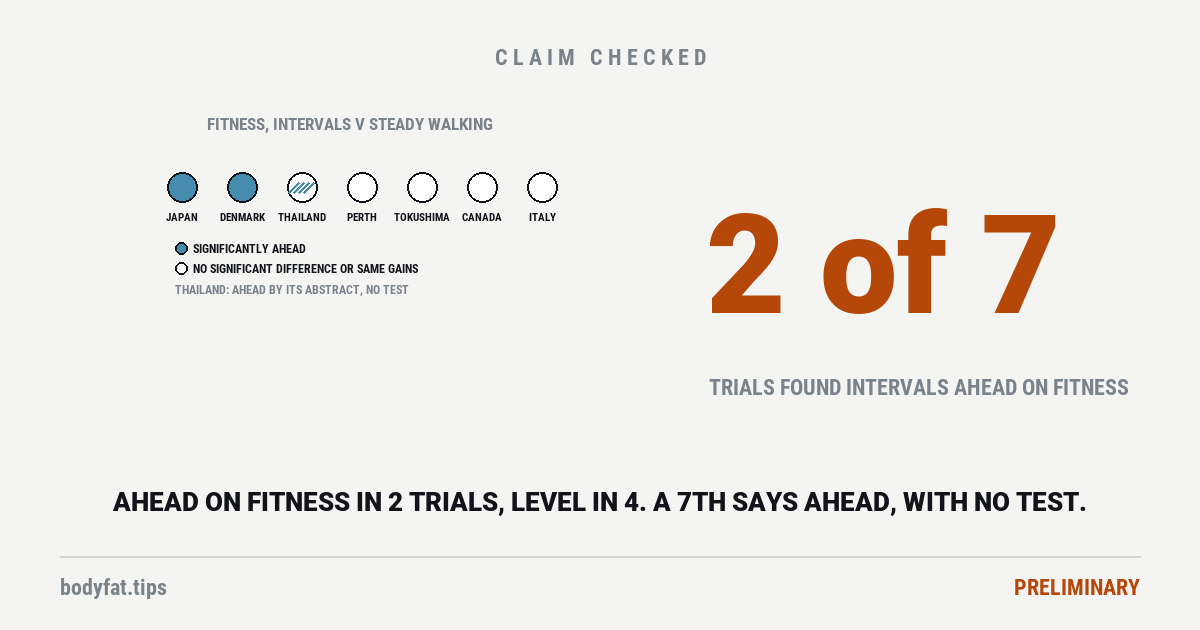
The trials run elsewhere are smaller and less tidy, and you can read them in the table. In Perth the interval and steady groups, both on a strict diet, did not differ significantly on anything measured but one blood fat [5]. In Tokushima, 50 adults with diabetes and weak legs were randomised to interval or steady walking for five months; leg strength, the main outcome, did not differ significantly, nor did fitness, body-mass index or long-term blood sugar, while walking speed and self-rated physical health improved more with intervals [6]. In Seoul, the interval group did better on a two-minute stepping test and a sit-and-reach flexibility test, and not significantly differently on weight, body fat, blood pressure, grip, balance or chair stands [17]. Three more, from Thailand, Italy and Canada, we read only as their abstracts, apart from the Canadian trial’s paper on blood sugar. In Thailand, 43 adults with type 2 diabetes walked on a treadmill three times a week for 12 weeks, steadily or in intervals matched for the energy burned, beside a group that did not exercise; aerobic fitness rose in both exercise groups and more with intervals, and long-term blood sugar fell with intervals and not with steady training, each group measured against its own start; the abstract reports no test between the two [11]. In Italy, 32 women past menopause followed an outdoor walking programme, steady or in intervals, and the abstract reports the same benefits from both, aerobic fitness among them [13]. In Canada, 30 older women with type 2 diabetes did 75 minutes a week of walking intervals or 150 minutes of steady walking for 12 weeks; aerobic fitness rose to a similar extent in both, and the distance they could cover in a six-minute walking test, and their grip strength, improved more with intervals [15]. Count the seven trials in the table that report a test of aerobic fitness, leaving aside Seoul’s stepping test, and intervals came out significantly ahead in 2 of 7, the 2007 and Danish trials. The Thai trial’s abstract reports a bigger rise with intervals but no test between the groups; we could not read its full text, and the 2017 pooling’s own calculation for that trial put the gap at 3.2 mL/kg/min, with a range that includes no difference [12]. The other four found no significant difference or the same gains, by our count.
Against no exercise at all, the picture is similar. In 39 colorectal cancer survivors, 12 weeks of home interval walking did not change peak oxygen uptake compared with usual care, but improved how the body handled a sugar drink and held off the fat gain seen in the usual-care group [18].
Has anyone pooled them? Partly. A 2017 meta-analysis, the kind of study that gathers every trial on a question and combines them, pooled seven small trials of interval training in type 2 diabetes, against continuous training or no exercise, 189 people in all [12]. Its five comparisons with continuous training were one of walking alone, the Danish trial; three of walking mixed with running, jogging or cycling, the Thai trial among them; and one of cycling [12]. Pooled, intervals came out ahead of continuous training on aerobic fitness, by 2.6 mL/kg/min, and on HbA1c, a blood test of average sugar over about three months, by 0.26 of a percentage point. Both differences were statistically significant, though four of the five trials that compared HbA1c with continuous training did not find a significant advantage on their own [12]. Its fitness figure rests on four of those trials and its HbA1c figure on five [12].
That pooling searched to October 2017, and poolings of interval training in type 2 diabetes have multiplied since. They take in every kind of interval training, cycling and running as well as walking, and on blood sugar they disagree. A 2026 meta-analysis, searched to November 2025, found no significant difference between interval and continuous training in HbA1c or in blood pressure [19]. It counts 21 trials, but its own table lists the Canadian walking trial twice, once for each of its papers, and three other pairs of reports with the same group sizes and ages, so by our reading the trials are fewer; of the trials in our table, only the Canadian one is among them [19]. A 2025 review of ten earlier poolings, searched to August 2024, which between them take in the Danish, Thai and Canadian walking trials, found every HbA1c estimate against continuous training leaning towards intervals, by 0.07 to 0.37 of a percentage point where given in those units, though in at least four of the eight the range includes no difference, by our reading of its table. On fitness, six of its seven estimates put intervals significantly ahead, by 1.68 to 4.12 mL/kg/min where given in those units. It rated six of the ten poolings low or critically low in quality, and one of the ten is the 2017 pooling above [20]. Of five more poolings from 2024 to 2026 that we read as abstracts, one found a small HbA1c edge for intervals and four did not, and the four that compared fitness all put intervals ahead in at least part of their analyses [9]. So for interval training of every kind, the poolings agree on a modest fitness edge and split on blood sugar. We found no pooling of interval-walking trials alone [9]. The newest reviews of interval walking itself are narrative. One, in 2024, was written by the Japanese and Danish researchers behind most of the trials; it calls the health benefits “well established”, while saying the studies were mostly short and tightly controlled and that keeping people at it long term is hard [21]. The other, a 2025 conference review of seven studies, lists the Shinshu group’s 679-person programme as a randomised trial, which it was not [22] [23]. For interval training in general, running and cycling included, the pooled evidence is much larger: intervals beat steady effort on fitness by a real but small margin, and our VO2 max verdict has those numbers.
What “three minutes fast” meant in the trials
Online, the Japanese walking technique runs on feel: walk like you are late for a train, breathe harder, be able to say only short phrases [24]. One viewer of the viral video suggested a pace at which you could still hold a conversation [2]. In the trials it was a measurement.
In Matsumoto the fast stretch was set above 70% and below 85% of each walker’s measured peak, and the device recorded whether they got there [3]. Most could not keep that pace up for more than three minutes, which is why the interval is three minutes long; they recovered in two or three [3]. The authors had found earlier that older people walking at their fastest reach heart rates close to the maximum expected for their age [3]. In Copenhagen the fast intervals averaged 89% of each walker’s peak energy use, by the same kind of device, which came to 69% of their maximum heart rate [4]. In a later Shinshu trial of 31 women, the fast walking was set to feel 16 to 18 on the Borg scale, a 6-to-20 scale of how hard exercise feels, near the top of it [25].
So the pace is personal and, for many older walkers, hard. The device also let people reach the target on hills and stairs as well as on the flat [8], and it is how the trials knew the target was hit.
How much fast walking? In Matsumoto the interval walkers logged about 51 to 55 minutes of walking a day on the devices’ records, 32 to 35 of them fast [3]. In the group’s later before-and-after study of 679 people, with no comparison group, gains rose with fast-walking time up to about 50 minutes a week and levelled off beyond it [23]. The video version, five three-minute fast stretches, on the trials’ four days a week, is 60 minutes of fast walking a week, by our arithmetic. That at least clears the 50, if the fast is really fast.
Does Japanese walking lower blood pressure?
In the 2007 trial, yes: systolic down 9 mmHg with intervals, against about 3 with steady walking, a significant difference [3]. Of the trials on this page whose blood-pressure comparison we read, it is the only one in which intervals beat steady walking.
Elsewhere the trials found no significant advantage. In the Danish trial, blood pressure did not change in any group [4]. In Perth and in Seoul there was no significant difference between interval and steady walking [5] [17]. And in Osaka, 155 people around 75 years old did five months of interval walking or no training; the changes in blood pressure did not differ significantly between the groups, though men who did more fast walking saw larger falls [26]. Their average systolic pressure started at about 131 to 132 mmHg [26]. The Osaka abstract calls it an intervention study and does not say the groups were randomised; another report from the same department, on an interval-walking programme of the same design in people of the same age, describes a nonrandomised controlled trial [27].
Pooled, it is mixed. In the 2017 analysis of trials in type 2 diabetes, systolic pressure was not significantly lower with intervals than with continuous training across three trials, though it was in the two of them matched for the energy burned [12]. The 2026 pooling of interval training of every kind found no significant difference in systolic or diastolic pressure [19]. In the Canadian trial resting pressure fell over the 12 weeks, and the abstract does not report a difference between the groups [15].
Japanese walking and blood sugar
The case here comes from the Danish group. In its four-month trial, the interval walkers’ average and peak blood sugar on a continuous glucose monitor, a sensor under the skin that reads sugar every few minutes, came down, the average just at the line researchers use for “probably not chance” (P = 0.05) [4]. Their HbA1c did not change significantly [4]. In the group’s two-week trial of 14 people on a supervised treadmill, intervals cut the highest readings and the size of the swings, and steady walking did not [28]. Neither paper reports the interval and steady walkers as significantly different from each other on blood sugar: the falls were against each group’s own starting point, and against the people who did not exercise [4] [28].
Outside Denmark, the Thai trial’s abstract reports that HbA1c fell significantly with intervals and not with steady training, each group measured against its own start, with no test between the two; the 2017 pooling’s calculation for that trial put the difference between them, 0.30 of a percentage point, within what chance could produce [11] [12]. HbA1c did not differ significantly between interval and steady walkers in Tokushima [6]. The Canadian trial published its blood-sugar results in a second paper. There HbA1c and fasting sugar fell significantly with steady walking and not with intervals; the fall in fasting sugar was significantly bigger with steady walking, while the two groups’ HbA1c changes were not significantly different [16]. In the six interval walkers who wore a sensor, a single session in the last week lowered the following 24 hours’ average and peak sugar against a day without exercise, and the six steady walkers’ readings did not change significantly [16]. In a Latvian trial against no training, HbA1c fell, but not significantly (P = 0.09), in the 14 of 30 interval walkers analysed, the rest having done too few sessions or started insulin [29]. In the 2017 pooling, intervals came out 0.26 of a percentage point lower than continuous training [12]. The later poolings of interval training of every kind mostly found no significant difference in HbA1c [19] [20] [9]. If your question is the spike after a meal, walking after eating is a different trick with its own verdict.
Does Japanese walking help you lose weight?
This is where the marketing runs furthest ahead: one of the videos Google’s AI answer cites is titled for weight loss [1]. Here are the weight results on this page.
In the 2007 trial, the women in both walking groups lost a little and the women who did not train gained a little: 2.6 lb (1.2 kg) lost with steady walking, 1.8 lb (0.8 kg) lost with intervals and 1.8 lb (0.8 kg) gained without training; the men’s changes were not significant [3]. The steady walkers did at least as well. In the Danish trial the interval walkers lost 9.5 lb (4.3 kg), 6.8 lb (3.1 kg) of it fat, and the steady walkers’ average fell 1.5 lb (0.7 kg), not a significant change; the difference between the two groups was significant, at about an hour of walking on most days [4]. In Seoul, Perth and Tokushima the interval and steady walkers did not differ significantly in weight or body-mass index [17] [5] [6], and in Canada weight and fat mass fell in both groups with no significant difference between them [16].
The longest trial on this page tested an app. In a year-long Danish trial of 214 people with type 2 diabetes, those given an interval-walking app lost 3.1 lb (1.4 kg) more than those on standard care [30]. The confidence interval, the range the true average difference probably sits in, ran from 6.8 lb (3.1 kg) more lost to 0.4 lb (0.2 kg) less, so no difference at all is still on the table [30].
How to lose 20 kg by walking?
That is one of the questions people ask beside this one. Twenty kilograms is 44 lb. Leaving aside the Perth trial, where everyone was also on a strict diet, the largest weight loss we could read for an interval-walking group on this page was 9.5 lb (4.3 kg) in four months, in 12 people walking about an hour on most days [4]. That is about a fifth of 44 lb, by our arithmetic. Our verdict on walking and weight loss has the larger picture: across 22 trials of brisk walking in adults with obesity, walking took off about 4.7 lb against not walking.
Japanese walking for beginners, and at home
The trials wrapped a lot around the walking: a fitness test to set each person’s pace, a month of small-group coaching, a device that beeped, and a trainer reading the data every two weeks [3] [8]. Even so, about half the 2007 interval group did not make it into the analysis [3]. In the Shinshu group’s 22-month programme of 696 people, adherence averaged 70% [31]. In Tokushima, 6 of 21 interval walkers completed the full prescription, against 13 of 25 steady walkers [6]. And when the Danish group handed the method to people with type 2 diabetes as a smartphone app, the year-long trial of 214 found it did not raise their moderate-to-vigorous activity compared with standard care [30].
The Tokushima trial also counted knee and hip pain: 10 interval walkers complained of it, against 3 steady walkers, and all of them kept going once it eased; one interval walker had bleeding at the back of the eye that the authors judged to be linked to the training [6].
At home? The 2007 and Danish four-month trials were done in daily life, at times and places the walkers chose [3] [8] [4]. The creator who popularised the name usually does his on a treadmill or walking pad [10] [2]. A treadmill handles the intervals fine. What it cannot tell you is what 70% of your peak is.
Who these trials were done on
Mostly middle-aged and older Japanese adults without heart or lung disease: aged 44 to 78 in 2007, average 63, three-quarters of them women [3]; around 65 in the group’s later programmes [32] [23]. Then small groups of people with type 2 diabetes in Denmark, Japan, Thailand and Canada [4] [6] [11] [15], women past menopause in Italy [13], adults with obesity on a diet in Australia [5], adults over 65 in Korea [17] and cancer survivors in Denmark [18].
So read yourself against them. If you are healthy and in your 50s, 60s or 70s, you are close to the people in the 2007 trial. If you are young and already fit, or have heart disease, these trials are not about you. And the 30-minute video version, judged by feel, is not quite what these trials tested: where they say how the pace was set, it was set from a measurement [3] [4] [17].
Was it the intervals, or the box that beeped?
This section is the desk’s own reasoning, and it is labelled as such. Two trials found interval walking well ahead of steady walking, and the trials since have found it ahead on some measures and level on others. Why? Three answers, each rated.
Answer one: in 2007, the steady walkers were barely training. In both founding trials, steady walking did not significantly raise fitness: the Matsumoto steady walkers’ peak did not change significantly [3], and in Copenhagen the paper reports no change in the steady group, which the authors put down to a pace probably close to their normal walking speed [4]. In Matsumoto, “intervals against steady walking” partly meant “harder against easier”: the steady walkers were told to walk at about 50% of their peak, while the interval walkers spent 32 to 35 minutes a day in fast stretches set at 70% or more of it [3]. The flat results are measured. That they explain much of the gap is our inference. Copenhagen is the exception, and the better test. There the two groups worked at about the same average effort and burned about the same energy in training, so what differed was the rhythm, part fast and part slow against all at one pace, and intervals still came out ahead on fitness [4]. In Perth and Seoul the interval programmes were set to the same average intensity as the steady ones, by our arithmetic from their prescriptions, and the two came out mostly level [5] [17].
Answer two: the box, the coaching and the count. In 2007 every interval walker wore a device that beeped at the target and saw the trainers more often, and the analysis kept those who hit their targets [3]. In the group’s own 679-person programme, the gains tracked minutes of fast walking [23]. A device that tells you when you are fast enough, and a trainer who reads it, is a good way to make people walk hard. The difference in monitoring and contact is in the paper. How much of the result it explains is a surmise, which the authors judged unlikely and an outside cardiologist called a major bias [3] [10].
Answer three: who it was tested on. In the Shinshu group’s before-and-after study of 666 people, the gains were biggest in those who started least fit [32]. The trials that found no significant difference in fitness were in people on a strict diet [5], in people with diabetes and weak legs [6], in older women with diabetes [15] and, by its abstract, in women past menopause [13]. So “it works” and “it didn’t” may both be true, for different starting points. That is a surmise: the before-and-after study has no comparison group.
Put the three together and here is what we think is true, stated plainly so you can disagree with it: Japanese walking is a way of getting yourself to walk hard for part of the time; in 2007 the steady walking it beat was also easier, in Copenhagen it was matched for effort and intervals still won, and whether the three-minute rhythm adds anything beyond the hard walking is not settled by these trials.
What we could not find, and would like to: a randomised trial, run by researchers with no connection to the method’s developers, that compares the 30-minute version people do from videos, judged by feel without a device, with steady brisk walking for the same time, in ordinary middle-aged and older adults, for six months or more, counting everyone who was assigned rather than only those who kept it up [9]. Of the trials by other universities we found, the longest ran five months, and the Italian one’s abstract gives neither its length nor how its pace was set [13]. If you know of one, the corrections line on this site is open.
Where “Japanese walking” came from
The research is the 2007 Matsumoto trial, the end of a programme that had started by telling people to walk 10,000 steps and found it did not make them fitter [8] [3].
The framing started at the university. In February 2016 Shinshu University’s news page reported a ceremony for people who had kept up the programme for ten years: 109 of the 585 who started in 2005, over 18%, whose knee strength was 20 to 30% higher and endurance 40% higher “as compared with those of their contemporaries” [33]. A 2018 conference abstract gave the detail: of 732 people who started between 2005 and 2007, 148 kept going for ten years, by our count, and after ten years their peak fitness was at least 40% above, and their knee strength at least 20% above, comparison values built from people of the same age who were just joining the programme [34]. Their fitness had risen about 20% in the first six months and then held, while the comparison values fell about 20% over the decade; their knee strength fell over the years too, and stayed above the comparison [34].
That is a comparison between the fifth who stuck with it and other people their age. It is not a 40% improvement. But that is how it travelled: in June 2025 a business magazine’s health section told readers the 2018 study found “a 20% improvement in their leg strength, and a 40% improvement in their peak exercise capacity” [35].
The spread was a video. In late May 2025 an Australian fitness creator posted a TikTok of the routine that passed five million views in two days, a British regional news site reported, saying that compared with 10,000 steps, “this walking protocol showed 29 times boost over aerobic fitness, a ten times improvement in leg strength, and a three times improvement in blood pressure” [2]. By August the Los Angeles newspaper put his video past 10 million views on TikTok and 17 million on YouTube [10]. We could not trace who first used the name; that newspaper credits him with the rebrand [10] [9].
Where does “29 times” come from? We think we found it, and this is our arithmetic, not the creator’s stated method. In the 2007 trial’s table, the men’s peak aerobic capacity on a bike rose 9.4% with intervals and 0.3% with steady walking [3]. Divide one by the other and you get 29. Divide a real gain by a number close to zero and you can get almost any multiple you like.
And it sells. Ask Google about Japanese walking, as we did on 23 October 2026, and its AI answer lists better aerobic fitness, lower blood pressure, stronger legs and better blood sugar, citing two hospital systems, a site named after the method, a national newspaper, a health publisher, an insurer, a personal trainer’s Facebook video and a YouTube workout titled for weight loss [1]. The site named after the method carries advertising and offers a walking timer [24]. The related searches include an app, a video and “before and after” [1].
None of this is aimed at anyone who has tried it. Walking faster for part of your walk is a reasonable thing to do, and the trials suggest it does more than strolling. It is the multiples, the 40% that was a comparison, and the weight-loss thumbnails that ran ahead of the evidence.
What this is rated, and what the rating covers
Preliminary — for the claim that Japanese interval walking improves fitness and health more than ordinary walking.
It is rated Preliminary because the advantage over ordinary walking rests mainly on two small trials, one from the group that developed the method and one from a Danish group that took it up, the first of which analysed under half of its interval walkers and monitored them more closely than the comparison group [3] [4]; because the smaller trials since, by other universities, found it ahead on some measures and level on others [5] [11] [13] [14] [15] [17] [6]; and because the poolings, all of interval training of every kind in type 2 diabetes rather than of walking alone, agree only on a modest fitness edge: the 2017 one that also puts intervals a little ahead on long-term blood sugar rests on four small trials for fitness and five for blood sugar, and a 2026 pooling found no significant difference in blood sugar [12] [19] [20]. The evidence that it beats steady walking is early, small and mixed. That is not the same as evidence that it does nothing.
Each part, rated alone, in words. That it raises aerobic fitness and leg strength more than steady walking in middle-aged and older adults: Preliminary, ahead for fitness in the 2007 and Danish trials, in a Thai trial by its abstract alone, and in the poolings of interval training of every kind, and not significantly different in Perth, Tokushima and Canada, with the same gains from both in an Italian trial by its abstract; ahead for strength in 2007 and for grip strength in Canada, by its abstract, and not significantly different on the Tokushima trial’s main outcome [3] [4] [11] [12] [20] [5] [6] [15] [13]. If leg strength is what you want, resistance training has far more trials behind it.
That it lowers blood pressure more than steady walking: Preliminary, one trial in favour, and no significant change or difference in the Danish, Perth, Seoul and Osaka studies, the last against no training at all; the 2017 pooling found no significant difference against continuous training across three trials, though it found one in the two matched for the energy burned, and a 2026 pooling of interval training of every kind found no significant difference [3] [4] [5] [17] [26] [12] [19].
That it improves blood sugar more than steady walking: Preliminary. No walking trial on this page reports intervals significantly ahead of steady walking on blood sugar. In two small Danish trials the interval walkers’ sensor readings improved and the steady walkers’ did not, though neither paper reports the two as significantly different; in a Thai trial HbA1c fell with intervals and not with steady training, by its abstract, which reports no test between the two; it did not differ significantly in Tokushima; and in a Canadian trial fasting sugar fell significantly more with steady walking. The poolings split: the 2017 one, four of whose five comparisons with continuous training involved walking, alone or mixed with running, jogging or cycling, put HbA1c 0.26 of a percentage point lower with intervals, and a 2026 pooling of interval training of every kind found no significant difference [4] [28] [11] [6] [16] [12] [19].
That it helps you lose weight: Preliminary. In one trial of 12 people a group, the interval walkers lost 9.5 lb (4.3 kg) and the steady walkers 1.5 lb (0.7 kg), a difference the paper reports as significant [4]; the others on this page whose weight comparison we read found no significant difference, and in 2007 the steady-walking women lost a little more [3] [17] [5] [6] [30] [16].
What is not rated here: tai chi walking and the “Japanese ab exercise”, which turn up in the same searches; thinking speed and arterial stiffness, which rest on one small trial [14]; and the frame in the section above, which is this desk’s reasoning from the evidence rather than a result the evidence delivered. It is marked as ours so that you can weigh it as ours.
This is journalism, not medical advice. If you have a heart or joint condition, the person to ask about fast intervals is the clinician who knows your history. How we read a study, and what each tier means, is set out here.
- Does Pilates Build Muscle? Not Clearly. Past 60, It Builds Everyday Strength
preliminary - Does Pilates Help You Lose Weight? A Little, Maybe. It Burns Like a Slow Walk
preliminary - Vibration Plate Benefits: The Three Biggest Randomised Bone Trials We Found With Results, 1,086 People, Showed No Clear Gain. Stronger Legs Are Another Matter.
preliminary