Does Drinking Water Lower Blood Pressure? Trials Don’t Show It; a Big Glass Raises It

“Drinking water can help prevent temporary spikes and support normal blood pressure,” says Google’s AI answer when you ask whether drinking water can lower blood pressure, and it gives a reason: when you are dehydrated, “your body releases a hormone called vasopressin, which narrows blood vessels.” Health sites, a heart charity and a veterans’ health system say much the same [1], though the answer itself adds that water “is not a direct medical treatment for high blood pressure”, and two of the pages it cites say so too [1]. The plain question underneath is a popular one: “can drinking water lower blood pressure” is searched about 9,900 times a month in the United States, by the database’s own figure for the past year, and 8,100 times in each of the two latest months, July and August 2026 (from a paid keyword database, pulled 20 October 2026) [1].
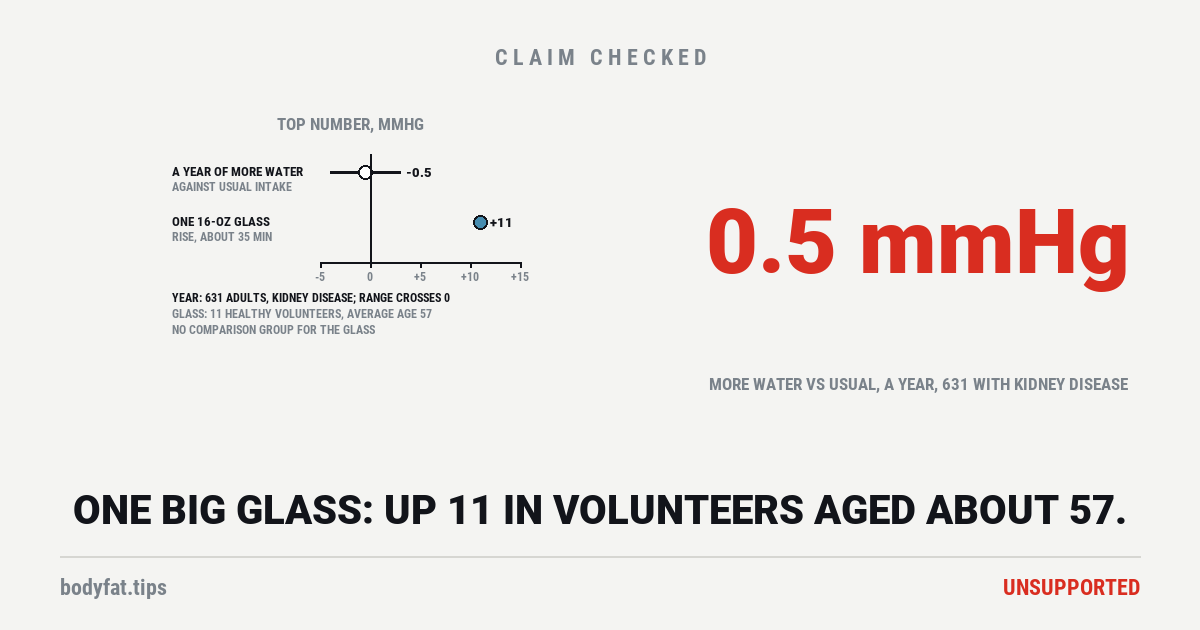
It has been tested, and it did not hold up. In the largest published trial we found, 316 of 631 adults with kidney disease were coached to drink more water for a year and drank about 20 oz (0.6 L) a day more, by their urine. Among the 590 whose blood pressure was measured at the end, the top number fell about 5 points in both groups, half a point more in the coached group, a gap chance could easily explain [2]. Smaller trials pointed both ways. What water measurably does is the opposite of the claim: a 16-oz (480 mL) glass, drunk fast, raised the top number of 11 healthy volunteers, average age 57, by 11 points within the hour [3].
This is journalism, not medical advice. If you have been told to limit fluids, as people with heart failure, some kidney conditions or some medicines are, follow that advice rather than drink more. A reading of 180/120 or higher needs care at once: the 2025 US guideline calls a reading above 180/120 severe [4]. Call your clinician the same day, and call for emergency help if it comes with chest pain, breathlessness, weakness, or changes in vision or speech.
Two words before the numbers. Blood pressure comes as two numbers in mmHg, millimetres of mercury: the top one, systolic, while the heart pushes, and the bottom one, diastolic, between beats. How to take a reading you can trust has its own page.
Does drinking more water lower blood pressure?
The test is a randomised trial: people are split by chance, one group drinks more water, the other carries on as usual, and the readings are compared at the end. Splitting by chance is what lets the difference be put down to the water rather than to who chose to drink it. Each result comes with a confidence interval, the range the true average probably sits in. When a gap between the groups is too big to put down to chance, researchers call it significant; when it is not, the trial could not tell water from no water.
We found nine controlled trials that had people drink more water for two weeks or longer and reported what happened to blood pressure, and a year-long follow-on of one of them [5]. Here they are. The largest, by far, was in people with kidney disease; every trial outside kidney disease had 175 people or fewer. One, a three-week trial in 35 young adults, is published only as a meeting abstract that sits behind a bot check on the journal’s site; we read its design and not its result [6].
| Trial | Extra water | Blood pressure, water group against the comparison group |
|---|---|---|
| 631 adults with kidney disease (590 measured at a year), Canada, 1 year [2] | Coached to drink more: about 20 oz (0.6 L) a day more, by their urine. The comparison group was coached to keep its usual intake, some to cut it a little | Top number fell 5 points in both groups; difference half a point, the true difference probably between 4 lower and 3 higher |
| 175 children aged about 8 (145 analysed), Italy and San Marino, 1 year [7] | Teachers prompted sips twice a day; urine tests did not show the children drinking more | Bottom number rose 4 points in the comparison schools and not at all with water; top number not significantly different |
| 141 healthy men aged 55 to 75, the Netherlands, 6 months [8] | Asked for 51 oz (1.5 L) more; the group averaged about 34 oz (1 L), though a test of the water passing through their bodies each day put the gap over the comparison group at about 12 oz (359 mL) | Top number 2.4 lower, the true difference probably between 8.0 lower and 3.2 higher; not significant |
| 99 adults with a heart risk factor (94 finished), Norway, 4 weeks [9] | 34 oz (1 L) of bottled water a day more; a third group drank the same amount of berry juice | The authors write that blood pressure “remained stable” and print no figures |
| 60 adults (55 analysed), Japan, 12 weeks [10] | Two 18.6-oz (550 mL) bottles of the trial company’s mineral water a day | Top number fell about 6 points against about 3; bottom number not significantly different |
| 48 dieting adults aged 55 to 75 (41 finished), US, 12 weeks; then a year’s follow-on of 40 of them [11] [12] | A 16-oz (500 mL) bottle before each of three meals | Top number fell 8 points in both groups, while both lost weight; no significant difference between them. In the follow-on the groups started apart, and the paper marks no significant difference at a year |
| 42 adults with polycystic kidney disease (35 finished), UK, 8 weeks [13] | Enough to make a median of about 3.3 quarts (3.2 L) of urine a day, against about 2 quarts (1.9 L) | Not significantly different |
| 35 healthy young adults, from a US university, 3 weeks [6] | Asked for 24 oz a day more than usual | Result not read: a meeting abstract we could not open |
| 20 healthy students, Sweden, 2 weeks each way, in random order [14] | About 68 oz (2 L) a day more | Daytime average pressure rose 2.4 points; night-time not significantly different, and clinic readings did not change, the authors report |
The largest is the Canadian one. All 631 of its adults had chronic kidney disease at stage 3 of 5, with protein leaking into the urine; their average age was 65, and 88% of them also had high blood pressure. They were split into two groups: 316 were coached to drink more and given vouchers for bottled water, and 315 were coached to keep to their usual intake, or, if they were already passing plenty of dilute urine, to cut it by a cup or two a day [2]. Their urine showed the coached group drinking about 20 oz (0.6 L) a day more for the year [2]. Blood pressure was measured at a year in 590 of them, 291 and 299 (12 had died, and 29 more had no reading at a year); the top number fell 5 points in both groups. The difference between them was half a point (0.5 mmHg), and its confidence interval ran from 4 points lower to 3 higher: it includes no difference at all [2]. Blood pressure was not the trial’s main question, kidney function was, and kidney function did not differ significantly either [2]. It was paid for by the research arm of a French food group whose brands include bottled waters [2] [1]; four of the authors report grants, fees or travel support from the food group, three of them from that research arm and one from another of its companies, that one as chair of a hydration research initiative the group runs with an international kidney society, and the paper says the funder asked for a kidney measure to be added to the trial [2]. The result is not the one a seller of water would want.
The Dutch trial split 141 healthy men aged 55 to 75 into a group asked to drink 51 oz (1.5 L) more a day for six months and a group given a dummy syrup; the water group averaged about 34 oz (1 L) more, though a test of how much water passed through their bodies each day put the gap over the comparison group at about 12 oz (359 mL) a day [8]. Their top number came out 2.4 points lower than the comparison group’s, with a confidence interval from 8.0 lower to 3.2 higher, which the authors report as not significant [8] [15]. A US weight-loss trial put 48 people aged 55 to 75 on a diet, and assigned 23 of them a 16-oz (500 mL) bottle of water before each meal and 25 none, and 41 finished: the top number fell 8 points in both groups, while both groups lost weight, and the authors found no group difference [11]. A year-long follow-on kept 40 of them in their groups, the water group still drinking 16 oz before each meal: over the year the water group’s top number went from 124 to 120 and the other group’s from 117 to 118, and the paper’s table marks the groups as significantly different at the start and at six months, and not at the end [12]. In 42 British adults with a kidney condition, 21 in each group and 35 finishing, eight weeks of drinking enough to make a median of about 3.3 quarts (3.2 L) of urine a day made no significant difference to blood pressure [13]. And in a Norwegian trial, 99 adults with at least one heart risk factor, high blood pressure among the ones that qualified (a top number of 135 to 160, or a bottom number above 90 and up to 100), were split three ways for four weeks: one group added 34 oz (1 L) of bottled water a day, one the same amount of berry juice, and one carried on as usual; the authors write only that blood pressure “remained stable”, and print no figures [9].
We found two more trials that measured blood pressure and, in the pages we read, reported it only at the start: a three-year Australian trial of 184 adults with polycystic kidney disease, part-funded by the same French food group’s research arm, which found that extra water did not slow the growth of their kidneys [16], and the Canadian trial’s own six-week pilot, in 29 adults with kidney disease [17].
We also found three smaller studies with no group that went without the extra water, so they cannot separate the water from everything else: 31 Swedish adults who drank 51 oz (1.5 L) more for six weeks showed no significant change [18]; at two Taiwanese workplaces given smart cups and reminders, one company’s top number and the other’s bottom number fell [19]; and in Hong Kong, 35 healthy adults told to drink about 40% more for three months, some of them also sleeping with the head of the bed raised, had arterial blood pressures that “were not modified”, the authors write, adding that the readings seemed to fall and that the study was not designed to detect small changes [20]. A fourth compared water with no test drink, but not by chance. In a Danish trial of milk drinks, 193 overweight 12- to 15-year-olds were assigned at random to drink a litre (34 oz) a day of water, skimmed milk or one of two milk-protein drinks for 12 weeks, and the 50 given water were compared with 32 of the same adolescents measured over the 12 weeks before the drinks began. Against them, the bottom number of the pressure in the aorta, the large artery leaving the heart, worked out from the pulse at the wrist, fell about 2 points, a significant difference; the arm-cuff readings were not significantly different. A Danish government science agency and the national dairy board paid for the trial [21].
What about the trials that found a fall?
Two did. In a Japanese trial, 60 adults were assigned at random and 55 analysed: 28 adults drank two 18.6-oz (550 mL) bottles of mineral water a day for 12 weeks on top of their usual drinks, and 27 did not. The top number fell about 6 points in the water group and about 3 in the other, by our reading of the paper’s chart, a difference the authors report as significant; the bottom number was not significantly different [10]. Blood pressure was one of dozens of things measured; the main one, blood sugar, did not move significantly, and the comparison group started heavier, which the authors say they allowed for [10]. And look at who ran it: three of the six authors, the first and the last among them, work at a Japanese drinks company’s research institute, and the water was that company’s own bottled brand, named in the methods [10].
In the children’s trial, ten schools in Italy and San Marino were assigned at random, and teachers in the schools assigned to water prompted the children to sip from a water bottle twice a day for a year; 86 children in those schools and 59 in the others were analysed [7]. Over the year the bottom number rose 4 points in the comparison schools and not at all in the water schools, a significant difference; the top number did not differ significantly [7]. One caution the paper itself supplies: the children’s urine tests did not show them drinking more [7]. And one of ours: it was schools that were assigned, though the paper’s comparisons are between children [7].
And one found a rise. Twenty healthy Swedish students spent two weeks drinking as usual and two weeks drinking about 68 oz (2 L) a day more, in an order set at random [14]. Their average daytime pressure, measured round the clock by a cuff they wore, went up 2.4 points [14]. That figure is the mean arterial pressure, a single average of the top and bottom numbers; the daytime bottom number rose 2 points, a significant rise, and the top number 2 points, just short of the line researchers use for ‘probably not chance’ (P = 0.06) [14]. Night-time pressure was not significantly different, and the authors report that clinic readings, taken after five minutes’ rest, did not change [14].
The newest review of trials that changed how much water people drink, from 2024, found 18 of them, on weight, kidney stones, headaches and more; its table reports blood pressure for two, the Dutch and the Swedish [15]. The children’s trial and the three-week trial came out after its search, and the Norwegian trial is not among its 18.
Why does drinking water increase blood pressure?
Because a large glass of water, drunk quickly, sets off a reflex. The best-known study is from Vanderbilt University in 2000: people drank 16 oz (480 mL) of tap water in a few minutes, sitting down, and had their pressure tracked [3]. In 11 healthy older volunteers, average age 57, the top number rose by about 11 points, peaking around 35 minutes after drinking [3]. In 8 younger volunteers, average age 25, there was no significant change [3]. And in 47 patients with autonomic failure, a nerve disease that takes away the body’s automatic control of blood pressure, the top number rose 33 to 37 points [3].
The researchers called it a sympathetic reflex, after the part of the nervous system that tightens blood vessels: the stress chemical norepinephrine rose in all 11 older volunteers after drinking, while the volume of their blood did not go up, so the water is not simply filling the pipes [3]. Later work named it the osmopressor response, a rise in pressure thought to be set off when watery, unsalted fluid dilutes the blood leaving the gut [22]. The 2023 review’s authors suggest that in people with healthy reflexes the body cancels much of it, and that the reflexes dull with age, which would explain why older people show more of it [22].
A 2023 meta-analysis, a study that pools the results of earlier ones, gathered 17 studies of drinking 12 to 17 oz (350 to 500 mL) quickly [22]. In people whose pressure drops when they stand, called orthostatic hypotension, the top number rose by about 24 points on average. In healthy people it rose about 2: by 1.87 across all the studies of them, and by 2.33 in the three randomised trials, 32 people in all [22]. Most of the healthy people in those studies were young, which fits the Vanderbilt finding [22] [3].
What about people who already have high blood pressure? One small Brazilian study gave 17 oz (500 mL) of water to 8 people with mild high blood pressure and 10 without: the top and bottom numbers rose by about 19 and 14 points in the first group and 17 and 14 in the second; we read it as its summary [23]. That is one study of 18 people, measured lying down at the finger; it is a reason to take the rise seriously, not a size to plan around.
How quickly does drinking water lower blood pressure?
In the studies that tracked it minute by minute, it does not lower it; it raises it, and fast. In the Vanderbilt patients the rise showed within 5 minutes, peaked at 30 to 35 minutes and was still there after 60 [3]; the university’s announcement put the start at two or three minutes [24]. In the healthy older volunteers the peak came at about 35 minutes [3]. More water did more: in four patients, 16 oz raised pressure more than 8 oz [3].
That is why researchers have tested it as a remedy, not a risk. The Vanderbilt team proposed using it for people whose pressure falls when they stand [3], and that is the group in which the 2023 meta-analysis found the largest rise [22].
How long after I drink water can I take my blood pressure?
The two main pieces of US guidance we read do not say; a patient handout we read does. The American Heart Association’s 2019 statement on measuring blood pressure asks you to avoid caffeine, exercise and smoking for at least 30 minutes beforehand and to empty your bladder; it does not mention water [25]. Nor does the text of the 2025 US guideline, though its measurement checklist is an image we could not read as text [4]. A patient handout is stricter: one written by a US quality-improvement organisation under contract with Medicare says “No smoking, food, or drink for 30 minutes before the measurement” [26]. A 2017 review of 29 sources of error in clinic readings lists water only under a full bladder, where studies of people who drank a lot found large rises [27]. We found no study set up to test whether a glass of water changes a home or clinic reading. The nearest, in 38 patients in hospital with heart failure, took cuff readings before and after a drink of water, and its English summary reports some of them higher straight after it and that the average pressure “was decreased significantly one hour after drinking water” [5].
The Vanderbilt team saw the gap 26 years ago. Doctors ask about coffee and cigarettes, one of them said, “but we would never think to ask if they had anything to drink in the last hour. Perhaps we should” [24].
So here is our reading, marked as ours. If you are older (the healthy volunteers who showed the rise averaged 57) and you have just drunk a large glass quickly, readings over the next half hour to an hour may run high [3]; their rise peaked at about 35 minutes, so the handout’s half hour would not cover a big glass [3] [26]. At any age, a cold drink just before a reading may push it up for the next 20 minutes or so [28]. Take the reading before the glass, or wait an hour, and do it the same way each day so that your readings compare with each other. A sip to wash down a pill is not what was tested. A UK pharmacy tells customers to drink water before its blood-pressure check “to make sure that you get more reliable results” [1]; the studies we read point the other way for a big glass. The rest of the routine, from cuff size to how long to sit, is on our page on measuring blood pressure at home.
Can dehydration cause high blood pressure?
This is the reason most of the pages we read give, and it has been tested. In a Delaware study, 35 young adults with normal blood pressure spent three days cutting back their water and then 16 hours with none, and on another occasion drank normally, in random order [29]. Their blood got measurably more concentrated: its sodium and its osmolality, how concentrated the blood is, both rose [29]. Their resting blood pressure did not rise significantly: a top number of 112 against 110, a bottom number of 64 both times [29].
The team behind the Canadian trial looked at the vasopressin story in their 2015 pilot study. People taking drugs that block vasopressin’s water-saving action have about three times as much of the hormone in their blood, they wrote, “with no concomitant change in blood pressure”, and in their view “there is no convincing evidence that vasopressin increases blood pressure” [17]. A 2019 review of hydration and the circulation lists what being short of water may do: dull the lining of the blood vessels, rouse the nerves that tighten them, and make the body worse at holding pressure up when you stand [30]. The last is a drop, not a rise, and the review notes that the standing studies were in young men [30].
For the long run, all there is so far is association: studies that compare people who drink more with people who drink less, which cannot by themselves show that one thing causes the other. In 3,823 Chinese adults followed for nine years, the 314 who said they drank six or more cups of plain water a day were less likely to report a later diagnosis of high blood pressure than those who drank one cup or less [31]. The odds ratio, the study’s measure of how much more or less likely, was 0.59, with a confidence interval from 0.37 to 0.91; at two to five cups the odds were not significantly lower, and the heavier water drinkers were also younger, better educated and more often city dwellers [31]. Water intake was what people said they drank, and the diagnosis was what they said a doctor had told them [31]. In Israeli health-plan records of 407,187 adults, those whose blood sodium sat in the upper part of the normal range were diagnosed with high blood pressure more often: a 29% higher risk above 143 mmol/L, in the summary’s account, which is what we read [32]. Blood sodium tracks salt and health as well as water, and neither study changed anyone’s drinking.
Can dehydration cause high blood pressure in elderly people?
The same Delaware team ran the same three-day test in women, 8 young and 7 aged around 65: resting blood pressure was higher in the older women, as you would expect, but not significantly different when they were short of water [33]. Seven women is not much to go on. What older age does change, in the studies above, is the other direction: older people’s pressure rose after a big glass of water, and young people’s rose less, or not significantly half an hour later [3] [28].
Should I drink cold or warm water for high blood pressure?
Neither lowered it in any study we read. In the Vanderbilt patients, cold and warm water raised pressure almost identically [3]. In a Japanese study of 22 people who drank 6.8 oz (200 mL) through a syringe over a minute, cold water at 39°F (4°C) raised the top number more than water at 82°F (28°C), and more in older women than in younger adults [28]. The younger adults, average age 20, were not spared: during the minute of drinking, their top number rose about 15 points with room-temperature water and about 23 with cold, and after cold water it stayed significantly above their resting level for the 20 minutes measured [28]. Whether hot water before bed does anything else for you is a different question, and not one this page rates.
How much water to drink to lower blood pressure?
No amount in the trials above lowered adults’ blood pressure significantly, except in the drinks company’s trial, at two bottles a day [10]. The 2025 US guideline’s table of non-drug treatments, with the points each is worth, lists weight loss, the DASH diet, less salt, salt substitutes, more potassium, less alcohol, exercise, meditation and slow breathing; drinking water is not on it [4]. What those are worth is on our page on lowering blood pressure naturally. How much water you need in the first place has its own verdict, and so does water for weight loss.
Who these studies were done on
The trials were in Canadian adults with chronic kidney disease, average age 65, most of whom also had high blood pressure; healthy Dutch men aged 55 to 75; Norwegian adults with at least one heart risk factor; American dieters aged 55 to 75; British adults with polycystic kidney disease; healthy, recreationally active young adults in a US university’s trial; healthy Swedish students; Japanese adults in their early sixties, more women than men, with anyone being treated for high blood pressure left out; and Italian and San Marino eight-year-olds [2] [8] [9] [11] [13] [6] [14] [10] [7]. The rise after a glass was measured in older and younger volunteers in Nashville, patients with nerve diseases, and a small group with mild high blood pressure in Brazil [3] [23]. The dehydration tests were in young adults and seven older women in Delaware, all with blood pressure under 140/90 when they joined [29] [33].
So read yourself against them. If you have high blood pressure and hoped water would bring it down: most of the people in the largest published trial had high blood pressure too, but all of them had kidney disease, and in them it did not [2]. Outside kidney disease the trials are small, 20 to 175 people each. Only the Norwegian one admitted people for high blood pressure, as one of several risk factors that qualified: a top number of 135 to 160, or a bottom number above 90 and up to 100, high by the 2025 US guideline [9] [4]. We found no trial set up to test more water in people with high blood pressure [5]. If you are older, a big glass drunk fast may push your reading up for the next hour [3]. If your pressure drops when you stand, the evidence is that a glass raises it, and whether that suits you is a conversation for your clinician [22].
Then why do so many people say water lowered their blood pressure?
This section is the desk’s own reasoning, and it is labelled as such. The trials did not find it. Plenty of people believe they have seen it. Here are three ways both can be true, each rated.
Answer one: everyone’s reading falls when they start paying attention. In the Canadian trial the top number fell 5 points in the people who drank more and 5 in the people who did not; in the US diet trial, 8 and 8 [2] [11]. Anyone who starts drinking more water and checks again a few weeks later may see a fall like that, and may credit the water, though in the US diet trial both groups were also losing weight [11]. The falls in both groups are measured; that they come from being measured again, from people whose first reading was high drifting back, and from other changes people make at the same time, is our reading.
Answer two: the water replaced something. A glass of water instead of a beer is less alcohol, which the 2025 US guideline counts among the things that lower blood pressure [4]. That is a surmise: the trials on this page added water on top of what people already drank and did not test a swap.
Answer three: water does change blood pressure, upward. For people whose pressure falls when they stand, a glass of water raises it by about 24 points on average [22]. A person who feels steadier after drinking may be right that water did something to their blood pressure, in the opposite direction from the claim. The rise is measured, in them; that this explains some of the belief is a hunch.
Put the three together and here is what we think is true, stated plainly so you can disagree with it: water does not lower blood pressure; what it measurably does is raise it for about an hour, the direction people whose pressure drops need, not the one people with high blood pressure want.
What we could not find, and would like to: the results of a Swedish trial that split 797 people into a group drinking 51 oz (1.5 L) more tap water a day and a comparison group, with blood pressure among its measures, and finished in November 2025 [34]. We found no published results [5]. Its collaborators include the research centre of the same French food group that funded the Canadian trial [34]. We would also like a test of a glass of water before a home reading. If you know of either, the corrections line on this site is open.
Where “water lowers blood pressure” came from
We could not trace who first said it. The earliest version we read about is a 1992 book, Your Body’s Many Cries for Water, by a physician who argued that many illnesses are the result of dehydration; a 2000 newspaper report on its followers says the author lists high blood pressure among what his regimen can “prevent and cure” [35]. We did not read the book itself. In February 2000, months before that report, the Vanderbilt team published the opposite: water raised blood pressure [3] [24].
The modern version leans on a hormone and a survey. Google’s AI answer says dehydration releases vasopressin, “which narrows blood vessels” and so raises blood pressure, and that drinking water “stops this stress response” [1]. A health publisher’s article, updated in April 2026, says dehydration “can raise blood pressure” and that hydration helps “prevent temporary spikes”, and for the long run cites a study in mice; a prescription-discount company’s blog cites a study that six to eight cups a day “may help prevent hypertension”, which by its wording is the Chinese survey above; an instruments company’s UK blog lists water first among drinks that lower blood pressure [1] [31]. Most of them hedge, though. The AI answer itself says water “is not a direct medical treatment for high blood pressure”; the health publisher writes that “drinking water is not a treatment for high blood pressure” and that too much can sometimes raise it; the discount company’s blog says the same in its own words, while promising that water “supports healthier blood pressure levels, whether you have hypertension or not” [1]. Not every page agrees even with that: a hospital system’s says water “has no immediate effect on lowering blood pressure” [1]. So the claim as it circulates is mostly the softer one, that water keeps blood pressure normal and heads off spikes when you are short of it, which is the dehydration question above; the plain version, that drinking more lowers it, is the question people type, and the instruments company’s blog says it outright.
And the trials have a sponsor with a product. The largest published trial we found was funded by the research arm of a French food group whose brands include bottled waters, and its water group got bottled-water vouchers; the same group’s research centre is a collaborator on the 797-person Swedish trial [2] [34] [1]. The one controlled adult trial on this page that found a fall was run by a Japanese drinks company’s researchers with the company’s own bottled water [10]. The US diet trial was paid for by an institute that, by its own past web pages, was a water-filter maker’s water research institute until it was renamed in November 2005, and was supported by an unrestricted grant from that company; its water group drank bottles of a soft-drink company’s water brand [11]. None of that makes their numbers wrong. It is why we read the numbers rather than the conclusions.
None of this is aimed at anyone who drinks more water hoping to help their blood pressure. Water is a fine thing to drink. It is the promise that it lowers blood pressure, repeated by pages that cite a mouse study and a survey, that the trials do not bear out.
What this is rated, and what the rating covers
Unsupported — for the claim that drinking more water lowers blood pressure, as it circulates.
It is Unsupported of the tested kind: it was tested, and it did not hold up. The largest published trial we found ran for a year and found half a point of difference, with a confidence interval from 4 lower to 3 higher, in people with kidney disease, most of whom also had high blood pressure [2]; a six-month trial in older men and two smaller trials found no significant difference [8] [11] [13], and a four-week trial reported blood pressure stable without printing figures [9]; the result of a three-week trial in 35 young adults, published only as a meeting abstract, we could not read [6]. It is not Preliminary, despite two trials that found a fall, because one was run by a drinks company with blood pressure among dozens of measures, the other was in children whose urine showed no extra drinking, and a third trial found a rise [10] [7] [14]. How far that reaches: the one large test was in people with kidney disease. Outside it the trials are small, and most are short, and we found none set up to test more water in people with high blood pressure [5], so this rating covers the claim where it has been tested; it is not a measured answer for someone whose only condition is high blood pressure.
The narrower claims, rated alone, in words. That a big glass of water raises blood pressure for a while: Supported, by many small studies that agree in direction, large in people whose pressure falls on standing, about 11 points in older volunteers half an hour after a 16-oz glass, and small or not significant in young adults at that point, though one study of 13 young adults, each given 6.8 oz (200 mL) through a syringe over a minute, found a clear rise while they drank, and for the 20 minutes measured after cold water [22] [3] [28].
That a day or two short of water raises resting blood pressure: Unsupported, of the tested kind; in the two Delaware experiments, one in young adults and one including older women, all with blood pressure under 140/90 when they joined, resting pressure was not significantly different [29] [33]. That years of drinking little raise the risk of high blood pressure: Preliminary, on associations in a Chinese survey and Israeli health records alone [31] [32].
That drinking water before a reading changes it: Preliminary; the laboratory rises, in older people after a big glass and in young people during and just after a small cold drink, point that way, and no study we found was set up to test it in a home or clinic reading, though one in patients in hospital with heart failure found some cuff readings higher straight after a drink [3] [28] [5].
What is not rated here: hot water, water and cholesterol, and mineral, potassium-rich, sparkling or other waters sold for what is dissolved in them rather than for the water; and the frame above, which is this desk’s reasoning from the evidence rather than a result the evidence delivered. It is marked as ours so that you can weigh it as ours.
This is journalism, not medical advice. If your blood pressure is high, talk to a clinician who knows your history, and if you have been told to limit fluids, keep to it. How we read a study, and what each tier means, is set out here.
Corrected on 23 October 2026, shortly after publication. Our record of the searches behind this page, in source [5], said the desk ran two ordinary web searches; it ran three. Nothing else changes.