Is Shrimp High in Cholesterol? Yes. Two-Thirds of a Pound a Day Raised LDL 7%, About as Much as Two Eggs.

“Is shrimp high in cholesterol?” is typed into Google about 9,900 times a month in the United States (from a paid keyword database, pulled 20 October 2026) [1]. There is usually a second question behind it. If it is, should I stop eating it?
Yes, shrimp is high in cholesterol: about 161 mg in a 3-ounce serving, about as much as a large egg. What it does to the cholesterol in your blood is smaller than the warning suggests. In the feeding studies, which gave people far more than a serving, the rise in LDL was small or unclear, except in one study that had no comparison group; and against eggs carrying the same cholesterol, shrimp’s rise was about the same as the eggs’.
And we found no trial that recruited people whose cholesterol was already high, which is who the warning is aimed at [2]. That gap runs through the whole page.
How much cholesterol is in shrimp?
USDA’s food composition database measured 189 mg of cholesterol in 100 g of cooked shrimp, from three samples that ranged from 177 to 197 mg [3]. A 3-ounce serving is 85 g, so that is about 161 mg, by our arithmetic; the American Heart Association’s 2019 advisory on dietary cholesterol prints the same 161 [4]. A large egg has about 186 mg [3].
Is that high? By the Food and Drug Administration’s own yardstick, yes. The Daily Value for cholesterol on a US food label is 300 mg, and the FDA’s guide says a serving with 20% or more of a nutrient’s Daily Value is high in it [5]. A 3-ounce serving of shrimp is about 54% of that, by our arithmetic.
You may also see 179 mg quoted for the same serving, including in Google’s AI answer [1]. That figure matches a different USDA entry, shrimp of mixed species cooked in water, which USDA built from recipes rather than by measuring [3]; the match is ours. Newer USDA analyses of farmed raw shrimp, eight samples, found 136 mg per 100 g [3]. Shrimp vary. None of the figures is low.
| Food | Cholesterol | Saturated fat |
|---|---|---|
| Shrimp | 161 mg | 0.05 g |
| Lobster | 124 mg | 0.18 g |
| Blue crab | 82 mg | 0.17 g |
| Alaska king crab | 45 mg | 0.11 g |
| Ground beef, 85% lean | 75 mg | 5.0 g |
| Chicken breast, no skin | 72 mg | 0.86 g |
| Salmon, Atlantic, wild | 60 mg | 1.1 g |
| For comparison: one large egg (50 g) | 186 mg | 1.6 g |
Read the second column beside the first. Saturated fat is the kind of fat that is solid at room temperature, found mostly in fatty meat, butter and cheese. A serving of shrimp has about a twentieth of a gram; the ground beef has about a hundred times as much [3]. The American Heart Association singles shellfish out on exactly this point: “relatively high in dietary cholesterol but very low in saturated fat” [4]. What saturated fat does is rated on our saturated fat verdict.
Shrimp cholesterol: LDL or HDL?
Neither, until it is inside you. The cholesterol in food is just cholesterol. LDL and HDL are the particles that carry cholesterol around the blood: LDL is the one cholesterol guidelines and drugs mainly target, HDL the one often called good. A cholesterol test reports both, with triglycerides, a type of fat carried in the blood, in mg/dL, milligrams per decilitre, the unit on an American lab report.
So the real question is what shrimp’s cholesterol does to those numbers. The only way to answer it is to feed people shrimp and measure.
Does eating shrimp raise your cholesterol?
We found five feeding studies that put shrimp, or a shellfish mix with shrimp in it, in front of people and measured their blood [2]. All five were small. All recruited people whose cholesterol was normal. The three whose amounts we could read used far more shrimp than a normal serving.
| Study | Who | Shrimp | LDL |
|---|---|---|---|
| New York, 1996 [6] | 18 adults aged 19 to 33, 11 men and 7 women, normal cholesterol | 10.6 oz (300 g) a day, against a low-cholesterol diet and against two eggs a day | 7.1% higher than on the low-cholesterol diet; eggs, 10.2% higher; the gap between the two could be chance |
| Surrey, England, reported 2009 to 2014 [7] | 21 or 23 healthy men, depending on the report | 7.9 oz (225 g) a day, against the same weight of crab sticks | Not significantly different from crab sticks |
| Seattle, 1990 [8] | 18 men, normal cholesterol | Shrimp in place of the meat in a normal diet, with less fat; the abstract calls the shrimp diet “higher in cholesterol” and gives no amounts | The abstract says the shrimp diet “did not change the blood lipids”; no figures. The 1996 paper’s account: LDL 5% lower, on a diet little different in cholesterol and 38% lower in fat [6] |
| 1982 [9] | 6 men, normal cholesterol | Lobster, crab and shrimp, 449 mg of cholesterol a day | Not reported in the abstract; total cholesterol 4% higher |
| Bushehr, Iran, 2012 [10] | 25 healthy men, shrimp-farm staff | About 10.6 oz (300 g) at lunch, three days a week; no comparison group | 32% higher, while their weight rose 2.6 lb (1.2 kg) |
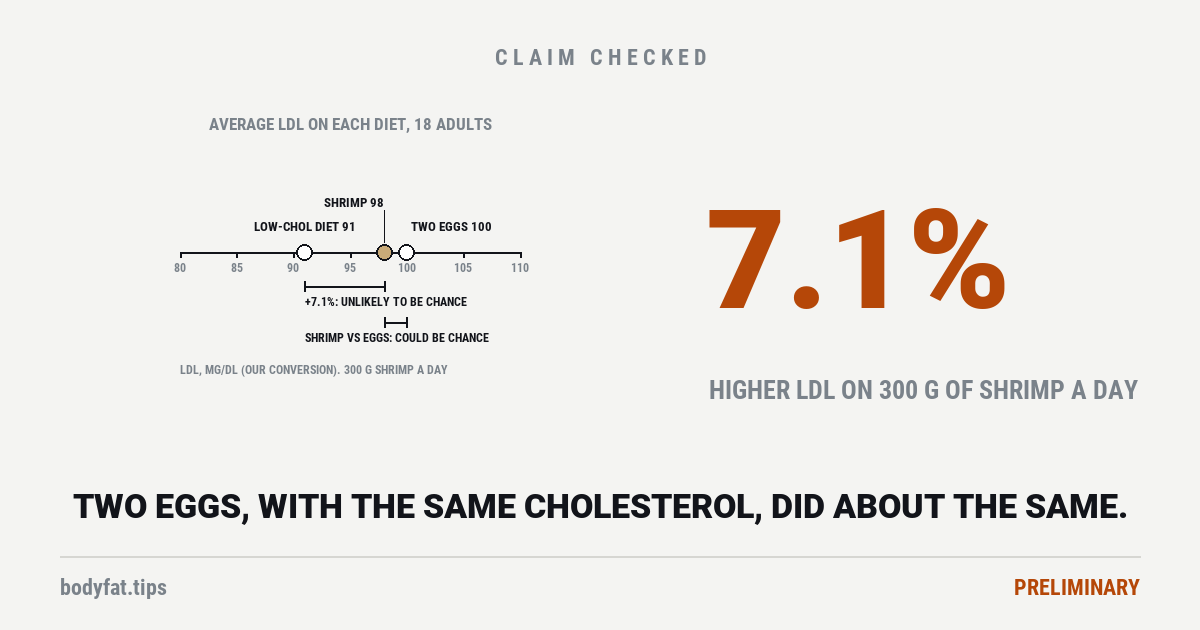
The one nearly every page cites ran at Rockefeller University in New York and was published in 1996 [6]. It was a randomised crossover trial: each person ate every diet in turn, in a random order, so each was compared with themselves. There were three diets. A low-fat baseline with 107 mg of cholesterol a day, matched for fat with the shrimp diet. A shrimp diet with 10.6 oz (300 g) of shrimp a day, about two-thirds of a pound, bringing 590 mg. And an egg diet with two large eggs a day, bringing 581 mg [6]. Eighteen people finished it, 11 men and 7 women aged 19 to 33, all with cholesterol in the normal range for their age and sex. Each spent three weeks on each diet, and the research centre supplied all of their food, with instructions to eat nothing else [6].
On the shrimp diet, LDL was 7.1% higher than on the baseline diet, with a P value of 0.014, under the 0.05 line researchers use for “probably not chance”, and under the stricter 0.017 line this trial set itself because it compared its three diets in pairs. HDL was 12.1% higher and triglycerides 13% lower. On the egg diet, LDL was 10.2% higher and HDL 7.6% higher [6].
So shrimp did raise LDL. Eggs raised it by about as much. Set side by side, LDL was 2.8% lower on shrimp than on eggs, with a P value of 0.20, far above either line, so that gap could easily be chance. That was the question the trial was built to answer, and its authors concluded that the shrimp and egg diets “produced similar increases in LDL-cholesterol concentrations” [6]. Against the eggs, triglycerides were 18.9% lower on shrimp, a gap unlikely to be chance, and HDL 4.1% higher, a gap that could be (P = 0.059) [6].
The authors concluded that “moderate shrimp consumption in normolipidemic subjects will not adversely affect the overall lipoprotein profile”, because HDL rose by a larger share than LDL and the ratios between them did not worsen [6]. Hold that at arm’s length, for two reasons. The trial never tested a moderate amount: it tested two-thirds of a pound a day, which the authors themselves say “far exceeds the typical consumption of shrimp”, and reasoned down from there [6]. And a ratio that holds steady because HDL rose too is only reassuring if a higher HDL protects you; two pills approved partly to raise HDL lost their approval after heart trials found no clear benefit, as our HDL verdict sets out.
The second trial is British, and it went the other way. Researchers at the University of Surrey gave healthy men 7.9 oz (225 g) of cold-water prawns a day, about half a pound, or the same weight of crab sticks, which are processed white fish, for four weeks each, in random order, with four weeks between [7] [11]. How much cholesterol that added depends on which report you read. The 2009 abstract says the prawns carried 300 to 400 mg a day and the crab sticks a trace [7]; the thesis, from the makers’ figures, about 295 mg [11]; the men’s food diaries, 794 mg a day on prawns against 275 mg on crab sticks [7]; and the 2010 journal paper’s abstract, 750 against 200 [12]. By the trial’s own statements of what the prawns carried, that is less than the 480 mg or so the New York trial added; only the diaries and the 2010 abstract put it higher. Total cholesterol, LDL, HDL and triglycerides were not significantly different between the two [7].
That is one trial, reported four times, and the reports do not agree on the details. A 2009 conference abstract counts 21 men [7]; a second, on the fat particles, reports 18 of them [13]; a 2014 PhD thesis that re-analysed the trial describes 21 men in two four-week periods [11]; and the 2010 journal paper, which we could read only as its abstract, says 23 men and describes the trial as lasting “12 weeks in a cross-over design” [12]. We count it once.
In the thesis, measured in 18 of the men, LDL went from about 132 to 123 mg/dL (3.42 to 3.19 mmol/L, the unit used outside the US) on prawns and from about 121 to 125 (3.14 to 3.22) on crab sticks, a difference that could be chance; the mg/dL figures are our conversion [11]. The thesis also found that apolipoprotein B, a protein that sits on each LDL particle and its close relatives, so a rough count of them, fell on prawns against crab sticks [11]. The 2009 abstract had found no significant difference in it [7]. Same men, two analyses, two answers, and neither is a finding we would lean on.
Two older studies are smaller still. In 1982, six men ate a diet with 449 mg of cholesterol a day from lobster, crab and shrimp, after a low-cholesterol diet. Their total cholesterol went from 184 to 192 mg/dL, a rise unlikely to be chance, which the authors called “only mildly hypercholesterolemic” [9]. In 1990, 18 men each ate six shellfish diets in turn, the shellfish replacing the meat in their usual food. The abstract calls the shrimp and squid diets “higher in cholesterol”, beside four shellfish diets it calls “low in cholesterol”, and says they “did not change the blood lipids”; it gives no amounts and no figures [8]. The 1996 paper describes the same study differently. By its account the shrimp diet “differed little from the basal diet in cholesterol content”, basal meaning baseline, while carrying 38% less fat, and total and LDL cholesterol fell 3% and 5% on it; it adds that neither earlier shellfish study “tested the specific effect of shrimp cholesterol” [6]. Its account of the 1982 study does not match that study’s abstract either: it puts the rise at 2 mg/dL, where the abstract’s 184 to 192 make it 8, by our arithmetic [6] [9]. We could not read the 1990 paper itself, so we give both accounts and lean on neither.
And one study found a big rise. In 2012, researchers in Bushehr, Iran, measured 25 healthy men who worked on a shrimp farm, first before the harvest, when the staff menu had no seafood, and again after six weeks of the harvest menu, which served about 10.6 oz (300 g) of farmed shrimp, cooked with onions and served with rice, at lunch three days a week [10]. LDL went from about 80 to 107 mg/dL, roughly 32% higher, and total cholesterol from about 148 to 178 [10]. The authors advise against farmed shrimp in a heart diet for people with high cholesterol or heart disease [10].
It is also the weakest design of the five. There was no comparison group: the same men were measured before and after, while their whole lunch menu changed for the harvest. Their weight went up 2.6 lb (1.2 kg) and their fasting blood sugar rose too, so the shrimp is not the only thing that changed [10]. The authors call the study observational themselves, name the unmatched diets as its main limitation, and say it cannot settle the question [10]. We read it in Persian; the translation and our reading of its table are ours. It is not in PubMed or Europe PMC; an ordinary web search found it [2].
Is boiled shrimp high in cholesterol?
Yes. Boiling does not take cholesterol out. Cooking drives water off, so the cholesterol per ounce goes up: 161 mg per 100 g raw and 189 cooked, in USDA’s entries [3]. What cooking can add is fat. Fried in butter, shrimp brings the butter’s saturated fat with it, and the 2025–2030 Dietary Guidelines ask Americans to swap deep-frying for baking, broiling, roasting, stir-frying or grilling [14].
Is shrimp healthier than chicken?
It depends which number you are counting. Per 3-ounce serving, shrimp has more than twice the cholesterol of skinless chicken breast, 161 against 72 mg, and less than a tenth of the saturated fat, 0.05 against 0.86 g [3]. Chicken has more protein, about 26 g against 20, and more calories, about 140 against 84, by our arithmetic from USDA’s figures [3]. Against 85% lean ground beef, shrimp has about twice the cholesterol, 161 against 75 mg, and about a hundredth of the saturated fat [3].
Which of those matters more for LDL? The 2026 US cholesterol guideline’s answer is that “healthy eating patterns that limit saturated fat while increasing unsaturated fat” produce “more consistent LDL-C lowering than restricting dietary cholesterol”, LDL-C being LDL cholesterol [15]. “Healthier” is a bigger word than any of this, and this page does not rate it.
Is crab or lobster high in cholesterol? What seafood should I avoid for high cholesterol?
Lobster carries about 124 mg of cholesterol in 3 ounces, blue crab about 82 and Alaska king crab about 45, all with less than a fifth of a gram of saturated fat; wild salmon has about 60 mg [3]. None of the US cholesterol guidance we read names a seafood to avoid for cholesterol. The American Heart Association says shrimp and other shellfish “can be incorporated into a heart-healthy dietary pattern when paired with other lean or plant-based protein sources”, and puts a 3-ounce serving of shrimp level with “about a whole egg” [4]. The current Dietary Guidelines list seafood among the protein foods to eat and do not mention dietary cholesterol at all [14]. The federal fish advice for people who are pregnant, breastfeeding or might become pregnant, and for children aged 1 to 11, does list fish to avoid, for mercury, which is a different question from cholesterol; it counts shellfish as fish and puts shrimp among its “Best Choices” [16]. Our canned tuna verdict covers that list, and what the omega-3 fats in fish are worth.
The same advisory adds a caution for one group: “Patients with dyslipidemia, particularly those with diabetes mellitus or at risk for heart failure, should be cautious in consuming foods rich in cholesterol” [4]. Dyslipidemia means abnormal blood fats, a high LDL among them. The advisory also reports that the National Lipid Association advises people with established high cholesterol to keep dietary cholesterol under 200 mg a day [4]. One 3-ounce serving of shrimp is 161 of those 200 mg, by our arithmetic. If that is you, the shrimp question belongs with your clinician or dietitian, who knows your numbers.
Does shrimp raise the risk of heart disease?
We found no trial of shrimp that counted heart attacks [2]. What exists is observational: studies that watch what people choose to eat, which can find a link but cannot show a cause. In a US study that followed 13,355 middle-aged and older adults, the people who ate the most shellfish did not clearly differ in coronary heart disease from those who ate the least, with a hazard ratio of 0.91 before any adjustment [17]. A hazard ratio compares how often something happens over time in two groups: 1.00 is no difference, 0.91 is 9% fewer. Its confidence interval, the range the true average probably sits in, ran from 0.80 to 1.03, so “no difference at all” is still on the table [17].
Two cautions. The study’s adjusted figure, 0.98, allowed for LDL itself, the very route by which shrimp is supposed to do harm, so that figure cannot test the claim; by our reasoning the unadjusted 0.91 is the cleaner read [17]. And it counted shellfish as people reported eating it, which is not the same as shrimp; we read it as its abstract. A 2021 letter using a US national health survey found that people who ate shrimp and people who did not had the same average LDL, 107.6 mg/dL, in a one-time snapshot that its authors say cannot show cause and effect [18].
What are the worst foods for cholesterol?
The guidelines we read do not rank foods. The 2026 US cholesterol guideline names nutrients, among the dietary causes of a raised LDL: high saturated fat intake, high trans-fat intake and high cholesterol intake, with weight gain, rapid weight loss and ketosis [15]. So dietary cholesterol is on the list, and the same guideline says eating patterns that limit saturated fat produce more consistent LDL lowering than restricting dietary cholesterol [15]. Our egg verdict rates the best-studied cholesterol-rich food.
What reduces cholesterol quickly?
Nothing on this page, and nobody can honestly promise a date. The foods with measured LDL-lowering effects are rated on our foods-that-lower-cholesterol verdict, mostly by single digits, and what weight loss does to the cholesterol test is on our weight-loss verdict.
Who these studies were done on
Every feeding study on this page recruited people whose cholesterol it called normal, each by its own definition [6] [7] [8] [9] [10]. Four of the five were men only; the 1996 trial’s 18 people included 7 women, and all 18 were young, aged 19 to 33 [6]. The Surrey men were 19 to 67, the Iranian farm workers 25 to 46 [11] [10]. And the three whose amounts we could read fed far more shrimp than a normal serving: about two and a half 3-ounce servings every day in Surrey, three and a half every day in New York, and three and a half on three days a week in Iran, by our arithmetic.
So read yourself against them. If your cholesterol is normal and you eat shrimp now and then, these studies were about people like you, eating far more of it than you do. If your LDL is already high, no trial we found recruited people like you [2]. Of the groups studied, the Surrey men come closest. That trial took men with total cholesterol up to 6.5 mmol/L, about 251 mg/dL by our conversion; their LDL averaged about 132 mg/dL at the start of the prawn weeks; and its thesis notes one or two men already above its cholesterol or triglyceride limits at the start of a period. It splits its results by BMI (body mass index, weight scaled for height), not by starting cholesterol [11]. For scale, a 2001 report of the US National Cholesterol Education Program classes an LDL of 130 to 159 mg/dL as “borderline high” and a total cholesterol of 240 or more as “high” [19]. By those lines, the Surrey men’s average LDL at the start was borderline high, and the trial’s entry limit sat above the line for high total cholesterol. One woman with high cholesterol did take part in the 1982 study, in a part that fed clams, oysters and scallops, not shrimp: her cholesterol rose from 311 to 352 mg/dL [9]. That is one person, not a finding.
Why did shrimp raise LDL in one trial and not in the other?
This section is the desk’s own reasoning, and it is labelled as such. The New York trial added about 480 mg of cholesterol a day to people’s food, by our arithmetic from its diets [6]. The Surrey trial’s prawns added 300 to 400 mg by its 2009 abstract, about 300 by its thesis, and about 520 by the men’s food diaries, that last by our arithmetic [7] [11]. One found LDL 7.1% higher. The other found no significant difference. Here are four ways to fit that together, each rated.
Answer one: the comparison was different. In New York, shrimp was set against a low-cholesterol diet matched for fat [6]. In Surrey it was set against crab sticks, which per daily portion carried about 35 g of carbohydrate and about 70% more sodium than the prawns, and the thesis itself raises the possibility that the difference confounded the result [11]. If the comparison food moved LDL too, it could hide a gap or create one. The differences are measured; that they explain the result is a surmise, and partly the thesis’s own.
Answer two: chance, in two small trials. A 7% change in LDL is small next to how much people differ, and both trials were around 20 people: 21 men in Surrey, 18 people in New York [7] [6]. The Surrey trial was sized on the New York one, which the thesis describes as 225 g of shrimp a day lowering LDL by 5%; the New York paper reports 300 g raising it by 7.1% [11] [6]. Two small trials can land on opposite sides of a small effect by chance alone. That is a surmise, and it cuts both ways: either result could be the fluke.
Answer three: the effect is real, and egg-sized. Pooled egg trials find that eggs raise LDL by about 5 to 8 mg/dL, and our egg verdict rates that Established. In the one trial that ran both, shrimp carrying the same cholesterol as two eggs raised LDL by about as much as the eggs did; the gap between them could be chance, and the authors called the rises similar [6]. If shrimp’s cholesterol works like the egg’s, a rise of that size, or a smaller one if Surrey’s dose was smaller, would be easy to miss in 21 men. That is our inference from the egg evidence, not a measurement in shrimp, and it cuts against the comforting reading: it says the rise is probably real, just small.
Answer four: Surrey gave less. The Surrey men ate 225 g of prawns a day, against New York’s 300 g of shrimp, and by the trial’s own 2009 abstract the prawns carried 300 to 400 mg of cholesterol, against the 480 mg or so New York added [7] [6]. A smaller dose would mean a smaller rise, harder to see in 21 men. But the men’s food diaries put the extra cholesterol at about 520 mg a day, by our arithmetic, more than New York’s, so the reports cannot settle it [7]. The doses are the reports’ own figures, and they disagree; that the dose explains the result is a surmise.
Put the four together and here is what we think is true, stated plainly so you can disagree with it: shrimp’s cholesterol probably nudges LDL up about as much as the same cholesterol from eggs would, a change small enough that trials of 20 people cannot agree whether it is there.
What we could not find, and would like to: a trial in people whose LDL is already high, giving shrimp in ordinary servings a few times a week against chicken or white fish, with LDL and apolipoprotein B measured over months. If you know of one, the corrections line on this site is open.
Where “avoid shrimp if your cholesterol is high” came from
The arithmetic came first. US advice long capped dietary cholesterol at 300 mg a day, as our egg verdict traces, and the Daily Value on every US food label still uses that number [5]. A food with more than half the day’s allowance in one serving was always going to end up on a list. For people with high cholesterol the cap was tighter: under 200 mg a day, in the National Lipid Association advice the American Heart Association reports [4], and in the heart association’s own advice as a newspaper column described it in 2006 [20].
The lists followed. That 2006 column was headlined “People with high cholesterol should avoid shrimp”, answered “Fiction”, and said shrimp’s cholesterol “once led nutritionists to recommend against eating the shellfish” [20]. It has not left the lists. A health publisher’s slideshow of “10 Foods to Avoid if You’re Watching Your Cholesterol”, first published in 2012 and updated in July 2026, puts shellfish first and shrimp ninth, calling shrimp “very high in cholesterol” [20]. Google’s AI answer today opens with the same fact: “Yes, shrimp is high in dietary cholesterol” [1].
The rebuttal is the side with something to sell. Google’s AI answer goes on to say that “moderate shrimp consumption does not harm the overall lipid profile”, and that eating shrimp has raised HDL and lowered triglycerides [1]; it does not mention that LDL rose. A seafood trade body’s page, cited in that answer, opens by saying the 1996 trial showed shrimp “did not raise blood cholesterol levels”; further down, the same page says the trial found shrimp raised blood cholesterol against a low-cholesterol diet, with LDL up by less than HDL [1]. A seafood importer’s nutrition page, footnoting the same trial, tells buyers that “the shrimp diet did not increase levels of heart-damaging LDL cholesterol” [1]. The trial itself reports LDL 7.1% higher on shrimp, about the same rise as on eggs [6].
The British trial got the same treatment. A seafood trade-press report said the prawn eaters “showed absolutely no effect” on their blood cholesterol, and quoted the director of a shellfish trade association on health professionals “still giving out-of-date advice” to cut back on prawns [20]. The trial had reported no significant difference against crab sticks, in men with normal cholesterol [12]. That is not the same thing as no effect, and it is not a test in people with high cholesterol.
None of this is aimed at anyone who likes shrimp, or anyone who stopped eating it because a list told them to. The warning overstated a small effect. The industry’s answer, in its opening lines, rubbed it out.
What this is rated, and what the rating covers
Preliminary — for the claim as people repeat it, that eating shrimp drives up your bad cholesterol, LDL. It has been tested only in people recruited with normal cholesterol and, where we could read the amount, only with far more shrimp than a serving.
It is rated Preliminary because the evidence is small and points both ways. The best trial, 18 young adults eating only the food it supplied, found LDL 7.1% higher on two-thirds of a pound of shrimp a day than on a low-cholesterol diet, about as much as on two eggs [6]. A randomised trial of half a pound of prawns a day, carrying less cholesterol by its 2009 abstract, found no significant difference from crab sticks [7] [12]. A six-man study found total cholesterol 4% higher on mixed shellfish [9], and an 18-man study in which shrimp replaced meat reports that the shrimp diet, which its abstract calls “higher in cholesterol” without giving amounts, “did not change the blood lipids” [8]; the 1996 paper’s account of that study has the diet little different in cholesterol and lower in fat, with LDL 5% lower [6]. The one large rise came from a study with no comparison group, in which weight rose too [10]. It is not “no rise”: LDL did go up in the best trial. If “drives up” means a big rise, none of the studies here with a comparison group found one.
Set this beside our egg verdict, which rates it Established that eggs raise LDL a little. Both ratings are about a rise in LDL. What differs is the evidence under them: how much there is, and whether it agrees. The egg rating rests on three pooled analyses of egg-feeding trials that agree on the direction, though, as that page says, they share many of their trials. This one rests on two small randomised trials that disagree, and three other small studies. In the one trial that fed both, the rise on shrimp and the rise on eggs were about the same [6].
Each part, rated alone, in words. That shrimp is high in dietary cholesterol: Established, in USDA’s measurements and by the FDA’s own yardstick [3] [5]. That it is very low in saturated fat: Established, in the same measurements [3] [4].
That eating a lot of shrimp, two and a half to three and a half servings a day, raises LDL a little, in people with normal cholesterol: Preliminary, on small and conflicting studies. One randomised trial found it and a six-man study found total cholesterol up 4%, while a randomised trial at a smaller dose found no significant difference [6] [9] [7]. The egg trials make a small rise plausible; the shrimp studies alone do not settle it.
That an ordinary serving, 3 ounces now and then, raises LDL: Preliminary, and untested at that dose; every study whose amount we could read used far more. A 3-ounce serving carries about as much cholesterol as a large egg, and the American Heart Association, which puts the two level, says healthy people “can include up to a whole egg or equivalent daily” [4]. If shrimp’s cholesterol behaves like the egg’s, a serving would do a fraction of what two-thirds of a pound did. That is our inference, not a measurement.
That shrimp is bad for people who already have high cholesterol: Preliminary. We found no trial that recruited them [2]; only the uncontrolled Iranian study, in healthy men, and the small rise in the New York trial point that way [10] [6]. Untested is not the same as disproven.
That people who eat shrimp have more heart disease: Unsupported, of the tested kind, though thinly tested: we found no trial, and the one US cohort of shellfish and heart disease we found, of shellfish rather than shrimp and read as its abstract, found no clear link [17].
What is not rated here: shrimp’s other nutrients; mercury, contaminants and how shrimp is farmed; shellfish allergy, which is a separate and serious matter for a clinician; and the frame above, which is this desk’s reasoning from the evidence rather than a result the evidence delivered. It is marked as ours so that you can weigh it as ours. The rating on our egg verdict, that eggs raise LDL by a small amount, stands; nothing here re-rates it.
This is journalism, not medical advice. If you are managing high cholesterol, or have diabetes or heart disease, what you eat belongs in a conversation with a clinician or dietitian who knows your numbers. How we read a study, and what each tier means, is set out here.
- Is Peanut Butter Bad for Cholesterol? Not in Nine Trials of Peanuts and Peanut Butter. In Place of Saturated Fat, LDL Fell About 14%; Otherwise It Came Out About Even.
unsupported - Is Avocado Oil Good for You? Its Fat Is Close to Olive Oil’s, Its Own Trials Are Small, and Most Bottles Tested in 2020 Were Stale or Mixed
preliminary - Does Caffeine Stunt Your Growth? The Warning Was Selling a Coffee Substitute in 1900, and the Tests Since Do Not Back It
unsupported