Does Low Vitamin D Make You Tired? The Best Trial in Tired, Deficient Adults Found a 2.5-Point Gap at Four Weeks. Genes That Lower It Did Not Clearly Raise Tiredness.

“Yes, low vitamin D levels can cause fatigue and persistent tiredness.” That is how Google’s AI answer began on 20 October 2026 when asked the question in our title, which is typed about 1,900 times a month in the United States (from a paid keyword database, pulled 20 October 2026) [1]. Its first reason was that vitamin D “helps your cells produce energy”. Among the pages it cited were an endocrinology practice’s blog, two medical groups, a wellness-clinic chain, a hospital system and one research paper: a report on a single 61-year-old man [1] [2].
So is it true? Here is what the trials found.
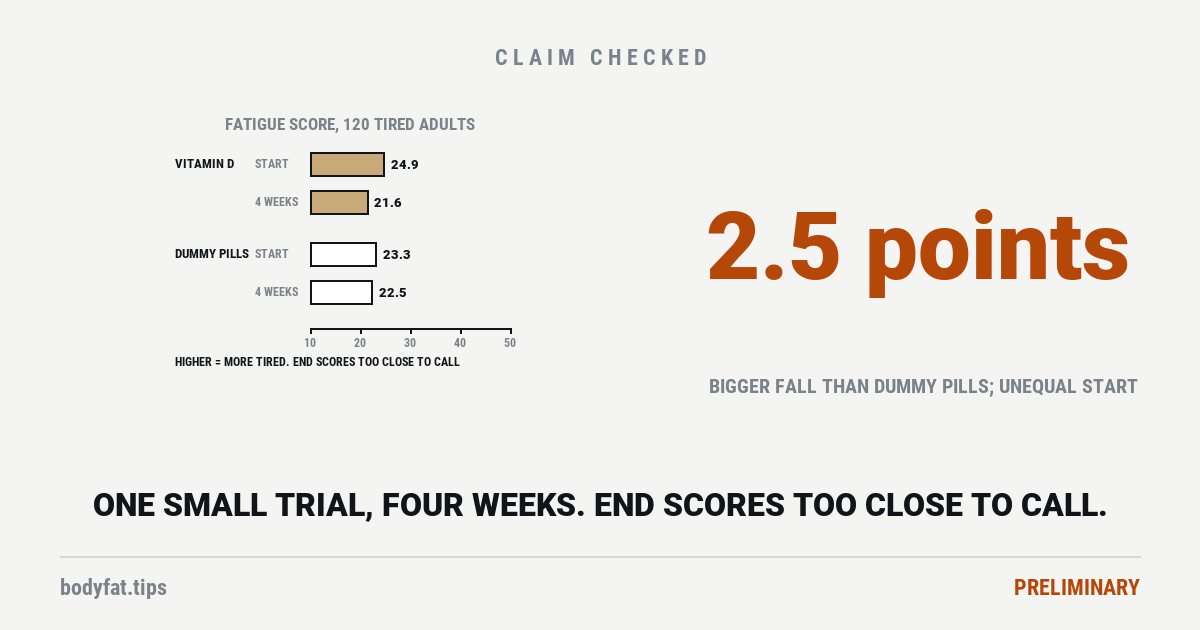
The short answer: not clearly, for most people who are tired and a little low. In the best trial we found, a double-blind trial of 120 tired, otherwise healthy adults below 20 ng/mL, a single dose of vitamin D lowered fatigue scores 2.5 points more than a dummy pill did after four weeks, on a scale that runs from 10 to 50, and at the end the two groups’ scores were too close to call [3]. A genetic study of 327,478 Britons found that the genes which lower vitamin D did not clearly raise tiredness [4]. Real deficiency, the long and deep kind that softens bone, is a different matter: it brings aching bones and weak thigh muscles, and vitamin D treats it [5]. Tiredness has many causes, some of them serious. If you have been tired for a few weeks and do not know why, England’s health service says to see a doctor, and it lists iron-deficiency anaemia, diabetes, an overactive thyroid, sleep apnoea and depression among the causes [6]. See a clinician before you treat yourself with a supplement.
Before the trials, two terms. Vitamin D status is read from a blood test for 25-hydroxyvitamin D, the form the liver makes, reported in nanograms per millilitre (ng/mL) in the US and nanomoles per litre (nmol/L) elsewhere; 20 ng/mL is 50 nmol/L. The Zurich trial below used 20 ng/mL as its line for deficiency, citing the US National Academies [3], whose experts count 20 as enough for most people and put the risk of deficiency below 12 [7]; our vitamin D page sets out who draws the line where. And a placebo is a dummy pill that looks the same as the real one, so that neither the people taking it nor, in a double-blind trial, the researchers know who got which.
Will taking vitamin D give you more energy?
In 2014 and 2015 a Zurich hospital ran the test this claim needs [3]. It recruited tired volunteers through notices at the university and its hospital, screened 286, and ruled out the usual suspects first: anaemia, low iron, thyroid trouble, depression, insomnia and other sleep disorders [3]. The volunteers in the trial were aged 20 to 50, average age 29, at a healthy weight, and every one was below 20 ng/mL; the two groups’ medians were 13 and 14 [3]. Each swallowed capsules in front of a doctor: 59 one dose of 100,000 IU of vitamin D3, 63 identical dummies; 58 and 62 were analysed [3].
Four weeks later the fatigue score, ten questions adding up to between 10 and 50, had fallen 3.3 points on vitamin D and 0.8 on the dummy capsules [3]. The P value for that difference was 0.01, on the right side of the line researchers use for “probably not chance” [3]. The paper counts 72% of the vitamin D group as improved, against 50% on the dummy [3]. The trial had registered that score as its main measure before it began [3]. That is a real, positive result, and it is the best evidence the claim has.
Three things in the same paper shrink it. First, the groups did not start level. The vitamin D group began more tired, at 24.9 against 23.3, and four weeks later the two groups’ scores were 21.6 and 22.5, a gap the paper’s own table puts at a P value of 0.41, which could easily be chance [3]. (The paper’s text gives the starting scores the other way round; we follow its table.) Second, the trial also asked people directly whether their tiredness was better than before treatment, and 48% on vitamin D said yes against 37% on the dummy, a gap that could be chance [3]. Third, a 2011 study of this fatigue scale in people with sarcoidosis, a lung disease that brings heavy tiredness, put the smallest change patients notice at about 4 points [8]. The trial’s difference was 2.5 [3]. That yardstick comes from a different illness, and we use it as a rough guide, not a rule.
There is a second account of the trial, or of one very like it. A 2020 doctoral thesis at the University of Zurich, by one of the paper’s authors, with two of its authors as referees, describes a trial of tired volunteers below 20 ng/mL: 286 screened, one dose of 100,000 IU or a dummy, the same fatigue score at four weeks [9]. It reports 133 enrolled, and fatigue improving in 70.0% on vitamin D against 54.5% on the dummy, which it gives as an odds ratio of 1.28 with a range from 0.73 to 2.26 [9]. An odds ratio compares the odds of something happening in two groups, and 1 means no difference. The range is the confidence interval: the range the true average probably sits in. When it includes 1, “no difference at all” is still on the table, as it is here.
The thesis gives a reason for running its analysis two ways: “unforeseen adverse events potentially biasing results” [9]. Its odds ratios also do not fit its own percentages: by our arithmetic, 70.0% and 54.5% imply about 60 and 66 people and an odds ratio near 1.9, not 1.28 [9]. The 1.28 is what dividing 70.0% by 54.5% gives, a ratio of the two shares rather than of the odds, and worked from the counts the range around either measure still includes 1, while neither matches the printed range of 0.73 to 2.26. That arithmetic is ours too. The thesis’s title also shares most of the Zurich trial’s registered title, down to the unusual word “peroral” [9] [3]. We could read only the thesis’s summary, so we cannot tell whether it is the same trial counted differently or a larger version of it, or which figure is right. We do not count it as a second trial, because by its own description it screened the same number of people, 286.
| Trial | Who, and what they took | Tiredness result | Who paid |
|---|---|---|---|
| Zurich, 2016 [3] | 120 tired, otherwise healthy adults aged 20 to 50, all below 20 ng/mL; one 100,000 IU dose or a dummy | Fatigue score down 3.3 points against 0.8 at four weeks, on a 10-to-50 scale; end scores 21.6 and 22.5, not clearly apart | Partly a Swiss private foundation; no conflicts declared in the paper; one author had declared fees from a vitamin D maker in another trial that year |
| Zurich thesis, 2020 [9] | What appears to be the same trial, described again: 286 screened, 133 enrolled | Improved: 70.0% against 54.5%; odds ratio printed as 1.28 (by our arithmetic, 70.0% divided by 54.5%), with a range from 0.73 to 2.26 | Not read: summary only |
| Duluth, Minnesota, 2009 [10] | 100 primary-care patients at 10 to 25 ng/mL; 50,000 IU a week or a dummy for eight weeks | Standardised difference 0.13 in vitamin D’s favour, range from 0.55 in its favour to 0.28 against, as worked out by other researchers [4] | Not read: summary only |
| Kuala Lumpur, 2014 [11] | 192 women at a university, average age 42 and about 12 ng/mL; 50,000 IU weekly, then monthly, or a dummy, for a year | Vitality score 5.0 points higher at a year, on a 0-to-100 scale; 3.5 points of the gap were there at the start | A university grant and a Malaysian government grant |
| India, 2026 [12] | 100 tired or low-mood women aged 40 to 55, below 30 ng/mL; 60,000 IU weekly, then monthly, or a dummy, for six months | Fatigue score 31.4 to 20.9 on vitamin D, 30.9 to 28.7 on dummy pills, on what the paper calls only “a validated fatigue assessment scale” | No funding statement in the paper |
The other trials in people who were low are smaller or murkier. In Duluth, Minnesota, 100 primary-care patients with levels between 10 and 25 ng/mL took 50,000 IU a week or a dummy pill for eight weeks [10]. The abstract reports a small improvement on a questionnaire about fibromyalgia, a condition of widespread pain, and no significant improvement in most muscle and bone symptoms [10]. For tiredness, the genetic study’s authors worked out the result themselves: a standardised difference of 0.13 in vitamin D’s favour among 90 patients, with a range from 0.55 in its favour to 0.28 against [4]. That scale measures a gap in units of how much people varied; 0.2 is what researchers call small, 0.5 moderate, 0.8 large.
In Kuala Lumpur, 192 women working at a public university, average age 42 and averaging about 12 ng/mL (30 nmol/L), took 50,000 IU a week for two months and then monthly, or a dummy, for a year [11]. Energy was not what the trial was built to test; it was one score on a standard health questionnaire, the vitality score, which the authors describe as measuring energy and fatigue on a scale from 0 to 100 [11]. At a year the vitamin D group scored 5.0 points higher, with a range from 0.7 to 9.4, and the authors called it “statistically significant but clinically insignificant” [11]. Look at the table, though, and most of the gap was there from the start: the vitamin D group began 3.5 points ahead, at 65.3 against 61.8, and its own score barely moved, to 65.5, while the dummy group’s slipped to 60.5 [11]. That reading of the table is ours.
The biggest effect comes from the least transparent paper. A 2026 trial in a small journal reports 100 Indian women around the menopause, aged 40 to 55 and below 30 ng/mL, who had been tired or low in mood for at least three months; half took 60,000 IU weekly and then monthly, half a dummy, for six months [12]. Fatigue scores fell from 31.4 to 20.9 on vitamin D and from 30.9 to 28.7 on the dummy [12]. The paper calls its measure only “a validated fatigue assessment scale”, does not name its hospital, gives no trial registration number, and reports that all 100 women finished [12]. We include it because it points the claim’s way. We cannot weigh it heavily.
What about people who are not low, or never checked? The biggest trial we found that asked about energy is the Women’s Health Initiative, whose calcium-and-vitamin-D trial gave 36,282 American women past the menopause, aged 50 to 79, 1,000 mg of calcium with 400 IU of vitamin D a day, or a dummy pill [13]. Among the 34,157 who reported symptoms, over an average of 5.7 years, energy and fatigue scores did not differ clearly between the groups, with a P value of 0.76, and nor did “feeling tired” in year eight [13]. Its authors list the limits themselves: 400 IU raises blood levels only about 4 ng/mL, women could take vitamin D of their own, and nobody’s starting level was measured, so many may not have been low [13]. Our calcium page covers what the same trial found for bones.
A Dutch trial gave 275 adults with type 2 diabetes, most of them not low (their average was about 24 ng/mL, 61 nmol/L), 50,000 IU a month or a dummy for six months; vitality fell slightly in both groups, and the 1.6-point gap between them could be chance [14]. The authors report the same for the third who started below 20 ng/mL, without showing the figures [14]. A 2015 review of 15 studies found vitamin D was not associated with significant changes in quality of life; the improvements it did find were in ill people on short courses, in studies mostly of poor quality [15]. And a review for family doctors published in October 2026 says trials of vitamin D for fatigue, hair loss and chronic pain “do not show consistent benefit”, including in patients who started low [16].
We found no pooling of placebo-controlled trials of vitamin D for tiredness in people without a named illness [17]. The nearest is a three-trial calculation in the genetic study’s introduction, which put the Zurich, Duluth and a chronic fatigue syndrome trial together and called the answer “inconclusive and heterogeneous” [4]. Its heterogeneity was 77%: the share of the spread between the trials’ results that is more than chance would produce [4].
Does low vitamin D make you tired, or do tired people get less sun?
Studies that simply measure people find a link sometimes, and sometimes not. At a Sicilian osteoporosis-prevention clinic, 240 outpatients over 65 who had been tired for more than four weeks had lower vitamin D than 240 who were not, about 15.8 against 19.2 ng/mL (39.5 against 48.1 nmol/L) [18]. In Swiss general practice, 1,682 consecutive patients rated their tiredness from 0 to 10; those below 20 ng/mL scored 3.6 and the rest 3.4, a gap that could be chance, though in the summer the deficient did report tiredness more often [19]. What did track their vitamin D was muscle weakness [19]. In 22 Swedish nursing homes, half of 545 residents, average age 86, had been tired for three months or more, and after allowing for age, sex and dementia, their tiredness was not linked to their vitamin D [20].
Even a clean link would not settle the question. These are observational studies: they find things that travel together, not which causes which. Tired people tend to move less and stay indoors, and skin makes vitamin D in sunlight, so tiredness could lower vitamin D rather than the other way round. Researchers call that reverse causation, and the genetic study’s authors name it as one explanation for the link [4].
Their study is the cleverest test of it. Mendelian randomisation uses inherited gene variants that nudge vitamin D up or down as a natural experiment: you were dealt them at conception, so they are not tangled up with how much you go outside or how you feel. In 327,478 UK Biobank volunteers of European descent, aged 38 to 73 when they joined, 19,526 said they had felt tired or had little energy nearly every day for the past two weeks [4]. Seven variants that lower vitamin D did not clearly raise the odds of that: 1.02 for each step down in genetically lowered vitamin D the size of the ordinary spread between people, with a range from 0.99 to 1.06 [4]. The authors state the limits: genes measure a lifelong tilt, not a fall into deficiency, the study rests on one question, and it cannot rule out that people with frank deficiency would benefit [4].
What are 5 signs of vitamin D deficiency to not ignore?
Vitamin D deficiency at its worst softens bone. In children that is rickets; in adults it is osteomalacia, bone that has not hardened properly. A 2020 clinical review lists what it does: diffuse bone pain and tenderness; weakness in the muscles near the trunk, mostly the thighs and around the knee; a waddling walk from struggling to lift the legs; bones that break too easily; and, over time, bowing of the long bones of the legs [5]. Those are five signs worth not ignoring. The same review notes that the condition is often silent, especially in older people [5].
Tiredness is not on that list. The review does not use the words fatigue or tiredness, and neither does the NIH’s vitamin D fact sheet for health professionals, which names bone pain, bone deformities, muscle weakness and pain, seizures and muscle spasms from low calcium, and dental problems [5] [7]. Several of the pages Google’s answer cites put fatigue at or near the top of their lists [1].
A clinician looking for osteomalacia checks more than the vitamin D number: calcium and phosphate; alkaline phosphatase, an enzyme that rises when bone is being remodelled; and parathyroid hormone, which the body raises when calcium runs short. An X-ray can show thin cracks called Looser’s zones, which the review calls almost always diagnostic in the right setting [5].
How long does it take to feel better from low vitamin D?
For osteomalacia, the review says symptoms begin to improve within a few weeks of effective treatment and can take several months to go completely [5]. For ordinary tiredness the trials cannot give you a timetable, because they did not find a clear effect to time. The Zurich trial measured at four weeks, when a single big dose was expected to have pushed blood levels to their peak [3]; the Indian trial reported a lower score at eight weeks [12]. Anyone selling a date is guessing, and nobody can honestly promise one, including us.
How can I raise my vitamin D levels quickly?
This page will not hand you a dose; that is a clinician’s call. For scale: the Zurich trial’s single 100,000 IU raised its volunteers’ levels by an average of 14 ng/mL in four weeks [3]. Big occasional doses have their own record of harm in older women, and the daily intakes and ceilings set by the bodies whose job that is are on our vitamin D page.
In people with an illness, the record is split
These trials are not about ordinary tiredness, but they are part of the record. In 50 people with chronic fatigue syndrome in Scotland, 100,000 IU every two months for six months left a fatigue score 0.2 points higher than placebo, with a range from 0.8 lower to 1.2 higher, which could be chance [21]. In 80 people in Thailand with tiredness or other symptoms after COVID-19, 60,000 IU a week for eight weeks lowered a fatigue score by 3.5 points more than a dummy [22]. A Japanese trial of 91 people with chronic fatigue syndrome after COVID-19 or vaccination reported fewer symptoms with vitamin D tablets plus advice on diet, sun and exercise; it was open-label, meaning everyone knew what they got, both groups also took a prescription form of vitamin D, and it counted symptoms rather than scoring tiredness [23].
In multiple sclerosis, a 2023 pooling of five trials and 345 people found a small effect on fatigue, a standardised difference of 0.18, with a range from 0.01 to 0.36 [24]. Nearly half of those people came from one Israeli trial, which the pooling describes as giving 1 microgram of vitamin D a day; the trial’s own title says it tested alfacalcidol, a prescription form of vitamin D that skips the kidney’s activation step [24]. Without it, the pooled figure fell to 0.05, with a range from 0.33 in vitamin D’s favour to 0.24 against [24].
Who these studies were done on
Read yourself against them. The Zurich trial, the claim’s best evidence, was young Swiss adults of healthy weight, mostly white, enrolled mostly in winter and spring [3]. The year-long trial was Malaysian women in their forties [11]; the six-month trial, Indian women around the menopause [12]; the biggest null result, American women past the menopause on a low dose with calcium [13]; the genetic study, UK adults of European descent aged 38 to 73 [4]. If you are older, have dark skin, have had weight-loss surgery, have a bowel or kidney condition, or are very low, these results fit you less well, and whether to test and treat is a question for a clinician who knows you.
If tiredness and low vitamin D turn up together so often, why do the trials find so little?
This section is the desk’s own reasoning, and it is labelled as such. Tiredness and vitamin D tests go together in practice: in one English NHS trust in 2017, tiredness was the stated reason for 22.4% of 17,405 vitamin D tests, and for 31.3% of those in people under 60 [25]. Some studies find the tired have lower levels [18]. Yet the trials that give tired people vitamin D find small gaps or none. Here are three ways to fit that together, each rated.
Answer one: the tiredness comes first. People who feel worn out go outside less, and the genetic study’s authors offer that reverse causation as one explanation for the link [4]. Their main test is on its side: genes that lower vitamin D did not clearly raise tiredness [4]. Their reverse test is not: genes linked to tiredness did not clearly lower vitamin D either [4]. So this is a surmise with half of the genetic evidence behind it.
Answer two: most tired people are not low enough for it to matter. The 12 people in the 2013 study behind the “energy from within the cells” headline were below about 6 ng/mL (15 nmol/L) [26]; the Zurich volunteers’ median was 13 to 14 [3]; the deficiency that softens bone and weakens muscle is the long, deep kind [5]. Those levels are measured. That any benefit for tiredness sits at the deep end is a surmise, and the genetic study’s authors leave the same door open [4]. One result points the other way: in Duluth, 38 patients below 10 ng/mL, lower than most of the Zurich volunteers, were treated openly with no dummy-pill group, and the trial’s abstract reports that they did not show symptom improvement over eight weeks or a year later [10].
Answer three: a tiredness score moves when people expect it to. Every study we read that gave vitamin D to tired people without a dummy-pill group reported improvement: all 12 people in the 2013 study [26], all five fatigue measures in 116 treated patients in New Jersey [27], the one man in the case report [2]. The 38 Duluth patients above, who did not improve, had been screened for low vitamin D rather than picked for tiredness [10]. The double-blind trials found much less [3] [21] [13]. Tiredness is rated by the person feeling it, which is why the Zurich team chose a dummy-pill design [3]. The pattern across designs is an observation; how much of it is expectation is not something these studies measured.
Put the three together and here is what we think is true, stated plainly so you can disagree with it: for most tired people a lowish vitamin D result is a companion of the tiredness, not its cause; where vitamin D really is the cause, it tends to come with aching bones and weak muscles, and a clinician can test for that.
What we could not find, and would like to: a registered, placebo-controlled trial in a few hundred adults who are both tired and clearly deficient, below 12 ng/mL, the line under which the US National Academies put the risk of deficiency (our vitamin D page has the numbers), run for six months or more, that reports both groups’ scores at the end as well as their changes. In ClinicalTrials.gov and the ISRCTN registry we found no such trial [17]; the nearest are the four-week Zurich trial and the six-month Indian trial that gives no registration number [3] [12]. If you know of one, the corrections line on this site is open.
Where “low vitamin D makes you tired” came from
The research behind the energy story is small. In a study published in 2013, a Newcastle team scanned the calf muscles of 12 adults below about 6 ng/mL who had come to their doctors with fatigue or cramps, gave them 20,000 IU every other day for 10 to 12 weeks, and scanned them again [26]. Their muscles recovered faster after exercise, the time measured falling from 34.4 to 27.8 seconds, and all 12 said they felt better [26]. The authors list the limits: no dummy pill, no blinding, no fatigue questionnaire, and before treatment their muscles were not clearly worse than 15 healthy volunteers’ [26]. The idea that low vitamin D tires people is older than the study: its summary calls vitamin D deficiency “a well-recognized cause of fatigue and myopathy”, or muscle disease [26]. What the study added was an explanation in the cells.
The framing arrived in April 2013, in the university’s press release: “Vitamin D proven to boost energy – from within the cells” [28]. It quoted the study’s lead researcher: “We have proved for the first time a link between vitamin D and mitochondria function”, mitochondria being the energy-making parts of a cell, and “a simple vitamin D tablet could help boost your energy levels” [28]. Its evidence was the 12 people and one scanner, with a line about an unnamed “parallel study” linking low vitamin D to poorer mitochondrial function [28]. “Proven” was the release’s word, and the researcher’s own in it, not the paper’s, though the paper’s own summary does claim, “for the first time”, a link between vitamin D and the mitochondria in muscle, and suggests it could partly explain its patients’ fatigue [26]. The step from those 12 people to “your energy levels” was the release’s. The paper itself cites a placebo-controlled trial from 2010 of vitamin D with calcium, in 40 young adults in India who were low in vitamin D, whose muscle energy measures were comparable with the dummy group’s after six months. The 2013 team point out that it scanned the muscle at rest, not recovering from exercise as they did, and in people who had no symptoms and were less deficient than theirs [26] [29].
Then it spread into practice and onto symptom lists. By 2017, tiredness was the stated reason for more than a fifth of vitamin D tests in one English NHS trust [25]. Today several of the pages Google’s answer cites list fatigue among the first signs of deficiency, and its first reason, that vitamin D “helps your cells produce energy”, is to our reading the 2013 release’s idea in plainer words [1]. We could not trace who first put tiredness at the top of the symptom lists. Further down, the same AI answer concedes that the research is mixed [1].
And it sells tests. A national laboratory company’s consumer site, ranking for this search, tells readers who have fatigue that “a test can provide insight” and sells one “without scheduling a healthcare provider visit” [1]. A wellness-clinic chain cited by the AI answer books consultations for “a personalized treatment plan designed to restore your energy” [1]. A symptom-checker app, also cited, argues the opposite, that supplements rarely resolve fatigue unless a significant deficiency is confirmed, and steers readers to its own symptom check [1].
None of this is aimed at anyone who is tired. Feeling exhausted is real, and wanting a simple, fixable cause is reasonable. It is the promise that a pill or a test will hand you your energy back that the trials did not keep.
Weight gain, hair loss, dizziness, headaches: what this page does not rate
People who search this also ask whether low vitamin D causes weight gain, hair loss, dizziness or headaches. This page does not rate those. Our vitamin D page covers weight, and the 2026 review for family doctors puts hair loss with fatigue among the symptoms where trials did not show a consistent benefit [16]. The low energy that comes from a lack of B12 is a different story, on our B12 page, and the multivitamin evidence is on its own page.
When tiredness needs a doctor
One of the searches beside this one is “vitamin D deficiency ruined my life”. If tiredness has taken over your days, that is a reason to see a clinician, not to self-treat with a supplement. England’s health service tells people to see a doctor if they have felt tired for a few weeks without knowing why, and lists causes such as sleep apnoea, iron-deficiency anaemia, diabetes, an overactive thyroid and depression; the blood tests it names are for anaemia, diabetes and thyroid trouble, and vitamin D is not on its list [6]. Some causes of persistent tiredness are serious. Our page on caffeine and sleepiness covers another common one.
What this is rated, and what the rating covers
Preliminary — for the claim that low vitamin D makes you tired, and that taking vitamin D gives you your energy back.
It is rated Preliminary because the evidence in its favour is small and conflicting, and comes from people who started low: one double-blind four-week trial of 120 that found a 2.5-point gap, with end scores not clearly apart [3]; a thesis about what appears to be the same trial reporting a result that could be chance [9]; a year-long trial whose vitality gap was mostly there at the start [11]; a six-month trial reporting large falls on an unnamed scale [12]; and a Duluth trial whose tiredness result could be chance [10] [4]. Against it, the genetic study of 327,478 found no clear link, and observational studies are split [4] [18] [19] [20]. It is not Unsupported, because the trials in people who were low lean the claim’s way and none is big or long enough to rule out a modest benefit. It is not Supported, because the best of them is small and four weeks long.
Each part, rated alone, in words. That vitamin D gives energy to people who are not low: Unsupported, of the tested kind: in the Women’s Health Initiative’s 34,157 women, on a low dose with calcium, and a Dutch trial of 275 adults with diabetes, energy and vitality scores were not clearly different from placebo, and the genetic study found no clear link in the general population [13] [14] [4].
That long, deep deficiency causes osteomalacia, with bone pain and weak muscles, and that vitamin D treats it: Established [5] [7]. Our vitamin D page treats the bone diseases of deficiency as settled too.
That vitamin D gives you energy by powering your cells: Preliminary. It rests here on four small studies that measured muscle energy, with a scanner or with light shone through the skin, and they measured different things in different people [17]. The two that found gains had no untreated comparison group, and treated people below about 6 ng/mL. In 2013, 12 people who had come to their doctors with fatigue or cramps recovered faster after exercise once treated, though their measures at rest did not clearly move, and before treatment they had recovered no slower than 15 healthy volunteers [26]. In 2014, 19 otherwise healthy people in India below 5 ng/mL had more of the muscle’s quick energy reserve, phosphocreatine, relative to free phosphate in their resting calves after 12 weeks [30]. The two that compared vitamin D with dummy pills tested people who were less deficient, and in neither did the pills alone clearly change the muscle’s energy measures. In 40 healthy young adults in India at about 8 to 10 ng/mL, six months of vitamin D with calcium left the muscle energy measures comparable with the dummy group’s while strength improved; the 2013 study’s authors say that trial scanned the muscle only at rest, and in people neither symptomatic nor severely deficient [29] [26]. In a Kentucky trial of 50 adults aged 60 to 80, whose groups averaged 25 to 27 ng/mL, 13 weeks of vitamin D alone did not clearly change how much oxygen the calf muscle used during exercise, or how fast that recovered afterwards; the only clear gains were in the group given vitamin D and a week of treadmill training, and they came from follow-up comparisons rather than the trial’s main test [31]. So the gains came from the most deficient people in studies without a dummy pill, while the dummy-pill trials tested people who were less deficient and measured different things; whether the difference is the depth of deficiency, the design or the measure, these four studies cannot say. Small, early and conflicting: that is what Preliminary means here.
What is not rated here: weight gain, hair loss, dizziness and headaches; how to raise your levels, and what dose; vitamin D for depression or for any illness above; and the frame above, which is this desk’s reasoning from the evidence rather than a result the evidence delivered. It is marked as ours so that you can weigh it as ours.
This is journalism, not medical advice. Tiredness has many causes, some of them serious, and anyone who is persistently tired should see a clinician rather than self-treat with a supplement. Whether to test your vitamin D, and what to do with the result, belongs with someone who can see your history. How we read a study, and what each tier means, is set out here.
- When to Take Creatine: Before or After Training, Six Trials Found No Significant Difference in Muscle or Strength
unsupported - Creatine HCl vs Monohydrate: Eight Studies Compared Them, and Only One Put HCl Ahead, on Sprints, Not Muscle
unsupported - How Much Protein Is Too Much? At About Twice the Recommended Amount, for Up to Two Years, Trials Found No Consistent Sign of Damage to Healthy Kidneys
unsupported