Does Finasteride Lower Testosterone? No. It Rose About 8 to 10% in Two Large Trials. What Falls, by About 70%, Is DHT, the Hormone Made From It.

“Does finasteride lower testosterone” is searched about 2,400 times a month in the United States (from a paid keyword database, pulled 20 October 2026) [1]. It is a fair thing to wonder. The hair-loss and prostate pill works on testosterone’s chemistry, and lower sex drive is on its list of side effects [2].
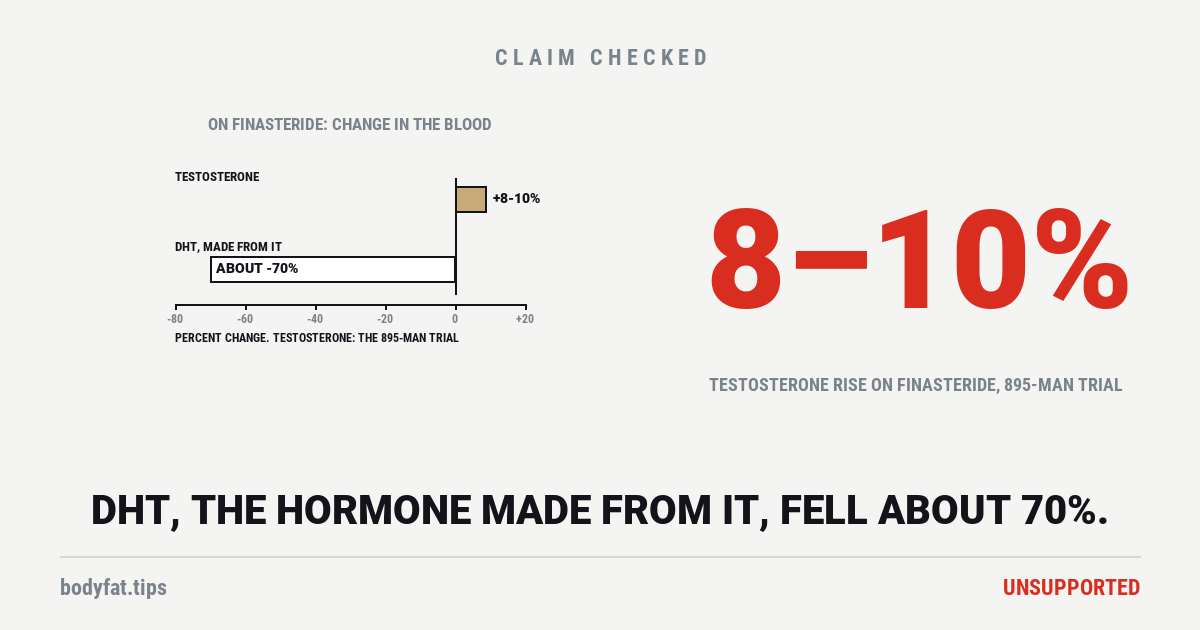
No. In the controlled trials, testosterone on finasteride went up modestly or did not change significantly. What falls is DHT, by about 70%. DHT, short for dihydrotestosterone, is a hormone your body makes from testosterone, using an enzyme called 5-alpha-reductase, and finasteride blocks that enzyme [2]. With less testosterone being turned into DHT, DHT falls [3] [4] and testosterone stays where it was or rises slightly [3]. A drop in DHT with a small rise in testosterone is the drug working. It is not a sign of low testosterone.
The side effects are a separate question, and a real one. In the hair-loss trials, about 4 in 100 men on the 1 mg tablet reported a sexual side effect in the first year, against about 2 in 100 on a dummy pill [2]. That is covered further down, along with what the European and British regulators now say about mood. It is not a testosterone result, and this page keeps the two apart.
This is journalism, not medical advice. If you take finasteride or are thinking about it, decisions about starting, stopping or changing it belong with your prescriber.
What happens to testosterone on finasteride?
The trial on this page that measured testosterone against a dummy pill in the most men gave 895 men aged 40 to 83 with an enlarged prostate, at 30 centres in the US and Canada, 5 mg of finasteride a day (297 men), 1 mg (298) or a dummy pill (300), for a year [5]. Neither the men nor their doctors knew who was taking what. In both finasteride groups testosterone rose about 8 to 10% within two weeks and stayed up: about 484 to 492 ng/dL, in a lab whose normal range for men was 344 to 1,029 ng/dL [5]. DHT, meanwhile, fell “to levels present after castration”, the authors’ own words [5].
Every other controlled trial we read that measured testosterone found a rise or a change within chance. Here they are.
| Trial | Who, what dose, how long | What testosterone did |
|---|---|---|
| Healthy volunteers, 1990 [6] | 0.04 to 1 mg a day for 14 days, or 25 to 100 mg for 11 days, against a dummy pill | Rose at 1 mg for the first 8 days only, and at 50 and 100 mg; DHT fell at every dose |
| Healthy men, 1992 [7] | 20 men; 5 mg or a dummy pill; 28 days | Rose from about 508 to 528 ng/dL (17.6 to 18.3 nmol/L) at day 14; not significant at day 28 |
| Enlarged prostate, 1992 [5] | 895 men aged 40 to 83: 5 mg (297), 1 mg (298) or a dummy pill (300); 12 months | Rose about 8 to 10% within two weeks and stayed up, inside the normal range, at both doses |
| Enlarged prostate, 2000 [8] | 13 men on 5 mg and 15 untreated men; 6 months | No significant change |
| Enlarged prostate, four years, 2003 [9] | 301 of 3,040 men, picked at random for yearly tests; 5 mg or a dummy pill; 4 years | Rose modestly, significantly more than on the dummy pill, most in men who started lowest |
| Enlarged prostate, 2004 [10] | 399 men: 5 mg, a rival drug at five doses, or a dummy pill; 24 weeks | Mean testosterone “increased but remained in the normal range for all treatment groups” |
| Healthy men, 2007 [11] [12] | 99 men aged 18 to 55: 5 mg (34), a rival drug (33) or a dummy pill (32); 1 year | Rose, in the authors’ word, “transiently” |
| Raised PSA, 2013 [13] | 53 men aged 57 to 79; 5 mg or no treatment; 12 months | Rose about 18% |
| Men aged 20 to 85, 2014 [14] | 46 men: 5 mg (16), a rival drug (16) or a prostate drug that does not act on the enzyme (14); 3 months | About 606 to 692 ng/dL (21 to 24 nmol/L); the comparison group rose about 58 ng/dL (2 nmol/L); groups not significantly different |
| Healthy men on 1 mg, in the labels [3] | 82 men on 1 mg and 69 on a dummy pill | About 15% above where they started; the label gives no figure against the dummy pill |
| Hair loss, spray against tablet, 2022 [15] | 458 men: a 0.25% spray (189), the 1 mg tablet (85) or a dummy (184); 24 weeks | Four men on the tablet (the paper’s 6.7%; four of the 85 would be 4.7%, by our arithmetic) moved from normal to above normal; none on the spray or the dummy |
The four-year prostate trial is the longest look. It measured testosterone every year in a randomly chosen tenth of its 3,040 men and found a “modest, but significant” rise against the dummy pill, largest in the men who started lowest [9]. The drug’s own labels describe the same thing: testosterone about 15% above where it started on the 1 mg tablet [2], and a median rise of about 10 to 20% on 5 mg, “within the physiologic range” [3].
How big is the rise in men who start low? The four-year trial’s report charts it by starting level, splitting the men into thirds, and a 2019 review covered in the next section reproduces that chart [9] [16]. Read from it by us: men on finasteride in the lowest third, who started at 330 ng/dL or below, sat about 27 to 39% above their own starting level at the four yearly tests, against about 5 to 14% for the same third on the dummy pill; in the middle third, about 26 to 34%, against about 2 to 8%; and in the top third, who started above 471 ng/dL, about 6 to 10%, against falls of about 4 to 7% on the dummy pill [16]. The dummy-pill thirds moved too, up in the lower two and down in the top one, so the drug’s part in each third is the gap between the two groups. Those are figures for each third. For the trial as a whole, the review’s own text puts the rise on finasteride at 23 to 24% over the four years [16].
The largest trial on this page adds a check from outside the industry. In the 18,880-man prostate cancer prevention trial, men aged 55 and over took 5 mg or a dummy pill, and a study paid for by the US National Cancer Institute measured testosterone before treatment and about three years in, in 1,247 men on finasteride who were still taking it. The median rise was 10% [17]. Those men had been chosen for a study of prostate cancer risk, 553 who were diagnosed with it during the trial and 694 who were not, and they were compared with themselves at the start, not with the dummy-pill group [17].
Who paid for these trials matters, so here it is by role. The drug’s original maker paid for the four-year trial [9], and its researchers were among the authors of the 1990 trial in volunteers and the 1992 prostate trial [6] [5]; the maker of the rival drug paid for the 2007 trial and employed the first author of the 2004 one [12] [10]; and the spray’s makers paid for the 2022 trial [15]. The ones with funding from outside the industry, the 2013 trial, whose report acknowledges a US National Institutes of Health grant [13], the 2014 trial, paid for by the Scottish Government and the Wellcome Trust [14], and the cancer-prevention trial’s hormone study, paid for by the US National Cancer Institute [17], found what the rest found: a rise, or one not significantly different from the comparison group. We did not read a funding statement for the 1992 trial in healthy men or the 2000 study.
For scale: in healthy, non-obese men aged 19 to 39 the normal range runs from 264 to 916 ng/dL, as our verdict on normal testosterone levels sets out. A 10% rise on a reading of 450 ng/dL is 45 ng/dL, by our arithmetic. That is a nudge inside the range, not a move out of it.
Did any study find testosterone falling?
One found a clear fall, and it matters, so here it is in full. A 2019 pooling, a meta-analysis that combines studies to get one estimate, gathered 11 studies and 1,784 men on finasteride or dutasteride, a related drug that blocks more of the enzyme, and compared their testosterone at the start with their testosterone later [16]. On average it was 27 ng/dL higher, with a confidence interval, the range the true average probably sits in, of 1 to 54 ng/dL [16]. Its authors still concluded that these drugs are “not associated with consistent and significant increases” in testosterone [16].
Its chart for finasteride alone, ten study groups, puts the average at 25 ng/dL higher, with a range from 8 lower to 56 higher, so no difference at all is still possible [16]. It gives an I-squared of 91%: the share of the spread between the studies’ results that is more than chance would produce. Zero would mean they varied no more than luck allows; at 91%, almost all of the variation between them is more than luck would produce, and the studies’ own figures ran from 57 ng/dL lower to 100 higher [16]. And before printing a pooled figure we look for the biggest study inside it. In that chart the finasteride study drawn with the largest marker, and the only one where testosterone clearly fell, is a registry of 470 men taking 5 mg for an enlarged prostate: 57 ng/dL lower after 45 months, against men on a different prostate drug whose testosterone held [16] [18]. It is also the study that moves the pooled figure furthest in the pooling’s sensitivity analysis, a check on how much any single study shifts the result: read from that analysis’s chart, which covers the 15 study groups of both drugs rather than finasteride’s ten, the overall average rises from 27 ng/dL higher with every group counted to 34 (11 to 58) with the finasteride registry left out, and the authors write that no single study contributed decisively [16].
That registry was retrospective, assembled from records after the fact, and the men were not allocated to their drug at random, so the two groups may have differed in other ways [18]. It was led by the same researcher who led the pooling, and so was the only other study in the pooling where testosterone clearly fell, a registry of men on dutasteride [16]. It is a real result pointing the other way, and it sits beside every controlled trial in the table above finding a rise or a change within chance. One more thing about the pooling: it compares the men on the drug with themselves earlier, not with men on a dummy pill, so it cannot separate the drug from time, season or age [16].
Does finasteride block DHT completely?
No, and that is by design. Your body makes DHT with two versions of the enzyme, called type 1 and type 2. Finasteride blocks type 2, which makes about two-thirds of the DHT in your blood, and is about 100 times weaker against type 1 [2]. So DHT in the blood falls by roughly two-thirds to three-quarters: 65% within 24 hours of a 1 mg tablet [2], about 70% on 5 mg over four years [3], and 73% in healthy young men on 5 mg for a year [11]. Dutasteride, which blocks both versions, took it down 94% in the same trial [11].
How much scalp DHT does finasteride block? In a six-week trial of 249 men with hair loss, which took small samples of scalp skin before and after, DHT in the scalp fell 64% on 1 mg and 69% on 5 mg, against 13% on the dummy pill [4]. In the blood it fell 71% on 1 mg and 72% on 5 mg [4].
That trial also answers two of the dose questions people search. 1 mg against 5 mg: nearly the same fall in the blood [4], although in the year-long prostate trial 5 mg brought DHT down further than 1 mg did, while testosterone rose about the same on both [5]. 0.25 mg against 1 mg: the trial tested 0.2 mg, not 0.25 mg, and its authors found that doses “as low as 0.2 mg per day maximally decreased both scalp skin and serum DHT levels” [4]. Which dose suits a given man is a prescriber’s call, not ours.
Why less DHT is not low testosterone
Only a small slice of your testosterone ever becomes DHT, about 5% of what men produce, and in adults DHT is the main androgen, one of the male sex hormones, in two places in particular, the prostate and the hair follicles [12]. That is why a drug that cuts DHT can shrink a prostate and slow hair loss while leaving testosterone in the blood where it was. Our creatine and hair-loss verdict explains why DHT matters to the follicle.
The idea came from people born without the enzyme. In 1974 doctors described an inherited condition in which a missing 5-alpha-reductase leaves DHT in the blood markedly low, and the boys affected still went through a strongly masculinising puberty [19]. The authors of the 1992 trial describe the same men: they cannot turn testosterone into DHT and have poor prostate growth, “although some other tissues are responsive to testosterone alone” [5]. Little DHT, working testosterone: that is the separation finasteride copies with a pill. The tablet’s label still points to it: the harm finasteride can do to a male baby if a pregnant woman is exposed is, it says, similar to what is seen in that condition [2].
What about the signal that tells the testes to make testosterone? It is called luteinising hormone, or LH, and comes from the pituitary gland. The 1 mg label reports no clinically meaningful change in it [2]. In the year-long trial of healthy young men, the authors report that the drug did not affect LH, estradiol or sex hormone-binding globulin, the protein that carries testosterone in the blood [12]. In the 895-man trial LH rose slightly, a little more on the drug than on the dummy pill [5]. The one study we read that found LH falling, by 16%, gave all 48 of its men finasteride and had no comparison group [20]. How the carrier protein shapes the testosterone your cells can use is in our free and total testosterone verdict.
What about topical finasteride?
A spray or solution on the scalp is meant to keep more of the drug where the hair is. It does, partly. The largest trial we read randomised 458 men with hair loss to a 0.25% spray (189 men), the 1 mg tablet (85) or a dummy spray and pill (184) for 24 weeks [15]. Blood DHT stayed level on the dummy, fell 35% on the spray (from 39.32 to 25.75 ng/dL) and 56% on the tablet (from 35.50 to 15.75 ng/dL) [15]. Four men on the tablet, 6.7%, moved from a normal to an above-normal testosterone; none on the spray or the dummy did [15]. The paper gives the four as 6.7%; of the 85 men assigned the tablet they would be 4.7%, by our arithmetic, so its figure counts a smaller group that it does not name [15]. The trial was funded by the spray’s makers, and six of its authors were their employees [15].
How much reaches the blood depends on how much you put on and how often. In a one-week study, the same 0.25% solution applied twice a day cut blood DHT by 68 to 75%, about as much as the tablet’s 62 to 72% [21]. At the smallest once-a-day amounts, a later study found blood DHT down only 24 to 26% [22]. Neither found a relevant change in testosterone [21] [22]. Topical, in other words, does not mean the drug stays in your scalp.
What is the recommended concentration of topical finasteride? The spray tested in the largest trial we read was 0.25% [15]. That is what was tested, not a recommendation; the product and the dose are for a prescriber. The European regulator’s 2025 review found no evidence linking suicidal thoughts to finasteride skin sprays [23].
Does finasteride cause sexual side effects?
Yes, in a small share of men, and this is the question many people are really asking when they ask about testosterone. In the three year-long hair-loss trials behind the 1 mg label, 36 of 945 men on finasteride (3.8%) reported lower sex drive, erection problems or an ejaculation problem, against 20 of 934 on the dummy pill (2.1%) [2]. Taken one by one: lower sex drive 1.8% against 1.3%; erection problems 1.3% against 0.7%; ejaculation problems, mostly less semen, 1.2% against 0.7% [2]. On a questionnaire, the men on finasteride scored worse in three of four areas at a year, though not on overall satisfaction with their sex life [2]. The label says the problems went away in the men who stopped and in most of those who carried on [2].
A 2019 pooling of 11 placebo-controlled trials of the 1 mg dose found sexual side effects in 100 of 1,882 men on finasteride (5.3%) and 57 of 1,869 on the dummy pill (3.05%) [24]. As a risk ratio, how often it happened on the drug divided by how often on the dummy, that is 1.66, with a range of 1.20 to 2.30 [24]. Erection problems alone came out at 1.99, from 1.10 to 3.60; for lower sex drive the range, 0.87 to 2.27, included no difference [24]. The biggest study inside it is the original pair of hair-loss trials, 779 men against 774, which is about 41% of the people in the pooling, by our arithmetic [24].
In older men on the 5 mg prostate dose the first-year gap was larger. In the four-year trial of 3,040 men, 15% on finasteride and 7% on the dummy pill had a sexual side effect their doctors judged drug-related in the first year; in years two to four, new cases ran at 7% in both groups [25]. The label’s year-one figures from that trial are 8.1% against 3.7% for erection problems and 6.4% against 3.4% for lower sex drive [3].
Two cautions pull in opposite directions. A 2015 review of 34 finasteride hair-loss trials found that none reported its side effects adequately, that 19 were funded by the drug’s maker, and that the pattern of results suggested sexual side effects were being undercounted [26]. On the other side, side effects are partly expectation: in the 18,880-man prostate cancer prevention trial, 135 men reported sexual side effects during a three-month run-in when every one of them was taking a dummy pill [27].
None of this is a testosterone result. In the four-year trial, the sexual side-effect profiles “were similar across the baseline testosterone cohorts examined” [9], and in the healthy young men whose sex drive and erection scores dipped slightly, testosterone rose, if only for a while [12]. A side effect cannot stand in for a hormone measurement.
Can the side effects last after stopping?
Some men report that they do, and the regulators take those reports seriously. Both US labels list sexual problems that continued after treatment stopped, among reports from use after approval, and say that from such reports it is not always possible to estimate how often this happens or to establish that the drug caused it [2] [3]. The UK’s medicines regulator had received 426 reports of sexual problems with finasteride by April 2024, through its Yellow Card scheme, where anyone can report a suspected side effect; in almost half, the outcome was recorded as not recovered [28]. A report is a signal, not a rate, and the regulator says a report does not necessarily mean the medicine caused the problem [29].
The larger trials offer two looks. Inside the four-year prostate trial, of the men who stopped their pills because of a sexual side effect, 50% on finasteride and 41% on the dummy pill had it clear up afterwards [25], so a lasting complaint was common in both groups. And in 2026 the team behind the 18,880-man prostate cancer prevention trial, in which men aged 55 and over took 5 mg or a dummy pill for seven years, followed 14,239 of them through US Medicare billing records for a median of 20 years from when they joined [27]. They looked for 22 problems attributed to what is called post-finasteride syndrome, and none was significantly more common in the finasteride group, at the strict cut-off they set for testing 22 things at once [27]. Lower sex drive was recorded in 0.4% against 0.3%, a hazard ratio, which compares how often something happens over time where 1.00 means no difference, of 1.65 with a range of 0.89 to 3.05; erection problems in 21.8% against 21.7% [27].
Read that study for what it is. Billing records only catch problems serious enough to take to a doctor and get coded; 68% of the men on finasteride were still taking the trial drug when their records began; and they were older men on the prostate dose, not young men on 1 mg for their hair [27]. Its authors write that only a randomised trial with symptoms reported by the men themselves could settle the question [27].
Two smaller looks come from younger men. In the year-long trial of 99 healthy men aged 18 to 55, 34 of whom took 5 mg of finasteride, the men filled in the same sexual-function questionnaire 24 weeks after their pills stopped [12]. The finasteride group’s sex-drive score was then still a little below the dummy-pill group’s, 5.74 against 6.78 on a scale of 0 to 8, a significant difference; but that group had started lower, at 6.09 against 6.53, and was not significantly below its own starting point, and its erection score was no longer significantly below where it began [12]. The authors describe the changes as “largely reversed during recovery” [12]. And the 1 mg label reports 65 men from its own hair-loss trials, in which men were aged 18 to 41, who were switched without knowing it to a dummy pill for a year after 12 months on the drug, to see what stopping did to their hair; the label gives no sexual results for them [2].
Finasteride, mood and suicidal thoughts
Europe’s medicines agency reviewed this in 2025 and confirmed suicidal thoughts as a side effect of finasteride tablets, at 1 mg and 5 mg, with a frequency that cannot be estimated [23]. It counted 313 relevant reports for finasteride in Europe’s side-effect database, against an estimated 270 million years of use, most in men taking it for hair loss [23]. It said sexual problems are known side effects that may contribute to mood changes, added a patient card to the 1 mg pack, and judged that the benefits still outweigh the risks [23]. The UK regulator says finasteride is associated with depression, suicidal thoughts and sexual problems that may persist after stopping; it counts 170 UK reports of suicidal thoughts and related terms and 19 reports of death by suicide, and describes the published studies as showing “mixed outcomes” [29]. The US labels list depression and suicidal thoughts among reports from use after approval [2] [3].
In the 20-year follow-up, a depression diagnosis was recorded in 25.2% of the finasteride group and 24.3% of the dummy-pill group, not a significant difference at the authors’ cut-off; the same team’s 2016 analysis of those men, as the 2026 paper reports it, had found depression about 10% more common after finasteride, with a range of 1% to 19% [27]. We do not rate the mood question here; it is not a testosterone question, and the regulators have ruled on it. Both the European and UK regulators tell men taking the 1 mg tablet who develop depression or suicidal thoughts to stop it and contact a doctor [23] [29]. If you are having thoughts of harming yourself, contact emergency services or a crisis line now.
Is finasteride 1 mg a steroid?
Chemically it is built on a steroid-like frame, which is why its label calls it “a synthetic 4-azasteroid compound”, but it is not a hormone and does not act like one: the label says it has no affinity for the androgen receptor and no androgen-like or estrogen-like effects [2]. It does not add testosterone, the way an anabolic steroid or testosterone replacement does. It changes how much of your own testosterone is turned into DHT.
Is finasteride used for prostate?
Yes. The 5 mg tablet treats an enlarged prostate [3]; the 1 mg tablet is approved for male pattern hair loss, in men only [2]. The 5 mg label adds that it is not approved to reduce the risk of prostate cancer [3].
How long does finasteride 1 mg take to work?
On hormones, a day: DHT is down 65% within 24 hours [2]. On hair, much longer: the label says daily use for three months or more is generally needed before any benefit shows, and that stopping reverses the effect within 12 months [2].
Who these studies were done on
Mostly older men with an enlarged prostate, on 5 mg: aged 40 to 83 in the year-long trial [5], 55 and over in the prostate cancer prevention trial [27]. The young men who take 1 mg for their hair are represented by smaller studies, several of them on 5 mg: healthy men aged 18 to 55 for a year [12], 20 healthy men for a month [7], the label’s study of men on 1 mg [3], and the 11 finasteride hair-loss trials in the 2019 side-effect pooling, which enrolled men aged 18 to 60, all but one of them with an upper age limit of 50 or under, and reported side effects rather than hormones [24]. The direction of the testosterone result was the same in every one that measured it. Women were not in any of the hormone trials on this page; the tablets are labelled for men only [2].
So read yourself against them. If you are a younger man on 1 mg, the hormone evidence about you is thinner than for older men on 5 mg, and it points the same way. If your testosterone was low before you started, the four-year trial found the rise largest in men like you [9]; it does not tell you that the drug treats low testosterone, because that trial was set up to treat enlarged prostates, not low testosterone.
If testosterone goes up, why do some men on finasteride feel as if it went down?
This section is the desk’s own reasoning, and it is labelled as such. The trials say testosterone rises modestly. Some men on the drug are sure theirs fell. Here are three ways those fit together, each rated.
Answer one: the side effects read like low testosterone. Lower sex drive and erection problems are on finasteride’s label [2], and they are also on the list of reasons the testosterone guideline gives for checking a man’s level, as our testing verdict explains. A man who notices them on finasteride has every reason to suspect his hormones. The overlap is on the two lists; that it is why the belief spreads is our inference.
Answer two: a male hormone really did fall. DHT is an androgen, a male sex hormone, and on finasteride it falls far, in the 1992 trial to levels seen after castration [5]. “Finasteride cuts an androgen” is true. Drop a word and it becomes “finasteride cuts testosterone”. The fall is measured. That the claim shortened this way is a surmise.
Answer three: one low number, read without its story. Testosterone moves with the time of day and between labs, which is why guidelines ask for two early-morning tests before calling it low, as our normal-levels verdict sets out. A single low reading taken on finasteride carries no label saying what caused it. The forum thread that turns up in Google’s results for this question shows how that goes: its opening post describes 15 years on finasteride with a reading near the top of the lab’s range, then a spell of anxiety and depression, then a second, stronger enzyme blocker added, and a test two weeks after that with total testosterone near the bottom of the lab’s range and free testosterone, the part not bound to the carrier protein, below it [30]. We are not second-guessing anyone’s result; one reading cannot separate the drug from everything else going on. That a single reading misleads is the testing guideline’s caution; that it explains the belief is our surmise, and one finding cuts against it: the registry that found testosterone lower after years on finasteride [18], though its men were not allocated at random.
Put the three together and here is what we think is true, stated plainly so you can disagree with it: finasteride lowers what testosterone turns into, not testosterone itself, and the side effects some men get feel like low testosterone, so a normal blood test and a sincere belief can sit in the same man.
What we could not find, and would like to: a placebo-controlled trial in young men on the hair-loss dose that asked about sexual and mood symptoms with standard questionnaires during treatment and for a year or more after they stopped [31]. The nearest are the year-long trial of healthy men aged 18 to 55 on 5 mg, which repeated its questionnaire 24 weeks after stopping [12]; the label’s 65 men on 1 mg switched to a dummy pill for a year, followed for their hair [2]; and a 1999 trial of 181 men aged 19 to 41 on 1 mg, followed for 60 weeks off the drug, whose summary reports semen, prostate size and a prostate blood test, and nothing on sexual symptoms after stopping [32]. The longest randomised follow-up we found is the billing-record study of older men on 5 mg [27]. If you know of the trial we describe, the corrections line on this site is open.
Where “finasteride lowers testosterone” came from
The research behind the drug is the 1974 discovery that a missing enzyme can leave DHT low while testosterone carries on [19]. One of the doctors who described it was an author of the 1992 trial [5]. The framing came with the labels, which put the two facts that feed this question side by side: DHT down about 70%, testosterone up 10 to 20% [3], and lower sex drive and erection problems among the most common side effects [2].
We could not trace who first said finasteride lowers testosterone. It lives where men compare blood tests. In Google’s results today it sits beside its opposite: a testosterone-replacement forum thread from November 2016 titled “On finasteride: Low testosterone, ED, depression, and anxiety” [30], and a hair-loss forum thread titled “My testosterone went double after 3 years on Finasteride” [1].
The reverse claim has a traceable number. Google’s AI answer says finasteride raises testosterone “by about 15% to 25%”, and cites a 2009 review [1]. That review’s “15 – 25% rise” cites two papers [33]: a placebo-controlled trial that called the rise transient [11], and a study of 48 men with no comparison group whose own figure was 15% at three months, with the changes “further evident” at six [20]; the 2019 pooling’s chart has that study’s men at 382 ng/dL at the start and 482 at follow-up, about 26% higher, by our arithmetic [16]. Here is what the studies on this page found. For whole groups, the rise runs from a change that was not significant to about a quarter: about 8 to 10% in the two that measured it in the most men [5] [17], about 18% in the 2013 trial [13], a median of about 10 to 20% in the 5 mg label [3], and 23 to 24% over four years in the four-year trial, as the 2019 pooling’s text gives it [16]. In subgroups it went higher: in the four-year trial, the men who started in the lowest or middle third sat about 26 to 39% above their starting level at the yearly tests, against about 2 to 14% for the same thirds on the dummy pill, read from its chart by us [9] [16].
And it sells, in both directions. For this search the AI answer cites, among others, a private men’s clinic in England whose page answers “Finasteride does not lower testosterone” and carries a button to book a testosterone-replacement consultation, and a US telehealth company that puts the rise at 15 to 25% and says it “may offer benefits like lower body fat and improved bone mineral density” [1]. A UK online pharmacy’s guide says the body offsets the rise by cutting LH, and that the sexual side effects are “generally reversible upon stopping the medication”, on a page that also sells a testosterone test [1]; the placebo-controlled trials found no such fall in LH [12] [5], and the regulators say some men report problems that persist [29]. An Australian hair-loss clinic, in the same results, tells readers that if their DHT gets too low they “ought to be able to get a testosterone booster to fix this” [1]. Testosterone boosters have their own verdict, and it is not kind to them.
None of this is aimed at anyone who has felt worse on finasteride, or who is worried about trying it. Wanting to know what a pill does to your hormones is the right question, and the side effects are real for some men. It is the sellers on both sides who turned a hormone result into a pitch.
What this is rated, and what the rating covers
Unsupported, of the tested kind — for the claim that finasteride lowers testosterone in men.
It was tested, and it did not hold up. In every controlled trial we read that measured it, at 1 mg and 5 mg, in healthy young men and older men with an enlarged prostate, testosterone on finasteride rose modestly, rose for a while, or did not change significantly [5] [9] [11] [7] [14]. The only significant fall we found came from a registry in which the men were not allocated at random [18].
Each part, rated alone, in words. That finasteride raises testosterone: Supported, for a rise that is modest for whole groups, from about 8 to 10% in the 895-man trial and a median of 10% in 1,247 men about three years into the cancer-prevention trial to 10 to 20% in the 5 mg label and 23 to 24% in the four-year trial, sometimes only for the first weeks, and inside the normal range where the trials say so [5] [17] [3] [16] [7] [11]; larger in men who started low, about 26 to 39% above their own start in the four-year trial’s lower two-thirds, by our reading of its chart [9] [16]. The 2019 pooling calls the rise inconsistent [16], and nothing on this page rates it as a benefit; the four-year trial’s authors call the significance of the rise in the men who started lowest unclear, and the slightly lower body-mass index that went with it “intriguing” [9].
That finasteride lowers DHT: Established, by about 65 to 73% in the blood and about 64% in the scalp at 1 mg [2] [3] [4] [11].
That it causes sexual side effects in some men while they take it: Established, as an excess over the dummy pill of about 2 in 100 men on the hair dose in the first year, larger in older men on the prostate dose in the first year and not in later years [2] [24] [25]. The trials’ weak reporting means the true figure may be higher [26].
That the sexual side effects persist after stopping: Preliminary. Reports to regulators point that way [28] [2]; the longest randomised follow-up we found, in older men on the prostate dose, found no significant excess on billing records [27]; and in younger men on 5 mg, sex-drive scores 24 weeks after stopping were still a little below the dummy-pill group’s, though not significantly below where the men had started [12]. The mood question is not rated here; the regulators’ decisions are reported above.
What is not rated here: hair regrowth, prostate cancer, fertility, and the frame in the section above, which is this desk’s reasoning from the evidence rather than a result the evidence delivered. It is marked as ours so that you can weigh it as ours.
This is journalism, not medical advice. Whether to start, stop or change finasteride, and what to do about a side effect, belongs with the prescriber who knows your history. How we read a study, and what each tier means, is set out here.
- Does Alcohol Lower Testosterone? A Heavy Night Can, for Hours. Three Beers a Day Cut It 6.8% in 10 Men; in 7,938 Men, Drinkers’ Levels Were No Lower.
preliminary - Does Testosterone Raise Blood Pressure? A Little: About 1.5 Points Against Placebo in the Biggest Trial, and 4.9 on One Oral Form
supported - Does Ozempic Cause Vision Loss? In Diabetes, Europe’s Regulator Says a Rare Optic-Nerve Stroke Shows Up About Twice as Often on It: Roughly 1 Extra Case per 10,000 a Year. The Trials Are Too Small to Tell.
preliminary