Is Avocado Oil Good for You? Its Fat Is Close to Olive Oil’s, Its Own Trials Are Small, and Most Bottles Tested in 2020 Were Stale or Mixed

Avocado oil is sold three ways at once: as a heart-healthy oil, as an olive oil at least as good, and as the oil to cook with when the pan is hot. One avocado-oil brand’s blog says it has “the highest smoke point of cooking oils”, which makes it “by far the safest oil for high heat cooking” [1]. Plenty of people want to know: “is avocado oil good for you” is searched about 14,800 times a month in the United States (from a paid keyword database, pulled 20 October 2026) [1].
Probably, in place of butter, for the same reason olive oil is: most of its fat is the same kind. That is a prediction from its make-up, not a result from its own trials. Its fat is close to olive oil’s [2]. The smoke-point claim, about the temperature at which an oil starts to smoke, was measured and did not hold: refined avocado oil, the kind sold for high heat, smoked at a lower temperature than ordinary sunflower oil [3]. The two trials we found that gave adults avocado oil and measured their blood fats are small: a meal study of 13 people and a 12-week trial of 31, 14 of them given avocado oil, in which cholesterol did not change significantly [4] [5]. And in the US market tests, most bottles bought in 2020 were stale or mixed with other oils [6].
A few terms first. LDL is the cholesterol that guidelines and cholesterol drugs mainly target, the kind people call bad; HDL is the kind usually called good; triglycerides are another blood fat on the same test. All are reported in mg/dL, milligrams per decilitre, the unit on an American lab report. Fats come in three main kinds: saturated, which is why butter is solid in the fridge; monounsaturated, the main fat in olive oil, with one kink in each chain; and polyunsaturated, the main fat in most seed oils, with two or more kinks, which also makes it the quickest to break down when heated.
Is avocado oil as good for you as olive oil?
On paper, nearly. Avocado oil is about 71% monounsaturated fat; olive oil about 73%, in the US Department of Agriculture’s food data [2]. Avocado oil carries a little less saturated fat and a little more polyunsaturated fat than olive oil, and both are far from butter [2].
| Fat | Saturated | Monounsaturated | Polyunsaturated |
|---|---|---|---|
| Avocado oil | 11.6 | 70.6 | 13.5 |
| Olive oil | 13.8 | 73.0 | 10.5 |
| Canola oil | 7.4 | 63.3 | 28.1 |
| Sunflower oil, the ordinary kind | 10.3 | 19.5 | 65.7 |
| Butter, per 100 g of its fat | 63 | 26 | 4 |
Bottles vary. USDA’s avocado-oil fatty acids rest on two analysed samples [2]. A Spanish lab that measured three avocado oils bought in Mexico found oleic acid, the main monounsaturated fat, at 62.7% to 68.1%, and palmitic acid, the main saturated one, at 11.6% to 16.3% [3].
On evidence, not yet. Olive oil’s reputation rests on two large randomised trials, in which chance decides who gets what, of a Mediterranean diet with free olive oil, and on studies following tens of thousands of people for decades; our olive oil verdict reads them and rates olive oil Supported. None of that was done with avocado oil, and no trial we found has compared the two oils in people [7]. So the honest answer is that avocado oil’s fat looks like olive oil’s, and only olive oil has been through the trials.
Is avocado oil good for cholesterol?
Two trials we found gave adults avocado oil and measured their blood fats, and they point different ways [7].
The first is a meal study published in 2017, paid for with Brazilian public research funds. Thirteen adults with overweight, averaging 65 years old, ate a rich breakfast of butter, eggs, bacon, bread, potatoes and sugar, or the same breakfast with avocado oil in place of the butter [4]. After the avocado-oil version, their insulin, blood sugar, total and LDL cholesterol, triglycerides and two markers of inflammation came out better over the following hours, while HDL did not differ [4]. We could read only its abstract and its three figures, not its text. A 2019 review describes the study as six days of avocado oil, but the paper’s first figure shows two breakfasts, one with butter and one with avocado oil, eaten in either order at least six days apart [4]. The University of Campinas’s own news article on the thesis behind it says the second breakfast came a week after the first, that blood was drawn every 30 minutes for four hours after each, and that this part of the work was done in Sweden [4]. The review’s six days looks like the gap between the two breakfasts; that reading is ours. Because the study set avocado oil against butter, it cannot separate the oil added from the butter taken away; that reading is ours too.
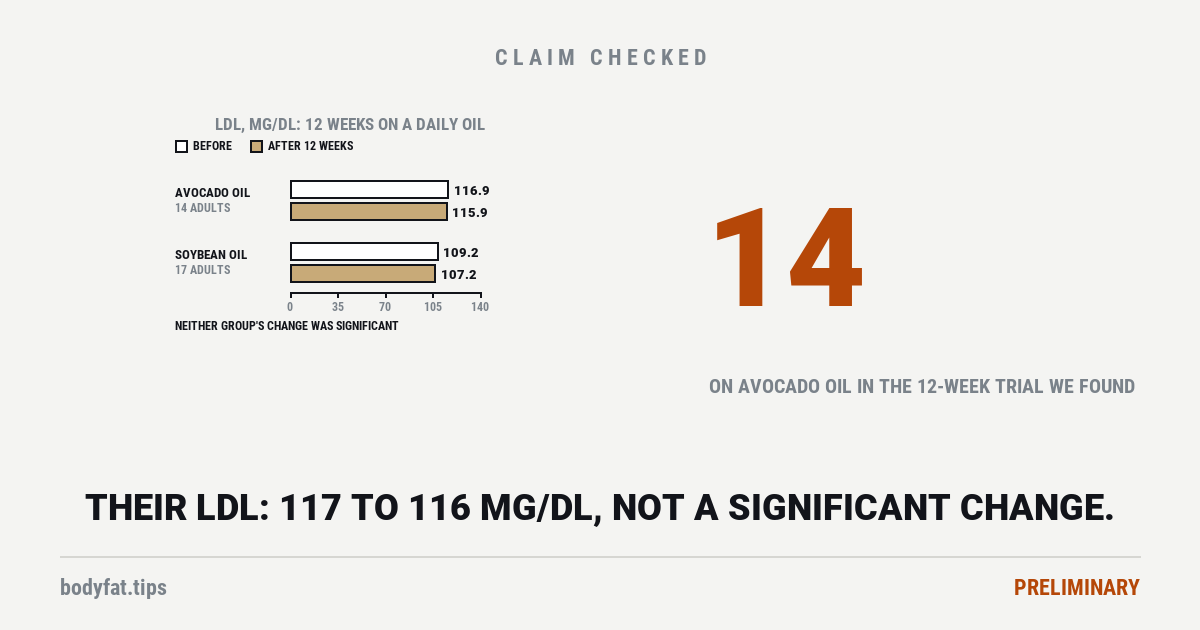
The second ran for 12 weeks. In a 2023 Brazilian trial, 31 adults with obesity and the metabolic syndrome, a cluster of a large waist, raised blood pressure, blood sugar and blood fats, took a small vial of oil a day: 14 got avocado oil and 17 got soybean oil, about two teaspoons (10 mL), with no other change to their diets [5]. Neither side knew which oil it had. On avocado oil, LDL went from 116.9 to 115.9 mg/dL and triglycerides from 177.8 to 182.2; on soybean oil, LDL went from 109.2 to 107.2 and triglycerides from 156.0 to 142.2 [5]. The paper reports none of these changes as statistically significant, in either group; it tested each group’s change from the start, not the difference between the groups [5]. Its authors point to the uncontrolled diets, the many medicines their patients took, the length and the small dose [5].
One detail in that trial matters more than its authors made of it. They measured the fat in their own avocado oil: 48.7% monounsaturated and 40.9% polyunsaturated [5]. USDA’s figure for the polyunsaturated share of avocado oil is 13.5% [2], so the trial’s oil carried about three times as much, by our arithmetic. The paper does not comment on it, and we cannot tell what was in the vials. The market tests below are why the question is worth asking.
Avocado oil has also been given daily to children, in a randomised trial in Mexico, as a comparison rather than as the thing being tested. There, 97 children aged 8 to 17 with obesity and insulin resistance, in which the body needs more insulin than normal to handle blood sugar, were analysed after three months on capsules of fish-oil fats, avocado oil, or both [8]. The avocado-oil dose was 1.8 grams a day, less than half a teaspoon; there was no group without a capsule, the groups did not differ clearly from each other on insulin or body size, and this report did not include blood fats [8].
What would the oil be expected to do? A network meta-analysis, a method that ranks many options at once by linking up trials that each compared two of them, put 54 trials of 13 oils and fats together in 2018 [9]. Olive oil in place of butter, for each tenth of the day’s calories, about a tablespoon and a half of oil on a 2,000-calorie day by our arithmetic, left LDL about 10 mg/dL lower (0.25 mmol/L) [9]. The confidence interval, the range the true average probably sits in, ran from about 6 to 14 mg/dL, our conversion; it is a range for an average across trials, not a forecast for any one person [9]. The authors flag that, for butter against olive oil, the direct and indirect trial evidence did not fully agree [9]. Avocado oil was not one of the 13 fats [9]. That its fat would do roughly what olive oil’s does is a prediction from its make-up, and we label it as one.
A trial built to test the oil properly is under way. Registered in April 2026, it plans to feed 54 adults with raised cholesterol four tablespoons a day of avocado oil and, in turn, of corn oil, in yogurt, rolls and muffins, for 21 days each, with neither the participants nor the researchers told which is which [10]. Its main measure is non-HDL cholesterol, everything on the test except HDL [10]. A food company whose brands include a leading corn oil is its listed collaborator, and its record, last updated in April, still listed it as recruiting when we read it on 20 October 2026 [10]. It is the first trial we found that feeds avocado oil on its own, as part of a controlled diet, for weeks at a time, to measure cholesterol [7].
One effect of eating avocado oil has been measured in people, and it is not special to avocado oil: fat in a meal helps the body absorb carotenoids, the yellow and orange pigments in vegetables. Our lycopene verdict reads those studies, which used corn, canola, olive and avocado oil.
Is avocado good for you?
The fruit has better trials than the oil, and one of them separates the two. In a 2015 trial, 45 adults with overweight ate three diets for five weeks each, in turn: one lower in fat, and two moderate-fat diets with the same fats, one built around an avocado a day and one using high-oleic sunflower and canola oils to match the avocado’s fatty acids [11]. LDL fell 13.5 mg/dL from the start on the avocado diet, 8.3 on the matched-oil diet and 7.4 on the lower-fat diet, and the avocado’s extra fall was statistically clear [11]. An avocado industry board paid for it, alongside US government grants [11].
A larger, looser test came later. In a 2022 trial, 1,008 American adults with a large waist were assigned an avocado a day or their usual diet for six months [12]. Belly fat, the trial’s main measure, did not differ significantly between the groups; LDL ended 2.5 mg/dL lower in the avocado group, with a range from 0.1 to 4.8, a result the paper calls nominally significant because it was one of many measures checked without adjusting for how many [12]. Its authors say the LDL difference lines up with the difference in fibre, about 3.3 grams of the soluble kind in each fruit, and add that changes in gut bacteria and the fruit’s plant sterols, plant compounds built much like cholesterol, may also have played a part [12]. The same industry board sponsored it [12].
Neither trial tested avocado oil. The oil carries none of the fruit’s fibre, in USDA’s data [2], though it does carry plant sterols: the avocado oils in the 2020 market tests below contained them [6]. And in the 2015 trial the fruit did more than oils matched to its fat [11]. The section below on the oil and the fruit comes back to this.
Is avocado oil good for frying?
It is a sound frying oil. The claim that it is the safest, with the highest smoke point, is not what the measurements showed. The smoke point is the temperature at which an oil starts to give off a steady stream of smoke. Sellers put avocado oil’s at “about 520°F (271°C) for refined avocado oil”, or at 470°F to 500°F, and one brand’s blog puts the virgin oil at 350°F [1].
A 2024 study by researchers at two Spanish public research institutes and a Mexican technological institute measured it, by the standard method of the American Oil Chemists’ Society, and then fried potatoes in each oil, nine batches at 356°F (180°C) [3]. By its authors’ account it was the first study to fry food in avocado oil [3].
| Oil | Smoke point | Breakdown products after 9 fryings |
|---|---|---|
| High-oleic sunflower oil | 451°F (233°C) | 9.9% |
| Virgin avocado oil | 480°F (249°C) | 11.4% |
| Virgin olive oil | 370°F (188°C) | 18.5% |
| Minimally refined avocado oil | 414°F (212°C) | 19.7% |
| Refined avocado oil | 428°F (220°C) | 23.9% |
| Sunflower oil, the ordinary kind | 453°F (234°C) | 25.1% |
Three things stand out. The virgin avocado oil had the highest smoke point, 480°F (249°C), and the refined avocado oil, the kind sold for high heat, one of the lowest, 428°F (220°C), below both sunflower oils [3]. That is the reverse of the order the brand’s blog gives [1]. In the fryer, high-oleic sunflower oil held up best, virgin avocado oil next, and refined avocado oil ended close to the 25% limit, just ahead of ordinary sunflower oil [3]. And the virgin olive oil, with the lowest smoke point of the six, 370°F (188°C), held up better than the refined avocado oil [3]. The authors credit vitamin E and other minor compounds that refining strips out [3]. Each figure comes from one product of each oil.
A second laboratory has measured avocado oil’s smoke point beside seed oils. In a 2018 study it heated ten oils bought in Australian supermarkets, without food: once up to 464°F (240°C) over about 20 minutes, and once at 356°F (180°C) for six hours [13]. Its avocado oil, which the paper’s methods do not grade but its text groups with the virgin oils, as “only produced with mechanical processes”, smoked at 386°F (197°C), below the sunflower, canola, grapeseed, rice bran and high-oleic peanut oils beside it, which smoked at 439°F to 514°F (226°C to 268°C) [13]. So on virgin avocado oil the two smoke-point studies disagree: in 2024 it had the highest smoke point of six oils, 480°F (249°C), and in 2018 it smoked below every seed oil it was tested beside [3] [13]. Yet, averaged over the 2018 study’s two heating tests, it ended with fewer breakdown products, 11.6%, than the sunflower, rice bran, grapeseed and canola oils, 14.4% to 22.4%, and slightly more than the peanut oil’s 10.7% [13]. Not every measure favoured it. In a standard test of how long an oil holds out against reacting with oxygen at 230°F (110°C), it lasted about 10 hours, behind the canola, rice bran and peanut oils and ahead of the sunflower and grapeseed, and the paper puts it among the four oils with the lowest such values after six hours of heating [13]. The authors conclude that smoke point “does not predict oil performance when heated” [13]. All three authors work at a laboratory that belongs to a company that calls itself the market leader in Australia’s olive industry and sells extra virgin olive oil under its own brands; in May 2018, the month the paper appeared, the company’s website already listed the laboratory among its brands [13]. So this is an olive-oil producer’s laboratory testing its own kind of oil against its rivals, and the extra virgin olive oil in the test came out best [13]. The paper carries no funding or conflict-of-interest statement, and the journal it appeared in is not indexed in PubMed [13]. That journal’s publisher is on a list of potentially predatory publishers, those suspected of charging authors to publish without the checks a journal is supposed to make: the list, an online continuation of one a librarian compiled, adds it to the publishers that “may be predatory”. That is the list’s description of the publisher, not a finding about this paper [13].
Smoke point is not the whole story because it measures something else. A 2025 study of 48 virgin olive oils found the smoke point is still judged by eye and depends mostly on free fatty acids, fat that has broken loose from its molecule as the oil ages or is badly handled, which its authors say limits its use for choosing a frying oil [14]. A refined oil has fewer of those and smokes later; that says little about how fast its fat breaks down in the pan. It may also be why the two studies above disagree on virgin avocado oil: the 2018 one carried more free fatty acids than the 2024 one, 0.38% against 0.10% [13] [3]; that the difference explains the gap is our reading, not either paper’s.
The breakdown products are what matter for health, and one study measured a class of them, aldehydes, reactive compounds formed when fats oxidise, that is, react with oxygen. Heated at 356°F (180°C) for up to 90 minutes, soybean and corn oils produced the most; olive oils and the one avocado oil were “much more resistant”, though the avocado oil was among the higher producers of one class of aldehydes, and was the only oil to form three other classes before the 60-minute mark [15]. A foundation that promotes diets built on animal fats part-funded that study [15]. Our vegetable oil verdict covers the little that has been measured in people who ate food made with reheated oil.
Is 100% pure avocado oil good for you?
The question behind this one is whether the bottle holds what the label says, and for avocado oil sold in the United States the answer has often been no. In 2020 a University of California, Davis lab tested 22 samples from six grocery stores and two online sellers, aiming to cover all the major brands and kinds [6]. Most were oxidised, gone stale, before the date on the bottle, 15 of the 22 by the university’s count [6]. Three, two labelled extra virgin and one labelled “pure”, were at or near 100% soybean oil [6]. Three more had fat and plant-sterol profiles outside the range of the pure samples, which the authors say could come from natural variation in the fruit, from processing, or from mixing with high-oleic sunflower or safflower oil [6]. The university’s news release counted all six as mixed with other oils, and put it as at least 82% of the samples stale or mixed [6].
The same lab came back twice. Of 36 store-brand avocado oils from 19 retailers in the US and Canada, 31% were pure and 36% were of the quality their labels claimed; low prices went with adulteration, but high prices did not guarantee purity [16]. And of 54 chips, mayonnaises and dressings bought in 2025 and 2026 and labelled as made with avocado oil, 48 contained other oils, against one failure among 20 foods made with olive oil [17]. We read that 2026 study only through the university’s news release [17].
There is now an international yardstick. In November 2024 the Codex Alimentarius Commission, the food-standards body run by two United Nations agencies, added avocado oil to its standard for named vegetable oils [18]. The producers’ trade association, responding to the 2026 study, called the standard “a voluntary reference standard, not binding legislation”, set on a limited dataset, and said a result outside its ranges should not by itself be taken as adulteration [19]. That is a fair point about natural variation, and it does not touch the bottles that were close to 100% soybean oil.
A university lab in Mexico, working separately, found the same kind of trouble in oils sold there. Of 25 avocado oils it bought in Mexico, all but two in supermarkets, and tested in 2021 and 2023, 10 met every fatty-acid limit in Mexico’s standard and the Codex one [20]. Mexico’s limits are the stricter of the two for some fatty acids, so a miss is not always another oil; but the oils sold as pure that missed two or more limits grouped, in the lab’s statistical analysis, with declared blends containing canola or safflower oil [20]. A national association of Mexico’s edible oil and fat manufacturers part-funded the work [20].
What does this mean for your health? Soybean oil in an avocado-oil bottle is above all a fraud on your wallet; what seed oils do to health has its own verdict. A stale oil tastes and smells off, “sort of like play dough”, in the university’s words, and its advice is to buy a size you will finish and keep it away from heat and light [6]. What eating stale oil does over years was not measured in any of these studies.
Is avocado oil good for joint pain?
The joint-pain studies are not of the cooking oil. They test avocado-soybean unsaponifiables, a supplement made from the small fraction of avocado and soybean oils that does not turn to soap when treated with lye. A 2019 pooling of trials against a placebo, a dummy pill, reported pain about 10 points lower on a 100-point scale overall, with the benefit in the knee and not the hip, and results that varied widely between trials [21]. We read it as its abstract. We found no trial of the cooking oil itself for joint pain [7], and this page rates neither.
Is avocado oil good for weight loss?
Not on any evidence we found. A tablespoon of avocado oil carries about 124 calories, the same as other oils, by our arithmetic from USDA’s figures [2]. In the 12-week trial, weight went up about 1.3 lb (0.60 kg) on avocado oil and 1.4 lb (0.62 kg) on soybean oil, changes the paper reports as not significant [5]. In the children’s trial, body-mass scores fell in all three groups, with no significant difference between them [8]. Neither trial was built to test weight loss.
Who these studies were done on
The 12-week trial was 31 Brazilian adults aged 30 to 60 with obesity and the metabolic syndrome, 27 of them women [5]. The meal study was 13 adults with overweight averaging 65, in Sweden [4]. The children’s trial was Mexican children aged 8 to 17 with obesity [8]. The fruit trials were 45 American adults with overweight aged 21 to 70 [11] and 1,008 American adults with a large waist, 72% of them women, averaging 50 [12]. The frying and purity studies tested oils, not people.
So read yourself against them. If you are swapping butter for an oil, the trials of oils like this one found LDL lower on the oil than on butter, and avocado oil’s own trials are too small to say whether it does better or worse than olive oil. If your LDL is high, which fat to cook with, and whether you need a drug, belongs with a clinician or dietitian who knows your numbers; the foods that lower cholesterol have their own verdict.
Is avocado oil the good part of the avocado?
This section is the desk’s own reasoning, and it is labelled as such. The fruit has the better trials; the oil gets the marketing. Here are three ways to fit the evidence on this page together, each rated.
Answer one: the oil is the avocado’s fat, and fat was only part of what the fruit did. In the 2015 trial an avocado a day lowered LDL by 13.5 mg/dL and oils matched to its fat by 8.3 [11]. The 2022 trial’s authors tied their smaller fall first to fibre [12], and the oil carries none of it [2]; they also named the fruit’s plant sterols, which the oil does carry [12] [6]. That the fruit beat oils matched to its fat is measured, in one trial of 45 people paid for by an avocado industry board; that the difference is what the bottle leaves out is a surmise.
Answer two: the fat should do roughly what olive oil’s does. The two fats are close [2], and olive oil in place of butter left LDL about 10 mg/dL lower in a pooling of trials [9]. That is arithmetic from other oils, not a measurement of avocado oil, and the one 12-week trial of avocado oil did not show a significant fall, though it replaced nothing in the diet and gave two teaspoons a day [5].
Answer three: the bottle may not be avocado oil. The 12-week trial’s own oil measured 40.9% polyunsaturated fat, about three times USDA’s figure [5] [2], and the market surveys found seed oil in many bottles [6] [16]. If the oil in a trial, or a kitchen, is partly something else, its result says less about avocado oil. That the trial’s oil was unusual is measured; that it was blended is a hunch, and the paper does not say.
Put the three together and here is what we think is true, stated plainly so you can disagree with it: avocado oil is a good cooking fat in place of butter, about as good as the olive oil it resembles, and no way to bottle an avocado’s benefits.
What we could not find, and would like to: a trial that fed people avocado oil checked for purity, against butter or olive oil, for long enough to move LDL. The nearest is the trial registered in April 2026, which is designed to set avocado oil against corn oil, a polyunsaturated oil, for three weeks each [10]. If you know of the trial we describe, the corrections line on this site is open.
Where “heart-healthy, and safest for high heat” came from
The evidence the oil leans on began with the fruit. In 1994 a Mexican trial fed 12 women with type 2 diabetes a diet high in monounsaturated fat, from avocado and olive oil, for four weeks, and their triglycerides fell 20%, against 7% on a high-carbohydrate diet [22]. We read it as its abstract.
Twenty years later a rat study of avocado oil cited that trial, with two Mexican trials of avocado-rich diets, as “a diet supplemented with avocado oil for 30 days” [23]. By their abstracts, none of the three gave people avocado oil on its own, and one lasted seven days [23] [22]. The rats themselves did show lower LDL on avocado oil, much as they did on olive oil [23]. We could not trace who first called avocado oil heart-healthy; this is one documented place where the fruit’s evidence became the oil’s.
Then it spread, mostly through the kitchen. Ask Google whether avocado oil is good for you and the pages it returns include a health publisher’s comparison with olive oil that gives avocado oil a smoke point “of around 520 degrees” and calls it better for high-heat cooking, and a small-batch oil seller that says other oils break down past their smoke point and avocado oil does not [1]. A nutrition-testing company’s page in the same results says, rightly, that very little research in humans exists [1].
And it sells. The brand blog’s line, the safest oil for high heat, sits on a page that sends readers to its store locator [1]. On the shelf, “made with avocado oil” now sells chips, mayonnaise and dressings, and in the 2026 tests 48 of 54 such products contained other oils [17].
None of this is aimed at anyone who cooks with avocado oil. It is a reasonable oil, and in place of butter it is probably a better one. It is the sellers’ superlatives, the safest, the highest, the healthiest, that the measurements did not support, and the bottles that were not what they said.
What this is rated, and what the rating covers
Preliminary — for the claim that avocado oil is good for your heart, read as it is sold: that it improves your cholesterol.
It is rated Preliminary because the evidence in its favour is early, small and conflicting. A meal study of 13 adults, read as its abstract and figures, found better blood fats after a breakfast made with avocado oil than with butter [4]; rats given it had lower LDL [23]; and its fat make-up predicts what olive oil does in place of butter [2] [9]. Against that, the one 12-week trial we found, in 31 adults, found no significant change in cholesterol on avocado oil or on the soybean oil it was set against [5]. It is not rated Unsupported because that trial was small, changed nothing else in the diet, gave two teaspoons a day and used an oil whose make-up was unusual; it is not rated Supported because the oil itself has not been shown to do what its make-up predicts.
Each part, rated alone, in words. That avocado oil in place of butter lowers LDL: Preliminary, and the strongest case on this page: it is what the trials of olive oil, the oil it most resembles, found [9], and of the trials we found, only the meal study set avocado oil itself against butter [4].
That it is as good for you as olive oil: Preliminary. Their fats are close [2], and the evidence behind olive oil was gathered with olive oil.
That it is better for you than olive oil: Unsupported, of the untested kind: no trial we found has compared them in people, and nothing tested points that way [7].
That it is the safest oil for high-heat cooking, with the highest smoke point: Unsupported, of the tested kind. Measured, refined avocado oil smoked at a lower temperature than both sunflower oils, and in the fryer it held up less well than high-oleic sunflower, virgin olive or virgin avocado oil [3]. The virgin kind had the highest smoke point of the six in that study, but in a second study an avocado oil the paper groups with the virgin oils smoked below every seed oil it was tested beside, so on the virgin oil’s smoke point the two studies disagree [3] [13].
That avocado oil holds up under heat better than polyunsaturated seed oils: Preliminary. Three laboratory studies we read in full, one product of each oil in each, mostly point that way: in the fryer, the virgin oil well ahead of sunflower oil and the refined kind barely ahead; heated without food, an avocado oil the paper groups with the virgin oils formed fewer breakdown products than four seed oils richer in polyunsaturated fat, though in a standard oxidation test it lasted less long than the canola and rice bran oils; and in the third, the avocado oil formed fewer aldehydes overall than soybean and corn oils, though it formed some kinds sooner [3] [13] [15]. Two more, which we read only as abstracts, are mixed [7]. Single products, mixed secondary measures and a second study run by an olive-oil producer’s laboratory are why it goes no higher.
That a bottle labelled avocado oil in the US may be stale or partly another oil: Supported, in two surveys of bottles by one university lab, with its third survey, of foods made with avocado oil, pointing the same way, with a separate lab’s survey of oils sold in Mexico pointing to the same kind of mixing, and with the producers’ trade association disputing how the limits were set [6] [16] [17] [19] [20].
What is not rated here: joint pain, where the trials tested a supplement, not the oil; avocado oil on the skin, which we did not review; weight loss, which no trial we found was built to test; the avocado fruit; how avocado oil compares with canola or palm oil, which have their own verdicts, as does saturated fat; and the frame above, which is this desk’s reasoning from the evidence rather than a result the evidence delivered. It is marked as ours so that you can weigh it as ours.
This is journalism, not medical advice. If you are managing high cholesterol, what you cook with, and whether you need a drug, belongs with a clinician or dietitian who knows your numbers. How we read a study, and what each tier means, is set out here.
- Does Caffeine Stunt Your Growth? The Warning Was Selling a Coffee Substitute in 1900, and the Tests Since Do Not Back It
unsupported - Is Palm Oil Bad for You? Against Liquid Oils It Raised LDL About 9 mg/dL in 26 Trials. The Cancer Worry Rests on Animal Studies.
supported - Does Caffeine Dehydrate You? Not at Ordinary Intakes: in Trials, Coffee and Tea Hydrated About as Well as Water. The Extra Urine Shows Up at Big Doses.
unsupported