How Much Protein Is Too Much? At About Twice the Recommended Amount, for Up to Two Years, Trials Found No Consistent Sign of Damage to Healthy Kidneys

“It is important to note that consuming too much protein can also have negative health effects.” That line sits under a 47-second short called “This is the minimum protein you need..”, posted on 12 June 2023 by a physicians’ explainer channel run by two orthopaedic surgeons, with guest specialists. It had 7,306,607 views when we read its numbers on 10 October 2026 [1]. The description does not say what the negative effects are. It gives the recommended amount, 0.8 g of protein per kilogram of body weight, says athletes may need more, and suggests asking a healthcare professional [1].
We read the description, not the video, so what is said on camera is not what this page checks. The question it leaves open is one a lot of people type into a search box: “how much protein is too much” is searched about 8,100 times a month in the United States, and “is high protein bad for kidneys” about 720 times a month (from a paid keyword database, pulled 10 October 2026) [2].
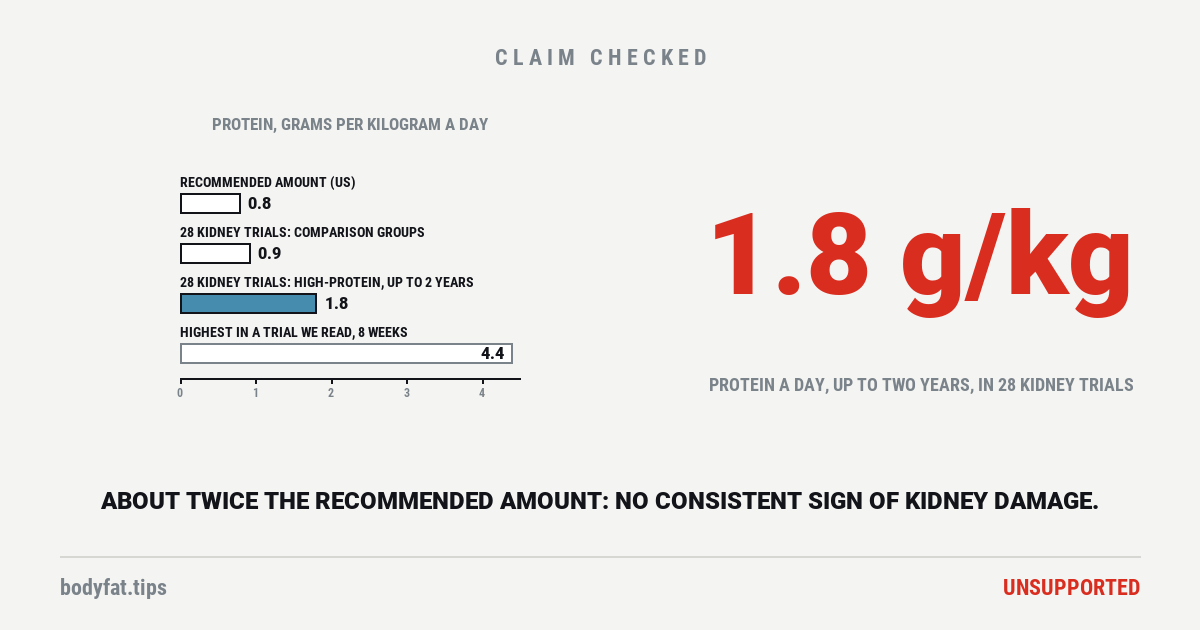
For adults whose kidneys are healthy, the trials have not found that eating about twice the recommended amount of protein, for up to two years, damages them. In 28 randomised trials, people without kidney disease ate on average 1.8 g of protein per kilogram a day against 0.9 g, about twice as much, for between four days and two years; their kidney filtration rose a little, as it does after any big protein meal, and no consistent sign of damage appeared [3]. For someone who weighs 180 lb, 1.8 g per kilogram is about 147 g a day, by our arithmetic.
There is no official upper limit. The US expert panel that sets nutrient targets found no intake level at which harm from protein could be identified, and put the acceptable range at 10 to 35% of calories [4]. Europe’s food-safety authority set no limit either, and calls twice its reference intake safe [5]. Trouble is documented at the far end, at about 45% of calories as protein, the kind of diet you get from lean meat with no fat [5]. And kidneys that are already damaged are a different question: the international kidney guideline advises people with chronic kidney disease to stay near 0.8 g per kilogram and to avoid more than 1.3 g [6].
This is journalism, not medical advice. If you have kidney disease, diabetes, a kidney transplant or only one kidney, or you are pregnant, take your protein target from a clinician who knows you, not from this page.
| Reference point | Per kilogram | At 180 lb (81.6 kg) |
|---|---|---|
| US recommended amount for adults [4] | 0.8 g | about 65 g |
| Europe: twice its reference intake, “safe” [5] | 1.66 g | about 136 g |
| US guidelines’ goal, January 2026 [7] | 1.2 to 1.6 g | about 98 to 131 g |
| High-protein groups in 28 kidney trials, on average [3] | 1.8 g | about 147 g |
| Kidney guideline’s ceiling for people with kidney disease at risk of getting worse [6] | 1.3 g | about 106 g |
| Highest intake in any trial we read: eight weeks, young people who lift [8] | 4.4 g | about 359 g |
Does too much protein damage your kidneys?
Start with what protein does to a kidney, because it is real and it is where the worry comes from. The kidneys clear the waste left when protein is broken down, and after a big protein load they filter faster. The speed is called the glomerular filtration rate, or GFR: how much blood the kidneys clean each minute. The worry, as the reviewers of the trials describe it, is that years of filtering harder, which they call hyperfiltration, might wear the kidneys out [3].
So the trials asked it directly. A 2018 review pooled 28 randomised trials and 1,358 adults without kidney disease. They were aged 23 to 72, averaging 49. The trials’ average body mass index, weight against height, was 31, in the range called obesity, and by our count of the review’s table about 1,260 of the 1,358 were in trials whose average was 25 or more; a few trials were of lean young adults, and some included people with type 2 diabetes or high blood pressure [3]. The high-protein groups ate 1.81 g per kilogram a day on average and the comparison groups 0.93 g [3].
At the end of the diets, filtration was a little higher in the high-protein groups: a standardised mean difference of 0.19 [3]. That is a way of putting trials that measured filtration in different units onto one scale; on the scale these authors used, 0.2 is small and 0.6 moderate [3]. But comparing only the end points can mislead when the groups started at different levels, and in 6 of the 19 trials that reported a starting value they did differ by more than 5% [3]. Measured as the change from the start, in the 18 trials the review could compare that way (its discussion counts 19 with a starting value), the difference was 0.11, with a confidence interval, the range the true average probably sits in, from −0.05 to 0.27 [3]. Because that range includes zero, no difference at all is still possible; the result was not statistically significant. In the trials that ran longer than 24 weeks it was 0.07, from −0.10 to 0.24 [3].
Filtration speed is not damage, so the reviewers looked for a damage sign too. Albumin, a protein that leaks into the urine when the kidney’s filters are hurt, was reported by 8 of the trials; one found it rose on the high-protein diet, a week-long trial in 24 men eating 2.4 g per kilogram [3]. The review rates its own certainty low to very low on GRADE, a standard system for rating how far evidence can be trusted, citing poor reporting of how the trials assigned people, unexplained differences between trials and imprecision [3].
Before printing that 28-trial result we looked for the biggest trial in it. It is a two-year American trial of 307 adults with obesity, mostly women, which set the plan in a best-selling low-carbohydrate diet book, Dr. Atkins’ New Diet Revolution, with unlimited fat and protein, against a low-fat diet; it is about 23% of the people in the review, by our arithmetic [3] [9]. On the high-protein plan, a kidney filtration measure called creatinine clearance was higher at 3 and 12 months, and blood urea, the waste from protein, was higher throughout; albumin in the urine showed “no differential effects” between the diets, in the authors’ words [9]. The authors found the diet “was not associated with noticeably harmful effects on GFR, albuminuria, or fluid and electrolyte balance” [9]. Two cautions they give themselves: by two years only half the people still had blood results, and the paper gives no figure for how much protein anyone ate, listing the lack of a measured marker of who stuck to the diets as a limitation [9].
The newest pooling, published in 2026 and searched to May of that year, gathered 22 randomised trials [10]. Filtration came out higher on high-protein diets, by 0.39 on the same kind of scale, from 0.09 to 0.69, in 20 trials and 1,478 people; the trials varied a lot, with an I-squared of 75%, which means about three-quarters of the spread between their results is more than chance would produce [10]. Creatinine in the blood, the usual kidney test, did not change significantly, in 19 trials [10]. The authors read the rise in filtration as most likely “short-term hemodynamic adaptations”, the kidney’s blood flow adjusting, and warn that their evidence “does not permit definitive conclusions regarding long-term renal safety” [10]. The biggest trial in their table is 419 people with type 2 diabetes followed for two years [10]; by six months, its two groups’ reported protein differed by only 1.1% of calories [11], so the biggest trial in it barely tested more protein.
Two older poolings point the same way and read it differently. A 2014 pooling of 30 studies found filtration higher by 7.18 ml a minute in the 21 that measured it, 1,599 people, with higher blood urea and more calcium in the urine in the smaller numbers that measured those, and its authors advised caution with high-protein weight-loss diets, “especially from animal sources” [12]. The 2018 review above faulted it for comparing only end values and for including acute studies “as short as 1 d” [3], though the 2014 paper’s own rules required at least a week, and it gives its trials as running one week to 24 months [12]. A 2018 review paid for by the US beef industry’s checkoff programme found that 8 of 13 trials reported significantly higher filtration on more protein, all within the normal range [13]. And a 2023 review of reviews for the German Nutrition Society concluded that for none of the kidney outcomes was there evidence that more protein “does specifically trigger kidney stones or diseases”, adding that “long-term data, also over decades, are required” [14].
One more thing about the test itself. The usual estimate of filtration is worked out from creatinine in the blood, and creatinine comes partly from muscle and partly from cooked meat [9]. So a diet rich in meat can move the number without the kidney changing, which is why the 2026 reviewers say their rise may partly reflect the diet rather than the kidney [10]. The same trap, a test moved by what you eat rather than by the kidney, is behind the creatine kidney scare.
What if your kidneys are not healthy?
Here the answer changes, and the two groups must not be mixed. In a study of 1,624 American nurses followed for 11 years, eating more protein was not significantly linked with the change in kidney function in women whose kidneys worked normally [15]. In women whose kidneys were already mildly impaired, each extra 10 g of protein a day went with a faster fall, by 1.69 ml a minute over the 11 years, and non-dairy animal protein showed the same pattern [15]. A 2026 Israeli study of 1,441 adults with stage 3 or 4 kidney disease measured protein from their urine rather than asking them; in 265 matched pairs, those eating under 1.0 g per kilogram had a 23% lower risk of losing half their kidney function, starting dialysis or dying (0.77, from 0.62 to 0.97), mostly from fewer dialysis starts [16]. It looked back at records, so it shows an association, not a cause [16].
The international kidney guideline, published in 2024, suggests that adults with chronic kidney disease from stage 3 on keep their protein at 0.8 g per kilogram a day, a level-2 suggestion, the softer of its two grades, resting on low-certainty evidence, and advises avoiding more than 1.3 g in people whose disease is at risk of getting worse [6]. It notes that most adults already eat more than recommended, about 1.2 g per kilogram on average [6]. That advice is for damaged kidneys. It is not evidence that healthy kidneys are harmed, and the healthy-kidney trials are not evidence that damaged kidneys are safe. The 2018 review’s subgroup of people with type 2 diabetes found no significant difference in filtration either, but people with diabetic kidney damage were not in it [3]. Soy-based diets in kidney disease are covered on our whey and plant protein page.
What do long studies of ordinary eaters show?
A cohort follows people as they live and records what they eat; nobody is assigned anything. It can show that people who eat more protein get more or less kidney disease. It cannot rule out that something else about them does the work.
A 2025 pooling of eight cohorts and 97,584 people found no clear link between total protein and getting chronic kidney disease: a relative risk, the chance in the highest eaters divided by the chance in the lowest, of 0.95, from 0.75 to 1.19, which its authors grade as low certainty [17]. Higher animal protein and higher plant protein both went with somewhat less kidney disease, 0.87 and 0.81 [17]. The foods split inside that: in one of its cohorts, 11,952 American adults followed for a median of 23 years, the fifth eating the most red and processed meat had 23% more kidney disease than the fifth eating the least, from 6% to 42% more, while nuts, legumes and low-fat dairy went with less [18].
Before printing that pooled figure we looked for the biggest cohort in it. It is the Singapore Chinese Health Study: 60,198 of the 97,584 people, about 62%, by our arithmetic from the pooling’s own table [17]. It counted end-stage kidney failure, from a national registry, over an average of 15.5 years, and it leaned the other way. Against the quarter eating the least protein, the other three quarters together had 24% more kidney failure, from 5% to 46% more; the top quarter alone, the comparison the pooling used, had 19% more, from 2% less to 44% more, and the rise from quarter to quarter was not statistically significant [19]. Red meat, nearly all of it pork in this population, stood out: the quarter eating the most had 40% more kidney failure, from 15% to 71% more, while poultry, fish, eggs and dairy showed no link [19]. One other study in the pooling pointed the same way, and it is not a study of people in general: a case-control analysis inside a cohort of low-income Black and white adults in the US South, which compared 1,057 people with kidney failure with 3,198 without. Their top quarter of protein, counted per kilogram of body weight, went with higher odds of kidney failure in the paper’s fully adjusted model (1.76, from 1.17 to 2.65), though not clearly in its simplest one (1.11, from 0.89 to 1.38); its authors place the link among Black adults with diabetes, in a population they describe as carrying a high burden of risk factors for kidney disease [17] [20]. A Korean and a Japanese cohort found less kidney disease in their highest eaters, and the rest no clear link [17]. The pooling also holds the nurses’ study above and the later of the two Korean analyses below [17], so those are not separate evidence beside it.
A second pooling, published in 2024 and searched to December 2023, did not include the Singapore cohort and found the opposite for total protein: the highest eaters had 18% less kidney disease (0.82, from 0.71 to 0.94) [21]. That figure comes from five cohort reports and 30,242 people, by our sum of its table, not the 148,051 in the review as a whole, most of whom are in one British cohort it counted for plant protein only; four of the five reports are also in the 2025 pooling, and the fifth is a second report from one of those, a cohort in Tehran [21]. The two poolings share most of their cohorts, so they are not two independent results. Read together, the cohorts point both ways.
One more disagreement is worth spelling out. In a Korean community cohort of 9,226 people, the quarter eating the most protein had a 32% higher risk of a fast fall in kidney function than the quarter eating the least, from 2% to 73% higher, and the link appeared only in people whose kidneys were already filtering unusually fast [22]. Its authors conclude that a high-protein diet “has a deleterious effect on renal function in the general population” [22]. A later analysis of the same community cohort, 7,339 people, one of the cohorts in both poolings above, found the opposite for a different outcome: those eating more than 1.3 g per kilogram were 37% less likely to develop kidney disease than those eating 0.8 to 1.3 g [23]. The two analyses draw on the same study, so their people overlap and neither is a replication of the other, in either direction.
A 2026 Norwegian study did what the other cohorts here did not: it measured filtration directly, with a tracer cleared by the kidneys, again and again over a median of 10 years, in 1,324 adults who were 50 to 62 and free of diabetes, kidney and heart disease when the study enrolled them, averaging 64 in this analysis, half of them women [24]. They ate 1.2 g of protein per kilogram a day on average, the top quarter 1.4 g or more. Protein was not linked with how fast filtration fell: −0.01 ml a minute a year for each extra 0.1 g per kilogram, from −0.04 to 0.02 [24]. That is the general population at ordinary intakes, not people eating 2 g or more.
Does a lot of protein weaken bones or cause kidney stones?
The bone worry starts with a measured fact: more protein puts more calcium in the urine. The 2014 pooling found about 25 mg more a day [12], and in the two-year trial it was about 36% higher at 3 and 12 months [9]. The fear was that the calcium came out of the bones. The trials did not find it. A 2017 review of 16 randomised trials and 20 cohorts found no adverse effect of higher protein on bone; at the lower spine, bone density came out 0.52% higher, from 0.06 to 0.97%, in five trials, with no clear effect elsewhere [25]. A 2019 review found no clear link between protein and fractures in cohorts (0.94, from 0.72 to 1.23), within intakes of about 0.8 to 1.3 g per kilogram [26]. In the two-year trial the extra urinary calcium came, in its authors’ words, “without changes in bone density” [9]. The cohorts in the 2019 review ate about 0.8 to 1.3 g per kilogram, so they say little about bone at 2 g and above [26].
Stones next. The German review of reviews found the cohorts on total protein showed no clear link with kidney stones: 1.04, from 0.92 to 1.18, in two cohorts and 154,221 people [14]. Protein from meat, fish and eggs rather than dairy went with 11% more stones, from 3% to 20% more, in two cohorts, and dairy protein with 9% fewer [14]. In the two-year trial, the extra urinary calcium came with no new kidney stones showing up clinically [9]. If you have had stones, the advice is different and belongs to your clinician; the diet trial that cut repeat stones by changing calcium, salt and animal protein together is on our calcium page.
Is a high-protein diet bad for your heart?
The trials of high-protein diets, their 2026 reviewers say, are too short and were not designed to count heart attacks, and that their own findings “should not be extrapolated to long-term cardiovascular safety” [10]. The beef-funded review concluded that protein above the recommended amount had no adverse effect on blood pressure [13]. For heart deaths the evidence is cohorts. A 2023 pooling found no clear link between a high-protein diet and death from heart disease, 0.94 from 0.60 to 1.46, in six cohorts whose results varied far more than chance would produce (an I-squared of 98%) [27]. A 2020 pooling of 31 cohorts found, in the 8 to 10 cohort reports that counted heart deaths for each kind of protein, that total and animal protein were not significantly linked with them, while plant protein went with 12% fewer [28].
Where the protein comes from matters more than how much, in these studies. In 131,342 American health professionals, each extra 10% of calories from animal protein went with 8% more heart deaths, from 1% to 16% more, and the links with protein source were confined to people with at least one unhealthy habit, such as smoking, heavy drinking, obesity or inactivity [29]. Red and processed meat on their own have their own verdict.
Does eating a lot of protein shorten your life?
The scariest version of the claim came out of a single study. In March 2014 a University of Southern California press release ran under the headline “Meat and cheese may be as bad for you as smoking” and began “That chicken wing you’re eating could be as deadly as a cigarette” [30]. The study behind it followed 6,381 Americans aged 50 and over for 18 years [31]. Across all of them, the amount of protein was not linked with death from any cause, heart disease or cancer, only with deaths from diabetes, which were few: 21 among people who did not have diabetes at the start [31]. The headline came from splitting them by age: among the 3,039 aged 50 to 65, those getting 20% or more of their calories from protein, compared with those getting less than 10%, had a hazard ratio for death of 1.74, from 1.02 to 2.97, a figure that compares how often deaths happened over time, where 1.00 means the same; for cancer deaths it was 4.33 [31]. Among the 3,342 aged 66 and over, the same high intake went with 28% fewer deaths (0.72, from 0.55 to 0.94) [31]. Diet was measured once, by one day’s recall [31].
In the same 2020 pooling, the 21 cohort reports with figures for total protein and deaths from any cause, 480,304 people, showed more total protein going with slightly fewer deaths, not more: 0.94, from 0.89 to 0.99 [28]. The two largest, a cohort spanning 18 countries and the US health professionals above, are each a little over a quarter of those people, together more than half, by our arithmetic [28]. A 2026 pooling of nine cohorts, 1,036,799 people, found that swapping 3 to 5% of calories from animal to plant protein went with 9% fewer deaths [32]. And one signal stands out against animal protein: a 2022 review of the observational poolings found that only one link reached its “highly suggestive” grade, that each extra 5% of calories from animal protein went with 12% more type 2 diabetes, from 8% to 17% more [33]. All of this is cohorts, which can show who dies or gets ill, not what caused it.
Is there an official upper limit for protein?
No. Many nutrients have a tolerable upper intake level, the most you can take daily without likely harm. For protein, the US panel found “no defined intake level at which potential adverse effects of protein was identified”; its upper end of 35% of calories was set to leave room for carbohydrate and fat, not because harm begins there [4]. Europe’s authority wrote that “A UL cannot be derived”, that “in adults an intake of twice the PRI is safe”, its reference intake being 0.83 g per kilogram, and that “Intakes of 3–4 times the PRI have been observed without apparent adverse effects or benefits” [5]. The US guidelines published in January 2026 set a protein goal of 1.2 to 1.6 g per kilogram a day and, in their ten pages, give no upper figure [7].
Where the European opinion does describe harm, it quotes the US report: acute adverse effects reported at 45% of calories or more, and deaths when adults ate such a diet for several weeks [5]. It also quotes the US estimate of how much urea, the waste from protein, a liver can make: for a 70 kg (154 lb) man not used to high-protein eating, the most corresponds to about 250 g of protein a day, or about 40% of calories [5]. Those are the nearest things to a ceiling the official bodies offer.
What is the most protein a trial has tested?
The highest intake in any trial we read was 4.4 g per kilogram a day, about 307 g, for eight weeks, in young people who lift weights [8]. Of 40 who started, 30 finished; three said they could not eat the protein needed and one complained of stomach trouble [8]. The 20 assigned to the high intake ate about 2,835 calories a day against 2,052 in the comparison group, and their weight and body fat did not change significantly [8]. That trial measured body composition, not kidneys.
The longest at very high intakes ran a year: 14 men who lift alternated between their usual diet, already 2.51 g per kilogram, and a higher one, 3.32 g, in blocks of two and four months, logging their food in a phone app [34]. Their blood tests of kidney and liver function showed no harmful changes [34]. Both trials were run by the chief executive of a sports-nutrition society, with protein powder from companies that sponsor it [8] [34]. They are small and short, in young people who lift, mostly men, who were already eating a lot of protein, and they are what “tested at 3 g per kilogram” means. What a 3.4 g per kilogram diet did to lifters’ body composition is on our recomposition page.
Is 100 g, 200 g or 500 g of protein a day too much?
Work it through in pounds. For someone who weighs 180 lb, 100 g a day is about 1.2 g per kilogram, inside the 2026 US goal [7]; for someone who weighs 130 lb it is about 1.7 g, about Europe’s twice-the-reference figure [5]. Neither is high by the standards of the trials.
200 g a day at 180 lb is about 2.4 g per kilogram, by our arithmetic; at 150 lb it is about 2.9 g. That is above the 1.8 g average of the kidney trials, though inside what a few small or short trials have tested, from 2.4 g for a week or a month [3] to about 3.3 g for a year in 14 men [34]. It is also about 800 calories, which is 32% of a 2,500-calorie day and 40% of a 2,000-calorie one, our arithmetic again: at the top of the US range, or over it [4].
500 g a day is about 6.1 g per kilogram at 180 lb and 2,000 calories of protein. That is far above the highest intake in any trial we read [8], twice the US estimate of what a liver can turn into urea [5], and, unless you eat more than about 4,400 calories a day, past the 45% at which acute harm has been reported [5]. By every figure on this page, and this is our judgement, that one is too much.
What are the symptoms of too much protein?
The trials mostly measured blood, not symptoms. What moves in the blood is urea: higher by about 8 to 14% throughout the two-year trial [9] and by 1.75 mmol per litre in the 2014 pooling [12]. That is the expected waste of digesting more protein; the German reviewers read such changes as the body regulating itself, not as disease [14]. The two-year trial also found people made more urine on the high-protein plan, 438 ml a day more at 12 months, about 15 fl oz; its authors suggest the extra waste could trigger thirst, and say that needs confirming [9]. In the 4.4 g trial, the reasons people gave for dropping out were not being able to eat that much, and, in one case, stomach trouble [8]. Its authors add that a few participants complained of stomach trouble and of feeling “hot”, which they reported but did not measure [8].
“Too much protein in the blood” is a different thing. A high total-protein result on a blood test, by the US National Library of Medicine’s account, may be a sign of an infection such as HIV or viral hepatitis, or of a blood cancer, and a high albumin may mean severe dehydration [35]. Eating a lot of protein is not among the causes it lists. An unexpected result is a reason to see a clinician, not to change your diet first.
What happens if you eat too much protein but too few calories?
This is the one place where the trouble is documented, and it is old. In 1913 an Arctic explorer wrote that anyone who had to live for several weeks in winter on lean meat alone “will actually starve”, hungry after every meal however much they ate, and eventually weak or ill; people living on rabbit with nothing else considered themselves starving [36]. The name usually given to it is “rabbit starvation”. The same explorer used it in a 1946 book, as a name already known, for “the extreme fat-hunger” of people living on rabbits, who, the book says, develop diarrhoea “in about a week” without fat from another source [37]. We could not trace who first used it.
In 1928 the same explorer agreed to eat only meat for a year under observation at Bellevue Hospital in New York, starting on lean meat alone. On those first days about 45% of the calories came from protein; “On the 3rd day nausea and diarrhea developed. When fat meat was added to the diet, a full recovery was made in 2 days” [38]. For the rest of the year the meat came with its fat, and protein supplied 15 to 25% of the calories [38]. The doctors wrote that the high share of calories from protein “may have been a factor” [38]. The study was paid for in part by the American meat packers’ trade institute [38].
Ordinary high-protein dieting is not that. In one trial in the 2018 review, 40 young men eating less than they needed ate 2.4 or 1.2 g of protein per kilogram for four weeks, with fat and carbohydrate alongside [3]. What higher protein does for someone eating less is on our protein for weight loss page.
How much protein is too much in one sitting?
You may have read that the body can only use about 30 g at once and wastes the rest. A 2023 trial tested it properly. Thirty-six young men did a whole-body weight workout and then drank a placebo, a dummy drink with no protein, or 25 g or 100 g of milk protein labelled so it could be traced, and were followed for 12 hours [39]. Of the 25 g, 66% had reached the blood by 12 hours; the 100 g was still arriving, 53% by then and not levelling off [39]. About 18% of the 25 g, roughly 4.5 g by our arithmetic, ended up in muscle, against 13 g from the 100 g, and the authors found protein had a “negligible impact” on how much the body burned for fuel [39]. The authors say earlier studies had found 20 to 25 g enough to maximise muscle building after exercise [39]. Their trial was one session, in young men, so it does not say whether one big meal builds as much muscle over months as the same protein spread out [39]. How much a day builds muscle is on our protein for muscle page.
How much protein is too much for a woman, or for a man?
The reference amounts are set per kilogram of body weight, not by sex: 0.8 g for adults, and 1.1 g in pregnancy and while breastfeeding [4]. The kidney trials mixed men and women [3], the two-year trial was mostly women [9], and the highest intakes were tested in young people who lift, most of them men: the 4.4 g group was 9 women and 11 men [8], and the year-long trial was 14 men [34]. Pregnancy is its own case. In the one trial of a high-protein supplement in pregnancy that a 2015 review found, 505 women, babies were 58% more likely to be born small for their age, from 3% to 141% more; the review says such supplements “may be harmful to the fetus” [40]. That is one trial, and it is a reason for any pregnant reader to take protein advice from a clinician.
Who these studies were done on
The kidney trials were mostly middle-aged adults who were overweight or had obesity, some with type 2 diabetes or high blood pressure, none with kidney disease, eating about twice the comparison groups’ protein for weeks to two years [3]. The highest intakes were tested in young people who lift [8] [34]. The cohorts were adults on several continents followed for 3.5 to 32 years [17] [28]. The kidney-disease advice is for people with chronic kidney disease [6].
So read yourself against them. If your kidneys are healthy and you eat up to about twice the recommended amount, the trials were about people like you, for up to two years. If your kidneys are already impaired, or you have diabetes with kidney damage, they were not about you, and your target is a clinician’s call. If you are eating far more than 3 g per kilogram, the longest study we read at those intakes is a year in 14 men [34].
If protein makes the kidneys work harder, why doesn’t that wear them out?
This section is the desk’s own reasoning, and it is labelled as such. Protein raises kidney filtration. Years of high filtration are the thing the kidney worry is built on. And the trials found no consistent damage. Those can all be true. Here are three ways to fit them together, each rated.
Answer one: the extra work is a range the kidney already has. The 2018 reviewers describe the rise after protein as the kidney’s normal reserve, and point to pregnancy, when filtration rises by about 65% without raising later kidney disease, and to people who have had a kidney removed, whose remaining kidney works harder and stays normal for more than 20 years [3]. That filtration rises is measured. That it is reserve rather than wear is the reviewers’ reading, argued from pregnancy and from people with one kidney, not a measurement in people eating high protein for decades.
Answer two: the extra filtering does not pile up. In the 2018 review, among trials in which people kept their weight steady, the extra rise in filtration on more protein came mainly in the first eight weeks (0.30 on its scale), and trials of 8 to 24 weeks and of more than 24 weeks found no significant extra rise (−0.07 and 0.00) [3]. In the two-year trial, creatinine clearance was higher at 3 and 12 months but not significantly at 24 [9]. That the rise is front-loaded is measured, in subgroups of a pooling with few trials in each; that it means the kidney settles rather than wears is our reading.
Answer three: the damage the theory predicts starts from kidneys already damaged. The 2018 reviewers note that the hyperfiltration theory was built on kidneys that had lost filtering units, where each remaining unit is pushed harder, whereas protein raises the whole kidney’s flow [3]. In the nurses’ study, more protein went with faster decline only in women whose kidneys were already impaired [15], and the kidney guideline’s ceiling is for chronic kidney disease [6]. That is a surmise with one cohort and a guideline on its side, and the guideline grades its own evidence low. The Singapore cohort above sits less easily with it: it found more kidney failure with more protein in a general population, and it took no blood or urine measures of its own, so it cannot say how many began with damaged kidneys [19].
Put the three together and here is what we think is true, stated plainly so you can disagree with it: protein is a load, not a poison; a healthy kidney carries it, and the people who should worry are the ones whose kidneys are already carrying something else.
What we could not find, and would like to: a randomised trial longer than two years, in people without kidney disease, that measured filtration directly rather than estimating it from creatinine, and counted kidney disease as an outcome. The longest we found ran two years [9] [41]. A longer one was registered: a three-year trial of higher against moderate protein in adults with prediabetes listed kidney safety markers at three years, in a subgroup, among its outcomes when it registered in January 2013; its kidney sub-study reported at one year, the registry shows no results, and we found no three-year kidney report [41]. The German reviewers ask for data “over decades” [14]. If you know of a longer trial, the corrections line on this site is open.
Where “too much protein” came from
We could not trace who first said that protein damages healthy kidneys. What we can show is where the idea appears, dated. The research it leans on is real: in 2003 the nurses’ study found more protein went with faster kidney decline in women whose kidneys were already impaired, and showed no significant link in women whose kidneys were normal [15]. The fear got its loudest framing in 2014, when a university press release compared meat and cheese with smoking [30].
Then it spread. The description under the channel’s 47-second short warns of “negative health effects” without naming one [1]. Ask Google how much protein is too much and its AI answer calls more than 2 g per kilogram “generally considered excessive” and lists “Kidney and Liver Strain”, but it puts that strain on “pre-existing or compromised kidney conditions” and adds that “healthy kidneys handle moderate-to-high intake well” [2]. A large US hospital system’s health page in the same results draws no such line: if you consistently take in more protein than your body needs, it says, “it can stress or even damage your kidneys” [2].
And it sells. In Google’s top ten is a lab-test seller’s article, “Are You Eating Too Much Protein? Signs, Risks, and Lab Tests That May Help”, which points readers to kidney test panels; further down, a brand that sells protein chips and bars warns its own readers of “kidney strain” from long-term excess, while saying that “healthy kidneys can handle moderate increases in protein intake” [2]. The worry is a marketing channel in both directions.
None of this is aimed at anyone who eats a lot of protein, or at anyone who worries about it. The worry has a real basis in kidneys that are already damaged. It is the leap from those kidneys to everyone else’s that the trials did not bear out.
What this is rated, and what the rating covers
Unsupported, of the tested kind — for the claim that eating about twice the recommended amount of protein, for up to two years, damages healthy kidneys.
What was tested: higher against lower protein, in randomised trials of adults without kidney disease, most of them in trials of people who were overweight or had obesity and some with type 2 diabetes, at an average of 1.8 against 0.9 g per kilogram a day, for four days to two years, and at about 3.3 g per kilogram in two small trials of young men [3] [10] [34]. What it found: filtration rose, the change in filtration over time was not significantly different, creatinine in the blood did not change significantly, and no consistent sign of damage appeared [3] [10]. Unsupported here does not mean proven safe for a lifetime. The trials were short, their certainty is graded low to very low, and we found no trial longer than two years that reported kidney results [3] [14] [41].
Each of the other claims on this page, rated alone, in words. That high protein harms healthy kidneys over decades: Preliminary. No trial has run that long, and the cohorts point both ways: the biggest, in Singapore, found more kidney failure with more protein, and with red meat most of all; a case-control study in the US South found more in its fully adjusted model, a link its authors place among Black adults with diabetes; one Korean analysis found faster decline; a later Korean analysis and a Japanese cohort found less kidney disease, a cohort that measured filtration directly found no link, and two poolings that share most of their cohorts came out at no clear link (2025) and less kidney disease (2024) [19] [17] [20] [22] [23] [24] [21].
That more protein speeds the decline of kidneys that are already impaired: Preliminary, on cohorts, one of women with mild impairment and one of people with stage 3 or 4 disease, and a guideline that grades its own evidence low [15] [16] [6].
That high protein weakens bone: Unsupported, of the tested kind, in 16 trials and the cohorts beside them [25] [26]. That it raises the calcium in urine: Supported, in a pooling and a two-year trial [12] [9].
That eating more protein causes kidney stones: Unsupported, of the tested kind, for total protein in cohorts [14]. That protein from meat, fish and eggs raises stone risk: Preliminary, on two cohorts [14].
That high protein harms the heart: Unsupported, of the tested kind, for total protein in cohort poolings [27] [28]. That animal protein in place of plant protein raises the risk of death, from heart disease or any cause: Preliminary, on consistent cohort links and no trial [29] [28] [32]. That high protein in middle age shortens life, or that animal protein raises the risk of type 2 diabetes: Preliminary, the first on one cohort’s age subgroup that a pooling of 21 cohort reports did not bear out, the second on cohort poolings alone [31] [28] [33].
That eating most of your calories as lean protein without fat makes you ill: Preliminary, on an explorer’s accounts, one supervised hospital episode and expert bodies citing such reports [36] [38] [5]. That more than about 30 g at one meal is wasted: Preliminary, on older short studies, as the newest trial describes them; that trial, which followed 100 g for 12 hours, found no upper limit, in its authors’ words [39]. That high-protein supplements in pregnancy harm the baby: Preliminary, on one trial [40].
What is not rated here: how much protein builds muscle or helps weight loss, which have their own verdicts; whether protein keeps you full; protein for children, for people on dialysis and for people with liver disease; and the frame above, which is this desk’s reasoning from the evidence rather than a result the evidence delivered. It is marked as ours so that you can weigh it as ours.
This is journalism, not medical advice. If you have kidney disease, diabetes, a kidney transplant or only one kidney, or you are pregnant, your protein target belongs with a clinician who knows your kidneys and your medicines. How we read a study, and what each tier means, is set out here.
- Should You Take Calcium Supplements? The Trial That Cut Hip Fractures Was in French Care Homes. At Home, the Best Trials Found No Clear Drop.
unsupported - Do You Need a B12 Supplement? If You Eat No Animal Foods, Yes. Energy at Normal Levels: Not Shown.
established - Glycine Benefits: Three Sleep Trials, 37 People, the Maker’s Staff on Every Paper. GlyNAC: a Trial of 24, and a Bigger One That Missed.
preliminary