Does Calisthenics Build Muscle? The Light-Load Leg Grew 6.8%, the Heavy-Load Leg 7.2%. Muscle Can’t Tell What It’s Lifting, Only How Close to Failure You Got.

The argument has been running in gym car parks for decades and on Reddit for fifteen years. Weights build muscle; calisthenics builds skills, or “lean” muscle, or endurance, or something that is not quite the real thing. Then someone posts a photo of a man who has never touched a barbell and the thread starts over.
The thread can stop. The question has an answer, and it comes from a trial that did something cleverer than comparing two groups of people. It compared two legs on the same person.
Can you build muscle by only doing calisthenics?
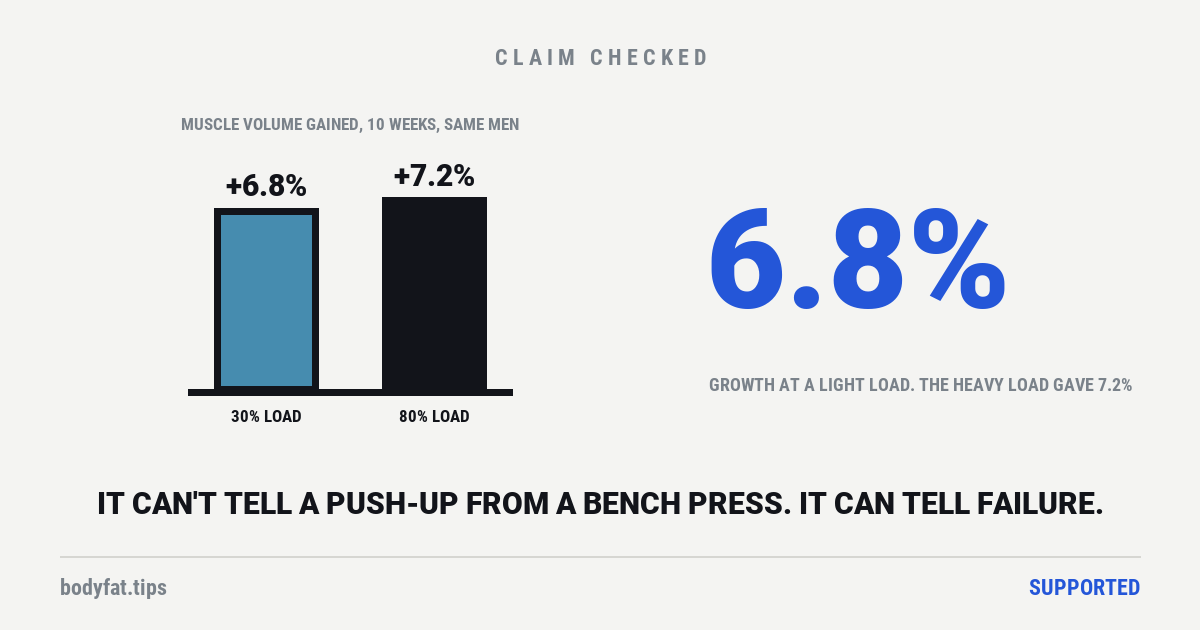
In 2012 a McMaster University lab took eighteen young men and gave each of their legs one of three jobs for ten weeks [1]. One leg trained at 30% of the most it could lift once — a light load, the kind you can move twenty or thirty times — and did three sets to the point where it could not do another rep. The other leg trained at 80%, heavy, for three sets to the same point. Muscle volume was measured by MRI before and after [1].
The light leg grew 6.8%. The heavy leg grew 7.2%. The difference was well inside what chance would produce [1]. There was a third arm — heavy, but one set instead of three — and it grew 3.2%, which is the volume half of the story [1]. Each man’s legs were given two of the three jobs, so each comparison is twelve legs against twelve. The heavy leg did come out stronger on the lift it had practised. But on size — the thing the question is about — the muscle could not tell which leg had been lifting heavy.
That was one trial of eighteen men. It has since been checked across the field. A 2021 network meta-analysis — a method for ranking several options against each other across many trials at once — pooled 28 studies and 747 adults who trained their sets to failure at light loads (more than 15 reps), moderate (9 to 15) or heavy (8 or fewer) [2]. Muscle growth: no difference between loads, in the full set or the high-quality subset [2]. Strength: the heavy loads won by an effect size of about 0.6 and the moderate loads by about 0.35 — on the scale where 0.2 is small, 0.5 moderate and 0.8 large, a moderate edge for heavy and a small one for moderate [2]. An earlier meta-analysis of 21 studies had found the same split [3].
Read that against the question. A push-up is a light-load exercise. So is a bodyweight squat, a dip, an inverted row — anything you can do more than fifteen times. The trials say light loads build muscle as well as heavy ones, provided the set gets close to the point where you cannot do another rep. So: yes. Calisthenics builds muscle, for the same reason a light dumbbell does, and on the same condition.
Push-ups vs bench press: what happened head to head
Three small trials have put the push-up directly against the bench press, and they agree with the leg study.
| Trial | How the push-up was loaded | Result |
|---|---|---|
| 18 men, 8 weeks [4] | Position adjusted (kneeling and so on) to match 40% of the bench max | Chest and triceps grew in both groups; triceps +1.5 mm on the bench, +2.7 mm on push-ups; bench strength +5.0 kg vs +3.1 kg |
| 30 trained students, 5 weeks [6] | Elastic band added until muscle activity matched a 6-rep-max bench | Strength gains the same in both groups, 14–22%; controls unchanged |
| 23 men, 4 weeks [5] | Progressively harder push-up variations | Both groups raised their bench max; the push-up group got better at push-ups; four weeks too short for either to show thickness change |
The eight-week trial is the one with a tape on the muscle [4]. Eighteen men, twice a week, bench press at 40% of their max or push-ups adjusted — kneeling, hands raised — until the load matched. Chest and triceps thickness rose in both groups; the triceps went up 1.5 mm on the bench and 2.7 mm on push-ups [4]. Bench-press strength rose in both too, a little more in the group that had been bench pressing: 5.0 kg (11 lb) against 3.1 kg (7 lb) [4]. Biceps grew only in the bench group, which is the sort of detail a small trial throws up and which nobody should build a programme on.
The five-week trial matched the exercises by muscle activity — a band was added to the push-up until the chest was working as hard as under a six-rep-max bench — and got the same strength gains from both, 14 to 22%, while controls stayed put [6]. The four-week trial used progressively harder push-up variations, saw bench strength rise in both groups, and was too short for either to show a thickness change [5].
How many pushups equal a bench press?
The trials did not count. They matched the two by position and by bands, not by reps, because a push-up’s load depends on where your feet are and how much of you there is [4] [6]. That is also the answer to the question. A push-up equals the bench press it matches, and you match it by making the push-up harder — feet up, hands closer, one arm further out — not by doing more of the easy kind. Which is where the whole subject turns.
If load doesn’t matter, why do calisthenics people have big arms and small legs?
This section is the desk’s own reasoning, and it is labelled as such. The trials say load does not decide muscle growth. The stereotype — broad shoulders, thin thighs — is common enough that “does calisthenics build muscle in legs” is one of the searches that brought you here. Both can be true, and here are three reasons why, with the evidence for each.
Answer one: the progression ceiling. The condition on the load-independence finding is that the set approaches failure [2] [3]. A push-up can be made harder for years: feet raised, archer, one arm. A pull-up gets a weight belt. A bodyweight squat runs out of ways to get harder fast; once you can do thirty, the only hard version left is one leg, and most people never get there. So the leg sets drift away from failure, and the trials say muscle does not grow from sets that stop early. Half of this is measured — the light-load leg in the McMaster study was taken to failure every set [1] — and half is a surmise: that people doing forty bodyweight squats stop long before they have to.
Answer two: the failure gap gets wider as the reps go up. A 2024 analysis across the literature found that muscle growth rises as sets end closer to failure, while strength does not much care [7]. A separate meta-analysis found that going all the way to failure adds only a trivial amount over stopping just short [8] — so near is enough. But near is a different place at rep 6 and at rep 36. At six reps you are near failure in twenty seconds; at thirty-six you are near it after a minute of burning, and the instinct to rack it early is strong. The mechanism is measured [7] [8]. The claim that high-rep sets are stopped early more often is ours.
Answer three: the industry’s tell is the equipment. Ask Google whether calisthenics builds muscle (we did, in September 2026) and its AI Overview cites, alongside Harvard Health and Reddit, a weighted-calisthenics equipment brand; ask it calisthenics versus weights and it cites a pull-up-bar seller and a gym chain. The no-equipment method’s own industry sells weight vests and dip belts. That is the ceiling in Answer one, priced. It is an observation, not a trial, and we mark it as one.
Put the three together and here is what we think is true, stated plainly so you can disagree with it: calisthenics builds muscle exactly as far as you can keep making the exercise harder. For the upper body that is a long way. For the legs it is a short one, and the fix is a weight — at which point the argument in the car park has quietly dissolved, because the muscle never knew what it was lifting in the first place.
What we could not find, and would like to: a trial that ran a progressive calisthenics programme against a weights programme for six months and measured whole-body muscle, legs included. The head-to-head trials are four to eight weeks, upper body only, and 18 to 30 men [4] [5] [6]. If you know of the longer one, the corrections line on this site is open.
Can 100 pushups a day build muscle?
Only if some of those hundred are hard. The trials are consistent that growth tracks how close a set gets to failure [7] [8], and a hundred push-ups spread across a day in sets of ten is a hundred reps that never get near it. Twenty in a row, four times, with the last few ugly, is a different hundred. Nobody has trialled the challenge itself; that is our reading of what the failure evidence implies, and it is marked as such.
Is 20 minutes of calisthenics enough?
The trials on this page trained two or three times a week [1] [4] [5], and none of them measured minutes. Twenty minutes of sets that end near failure is a real session. Twenty minutes of sets that do not is a warm-up. How fast you move the reps and whether you are sore afterwards have their own verdicts, and neither is the variable that matters here.
Is there a downside to calisthenics?
Two the trials show, and one they do not. Strength is specific: the men who trained push-ups got better at push-ups, and a little less good at the bench press — numerically, not significantly — than the men who had been benching [5] [4]. If the number you care about is a barbell number, train the barbell. Second, the ceiling in the section above: the legs need load eventually. What the trials do not show is anything about bone density, longevity or “calisthenics vs weights for women,” all of which people search for and none of which this page rates. For fat loss, resistance training of any kind has its own verdict; nothing in those trials separates the barbell from the bodyweight. And how fast the muscle arrives varies more between people than between methods.
Where “no equipment, full physique” came from
The claim arrived before the science did, as a book. In 2010 a bodyweight-only training manual sold as prison lore — Convict Conditioning — laid out step-by-step progressions from wall push-ups to one-arm push-ups, and the idea that the progression was the load. Two years later the McMaster leg study gave that idea a mechanism it had not had [1]: the muscle grows on effort, not on iron.
Then the format moved outdoors and onto video. Street-workout and bar channels made the physique the argument, and “calisthenics vs weights” became a genre of its own. The old page on this site that this one replaces was two of those: a “start calisthenics today” listicle and an app recommendation.
And where it lives now: ask Google and the AI Overview answers a no-equipment question by citing an app, a weighted-calisthenics equipment brand, a pull-up-bar seller and a gym chain — the shopping list for a method whose pitch is that you need nothing.
None of this is aimed at anyone training in a park. You are doing the thing the trials say works, and if your legs have stalled, the fix is a backpack with books in it, not a membership. It is the “versus” that was never real.
What this is rated, and what the rating covers
Supported — for the claim that calisthenics builds muscle.
It is rated Supported because the mechanism it rests on — that muscle growth does not depend on load once sets approach failure — is replicated across a within-person trial [1] and two meta-analyses of 21 and 28 studies [2] [3], and because the three direct push-up-versus-bench trials point the same way [4] [5] [6]. It is not Established because those direct trials are small, short and upper-body only, and no trial has compared a calisthenics programme with a weights programme on whole-body muscle over months. Protein matters to the result as much as the method does.
What is not rated here: “faster than the gym,” which no trial supports in either direction; bone density, longevity and fat loss as calisthenics-specific claims; and the frame in the section above, which is this desk’s reasoning from the evidence rather than a result the evidence delivered. It is marked as ours so that you can weigh it as ours. How we read a study, and what each tier means, is set out here.
Two numbers were misquoted on the day this page was published, and an independent editorial review caught them. The strength result from the 28-study meta-analysis was given as an effect size of about 0.6 for both heavy and moderate loads; the paper gives about 0.6 for heavy loads and about 0.35 for moderate ones, and the sentence now says so. The ten-week leg trial was described as funded by the Canadian Institutes of Health Research; the paper’s own grants statement names a grant from Canada’s Natural Sciences and Engineering Research Council, with one author on a CIHR scholarship. The source entry and the evidence panel now match the paper.
Also added: that the leg trial had a third arm (heavy, one set, +3.2%) and compared twelve legs against twelve; the two authors missing from source [2]; and a note that the push-up group’s smaller bench-press gain was numerical rather than statistically significant. The rating is unchanged.
- Does Dancing Help You Lose Weight? A Zumba Class Burned 369 Calories, Not 1,000. Eight Pooled Trials Couldn’t Find the Fat Loss.
preliminary - Exercise for Lower Back Pain: 249 Trials, 15 Points Less Pain on a 100-Point Scale. If the Pain Is New, the Answer Changes.
established - Time Under Tension: 14 Studies Put Slow Reps Against Fast. The Slow Group Grew the Same — If Anything, a Shade Less.
unsupported