The No-Sugar Diet: Cutting Sugar Lost 1.8 lb in the Trials Pooled for the WHO. Swapping It for the Same Calories Changed Nothing. The Sugar Was Never the Point.

The rule fits on a Post-it: no added sugar, thirty days. The promises fill a page. The weight comes off, the energy steadies, the skin clears, the cravings die, and somewhere around day three you get a headache that proves the poison is leaving.
Thirty randomised trials have tested the first promise. One kind of trial among them tested it in a way that changes what the whole diet is. So this page is about two questions: what does cutting sugar actually do to your weight, and what, exactly, is leaving your body in week one?
Can you lose weight with a no sugar diet?
Yes, and the size of it has been measured. In 2012 a team at the University of Otago pooled every randomised trial on sugar intake and body weight it could find — thirty of them — for the World Health Organization, which was rewriting its sugar guideline [1]. In the five adult trials where people cut their sugar and were otherwise left to eat what they liked, weight fell by 1.8 lb (0.80 kg), with a plausible range of 0.9 to 2.7 lb (0.39 to 1.21 kg) [1]. Adults told to eat more sugar gained almost exactly the same amount, 1.7 lb (0.75 kg) [1]. Symmetrical, which is what you would expect if something real is going on.
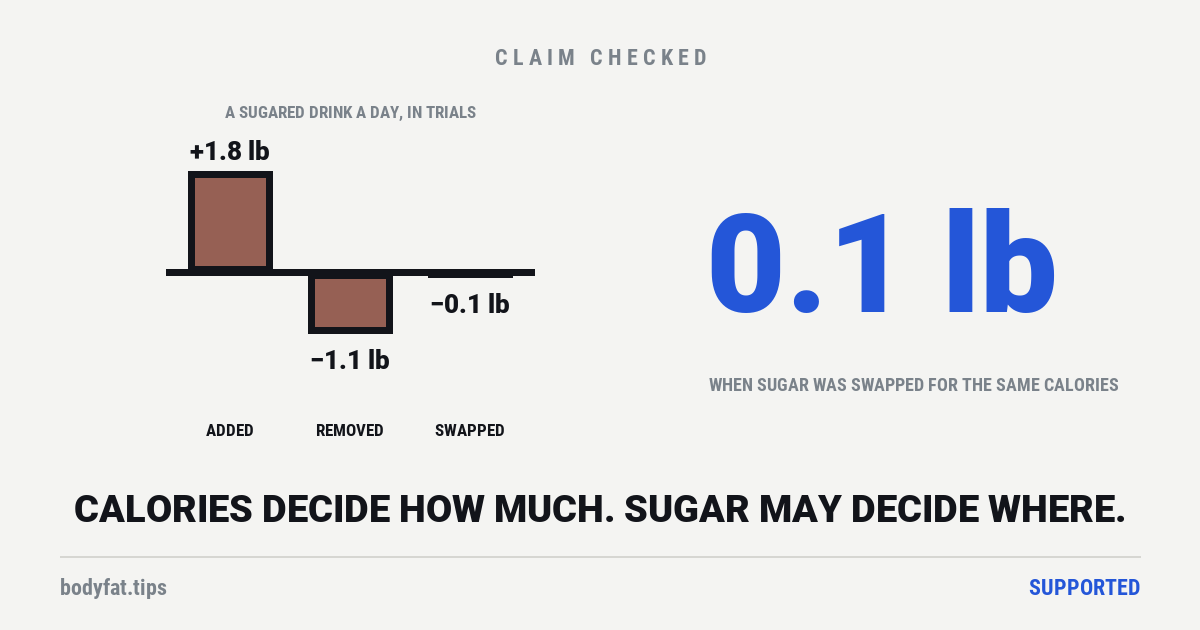
Then the trial design that matters. In the trials where people swapped sugar for the same number of calories from other carbohydrates — bread for the biscuits, roughly — the sugar-swapped-out group ended 0.1 lb (0.04 kg) lighter, with a range of −0.3 to +0.1 lb, which is to say nothing [1]. The reviewers’ own conclusion: the change in body fat “seems to be mediated via changes in energy intakes.” In plain words: sugar moved the scale by moving the calories. Hold the calories still and the sugar does nothing to your weight.
| What people did | Weight | Source |
|---|---|---|
| Cut sugar, otherwise ate freely | −1.8 lb (0.80 kg) | 5 adult trials, inside the 30-trial review [1] |
| Ate more sugar | +1.7 lb (0.75 kg) | [1] |
| Swapped sugar for the same calories of other carbs | −0.1 lb (0.04 kg), effectively zero | [1] |
| Added one sugared drink a day | +1.8 lb (0.83 kg) | 16 trials [2] |
| Removed one sugared drink a day | −1.1 lb (0.49 kg) | [2] |
Hold on to that, because it decides what a no-sugar diet is.
Which sugar? The drinks.
A 2023 meta-analysis narrowed the question to sugar-sweetened drinks: soda, sweetened tea and coffee, energy drinks, juice drinks [2]. Sixteen randomised trials in 1,343 adults: add one serving a day and people gained 1.8 lb (0.83 kg); take one away and they lost 1.1 lb (0.49 kg) [2]. Twenty-one cohort studies following 448,661 adults over years: each daily serving was worth about 0.9 lb (0.42 kg) of extra weight, in a straight line — more servings, more weight [2].
Note who found this. The group’s listed funders include the National Honey Board, the International Life Sciences Institute, the United Soybean Board and a nut-and-dried-fruit trade council, alongside the Canadian and US health agencies [2]. A lab that takes money from sweet-food industries found that sugared drinks add weight. That cuts the opposite way from the usual worry about funding, and it is worth knowing.
A 2023 umbrella review — a review of 73 meta-analyses at once — put a number on the target: keep free sugars under 25 g a day, about six teaspoons, and sugared drinks under one serving a week [3]. “Free sugars” means the sugar added to food plus the sugar in honey, syrups and juice; it does not mean the sugar inside a whole apple or a glass of milk [3]. A 12 oz can of regular cola carries about 39 g on its own label. One drink, a day and a half’s allowance.
If sugar doesn’t move the scale, why did your cousin lose fifteen pounds on it?
This section is the desk’s own reasoning, and it is labelled as such. The swap trials say the molecule does nothing to your weight. The free-eating trials say cutting it loses a couple of pounds. And people who go thirty days without sugar routinely report losing a great deal more than that. Here are three ways to reconcile the three, with the evidence for each.
Answer one: the food list is the diet. “No added sugar” is not a rule about a molecule. It is a rule that removes soda, juice, sweetened coffee, cookies, cake, ice cream, candy, most breakfast cereal, flavoured yogurt and the ketchup — an entire category of the most calorie-dense, easiest-to-overeat food in the house, in one stroke. The calories fall because the category is gone. This is not a hunch; it is exactly what the swap-versus-free-eating comparison shows [1]: keep the calories and nothing happens, let them fall and the weight follows.
Answer two: the drinks went first. The per-serving numbers above are for one drink a day [2]. Someone who was drinking three cans and a sweetened latte is removing three or four servings, and the trials say each one is worth about a pound over a trial’s length. That scaling is arithmetic, not a measurement — nobody has run the three-cans-a-day trial — but it is the arithmetic the evidence points at, and it explains why the same diet does almost nothing for a person who never drank the stuff.
Answer three: “none” is easier to obey than “less.” A bright line needs no counting. “No added sugar” can be checked on a label in two seconds; “about 25 g a day” needs a running total. We think this is a large part of why the thirty-day format works when “cut down” does not — and it is a hunch. We could not find a trial that pitted an abstinence rule against a moderation rule for sugar and measured who was still following it.
Put the three together and here is what we think is true, stated plainly so you can disagree with it: a no-sugar diet is a soda-and-snacks diet with a stricter name. It works in proportion to how much of that category you were eating, and it works because the category left, not because a molecule did. The molecule matters for something else — see the belly-fat question below — but not for the number on the scale.
What we could not find, and would like to: a trial that took people who drink little or no sugared soda, put half of them on a strict no-added-sugar rule for three months, and weighed them. That is the trial the thirty-day challenge actually needs, because it is the one that would show whether the rule does anything once the drinks are already gone. If you know of one, the corrections line on this site is open.
What happens after 7 days without sugar?
Nobody has measured it. That is the honest answer to the most-asked question about this diet. No trial we could find weighed, scanned or blood-tested people at day seven of a no-sugar rule. The seven-day, fourteen-day and twenty-one-day milestones are the lengths of programmes, not of anything in your physiology.
What is circulating instead is a script. Ask Google what happens when you stop eating sugar and its AI Overview lays out phases “according to” a hospital system’s blog: headaches, fatigue, bad mood and cravings first, then steady energy, better focus and clearer skin. It is the vocabulary of withdrawal. So does sugar withdraw?
The most thorough review of that question, from Cambridge neuroscientists funded by the Medical Research Council and the Wellcome Trust — published, it should be said, in a journal supplement sponsored by a company with sugar-industry funding, a disclosure the sources carry — found “little evidence to support sugar addiction in humans” [4]. The addiction-like bingeing seen in rats happens only when rats are given sugar on and off — intermittent access — and comes from the pattern of access to something sweet, not from sugar’s chemistry [4]. The authors argued against writing “sugar addiction” into policy at all. The headache on day three may be real for you. The evidence that it is a drug leaving your system is not there.
How long does it take to detox your body from sugar?
There is nothing to detox. Sugar is not stored as sugar in any form you could flush out; what the body keeps is glycogen, and it keeps that whether you “detoxed” or slept. The 21-day and 30-day countdowns come from books, not biology: I Quit Sugar (2013) sold an eight-week programme and The 21-Day Sugar Detox (2013) sold three weeks, and the format outlived both.
What does change on a clock is taste, and that one has a trial. Healthy adults replaced 40% of their simple-sugar calories with other food for three months while a matched group changed nothing [5]. By the third month the low-sugar group rated sweet puddings about 40% sweeter than the control group did — the same pudding, tasting sweeter — but rated them no more or less pleasant [5]. So “natural foods will taste sweeter” is true and measured. “You will stop wanting sweet things” is not what the trial found. Sixteen people against seventeen, funded in part by PepsiCo, and worth knowing exactly what it showed.
Will I lose belly fat if I cut out sugar?
This is the one place the molecule, not just the calories, has evidence behind it — and it points the way the question hopes.
Overweight adults drank a litre a day of regular cola, or the same calories as milk, or diet cola, or water, for six months [6]. Total fat mass did not differ between the four groups. But liver fat in the cola group rose 132 to 143% relative to the others, fat inside the muscles 117 to 221%, and visceral fat — the fat packed around the organs, the “belly fat” that matters medically — 24 to 31% [6]. Same calories as the milk group; different address for the fat. Diet cola behaved like water on every fat measure [6].
A ten-week trial found the mechanism. Overweight adults got a quarter of their calories from drinks sweetened with either fructose or glucose [7]. Both groups gained the same weight; only the fructose group added visceral fat, made more new fat in the liver and lost insulin sensitivity [7]. Table sugar is half fructose. The syrup in soda is a little more than half.
So: the calories decide how much fat you carry, and the sugar has a say in where it goes. Two caveats the trials impose. Both studies added sugar and watched fat arrive; neither took sugar away and watched belly fat leave, so the reverse is inference, not measurement. And you still cannot aim fat loss at your waist with exercise — that is a separate verdict, and it stands. What you can do is stop sending fat there by the litre.
What can you eat on a no sugar diet?
The trials did not test a food list, so this is the guideline, not a result. Whole fruit and plain milk are not the target — their sugar comes packaged with fibre or protein, and the 25 g line does not count them [3]. Honey, maple syrup and agave are sugar with better marketing and count in full [3]. Juice counts [3]. Ketchup, flavoured yogurt and instant oats are where people get caught. And the sweetener question, which the AI Overview settles with a flat “eliminate”: this site’s diet soda and sugar alcohol verdicts are the calibrated version, and in the six-month cola trial the diet cola did what the water did [6]. If blood sugar after meals is the worry, a walk after eating has its own numbers.
Who this works for, and who it does nothing for
The cohorts say the sugar-and-weight link holds in children and adults [2], and the trials in adults are the clean ones. In children, the trials told families to cut sugary foods and drinks and the families mostly did not, so those trials showed no change [1] — a compliance result, not a physiology result. The people it does least for are the ones the arithmetic in Answer two predicts: if you did not drink sugar, there is not much for the rule to remove.
Where the sugar detox came from
1972: a London nutrition professor published Pure, White and Deadly, the book that made sugar the villain of the Western diet. The decade went to the fat hypothesis instead. 2009: a University of California paediatric endocrinologist’s ninety-minute lecture, Sugar: The Bitter Truth, called fructose a toxin and has been watched millions of times. Sugar was back as the poison.
2013 is when the poison got a countdown. I Quit Sugar sold an eight-week “detox programme”; The 21-Day Sugar Detox sold three weeks. The word did the work: a poison you detox from is a drug you withdraw from, and withdrawal comes with phases, symptoms and a day count.
From there it became a challenge format — thirty days without sugar, filmed — and the phases hardened into a script that hospital blogs now publish and Google’s AI Overview repeats “according to” them.
And where it lives now: ask Google about the no-sugar diet and its AI Overview cites a company called The No Sugar Company, a sugar-free snack brand, a supplement retailer, an addiction-treatment referral site and a plastic-surgery clinic’s thirty-day challenge — then offers to write you a three-day meal plan. “Sugar detox” on its own draws 5,400 searches a month.
None of this is aimed at anyone who did thirty days without sugar and felt better. You probably did, and you probably lost weight, and the reason is in Answer one. It is the word “detox” that owes you an explanation.
What this is rated, and what the rating covers
Supported — for the claim that cutting added sugar helps you lose weight.
It is rated Supported because thirty randomised trials pooled for the WHO found a real, modest loss when sugar came out and calories were not deliberately replaced [1]; a second meta-analysis of sixteen trials found the same for sugared drinks specifically, with a dose-response across the cohorts [2]; and an umbrella review of 73 meta-analyses rated the evidence moderate [3]. It is not Established because the swap trials show the effect belongs to the calories, not the sugar [1] — the diet works by what it removes from the plate — and because the reviewers flagged heterogeneity and possible bias in some trials [1]. The size is under two pounds in a trial; more if you drank a lot of it, by arithmetic rather than measurement. What a pound of fat costs in calories is its own verdict.
What is not rated here: “detox,” withdrawal and the day count, which no trial has measured and the addiction evidence does not support [4]; clearer skin, steadier energy and sharper focus, which the trials on this page did not test; the belly-fat mechanism, which was measured by adding sugar and is inferred in reverse [6] [7]; and the frame in the section above, which is this desk’s reasoning from the evidence rather than a result the evidence delivered. It is marked as ours so that you can weigh it as ours. How we read a study, and what each tier means, is set out here.
Two funding disclosures were wrong or incomplete on the day this page was published, and an independent editorial review caught them. The three-month taste study was described as having no grant data on record; Crossref, Europe PMC and its trial registration record PepsiCo Inc. as a funder and PepsiCo Global R&D as a collaborator, and the page now says so beside the result it takes from that study. The sugar-addiction review was described as declaring no industry sponsorship; its authors declare none for their own work, but the paper appeared in a journal supplement sponsored by Rippe Health, whose founder’s published disclosures list sugar-industry funding, and the source entry and evidence panel now carry that.
Also changed: the headline and table attributed the 1.8 lb figure to “30 trials” when the review derives it from five adult trials inside its 30-trial pool; the swap figure now carries one sign throughout (the sugar-swapped-out group was 0.1 lb lighter, effectively zero); “diet cola behaved like water on every measure” now reads “every fat measure”, since the trial reported a blood-pressure difference; and the glycogen sentence was tightened. The rating is unchanged.
- A Vegan Diet Cost Older Adults 2.5 lb of Muscle in 12 Weeks. The Protein They Stopped Eating Is Most of the Story.
preliminary - How Many Calories to Lose a Pound? 3,500 Is a Rule About One Week, and Everyone Uses It as a Rule About a Year
unsupported - Carnivore Diet: Nine Human Studies. In the One That Measured Blood, LDL Went 157 to 256.
preliminary