Zone 2 Cardio: The Fourteen Experts Who Defined It Also Said the Benefits Might Not Be Unique to It

In 2025 fourteen sport scientists and professional coaches sat down together to answer a question that should not have needed a panel: what is zone 2?
They convened because, in their own words, “there is no clear consensus among coaches, athletes, and scientists regarding the definition of zone 2 training” [2] — and this is a thing being recommended to the general public as the intensity most of your cardio should happen at.
They did reach a definition. Then they added a sentence that has been very quiet ever since.
The line the experts wrote, and nobody quotes
Here is their conclusion about what zone 2 does to you. The panel expected a broad range of adaptations from it — and then wrote that those adaptations “might not be unique to zone 2 and could also be induced with sessions performed at slightly higher and lower intensities” [2].
Read that again with the marketing in mind. The entire pitch for zone 2 is that this specific band is where the magic happens. The fourteen experts who defined the band say the effects probably are not specific to it.
For the record, the definition they landed on: the intensity immediately below your first lactate or ventilatory threshold — roughly, the point where your breathing first noticeably changes [2]. Not a percentage of anything.
So can you find it? Fifty cyclists went in a lab to check
This is the part that matters most if you are wearing a watch, because the answer to “what qualifies as zone 2” depends entirely on which method you use to answer it.
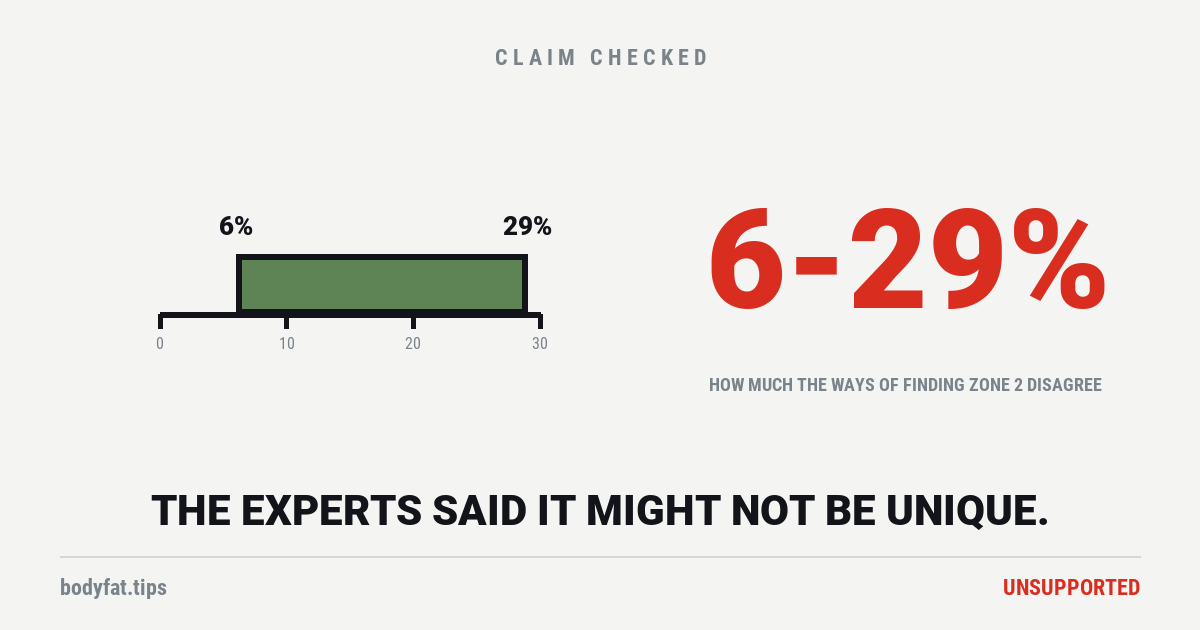
In 2025 researchers put fifty cyclists — thirty men, twenty women — through ramp and step tests, measuring power, heart rate, blood lactate, breathing and which fuel they were burning. Then they compared the common ways of defining zone 2 against each other [3].
| How zone 2 was defined | How much it varied |
| Across all the markers they tested | 6% to 29% |
| Ventilatory threshold and max fat oxidation | agreed well with each other |
| Fixed percentage of maximum heart rate — what every calculator uses | wide individual differences |
Two of the methods agreed with each other well: the ventilatory threshold — the breathing change — and the point of maximum fat oxidation [3].
The one that did not agree is the one you are using. Fixed percentages of maximum heart rate showed wide individual differences, and the authors’ conclusion is that they “may inaccurately reflect metabolic responses” [3].
Which is awkward, because the questions people actually type are zone 2 cardio calculator and zone 2 cardio heart rate by age. Both of those are fixed percentages of a maximum that was itself estimated from your age. It is an estimate stacked on an estimate, prescribing a band the experts defined by your breathing.
But is zone 2 the best intensity for your mitochondria?
This is the big claim — that low-intensity work is uniquely good at building the machinery your cells use to burn fat. In 2025 a review in Sports Medicine went at it directly. It is called “Much Ado About Zone 2”, which tells you where it lands [1].
Its first move is to name where the recommendation came from, and this is worth quoting because it is the whole provenance problem in one sentence. The recommendations, they write, “largely stem from observational data of elite endurance athletes who engage in large volumes of Zone 2 training and possess high mitochondrial and fatty acid oxidative capacity” [1].
Elite endurance athletes do enormous volumes of easy riding and running, and they have superb mitochondria. Both true. The leap is deciding the first caused the second, and then prescribing it to someone training four hours a week instead of twenty.
The review’s conclusion: current evidence does not support zone 2 as the optimal intensity for improving mitochondrial or fat-oxidation capacity, and higher intensities look more important — particularly when training volume is low [1].
That last clause is the one to keep. If you have twenty hours a week, the argument is genuinely open. If you have four, the case for spending all of them easy is not there.
The disclosure we are putting on our own best source
One of that review’s authors is the researcher behind much of the low-volume high-intensity interval training literature — the alternative the review argues for. He also discloses advising and holding equity in a company whose services relate to exercise [1].
We are flagging that on the source that supports our own conclusion, which is the easiest disclosure in the world to quietly not mention. It does not make the review wrong. It does mean that when someone with a professional and financial position in favour of high-intensity training writes a review concluding in favour of high-intensity training, you should want the other side’s best evidence too.
So here is the other side’s best evidence
It exists, it is good, and it is narrower than it sounds.
A 2024 meta-analysis pooled seventeen studies and 437 people to ask whether a polarized training distribution — most sessions easy, a few genuinely hard, little in between — beats the alternatives [4].
It does, for one outcome. VO2 max improved more on polarized training, with what the authors graded as high certainty. The effect size was 0.24 — and on the scale researchers use, 0.2 is small and 0.8 is large, so this is a real but modest edge [4].
Now the scope, which is where it gets interesting. That advantage appeared only in interventions shorter than twelve weeks, and only in highly trained athletes. And on the outcomes that are closer to actually racing — time trial performance, time to exhaustion, power at threshold — there was no difference at all [4].
So the strongest case for training mostly easy is a small VO2 max advantage, in trained athletes, over short blocks, that does not show up in performance. That is a real finding. It is not the finding on the thumbnail.
What this verdict is rated, and what it is not saying
Unsupported — and the scope matters more here than on almost any page we have written, so we are going to be explicit.
The rating is on the claim that zone 2 is the optimal intensity, uniquely good for your mitochondria and metabolic health. That is the claim in the marketing, it is the claim driving the searches, and a 2025 review assessed it and said the evidence is not there.
It is not a rating on easy cardio. Nothing in this literature says low-intensity exercise is a waste of time, and this page is not saying it either. Easy aerobic work is sustainable, it is repeatable, it is pleasant, it does not wreck you for tomorrow, and it raises your VO2 max — which is one of the better-evidenced things you can do for how long you live.
What the evidence does not support is that it has to be that band, found with that calculator, to the exclusion of going hard sometimes.
What we would actually do
Stop using a heart-rate calculator to find it. The lab study is clear that fixed percentages of an age-estimated maximum are the least reliable marker they tested [3]. Use the talk test instead: zone 2 is where you can hold a conversation but would rather not sing. That is a plain-language stand-in for the ventilatory threshold, which is what the experts actually defined it as [2].
If you train a lot, most of it should be easy anyway. Not because of mitochondria — because you cannot do twelve hours a week hard without breaking. The polarized data supports this for trained athletes and it always did [4].
If you train a little, do not spend all of it easy. This is the single most practical line in the 2025 review: higher intensities matter more when volume is low [1]. Four hours a week entirely in zone 2 is the case the evidence argues against most directly.
And do not buy anything to find your zone. The chest straps, the lactate meters, the subscriptions: the measurement they are selling is one the fourteen experts said might not be pointing at anything unique [2]. A conversation is free.
This is journalism about research, not medical advice. How we read a study · How to improve your VO2 max · Does jogging burn fat · Does cardio burn muscle · How many steps a day
- How Long Does It Take to Build Muscle? 585 People Did the Same Program for 12 Weeks. One Gained 59%. One Lost 2%.
unsupported - Resistance Training for Seniors: 121 Trials, a Large Gain in Strength — and a Much Smaller One in Daily Life
established - VO2 Max Test: The Cheap Estimates Sorted People Into Three Fitness Bands and Got It Right Half the Time
unsupported