Grounding Sheets: Engineers Measured the Current. It Was Nanoamperes, and It Only Tracked You Moving.

Almost every argument about grounding is about whether it works.
Far fewer have measured the step underneath — how big the electrical current it depends on actually is.
In 2014 some people did.
The measurement underneath
An electrical engineering department at the University of New Hampshire — a professor, a senior lecturer and three students — built low-noise instrumentation for the job and measured the current flowing between a person lying on a conductive bed sheet and the earth. About forty measurements, under varied conditions, on three people: the three students themselves, men aged 22 and 23 [1].
They reported no funding and no conflicts of interest; the sheets came from the manufacturer [1]. It is an engineering department measuring an electrical claim.
| Question | Measured answer |
| Does current flow between a grounded body and the earth? | Yes |
| How much? | Nanoamperes — billionths of an amp |
| What does it track? | Subject motion |
| Anything else in the signal? | Nothing they could detect |
Current does flow. That much is true and the paper says so.
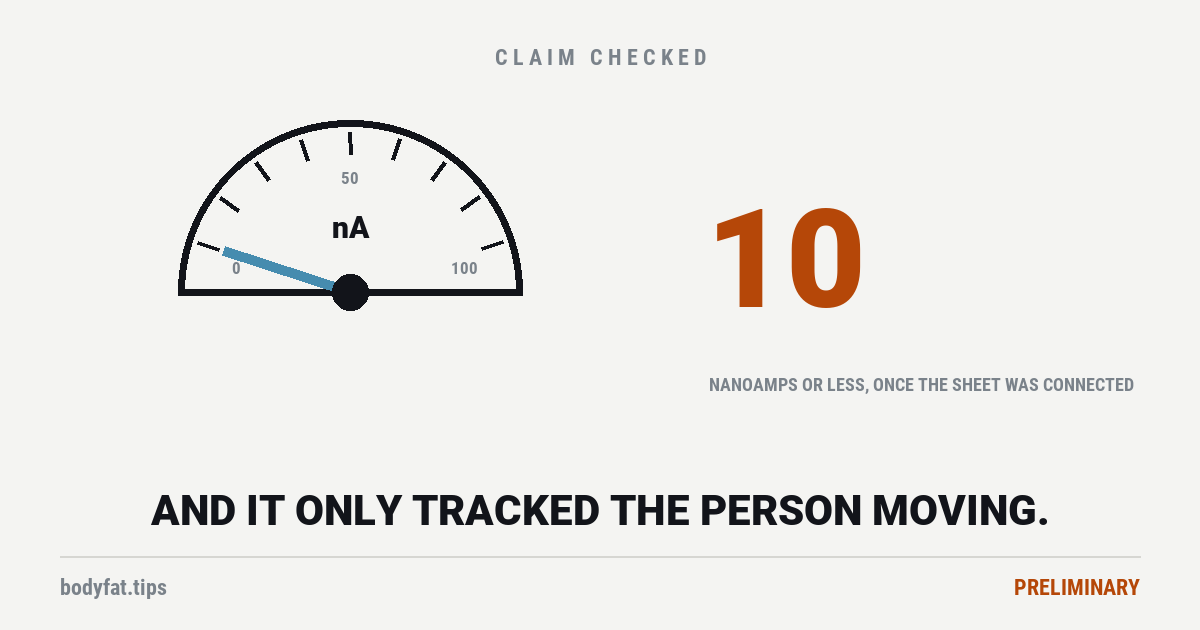
It is nanoamperes. A nanoamp is a billionth of an amp. Once the connection was made, the current stayed under 10 of them. And over a session about as much charge flowed back out as flowed in: in the engineers’ words, “the net current flow for the sessions was found to be nearly zero” [1].
And when the engineers looked for a signal inside the current — heartbeat, breathing, or a natural electrical rhythm of the atmosphere that some earthing writing says the body needs, which is what they set out to find — the only thing they could find was you moving. In their words: “There did not appear to be any information contained in this exchange except for information about subject motion” [1].
So the current tracked the subject shifting on the bed. That is the measured content of the connection the product is sold on.
What the study did not test is whether a current that size does anything to inflammation or to free radicals; that was never its question. The authors add that failing to find information in the current “does not rule out the possibility that it may exist”, below the noise of their instruments [1]. The next step is ours, and it is a reading, not a measurement: a few billionths of an amp that nets out to nearly zero over a session is a thin wire to hang “electrons neutralise free radicals” on.
Then somebody tested a grounding shoe
In 2022 a group put ten highly trained male runners through running-economy tests in two pairs of shoes: ordinary training shoes, and shoes with a conductor element under the insole. Twenty minutes at a fixed intensity on a dirt track, shoe order randomised, oxygen use, heart rate, lactate and perceived fatigue all recorded [2].
Running economy is just how much oxygen it costs you to hold a pace. Grounded, it was 50.9. Ungrounded, 51.1. Those are the same number [2].
No difference on any physiological measure. No difference on any perceptual one either — the runners could not tell.
And here is the part worth slowing down for. The trial was paid for under a contract between a sportswear company and the university that ran it, and four of its nine authors work for that company [2]. Normally that is a reason to read a result sceptically, and normally we would say so.
Here the design carries more weight than the sponsor. Neither the runners nor the testers knew which shoe was which, both runs were on the same day in random order, and the trial was sized in advance to catch a large effect (an effect size of about 1; researchers call 0.8 large) [2]. We do not know what result the company wanted: the paper says only that shoe companies are interested in the technology. What the trial cannot do is speak to this page’s claim. It tested shoes over twenty minutes of running, not sleep, and it measured oxygen, not inflammation.
So where do the positive results come from?
A small and unusually concentrated literature.
The idea did not start in a journal. The earliest document we could trace is an article in an online magazine about static electricity, dated January 2000 in the field’s own 2012 review: a retired cable-television executive reported that of 60 people with poor sleep, recruited through adverts in ten beauty salons, the half who slept on mattress pads wired to a rod in the ground reported better sleep far more often than the half whose pads were not connected. The magazine printed a note that it had not reviewed the work [5]. In July 2003 the same writer, in the same magazine, set out the claim on the box: grounding “reduces chronic inflammation” by “neutralizing excess free radicals” [5].
Then it moved into journals and patents. The first journal study of people sleeping grounded that the 2012 review cites, 12 people with no comparison group sleeping on pads their maker donated, came in 2004 [6]. A 2007 commentary, its preparation part-funded by a company in which its author declared a financial interest, proposed that “free electrons from the earth neutralize the positively charged free radicals that are the hallmark of chronic inflammation” [7]. The same year a grounding company filed a patent application titled “Personal body grounding systems to reduce and prevent inflammation” [8]. In 2012 a review written by the field’s own researchers gathered the work up [3]. That review traces the idea further back, to a German back-to-nature movement of the late nineteenth century and a doctor who wrote in 1929 about people sleeping wired to grounded pipes. We have not read those books, and we have not traced who first sold a grounding sheet, or when.
The 2012 review carries a disclosure, and we are going to quote it, leaving out only the names:
Three of the authors “are independent contractors for” a company the paper names, “the company sponsoring earthing research, and own a small percentage of shares in the company.” [3]
That is the authors’ own statement, printed in their own paper. They declared it, which is what a disclosure is for, and it is the same thing we report on every source here — including the creatine position stand written partly by people who consult for creatine companies.
What it tells you is not that anyone was dishonest. It tells you that the review the field wrote about itself and the field’s commercial interest are not independent of each other, and that who paid for a study is a question worth asking here more than usual.
The positive trials are small
The trials closest to the claim on the box put people to bed grounded and then took blood for markers of inflammation: C-reactive protein, cytokines or white-cell counts. Searching PubMed, Europe PMC, Crossref and the US trial registry, and running an ordinary web search, on 7 October 2026, we found four. Each deserves a fair hearing, and none of them is big.
Ten nights, 22 adults, a sham sheet. In 2019 a university sports-science group in Austria had healthy volunteers run downhill on a treadmill, hard enough to leave their legs sore for days, then sleep for ten nights on conductive sheets: 12 wired to the ground of a wall socket, 10 not. Neither the sleepers, the testers nor the analyst knew which was which. The grounded group lost less jump height and less strength in one leg, and their creatine kinase, an enzyme that leaks out of damaged muscle, rose by 310% against 760% on the sham sheets. Soreness did not differ. Inflammation markers were measured in only four people, two in each group [9]. The smaller creatine kinase rise is the direction two earlier company-funded trials had reported [10][11]. The authors declare no commercial or financial relationships; a therapy centre supplied the sheets, and the volunteers were paid in grounding equipment [9].
One night, 84 patients, a sham pad. In 2025 a neurosurgery team in Poland randomised 84 people recovering from lower-back surgery to spend one night, between the first and second day after the operation, with an electrode pad on the ankle wired either to the earth connection of the socket or, through a hidden switch, to nothing. C-reactive protein, a standard blood marker of inflammation, rose in both groups and rose less in the earthed group: from 15.34 to 24.42 mg/L, against 24.54 to 57.42 mg/L. The earthed group started lower and was younger on average (53 against 60). Pain fell somewhat more. The muscle-damage enzyme did not differ significantly between the groups, though the paper’s own summary says it did [12]. The team declares no conflicts of interest and no outside funding; its lead author co-wrote the 2012 review, which counts him among the field’s first experimenters [12][3].
Three nights, eight men, sham sheets. A 2010 pilot had eight men sleep on grounded or sham sheets after exercise that left their calves sore. By design it ran no statistical tests: it screened 48 measures, from blood tests to scans and pain scores, for differences of 10% or more, and white-cell counts and the muscle-damage enzyme were among those that passed. It was paid for by a grounding company; its first author worked on it as a contractor, and a second declares that he has contracted for the company since 2007 and owns a very small share of it [10].
Coded cords, no sham group. The fourth is the trial this page used to lead with. Its abstract calls it a double-blind randomised controlled trial; the randomisation decided which of two six-week periods each therapist joined. It deserves the same fair hearing [4].
Sixteen massage therapists, six weeks. One week ungrounded, four weeks grounded while working and while sleeping, one week ungrounded again. They filled in standard questionnaires on pain, physical function, mood, fatigue and sleep. The setting was a wellness centre in California [4].
The therapists reported less pain, better physical function, more energy and lower fatigue while grounded [4].
Every therapist followed the same order, a week on a dummy cord, four on a live one, a week on a dummy again, so the comparison is the same people over time rather than a separate sham group; the cords were number-coded so the therapists could not tell which was which [4]. The same trial’s blood tests, published separately in 2018, are the closest thing in it to the claim on the box, and they do not show it: none of the four inflammation markers fell significantly across the four grounded weeks, and the changes its authors highlight are rises in the week after grounding stopped [13]. Both papers say who paid: a grounding company funded the project, a grounding seller donated the equipment, and the first author declares that he is a consultant for the company that paid [4][13]. None of that makes the result wrong. All of it makes it a starting point rather than a finding.
And when we searched on 7 October 2026, none of PubMed, Europe PMC or Crossref held a systematic review of earthing: the kind of paper that gathers every trial and grades how good each one is. One paper has the name without the method. Published in September 2026 in a journal of Ayurvedic medicine, it is titled a systematic review of electromagnetic fields and of earthing, which it calls zero-volt therapy; it describes no search of the research databases and grades nothing, and its sources include classical Ayurvedic texts and two popular books about earthing [18]. None of the reviews that turned up grades the trials.
What the AI is telling people, and who is selling it
We pulled the pages that the AI-written answer at the top of the search results cites to answer “grounding sheets”. Twenty-five domains.
A hospital system’s health library is in there. So is a big consumer health site. So is PubMed Central.
So is an online marketplace. So is a mattress brand, and a bed retailer. And so are several sites whose domain names are their business model, with grounding or earthing in the name.
We are not going to publish a precise count of how many are selling, because we would have to defend it domain by domain and some are genuinely ambiguous. What we can say is that the answer a reader gets from the top of the search results is assembled substantially from pages with a grounding product to move.
Regulators and a court have looked at the sellers’ side of this. In February 2013 the UK’s advertising regulator upheld a complaint about a magazine advert for earthing products, ruled that its claims, better sleep and “anti-inflammatory” properties among them, were misleading, said it had “yet to see any evidence for the efficacy of earthing products”, and told the advertiser not to make efficacy claims for them [14]. In April 2023 a regional court in Germany ordered the seller of a grounding bed pad to stop advertising that it lowers cortisol, improves circulation in the small blood vessels and relieves inflammation. The seller had put forward the Austrian sleep trial above; the court held that a fall in inflammation markers in two people could not support a general claim, and that a smaller rise in the muscle-damage enzyme does not show an anti-inflammatory effect. The consumer organisation that sued said in May 2023 that the judgment was not yet final [15].
In September and November 2025 New Zealand’s advertising complaints board upheld three complaints against a seller of grounding sheets and underlays whose adverts said “Studies show” grounding “helps lower inflammation”, and that it works by “neutralising free radicals”. The seller did not respond, and the adverts were ordered removed [16]. Each ruling settled what one seller could say in one advert or video; none of them was a test of whether grounding works.
Why this is rated Preliminary, not Unsupported
Because those are different findings and the difference matters.
Preliminary is the rating for “nobody can tell yet” — the evidence is animal-only, or too small, or genuinely conflicting. We use it a lot and we are not shy about it.
Unsupported means we looked and the claim was not there. This page used to say that, and the evidence does not let it. The claim on the box has been tested, in small trials, and the results point different ways. Two sham-controlled trials from teams that declare no conflicts of interest found a smaller rise in a muscle-damage marker after ten nights grounded and a smaller rise in C-reactive protein after one; neither reports how many people it needed, one lasted a single night, and the other measured inflammation in four people. The company-funded therapist trial found no fall in inflammation markers while people were grounded. And the current the whole idea depends on was measured at a few billionths of an amp that tracks you rolling over, which is our reason to doubt the electron story, not a test of it. Small, few, and pointing different ways: that is Preliminary.
What would change it? A trial registered before it starts, big enough to answer the question (with the number of people it needs worked out in advance), with sham sheets, inflammation measured in the blood of everyone in it over weeks rather than one night, and a team with no stake in a grounding company. That study is not hard to run. Twenty-two years after the 2004 sleep study, with a large market waiting on the answer, none of the trials we found does all of that. If one comes back positive, this page moves up; if it comes back flat, it moves down.
What we would actually do
If you have one and you sleep better on it, keep using it, and check the plug. We mean the first part. Better sleep is a real experience whatever turns out to be causing it, and nothing here says otherwise. What we object to is being sold the electron story as if it had been shown: the engineers who measured the current found a few billionths of an amp that nets out to nearly zero.
The plug is the part with a safety record. These products connect to the ground (earth) contact of a wall socket [4][9]. In March 2025 the UK’s product-safety regulator reported an earthing bed sheet turned back at the border because its travel-adapter plug had its pins so close to the edge that a finger could touch a live pin while it was being plugged in or pulled out; it rated the risk of electric shock high [17]. If yours came with a travel adapter, look at it. One built like that should not be used.
Do not buy one for inflammation. That is the claim doing the commercial work, and the trials behind it are small: the largest sham-controlled one we found ran for a single night after surgery, and the company-funded one found no fall in inflammation while people were grounded. Sellers in three countries have been told by an advertising regulator or a court that they had not substantiated it.
Be suspicious of any product sold on a mechanism instead of an outcome. “Electrons neutralise free radicals” is a sentence that sounds like chemistry and functions as marketing. When the outcome is easy to measure and the seller is talking about the mechanism, ask what the outcome trials found. Here they are small, and they do not agree.
And walking barefoot on grass is free. Whatever grounding does or does not do, the version that costs nothing rests on the same idea as the version that costs a bedsheet. The trials on this page tested the equipment, not the grass.
This is journalism about research, not medical advice. How we read a study · Red light therapy · Cold plunges · Lymphatic drainage massage
This page was corrected on 9 October 2026 after an independent editorial review, and its rating changed. It said the one independent test of grounding’s effects had found nothing, that no independent group had repeated the positive results, and that the best positive trial had sixteen people in it. All three were wrong. The null trial, of grounding running shoes, was paid for under a contract with a sportswear company, four of its authors work for that company, and it did not test sleep or inflammation. Two randomised trials with sham equipment, from teams that declare no conflicts of interest, have grounded people overnight and taken blood: 22 adults over ten nights in 2019, and 84 surgical patients over one night in 2025. Both reported smaller rises in a blood marker, and both are small. The page now describes them, with the company-funded therapist trial’s own blood tests, which found no fall in inflammation markers while people were grounded. The rating moves from Unsupported to Preliminary.
Also corrected: the page called the 2012 review the paper that proposed earthing in the first place; the idea appears in a trade-magazine article dated January 2000 and the inflammation claim in the same magazine in 2003, and the page now traces it by date. It compared the measured current with nerve impulses without a source; that comparison is gone, and the page now says that the three people measured were the student authors themselves and that the study did not test inflammation. Its quotation of the engineers is now exact. It applied a 2012 shareholding disclosure to the 2019 therapist trial; that trial’s own declarations are now reported. It said bare feet on grass had exactly the same evidence as a grounding sheet; the trials tested equipment. The footwear trial’s runners were all men and both of its tests ran on one day. The page now describes companies and sellers by role rather than by name, and adds a note on plug safety and the rulings against sellers’ inflammation claims. It now also describes a 2026 paper that calls itself a systematic review of earthing but describes no search and grades nothing. The provenance chain’s search figure now says where it came from and when we pulled it.