How Long to Build Muscle? Same 12 Weeks. One Grew 59%. One Barely Changed.

Somebody ran a very large, tightly standardised version of this experiment. 585 men and women aged 18 to 40, none of whom had lifted weights in the previous year or used muscle-building supplements. Twelve weeks. One identical progressive training programme, every session supervised — performed with one arm only. [1]
That detail is what makes the study worth reading. Everyone trained the non-dominant arm and left the other alone, and both arms were scanned before and after, so the untrained arm could serve as a comparison. But the paper analysed each arm on its own: every range in the table below is the change in the trained arm, not the trained arm minus the untrained one [1]. And the untrained arm moved too. With no training at all it grew 1.4% on average and got 10.6% stronger on a one-rep max (the heaviest weight you can lift once), and its own size readings spread several percentage points either way (our arithmetic from the paper’s figures; it does not print that spread) [1]. So part of the spread below is measurement error and day-to-day variation rather than training, and the paper did not separate the two for each person.
Biceps size was measured by MRI at the start and at the end.
What came back
| Measured | Range across people |
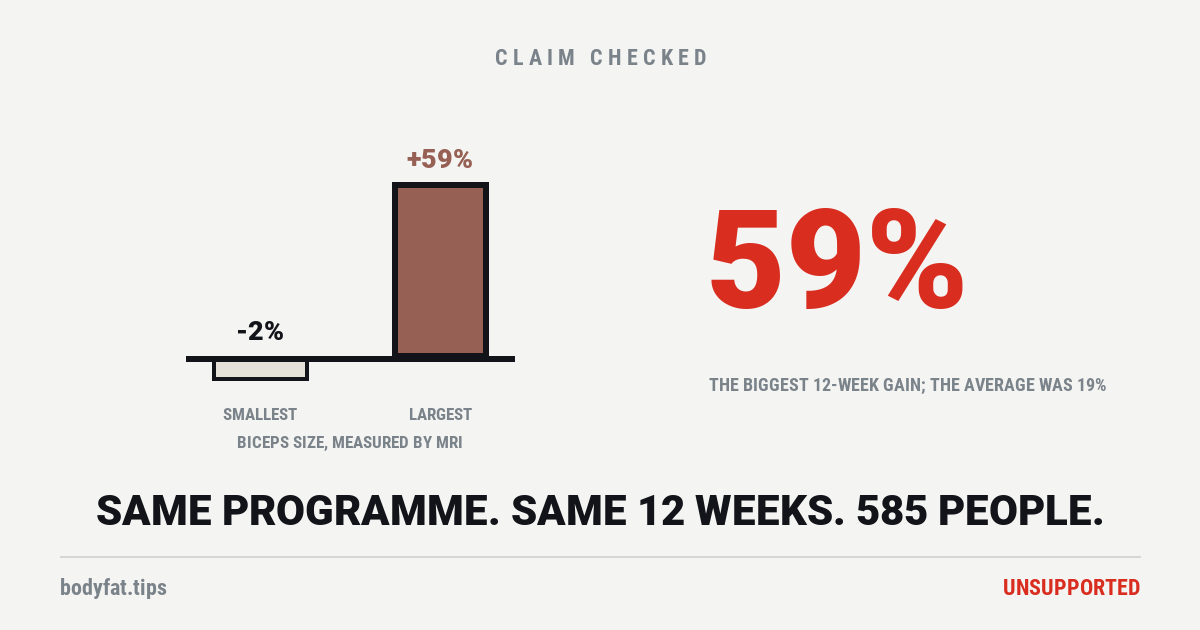
| Biceps size (MRI) | −2% to +59% |
| Strength, one-rep max | 0% to +250% |
| Isometric strength | −32% to +149% |
| Men vs women, size | men 20.4%, women 17.9%, on average |
| Men vs women, relative strength | women gained more |
Read the top row again. Same programme, same twelve weeks, measured the same way: one person’s biceps grew by 59%, and somebody else’s measured slightly smaller. [1] The middle is less dramatic. The average gain was 18.9%, and 232 of the 585 landed between 15% and 25%; 36 gained less than 5%, and 10 gained more than 40%. [1]
The researchers describe it plainly — “some subjects showing little to no gain, and others showing profound changes”. [1] Strength ranged from no change at all to more than tripling.
So the honest answer to “how long does it take” comes in two halves. For a group of beginners, there is one: in this study the trained biceps grew by close to a fifth in twelve weeks. Change can show up sooner than that. In a small trial of ten untrained young men, an ultrasound of the thigh read 2.7% larger in the third week and about 10% larger after ten weeks, though the authors concluded that swelling from the training itself may account for much of the early increase [4].
For you personally, it is less clear. The measured results ran from slightly smaller to 59% bigger, and what that spread means is still argued over. A Finnish laboratory that pooled ten of its own training trials, with 72 people randomised not to train, found the same kind of spread in its 287 trainees, aged 19 to 78, from −11% to +30% over 20 to 24 weeks; but the people who did not train moved too, from −11% to +17% [5]. A 2026 summary of the field’s conference on the question calls the 585-person study the landmark report, and says that telling real differences between people from random variation “remains challenging” [6]. A 2026 analysis of 102 trials, posted online as a preprint, without a journal’s peer review, comes down on one side: it found little sign that training makes results more variable than not training does, and argues that the average effect can be assumed to apply to everyone [7]. Whether you should expect roughly the average, or something far from it, is the open question. That is what this page’s Unsupported rating is about: a set gain by a set week, promised to one person. Measured results scattered widely in both large studies on this page, which is reason enough not to promise any one person a number, even if part of the scatter is noise. An average for a group of beginners does exist, and the rating is not about that.
What this does not mean
It does not mean training is a lottery, and it does not mean it might not work. Almost everybody in that study gained; the argument is about how much, not whether.
That training builds muscle is about as settled as anything on this site: a review of 121 randomised trials in older adults pooled 73 of them for strength and found a clear gain, large in the review’s main estimate and small in its most carefully run trials, creatine was one of two supplements out of 250 that beat lifting alone, and protein adds a measurable amount on top. The direction is not in question. The schedule is.
And the numbers you have seen quoted
You will find figures attached to this question — a pound a month, two pounds a month, a number for beginners and a smaller one after the first year. Here is what the large pooled studies actually measure.
In a 2018 review of 49 trials and 1,863 people, all of them lifting, protein supplementation added 0.66 lb (0.30 kg) of fat-free mass across the 26 comparisons that measured it, with a plausible range for that average of roughly 0.2 to 1.1 lb. The same paper is the source of “no further benefit beyond about 1.6 grams per kilogram a day”, a plateau its authors report as not statistically significant (p = 0.079). [2] A 2026 network analysis of 36 trials and 1,552 people, which set whey, casein, milk, soy, pea, rice and blends against placebo alongside supervised training, put whey 2.7 lb (1.24 kg) of lean mass ahead of placebo. That is the analysis’s own estimate, and its table of trials gets some of them wrong. [3]
Both of those are what a supplement adds on top of training. Neither is the answer to how much muscle training itself builds, and neither is a timeline. They get quoted as though they were both.
What to do instead of watching a calendar
— Judge by your own trend over months, not against a schedule. You are the only person whose response rate is knowable to you, and the only way to know it is to accumulate it.
— Twelve weeks is a reasonable first look, not a verdict. That is the window this study used, and it was long enough for the measured results to run from slightly smaller to 59% bigger.
— If you are new to lifting and progressing slowly, you may well be inside the published range. Somebody in that study trained under supervision for twelve weeks and measured slightly smaller. That is a documented outcome, not a personal failing.
One finding worth carrying separately. Men’s trained biceps grew 20.4% on average and women’s 17.9%, and on relative strength women gained more than men did, which the authors suggest may partly reflect women being less practised at the lift to begin with. [1] If you have been told women cannot build muscle, this is 342 women measured by MRI saying otherwise.
And the thing being sold against this question is certainty. A programme promising a specific result in a specific number of weeks is promising more than the evidence gives it: the studies give an average for a group, and whether any one person should expect that average is exactly what researchers are still arguing about. Here is how we grade this kind of evidence.
Related: the supplement shelf ranked by what held up, whey against plant protein, why your body fat reading is softer than it looks, and why the calorie arithmetic stops working after a few months.
Corrected on 30 September 2026. This page quoted the headline figure of our protein verdict as 0.66 lb “across 49 trials and 1,863 people”, with “no further benefit beyond about 1.6 grams”. That verdict was corrected today after an independent editorial review. The 0.66 lb pools 26 comparisons inside a review of 49 trials, all of them in people who lift, and the paper’s own results report the 1.6 plateau as not statistically significant (p = 0.079). The paragraph and the evidence panel now say both. The funding row said “Not stated in the sources read”; two of the three sources state it, and the row now gives what each says. This page’s rating is unchanged.
Corrected on 9 October 2026, after our resistance training for seniors verdict was corrected the same day. This page said 121 trials in older adults found a large effect on strength. That is the review’s main estimate; in its most carefully run trials the gain was small, and the link now says both. The provenance chain’s search figure now says where it came from and when we pulled it. Nothing else on this page changed, and the rating is unchanged.
Corrected again on 9 October 2026, after our whey versus plant protein verdict was corrected the same day. This page said whey beat placebo by 2.7 lb of lean mass across 36 trials. Those 36 trials compared several proteins with placebo, and the 2.7 lb is the analysis’s own estimate from them, drawn from a table of trials that our whey verdict found gets some of them wrong. The sentence and the evidence panel now say so. Nothing else changed, and the rating is unchanged.
Corrected a third time on 9 October 2026, after an independent editorial review of this page. This page said the 585-person study used each person’s untrained arm as their control, so that the spread of results was “the training, and nothing else”. The paper did not analyse it that way. Both arms were scanned, the untrained one, in the paper’s words, “to act as a control”, but each was analysed on its own, and every range it reports, the −2% to +59% included, is the change in the trained arm. With no training at all the untrained arm grew 1.4% and got 10.6% stronger on a one-rep max, so part of the spread is measurement and day-to-day variation, and the paper did not separate the two for each person. The page now says so; gives the study’s average (18.9%) and its middle (232 of 585 between 15% and 25%); says who took part (adults aged 18 to 40 who had not lifted in the previous year, training one arm); adds when change first shows on a scan; and reports what has been published on how much of such a spread is real, which is not settled. The headline no longer says one person lost 2%: the paper calls that end of the range “little to no gain”.
Also changed: the funding row said two of the three sources stated their funding and that we had not read the variability study’s own statement. All three state it, and the 30 September note above repeated the error; the paper names a US National Institutes of Health grant, and the row now covers the four sources added today as well. “Men gained 2.5% more size” was percentage points, and the page now gives both averages (20.4% and 17.9%). A line saying the study showed women need not train differently went beyond a study of one programme, and now says only that women build muscle. The link to our seniors verdict now says 73 of its 121 trials were pooled for strength. And a line saying the study “says nobody can promise” a timeline put our inference in its mouth; it is now marked as ours. The page now says what its Unsupported rating covers: a set gain by a set week, promised to one person. The rating is unchanged.