Cortisol Detox: The Treatment for Low Cortisol Is Being Given Cortisol.

There is nothing to detox. Cortisol is not a toxin that accumulates. It is a hormone you manufacture, need, and would die without.
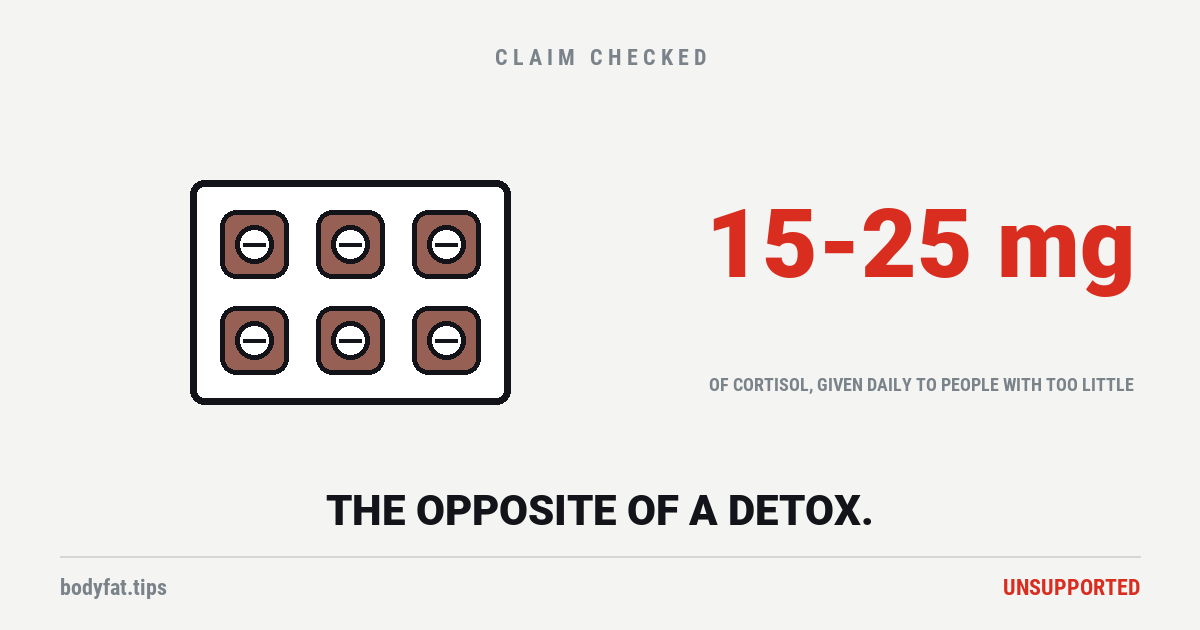
Here is the cleanest way to see it. When somebody genuinely has too little cortisol, the treatment is giving them cortisol — hydrocortisone, 15 to 25 milligrams a day. [2]
The product is promising to flush out the thing that doctors prescribe.
| Too much | Too little | |
| Name | Cushing’s syndrome | Adrenal insufficiency |
| People living with it | 57–79 per million — a few new cases per million a year: about 2 to 3 by one review’s counts [4], 2 to 8 by another’s estimate [9]; the steroid-induced kind is the commonest and is not counted here |
<279 per million — but the steroid-induced kind is common and is not counted here |
| Treatment | Remove the cause. When the cause is steroid medicine, whether and how fast to reduce it is for the doctor who prescribed it [6], never a call to make alone | Give them cortisol |
| Diagnosed by | Starts with one of these: urine collected over 24 hours, saliva taken late at night, or blood drawn after dexamethasone, a steroid tablet that switches cortisol off in a healthy body [5] | Blood drawn early in the morning [2] |
| Not by | A mirror, a questionnaire, or an “adrenal panel” you order for yourself. Each test above is ordered by a doctor, for a stated question, and read by one. | |
The adjacent idea was reviewed, and it failed
“Cortisol detox” is the newer wrapper. The older one is “adrenal fatigue” — the notion that chronic stress wears your adrenal glands out until they underproduce.
In 2016 two endocrinologists went looking for evidence of it. They searched three databases, screened 3,470 articles, and found 58 studies that met their criteria — 33 in people who were healthy or had burnout, which the reviewers counted as a stressful condition and not a disease, and 25 in patients with chronic fatigue syndrome or another illness. [1]
What they found was “an almost systematic finding of conflicting results”. [1] Their conclusion is one of the bluntest sentences in the medical literature:
“This systematic review proves that there is no substantiation that ‘adrenal fatigue’ is an actual medical condition. Therefore, adrenal fatigue is still a myth.” [1]
They also note that no endocrinology society recognises it. [1] For completeness: the journal published a correction to that paper the same year, and we have now read it. It says that “the comment section for row 12 in Table 1 should be blank” and reprints the corrected table [3]. That is the whole of it — a stray note in one row of a summary table. It does not touch the findings, the 58 studies, or the conclusion. We flagged it before we could read it because an unread correction sitting next to a paper’s central claim is worth declaring; now that it has been read, it turns out to be nothing.
What the tests are actually measuring
The review looked at which tests these studies used, and the list is worth seeing: waking cortisol, the cortisol awakening response, salivary cortisol rhythm. [1]
Those are the same measurements sold direct to consumers as “adrenal panels”. The reviewers describe the approach as “an unsubstantiated methodology in terms of cortisol assessment (not endorsed by endocrinologists)”, and separately criticise “the poor quality assessment of fatigue” across the studies. [1]
So the test that tells you that you need the detox is the test the reviewers say is not fit for the purpose.
The part of this that could actually matter to you
Here is where we stop being amused, because there is a real version of low cortisol and one form of it is genuinely common.
Adrenal insufficiency in its primary and secondary forms is rare — fewer than 279 people per million. But the glucocorticoid-induced form is described as common. [2] Glucocorticoids are steroid medicines: corticosteroids such as prednisone, which act like cortisol. Not the muscle-building kind.
Take more of one than your body would make for itself, for long enough, and your own production can switch off. The 2024 guideline written jointly by the European Society of Endocrinology and the Endocrine Society puts numbers on that for tablets: more than about 4 to 6 milligrams of prednisone a day, its estimate of the dose that matches what the body makes, for three to four weeks or longer. Any route can do it, the guideline says; joint injections are on its list, and so are inhalers and creams at high doses or after more than a year. [6] Those lines describe who is at risk. They are not a way to judge your own prescription.
While the medicine is being taken it does cortisol’s job, and there may be nothing to notice. The shortfall shows when the supply drops below what the body needs: a taper, a run of missed doses, a stomach bug, an illness that raises the need. [6] That is why doctors suspect it in people who have recently tapered or stopped. [2] And it usually mends: the guideline says the body’s own production comes back in most cases, over anything from a few months to, in some cases, four years, though the data behind that are thin. [6]
So if you take steroid medicine, nothing on this page is a reason to stop it or cut the dose on your own. The guideline puts the taper with the clinician who prescribed the medicine, who has to weigh it against the illness it was prescribed for. [6] If you have recently tapered or stopped and you feel terrible, that is a specific, recognised, treatable situation — and it belongs in front of that doctor, not a supplement. [2]
We are not printing a symptom list, deliberately. The symptoms are explicitly nonspecific — fatigue appears in 50 to 95% of cases, nausea and vomiting in 20 to 62% [2] — which means a checklist on a page like this would convert ordinary tiredness into self-diagnosis for thousands of people. The trigger worth knowing is the steroid taper. The rest is a blood test somebody qualified orders.
And the reason to take it seriously rather than treat it as a wellness question: untreated adrenal crisis “can cause hypotension and shock, hyponatremia, altered mental status, and death”. [2] In plain terms: blood pressure that falls dangerously low, too little sodium in the blood, confusion, and death. We said no symptom list, and this is not one. It is a narrow warning for people who take steroid medicine or have recently stopped: the 2024 guideline calls an adrenal crisis “a life-threatening emergency” and lists vomiting, collapse and confusion among its signs. [6] Those are for an emergency room, not an appointment.
So what were you actually looking for?
Most people searching this are not worried about their adrenal glands. They feel wired, tired, and want the feeling to stop.
That is a reasonable thing to want, and there is real evidence behind some of it — we went through it in what actually lowers cortisol, where pooled randomised trials show meditation and yoga do measurably move it, a little and on average. What that page also shows is that other stress markers moved in those trials, mostly measured in different people, so the pooled results cannot tell you whether the fall in cortisol is the reason any of it helps. That question has been tested directly, and it is not settled. A 2015 systematic review of how yoga reduces stress found five studies that had tested any explanation at all; by its summary, salivary cortisol was one of four explanations that held up, and the reviewers asked for larger, randomised, better-controlled studies. [7] A trial of yoga for chronic back pain ran the same kind of test, and cortisol did not qualify. [8]
Which makes “detox your cortisol” wrong about the direction, and unproven about the target.
The verdict
Cortisol detox is Unsupported, and not in the close-call sense. There is no accumulation to clear, no procedure described in the literature, and the treatment for genuinely low cortisol is a daily dose of the hormone the product proposes to remove.
Its predecessor concept, adrenal fatigue, was systematically reviewed and called a myth by the people who did the review. [1]
If you feel persistently awful, that is worth investigating properly — especially if you take steroid medicine or have recently come off it. We read the research; we are not your doctor, and this is one of the pages where that sentence is doing real work.
Related: how to lower cortisol · cortisol face and cortisol belly · high cortisol symptoms · cortisol rhythm and fat loss · ashwagandha benefits · all the habits we have checked
Two things on this page were corrected on 30 September 2026, after independent editorial reviews of two neighbouring pages. The table put two different kinds of number side by side. For Cushing’s syndrome it gave new cases in a year, 2 to 3 per million; for adrenal insufficiency it gave people living with the condition, fewer than 279 per million. Read across, that made one look about a hundred times rarer than the other. Counted the same way, 57 to 79 people per million live with Cushing’s, by the review the table already named, so the gap is at most about five-fold. The row now compares like with like, and that review is in the source list, where it had been missing.
And this page said 87 randomised trials show meditation and yoga lower cortisol, that six other markers moved at the same time, and that cortisol is “probably not the reason” any of it helps. The count was wrong and so was “at the same time”; both are corrected on that page. “Probably not” went further than the evidence, which is that nobody has tested it. The rating is unchanged.
The medical details on this page were corrected on 30 September 2026, after an independent editorial review of the page itself. The table gave one line for diagnosing both conditions: “A blood test a doctor orders. Not a mirror, not a questionnaire, not a saliva kit.” That is right for adrenal insufficiency and wrong for Cushing’s syndrome, where the Endocrine Society’s guideline starts with urine collected over 24 hours, saliva taken late at night, or blood drawn after dexamethasone; what separates a real test from a sold one is who orders it and why, not what is sampled. The page said the steroid-induced form of adrenal insufficiency comes from “taking steroids at high doses and then coming off them”. The 2024 guideline on it sets the bar far lower: any dose above what the body makes for itself, about 4 to 6 milligrams of prednisone a day, for three to four weeks or longer, and any route can do it. The page never told a reader who takes steroid medicine not to stop it alone, and it filed a possible emergency under “a doctor’s appointment”; it now says both, from that guideline. And it said hydrocortisone is taken “usually for life”. The review we cited for that, which we have read only as its published summary, gives no duration there, and the guideline says that in the steroid-induced form the body’s own production usually comes back. The phrase is gone. Both guidelines are now in the source list.
One correction is to the note above. It said, as the sentence it introduced did, that nobody has tested whether cortisol is the reason meditation and yoga help. That was wrong. A 2015 systematic review found five studies that tested what yoga’s effect on stress runs through, cortisol among the candidates, and a trial of yoga for back pain ran such a test and found cortisol did not qualify. Both are now cited, and the sentence says the question has been tested and is not settled. Also corrected. The table now says that prescribed steroid medicine is the commonest cause of Cushing’s syndrome as well as the common form of adrenal insufficiency, that neither count includes it, and that the Cushing’s counts were made from medical records. The evidence panel said of the 2016 erratum that “its contents were not available to us”; the text of this page has quoted that erratum since 1 September 2026, and the panel was never updated. The panel’s funding row read “Not stated in the sources relied on here”; the adrenal fatigue review states that it had none, and the row now covers every source on the page, as the study-design row now does too. That review’s 33 studies “in healthy people” were of people who were healthy or had burnout, which its authors chose to count as healthy. The figure printed as “nausea in 20 to 62%” is for nausea and vomiting. The $1.41 in the “What it costs you” box is what advertisers paid per click, not a cost to the reader; it and the 74,000 monthly searches now carry their country, source and date. Source [3] printed its DOI twice. The rating is unchanged.
One more change on 30 September 2026. The table gave new cases of Cushing’s syndrome as “about 2 to 3 per million a year” with no source beside it. That is the range of the counts in the 2021 review this page already lists, which is now cited there. A 2023 review in JAMA, which we have read only as its published summary, gives 2 to 8, and the cell now shows both. It came up while our page on high cortisol symptoms was being corrected the same day. Nothing else on this page changes.