Collagen Benefits: The Skin Trials Say Yes. Companies Are Behind Most.

In the trials, it works. Most of the trials have a company in them. Two meta-analyses by different teams pooled largely the same trials — 19 of the 26 in the 2023 review are also in the 2021 review’s reference list — and both found that collagen improved skin hydration and elasticity against placebo. [1][2]
That is more evidence than most things on the shelf next to it have, and we are not going to pretend otherwise because the category is expensive.
How much? The 2023 review pooled 18 of its trials for hydration and 19 for elasticity, and reported each result as a standardised mean difference: the gap between the collagen group and the placebo group counted in standard deviations, the yardstick researchers use when trials measured the same thing on different scales. On that yardstick 0.2 is called small, 0.5 medium and 0.8 large. Hydration came out at 0.63 and elasticity at 0.72. [1] Two cautions travel with those numbers. They are instrument readings, typically from a probe that measures water in the top layer of skin and a suction device that measures how far skin stretches and springs back; the review did not pool wrinkles. And the trials’ results spread far more than chance would explain: the review’s own measure of that, I-squared, the share of the spread that is more than chance would produce, came out at 70% and 84%, and it treats anything from 50% up as high. The spread is in size more than direction. On the review’s charts, 16 of the 19 hydration results and 17 of the 19 elasticity results put collagen ahead (one trial tested two collagens), at sizes from barely anything to 1.9 for hydration and 3.25 for elasticity.
The interesting part is underneath the result.
| Concern about | Trials given the middle grade |
| Missing outcome data | 13 of 26 |
| Departures from the assigned treatment | 7 |
| Which results were chosen for reporting | 2 |
| The randomisation process | 1 |
In half the trials, the reviewers worried about missing data
The 2023 review ran the Cochrane risk-of-bias tool, a checklist of the ways a trial’s design or conduct can tilt its own result, over its 26 trials. The tool grades each trial low risk, some concerns or high risk on five counts. For missing outcome data the reviewers gave the middle grade, “some concerns”, to thirteen of them. [1]
Missing outcome data means participants dropped out or their results never made it into the analysis. It matters more than it sounds, because the people who quit a skin-supplement trial are not a random sample — the ones seeing nothing have less reason to keep turning up. Lose them and the average quietly improves. That is the worry the grade points at. It is not a finding that it happened: “some concerns” sits below the tool’s high-risk grade, and no trial here was given that one.
The same middle grade went to seven trials for departures from the assigned treatment, to two for which results they chose to report and to one for its randomisation. The review’s own figure marks fourteen trials, not thirteen, for missing data and three, not two, for reporting; its text and its figure differ by one trial. No trial was graded high risk on any count, and twelve of the 26 were graded low risk on all five. [1]
None of that makes the finding wrong. It does mean the finding is resting on softer ground than a pooled p-value below 0.00001 makes it look.
Who paid for the trials
The 2023 review does not say. It names its own funder, a Taipei hospital, and nothing about who paid for the 26 trials it pooled. [1] The 2021 review we could read only as a summary. So we read the trials.
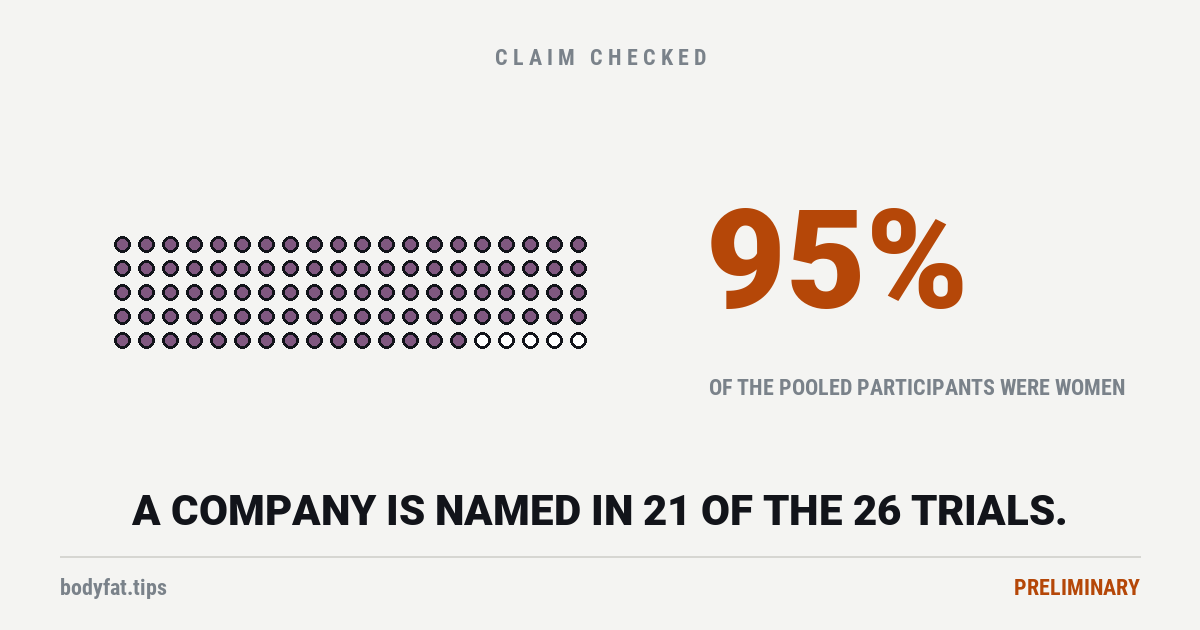
In 21 of the 26, the trial’s own paper or its publisher’s record names a company as the funder, the supplier of the product or the employer of one or more of its authors. They are mostly ingredient makers, supplement brands and cosmetics companies. Three trials name only a university or a state research fund, or say they had no grant. Two we could not settle: one shows no funding statement on the only page we could open, and one we could not find in full.
| What the paper names | Trials |
| A company as funder, supplier of the product or employer of an author | 21 of 26 |
| Only a university or state research fund, or no grant at all | 3 |
| Could not be read | 2 |
Has anyone checked whether that matters? One team has. A 2025 meta-analysis in The American Journal of Medicine pooled 23 trials, 18 of them among the 26 here going by its reference list, and found the same overall improvement. Then it divided them. In the trials that reported company funding the improvement was there. In the trials that did not, and in the trials it rated high quality, it found no significant effect. Its authors conclude there is “currently no clinical evidence to support” collagen supplements for skin ageing. [4] We have read that paper’s summary, its three summary charts, its reference list and its funding note (no funding, no conflicts declared). The full text is behind a paywall, so we cannot tell you how many trials sat on each side of those splits. What the charts do show is how widely the trials’ results spread: by the paper’s own measure, more than 90% of the spread between trial results on each of its three outcomes is more than chance would produce. On each chart three trials land below zero, by 0.4 at most, and the rest at or above it; one trial reports an effect more than ten times the size of most of the others, and on one outcome the pooled effect is no longer clear once a single extreme trial is set aside. [4]
And the split is disputed. A letter the same journal printed in November 2025 says five of the seven trials the paper treated as having no company funding were in-house trials run by collagen makers, which would mean the group it counted as free of company money mostly was not. [5] The letter’s authors state that they are employees of a private research firm and declare no conflict of interest. We cannot check their count against a table we have not seen. We can check the premise: one trial on the paper’s list has two authors from the company that supplied its collagen and says it “received no external funding”; another has three employees of the maker among its authors and no funding statement at all.
Read either way, the ground gets narrower. If the 2025 paper is right, the effect lives in the company-funded trials. If the letter is right, there were hardly any trials without a company in them to begin with. Our own count points the same way: of the 26 trials, three name no company in any of those roles and two we could not read.
A regulator has looked at one version of this claim. In 2013 the European Food Safety Authority gave its opinion on an application from Gelita AG to claim that VeriSol P improves skin elasticity. Gelita supplied the collagen, sold as Verisol, for two of the 26 trials. The company put forward two human studies. The panel found that one did not measure a function of the skin and the other showed no effect on the function it measured, and concluded that cause and effect had not been established. [6] That is an opinion on one product and the evidence one company submitted thirteen years ago. It does not judge the trials published since.
Ninety-five percent of the participants were women
The 2021 review pooled 1,125 people aged between 20 and 70, and states it plainly: 95% of them were women. [2]
So if you are a man buying collagen for your skin, the honest position is that you are extrapolating from a body of evidence that barely included you. It might work identically. Nobody has really checked.
This is the sort of thing that gets lost between a paper and a product page, and it is not a small detail — it is nineteen out of twenty participants.
The journal printed a letter about what was pooled
Just over three months after the 2021 review appeared online, the same journal published a letter about it from five researchers who were not its authors, titled “Concerning the heterogeneity of the studies included in meta-analyses”. We have read its title and its reference list; the letter itself is behind a paywall. [3]
As a statistic, heterogeneity is the share of the spread between the studies’ results that is more than chance would produce. The letter’s title, about the heterogeneity of the studies themselves, points at a different worry: whether studies this different belong in one pool at all — different products, doses, durations and measurement methods averaged into a single number. The 2023 review concedes the same point when it discusses the limits of the research, noting the studies “used different durations and forms of collagen supplementation, making it difficult to compare the results” and that sample sizes were “relatively small”. [1]
We are flagging the letter rather than adjudicating it. Two meta-analyses found an effect; a published letter, going by its title, questions whether the things pooled belonged together. Both are on the record.
Does it even reach your skin?
This is the objection people raise first, and it is weaker than it sounds, though it is not settled.
The intuition is that collagen gets digested like any other protein, so swallowing it can no more build skin than eating a brick builds a wall. But researchers tracked a specific collagen fragment — a three-amino-acid chain called Gly-Pro-Hyp — and found that in people it does appear in the blood after a dose of collagen. Getting from the blood to the skin is the part that has only been shown in animals: the same study found the fragment and its breakdown product in the skin of mice. [7] A second study gave rats a radioactively labelled version and found the label still in their skin 14 days later, when it had cleared almost everywhere else. But the same was seen in the rats whose tracer was plain proline, a single amino acid, so it does not show the fragment arriving intact. [8] The 2023 review describes both as animal work. [1]
So delivery to skin is plausible and, in people, unproven. It is still not the biggest problem here. The trials are.
Does collagen make you gain weight?
People ask it two ways. Will the scoop itself show up on the scale? And why did the scale go up after I started? The first has a number. The second has trials, more than you might expect, because collagen has been tested on weight from both directions: sold to some people to lose fat, and given to others while they built muscle.
How many calories are in a scoop?
Not many, and nearly all of them are protein. The US Department of Agriculture lists plain unsweetened gelatin powder, which is collagen cooked out of skin and bone, at 335 calories per 100 grams: 85.6 grams of protein, a trace of fat and no carbohydrate. [9] Collagen peptides are the same protein cut into shorter pieces, and their labels agree. Two unflavoured collagen-peptide powders we looked up in the National Institutes of Health’s supplement label database list 70 calories and 18 grams of protein for a 20-gram serving, which they call two scoops. [10] That is about 35 calories a scoop, and 70 calories is 3.5% of the 2,000-calorie day that food labels use as a reference (our arithmetic).
Calories are calories: seventy a day that replace nothing are seventy a day, from collagen or from anything else. But the powder is rarely the whole of what goes down. A flavoured collagen drink, a creamer or a smoothie adds calories of its own, and the label is the place to look.
What did the scale do in the trials?
We found nineteen randomised trials that gave people a collagen supplement and reported what happened to their weight, body fat or waist. In six, people were not on a training programme. In nine, they were. In four more, collagen was set against another protein: in three it was the comparison drink, and in one small crossover two branded supplements, a collagen and a whey, were compared head to head. Here is every one we found, scale first, because that is the question.
| Trial | Who, what, against what, how long | Scale: collagen vs comparison | Who paid or supplied |
| Not training | |||
| 2019, Korea [11] | 90 overweight adults, 81% women, average age 41: 2 g of skate-skin collagen a day against dummy capsules, 12 weeks | +0.4 lb vs +1.5 lb (+0.2 vs +0.7 kg); not significant | No outside funding declared; a Korean company supplied the capsules; one author works for a skate-products company |
| 2023, Korea [12] | 74 adults aged 50 and over (84 enrolled), 78% women: 15 g a day against a drink with no protein, 12 weeks | −1.1 lb vs −0.2 lb (−0.5 vs −0.1 kg); not significant | A cosmetics and supplement manufacturer, and a government industry grant |
| 2024, Spain [13] | 64 adults with overweight or obesity: 20 g a day of a collagen made to swell in the stomach, in two bars, plus diet advice, against diet advice alone; not blinded; 12 weeks | −6.6 lb vs −3.3 lb (−3.0 vs −1.5 kg) in the 39 of 64 the authors analysed (see below); significant | A public grant; the collagen’s maker employs three of the authors and funds the research centre |
| 2025, Netherlands [15] | 56 adults with overweight or obesity: 10 g a day against a calorie-free sweetener, 4 weeks | Body measurements not significantly changed (read as its summary) | Not read; sponsored by a university hospital |
| 2021, Denmark [16] | 208 adults over 65 in five groups: 40 g a day against a carbohydrate drink, one year | No measured outcome changed against the carbohydrate drink, body composition included (read as its summary) | University and public funds and a dairy-protein maker, which made every drink |
| 2025, Thailand [17] | 80 women past menopause, four groups of 20: 5 g of fish collagen a day against a placebo, 6 months | No significant change in body composition between the groups | A Thai government grant |
| Training (the first seven: 15 g a day against a calorie-free silica placebo, 12 weeks) | |||
| 2015, Germany [18] | 53 men over 65 with low muscle mass, lifting three times a week | −2.0 lb vs −0.7 lb (−0.9 vs −0.3 kg); not significant | The collagen maker supplied it and paid part of the costs; a 2025 correction said which costs and added a patent conflict |
| 2019, Germany [20] | 77 women aged 18 to 50, lifting | −1.1 lb vs −0.9 lb (−0.5 vs −0.4 kg); not significant | Part-funded by the same maker |
| 2019, Germany [21][22] | 57 men averaging 24, lifting | +4.4 lb vs +3.1 lb (+2.0 vs +1.4 kg); not significant. Its first 25 men, reported separately: +6.6 lb vs +3.3 lb (+3.0 vs +1.5 kg); significant | A private collagen research institute; the maker’s collagen |
| 2020, Germany [23] | 59 women averaging 26, running and bodyweight exercise | −0.4 lb vs −0.7 lb (−0.2 vs −0.3 kg); not significant | Part-funded by the same maker |
| 2021, Germany [24] | 97 untrained men aged 30 to 60 with overweight or obesity, lifting, in three groups, one of them on whey | −3.5 lb vs −3.1 lb (−1.6 vs −1.4 kg) against placebo; not significant | Supplied and part-funded by the same maker |
| 2023, Germany [25] | 32 men aged 18 to 40, running and bodyweight exercise | −3.3 lb vs −1.5 lb (−1.5 vs −0.7 kg); not significant | Part-funded by the same maker |
| 2023, Austria [33] | 75 mostly inactive men randomised and 55 analysed, group averages 26 and 27 years, running and bodyweight exercise | Weight not reported at the end. Fat −2.2 lb vs −1.5 lb (−1.0 vs −0.7 kg); not significant | Funded and supplied by the same maker |
| 2023, England [34] | 39 young men, lifting: 15 g a day against 15 g of maltodextrin, a starch-based carbohydrate, 15 weeks | +4.6 lb vs +2.0 lb (+2.1 vs +0.9 kg); not significant, though the collagen group’s own rise was significant | Funded by the private collagen research institute; the same maker’s collagen |
| 2025, Spain [26] | 90 adults aged 45 to 65 with aching joints, training twice a week: 10 g a day of collagen with magnesium, hyaluronic acid and vitamin C against a maltodextrin drink, 24 weeks | Weight fell in both groups; the gap between them was not significant | A Spanish supplement maker made both drinks; one author works for it |
| Collagen against another protein | |||
| 2009, US [35] | 9 women averaging 71 on a fixed diet, each taking both in turn for 15 days: two branded supplements, a fortified collagen and a whey, compared head to head | Weight fell significantly over the whey period and did not change significantly over the collagen period, each against its own start; the summary gives no test of the gap between them (read as its summary) | Not read |
| 2014, Nepal [36] | 18 trekkers walking 13 days to Everest Base Camp: a collagen drink against a leucine and whey drink with the same calories, twice a day | −2.3% vs −2.2% of body weight; not significant (read as its summary) | Not read |
| 2019, Brazil [14] | 37 women with overweight or obesity, average age 41: 26 g a day of collagen against whey, a milk protein, 8 weeks; the paper calls collagen its control | +1.3 lb vs −0.7 lb (+0.6 vs −0.3 kg); not significant (p = 0.089). BMI rose on collagen, p = 0.044 (see below) | No funding declared |
| 2020, Canada [37] | 32 men aged 65 and over (group averages 74 and 77), home resistance-band training: 40 g of collagen with sunflower oil, as the placebo, against a five-ingredient drink built on whey, casein and creatine, with the same calories, 12 weeks | +2.6 lb vs +2.2 lb (+1.2 vs +1.0 kg). Within the collagen group the rise was significant for BMI and borderline (just short of significance) for weight; within the other group, neither. The paper gives no test of the gap for weight | A Canadian government grant; a Canadian nutrition company made both drinks; the rival drink’s developer, founded by the senior author, paid three authors’ salaries, and five authors hold shares in it |
Read down the scale column. In no full trial that tested the gap between its groups did weight rise significantly more on collagen than on what it was compared with. Two small trials that set collagen against another protein report no such test for weight in what we could read, one of them only as its summary. In one, weight fell on whey and did not change significantly on collagen; in the other, BMI rose significantly only within the collagen group. Both are described below. One report from inside a trial did find a gain: 25 young men lifting weights three times a week put on 6.6 lb (3.0 kg) on collagen against 3.3 lb (1.5 kg) on the placebo. They were the first 25 men of a trial of 57, and with all 57 counted the gap was not significant. [21][22]
The Brazilian trial against whey comes closest, and its paper reports the result two ways. The collagen group’s weight edged up 1.3 lb (0.6 kg) while the whey group’s fell 0.7 lb (0.3 kg), a gap that missed significance (p = 0.089, just the wrong side of the line researchers use for “probably not chance”). Its BMI, which is weight scaled to height, rose on collagen with p = 0.044, just inside that line, and the authors write that collagen “increased body weight”. Yet their own results section says the BMI rise “did not differ among the groups”. In this trial collagen was the comparison: the paper calls the collagen group its control group. [14]
Two lifting trials leaned the same way without reaching significance. In 39 young men in England lifting for 15 weeks, the collagen group gained 4.6 lb (2.1 kg), a rise significant within the group, against 2.0 lb (0.9 kg) on a carbohydrate drink; in the German trial of 57 young men the figures were 4.4 lb (2.0 kg) against 3.1 lb (1.4 kg). [34][21] In both, the placebo groups gained weight too.
The placebos say something the trials did not set out to test. In the six German training trials, the Austrian one and the 2023 Korean trial they carried no calories: silica in the training trials, a thickened water in the Korean one. So the collagen groups were taking in about 50 more calories a day of protein for twelve weeks, and still, in those that weighed people at the end, counting the German lifting trial in full, the scale did not separate them significantly from the placebo groups. Trials this small could miss a gain that small. That is our reading of their designs, not a result any of them reported. [12][18][20][21][23][24][25][33]
Two of the placebo-controlled trials without training did report a little less fat on collagen, and both deserve a second look. In the 2023 trial of Korean adults over 50, fat fell 1.5 lb (0.7 kg) more on collagen, measured with bioimpedance, a scale-like device that passes a small current through the body and estimates fat and everything else from the water it finds (our verdict on body-fat scales covers how far to trust one), and the gap held on an X-ray scan too. Its authors write that they could not rule out that this was simply the extra protein, since their placebo had none. [12]
The 2019 skate-collagen trial reported the larger fat result, and its own pages disagree about it. In its table the collagen group lost 2.6 lb (1.2 kg) of fat while the placebo group gained 0.7 lb (0.3 kg), a gap of 3.3 lb (1.5 kg) that was significant. Its summary also reports a significant gap in body fat percentage, −1.2% against 2.7%, figures its own table does not contain: there the changes are −0.6 against −0.2 points, and the gap was not significant. Body fat percentage is the main outcome in its registry entry, which was filed after the trial had begun, and the paper says its main outcome “was changed”. The figures do not square either. In that table the collagen group lost 2.6 lb (1.2 kg) of fat and 0.2 lb (0.1 kg) of lean tissue while its weight rose 0.4 lb (0.2 kg), and at the start its fat and lean tissue already added up to 3.1 lb (1.4 kg) more than its weight, before any bone. On the scan it used, fat, lean tissue and bone add up to the body’s weight (our arithmetic; the paper does not discuss it). [11]
The biggest result came from the trial least like a tub on a shelf. In Spain, adults with overweight or obesity who ate two bars a day of a collagen engineered to swell in the stomach, plus diet advice, lost 6.6 lb (3.0 kg) in 12 weeks against 3.3 lb (1.5 kg) on the diet advice alone. There was no dummy bar, so everyone knew which group they were in; of the 64 enrolled, the authors analysed 39, and among those they left out were 10 who reported not following the diet advice at all and 1 found to have lost weight before the trial began; and three of its authors work for the company that makes the collagen, which also funds the research centre. [13]
The other three trials of collagen against a dummy or a carbohydrate drink found no significant change: a year of 40 grams a day in Danish adults over 65, four weeks of 10 grams in adults with overweight in the Netherlands, six months of 5 grams in Thai women past menopause. [15][16][17]
Besides the Brazilian trial, three small trials set collagen against another protein, and in what we could read only one of them tested the gap for weight. Trekkers to Everest Base Camp lost 2.3% of their weight on collagen against 2.2% on a leucine drink, a gap that was not significant. [36] Older Canadian men training with resistance bands gained 2.6 lb (1.2 kg) on collagen with sunflower oil against 2.2 lb (1.0 kg) on a whey-based drink with the same calories. Within the collagen group the rise was significant for BMI and borderline, just short of significance, for weight; within the other group neither was; and the paper gives no test of the gap between the drinks for weight. The collagen group’s food records, the drink included, also rose significantly, by about 390 calories a day, while the other group’s fell slightly (our subtraction). [37] And nine older American women held to a fixed diet took two branded supplements in turn, a collagen and a whey, for 15 days each: weight fell on the whey and did not change significantly on the collagen, and the summary does not say whether the two differed. [35]
A 2023 review that pooled collagen trials reported 2.7 lb (1.21 kg) less fat on collagen than on placebo. [38] Its fat figure pools four trials: three of the German training trials above, all with the same maker’s collagen, and the Korean skate trial. Its weight figure, from six trials, showed no significant difference, and the trial given the most weight in it was of a Japanese skin product with 900 mg of collagen among four other ingredients, which we left out of the table because it does not test collagen. [38]
Isn’t the extra weight just muscle?
That is how the pages a search engine’s AI answer cites explain a rising scale: lean muscle, not fat. [32] In most of the training trials that measured it, the collagen groups did gain more fat-free mass, which is everything that is not fat: muscle, organs, bone and the water they hold. Before you lean on that, look at who ran the trials.
Eight of the nine training trials used collagen from the gelatin maker that supplied two of the skin trials above, and that maker or a private collagen research institute paid for, or helped pay for, all eight. Six were run in Germany, one in Austria and one in England. [18][20][21][23][24][25][33][34] A 2024 review pooled eight trials like these and found more fat-free mass on collagen than on placebo, a standardised gap of 0.48, just under what the yardstick above calls medium. [27] We read its list. All eight had product or money from that maker or that institute. Two of the eight are the same 25 men, reported once on their own and again inside the full trial of 57. [21][22] The review’s senior author is an author of six of the eight, and six of the eight measured fat-free mass with bioimpedance, which estimates it from body water. [27] A 2026 analysis that ranks protein supplements against each other went further and put collagen ahead of whey for fat-free mass. Going by its reference list, its collagen figure for that outcome rests on those same two papers: the same 25 men, counted twice. [28]
When the first of these trials, in older men, reported that the men on collagen had gained 9.3 lb (4.2 kg) of fat-free mass and lost 11.9 lb (5.4 kg) of fat in 12 weeks, six university protein researchers wrote to the journal calling the results “extraordinary”. The gain was larger than men on weekly testosterone injections had made in a training trial, they pointed out, and it came from 15 grams of a protein carrying less than half a gram of leucine, the amino acid most tied to building muscle. Three of the six declare grants, fees or advisory roles with dairy, beef, egg or other food companies, and dairy, beef and eggs are rival proteins. [19] The trial’s paper had said that the collagen maker provided the product and paid “part of the costs”. Ten years later the journal printed a correction saying which costs, the participants’ compensation and the lab work, and adding that one author is a co-inventor on a 2013 patent application for the substance it tested. [18]
This does not tell you whether collagen builds muscle; we have not rated that here, and our verdict on how much protein it takes to build muscle covers protein and training generally. For the weight question it tells you two things. In the full trials the scale did not separate collagen from placebo significantly anyway. And when someone says a rising scale is muscle, the evidence for that, with collagen, comes mostly from one company’s product, measured with a device that reads water.
Does collagen help with belly fat?
The trials that measured the belly do not support it. In the 2023 Korean trial, trunk fat, the area of fat around the organs and the waist-to-hip ratio all fell a little more on collagen, and none of those gaps was significant. [12] In the skate-collagen trial, the depth of the belly lying down fell by the same 0.04 inch (0.1 cm) in both groups. [11] In the German trial of 97 men with overweight, waists shrank 1.3 inches (3.4 cm) on collagen and 1.0 inch (2.5 cm) on placebo, a gap that was not significant, in groups whose waists differed at the start. [24] In the Thai trial, the waist-to-hip ratio and the area of fat around the organs did not change significantly. [17] Against whey, the fat over the belly on an X-ray scan fell on whey and rose slightly on collagen, a gap that was significant, in whey’s favour. [14] The one trial with a smaller waist on collagen was the open Spanish trial of the swelling collagen against no bar at all, and in it the fat around the organs did not fall significantly more than in the comparison group. [13]
Does collagen make you bloated, puffy or hold water?
Two of the pages the AI answer cites go further than calories. A supplement seller tells readers it is “completely normal to experience mild bloating or water retention” when you start. A clinician’s brand site that sells collagen puts a number on it: a one-to-three-pound rise in the first few weeks, gone within four to six. Neither cites a study for that. The seller’s page links one trial, the Spanish one in the table, and only for the idea that collagen helps you feel full. [32]
Here is what the trials counted. Most recorded only the complaints people volunteered, and few were made. In the skate-collagen trial one person on collagen left with indigestion, which the investigators judged unrelated; in the Brazilian trial two women on collagen left because they could not take the supplement, and three on whey left with nausea; in the German and English training trials that reported it, nobody left because of a side effect; and the Spanish trial, whose collagen is built to swell in the stomach, reported no side effects. [11][14][13][20][23][24][25][34]
Three small randomised trials looked for stomach symptoms on purpose. Fifteen active young women each spent a week on 15 grams of collagen a day and a week on a flavoured water, scoring nausea and stomach discomfort every day: stomach discomfort did not differ significantly between the two weeks, nausea if anything ran slightly higher on the water, and bloating was not asked about by name. [29] Twenty well-trained adults took 10 grams a day or a flavour-matched placebo for a week before a hard 70-minute run, and were asked about bloating by name during the run: 45% reported some on collagen and 40% on the placebo, and the authors found no significant difference in stomach symptoms between the two. That is a trial of stomach upset during hard exercise, not of everyday bloating. [39] Both were paid for by the same collagen maker, which employs two authors of each. In an eight-week skin trial of 52 women, paid for by another collagen maker, a dermatologist scored stomach side effects at four and eight weeks and recorded none. [40] A larger trial by the first maker, of collagen for stomach discomfort in 116 adults, finished in November 2025; its registry entry shows no results yet, and we found no paper. [31]
A study that tracked bloating for eight weeks cannot answer the question. Thirty-six women with digestive complaints started on 20 grams a day for eight weeks, with no comparison group; 14 finished, and 13 of the 14 reported fewer digestive symptoms, bloating among them. It was paid for by the first maker, which employs one author and paid another as a consultant. With no comparison group and most people gone, it cannot say whether collagen did that. [41]
Water is easier, because one of these trials measured it. In 59 young women running and doing bodyweight exercise for 12 weeks, total body water rose 1.3 lb (0.6 L) on collagen against 0.4 lb (0.2 L) on placebo (our conversion; a litre of water weighs a kilogram). The extra was inside the cells, where muscle keeps its water. Water outside the cells, the kind that collects as swelling, rose by about as much in both groups, 0.7 lb against 0.4 lb (0.3 L against 0.2 L), a gap that was not significant, and on the scale both groups ended slightly lighter. These are bioimpedance estimates, from a trial paid for in part by the collagen maker. [23] They were taken at 12 weeks. No trial we read measured body water in the first few weeks, which is where the one-to-three-pound story sits. Two give figures from the early weeks. After six days on each, the 15 women in the week-long trial above weighed 133.2 lb (60.4 kg) on collagen and 133.4 lb (60.5 kg) on the flavoured water, figures the trial did not compare (setting them side by side is our reading). [29] After four weeks, the Dutch trial’s summary reports body measurements not significantly changed. [15] Neither trial was built to look for water.
So why did my weight go up?
The trials cannot see your scale. What they can say is that, as groups, people taking collagen, at 2 to 40 grams a day for four weeks to a year, did not gain significantly more on the scale than people taking a dummy or a carbohydrate drink, in any full trial that tested the gap. Against another protein there is less to go on: two small trials tested the gap for weight and found it was not significant, and two report no test of it in what we could read. The near-exceptions are above: 25 young lifters counted on their own; a BMI rise in one small trial against whey that its own paper reports two ways; and the two trials without a test, one in which weight fell on whey and did not change significantly on collagen, and one in which BMI rose significantly only within the collagen group, whose recorded calories also rose. Where lifters on collagen gained weight, lifters on placebo gained too. So if yours went up, look at what else changed. Check the label of whatever the collagen goes into. Then look at anything that started at the same time: a new training plan, more food to go with it, more salt, or the ordinary day-to-day swing of a body that is mostly water. We cannot tell you which, because we do not know you.
This is journalism, not medical advice. Weight gain you cannot account for, or swelling in your ankles, legs, hands or face, is a reason to see a clinician, not a reason to switch supplements.
How we rate the weight questions
Collagen makes you gain weight: Unsupported, of the tested kind. In the nineteen randomised trials we found, weight did not rise significantly more on collagen than on the comparison in any full trial that tested it. Two reports come closest. The first 25 men of a lifting trial gained significantly more on collagen, where the extra was fat-free mass, and the full trial of 57 found no significant gap. In 37 women given collagen or whey, BMI rose on collagen (p = 0.044) and the authors write that collagen increased body weight, while weight itself missed significance and the paper’s results section says the BMI rise did not differ between the groups. Two small trials against another protein report no test of the gap for weight in what we could read (one we could read only as its summary). In that one, weight fell over 15 days on whey and did not change significantly on collagen; in the other, BMI rose significantly only within the collagen group, whose recorded calories rose too. In the full German trial and the English one, the collagen groups gained 1.3 lb (0.6 kg) and 2.6 lb (1.2 kg) more than the placebo groups, gaps that were not significant (our subtraction). Most of the trials were small and short, and small trials can miss a small gain. That is the limit on this rating.
Collagen takes off belly fat: Unsupported, of the tested kind. Four placebo-controlled trials measured the belly, by the waist, the trunk, the fat around the organs or the depth of the belly, and found no significant gap; against whey, belly fat went the wrong way on collagen; the one smaller waist came from an open trial of a specially made collagen against no bar at all.
Collagen on its own takes off body fat: Preliminary. Two small Korean trials against a dummy found 1.5 to 3.3 lb (0.7 to 1.5 kg) less fat on collagen over 12 weeks, with no significant difference on the scale. One of them reports figures that do not add up, had its capsules supplied by a company and counts a skate-products company’s employee among its authors; a company paid for the other. Three other trials against a dummy or a carbohydrate drink found no significant change, one of them a year long. That is early, small and conflicting evidence in its favour. These three ratings are ours, for these questions; the page’s rating, for skin, is unchanged.
How we found these trials: PubMed by title and abstract in several wordings (collagen peptides, hydrolysed collagen, collagen hydrolysate and gelatin, with body weight, body fat, obesity, waist and body composition; with whey and other proteins, for trials that set collagen against another protein; and separately with bloating, stomach symptoms and water retention), Europe PMC, the ClinicalTrials.gov registry, the trial lists of three reviews of collagen and body composition, from 2023, 2024 and 2026, [38][27][28] and three ordinary web searches, their first pages read. The English lifting trial turned up only in two of those lists: its summary never mentions weight. We counted collagen given on its own or with small additions: vitamins and minerals, hyaluronic acid in one trial, and sunflower oil in another, matching the fish oil in the drink it was compared with. We left out mixtures in which collagen was one of several unrelated ingredients, such as the Japanese skin product in the 2023 review, and two trials that used collagen as the comparison for whey-based drinks, whose full reports we could not open and whose summaries give lean mass but not weight. [42][43] A skin or joint trial that weighed people only as a safety check, without saying so in its summary, would not have turned up in these searches. One trial built for exactly this question has not reported, as far as we can find. A placebo-controlled trial of a branded fish collagen in 40 overweight men in Lille, France, with weight as its main measure, finished in the summer of 2019, after mouse work on the same product. Its registry entry shows no results, and we found no paper reporting them. [30]
What this page will not tell you
Which one to buy. There are about 33,100 US Google searches a month for the best collagen supplement, and advertisers pay an average of $3.69 a click for them (from a paid keyword database, pulled 14 August 2026). That is a good reason for someone to write that page. It is not a reason for us to.
Whether marine beats bovine. The 2023 review compared sources and found no significant difference for elasticity; for hydration it did find one. But its bovine evidence is a single trial of 72 women, whose results in the review’s analysis were not statistically significant on either measure, so marine against bovine cannot be settled from these data. [1]
A dose. Sources, forms and durations varied across the trials, which is exactly the heterogeneity the letter’s title points at. The 2021 review concludes that 90 days of collagen is effective [2]; the 2023 review found a hydration effect from four weeks and a larger one in trials that ran past eight. [1]
What collagen does on its own, in nearly half the trials. Twelve of the 26 tested a product with other active ingredients in it — vitamins, zinc, coenzyme Q10, hyaluronic acid, astaxanthin — although the 2023 review says it excluded trials of collagen combined with another supplement. [1] In the seven of those we could read in full, the comparison group got none of the extras either, so nothing in those trials separates collagen from what came with it.
Anything about joints, hair, nails or muscle. This page rates one claim about skin and, above, three about weight, reading the muscle trials only for what they show about weight and fat. Hair has its own verdict. Joints, nails and muscle have their own trials, and this page does not rate them.
The verdict
Collagen supplements improve skin hydration and elasticity: Preliminary. There are real trials, and pooled they show better instrument readings against placebo — 26 trials that two overlapping reviews pooled, not 45 across two independent ones, with a third meta-analysis finding the same overall effect. [1][2][4] We had rated this Supported. On the evidence as it now stands on this page, that was a rung too high: the trials are mostly tied to the people selling the product, their results differ in size far more than chance would explain, and the one analysis that looked at the better and the more independent trials separately found nothing clear in them.
The limits are real and they are specific. A company paid for, supplied or staffed at least 21 of the 26 trials, and an analysis that split trials by funding found no significant effect in those without company money or in those it rated high quality, a split a published letter disputes. [4][5] The reviewers had concerns about missing data in half the trials. Twelve trials tested blends. The participants were 95% women, none of the 26 gave collagen for longer than about three months, the studies were small and inconsistent, and the reviewers themselves say larger trials are needed. [1][2]
Which is an unusual place to land. Most of what this site checks either works or does not. In the trials, this works — and the evidence that says so is weaker, and closer to the people selling it, than the confidence with which it gets sold.
Related: creatine benefits · magnesium benefits · fish oil benefits · ashwagandha benefits · best supplements for muscle growth
This page was corrected on 30 September 2026 after an independent editorial review, and the corrections change what it says the evidence is. It said two independent meta-analyses had pooled 45 randomised trials. They are not independent and there are not 45: 19 of the 26 trials in the 2023 review are also in the 2021 review’s reference list, so the page had counted the same trials twice. Under Industry funding it said the funding of the pooled trials was not reported. It is, in the trials’ own papers, which we had not read: a company is named as funder, supplier or an author’s employer in 21 of the 26, three name none and two we could not read. And it left out a 2025 meta-analysis, published fifteen months before this page, that found no significant effect in trials without company funding or in trials it rated high quality. That analysis is now here, with the published letter that disputes how it sorted the trials.
Also corrected: mouse and rat experiments on collagen reaching the skin were reported as if they had been done in people. The reviewers’ bias grades were described as faults the trials had, when every one was the tool’s middle grade, “some concerns”, and no trial was graded high risk. A letter from five researchers was called the journal’s objection to its own paper and dated a year after the review; it appeared three months after. Searches were counted as people, and a conclusion about marketing was drawn from a keyword score; that sentence is gone. New on the page: how large the pooled effect was and what was measured, that twelve trials tested blends, that this page covers skin only, and a 2013 opinion from the European Food Safety Authority on one company’s claim. The headline and search description were changed to match.
The rating has changed with them, from Supported to Preliminary. The trials are real and the pooled effect is there. But a company is named in most of them, they disagree with one another to a degree the reviews themselves call high, nothing ran longer than about three months, and the one analysis that separated the trials by funding and by quality found no clear effect in the ones best placed to be believed. Supported, on this site, means the evidence is consistent with known limits. This evidence is not yet consistent.
One explanatory sentence was corrected on 1 October 2026. We wrote that heterogeneity means the pooled studies “were not really measuring the same thing”. As a statistic it is the share of the spread between studies’ results that is more than chance would produce; the letter’s title uses the word for whether studies this different belong in one pool, and the sentence now says both. Nothing else changes.
Corrected on 7 October 2026. The page and its provenance chain gave monthly search figures for collagen supplements, and what advertisers pay per click, without saying where they came from or when. They come from counts of US searches in a paid keyword database, pulled on 14 August 2026, and both now say so and name the search each figure counts. One figure had been rounded: the data hold 33,100 searches a month for the best collagen supplement, and the page now prints that rather than 33,000. The rating is unchanged.
Corrected on 23 October 2026. On 1 October we corrected this page’s definition of heterogeneity and left three sentences reading it the old way: that the 2023 review’s trials “disagreed with one another far more than chance would explain”, and that the 2025 review’s charts show “how far the trials disagree”, with more than 90% of the spread “real disagreement”; and, in the verdict, that the trials “disagree with one another far more than chance would explain”. The figure behind both, I-squared, is the share of the spread between trials’ results that is more than chance would produce. It does not say the trials pointed different ways, and on both reviews’ charts they mostly did not: nearly all put collagen ahead, at very different sizes, with two or three per chart slightly below zero. All three now say that, and so will the summary shown with the page. No figure we had printed changes, and the rating is unchanged: Preliminary.