Box Breathing: It Works. So Did Everything Else They Tested.

Four seconds in. Hold four. Four out. Hold four. Repeat.
Box breathing is famous (Google users in the US search for it about 49,500 times a month, by the count we pulled on 6 August 2026), and it has a good story attached — equal inhale, hold and exhale ratios, used in the military for stress regulation, sometimes called tactical breathing. [1]
Somebody tested it for a month against the alternatives. Here is what that found, and it is not what either the fans or the sceptics expect.
| Practice | People | Mood gain |
| Cyclic hyperventilation | 33 | 1.97 |
| Cyclic sighing | 30 | 1.89 |
| Box breathing | 21 | 1.84 |
| Mindfulness meditation (control) | 24 | 1.22 — not significant |
It works. So did everything else.
A trial ran 108 people through 28 days of a five-minute daily practice. [1] Three breathing techniques, plus mindfulness meditation as the comparison:
• Cyclic sighing — long, drawn-out exhales.
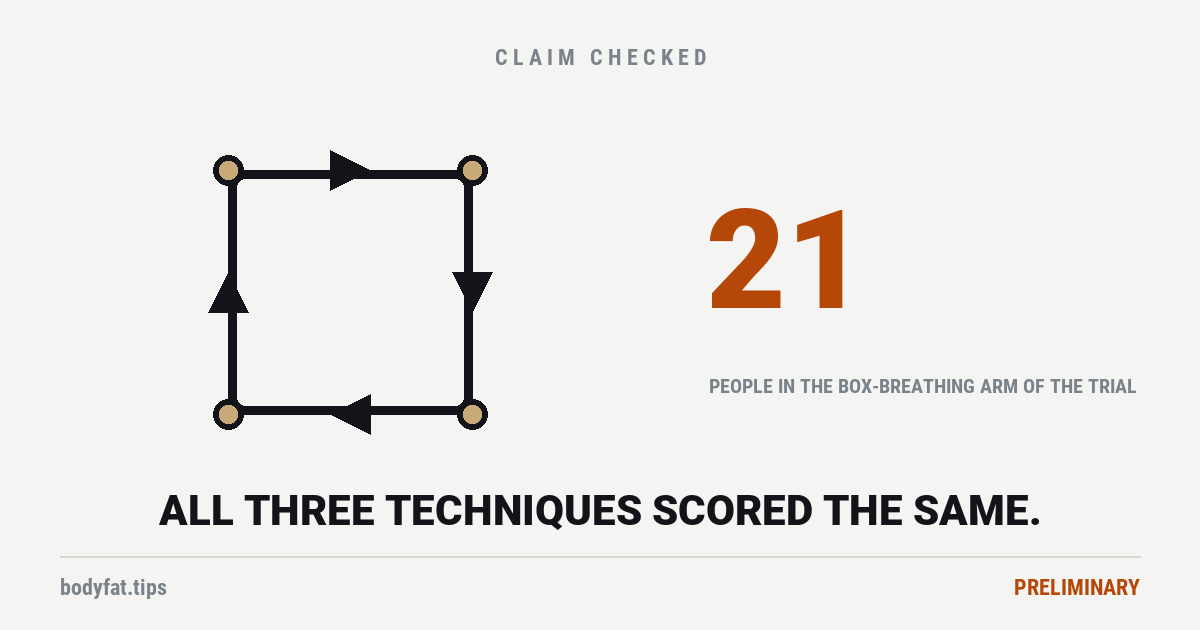
• Box breathing — the famous square.
• Cyclic hyperventilation with retention — long, forceful inhales and short exhales, then, every 30 breaths, a 15-second hold with the lungs empty.
The volunteers were mostly Stanford undergraduates, recruited remotely in the summer of 2020, with an average age of 28 and just over two-thirds of them women. Anyone reporting a moderate-to-severe psychiatric or medical condition that taking part might worsen, such as heart disease or pregnancy, was left out. [1]
All three breathing groups came out of each session in a slightly better mood, on a positive-mood score that runs from 10 to 50, and in each group the lift was statistically significant: too big and too consistent to put down to chance. Box breathing came in at 1.84. Cyclic sighing at 1.89. Cyclic hyperventilation at 1.97. [1] Those are, for practical purposes, the same number.
Meditation — the control — managed 1.22, and that one did not reach significance: its p-value of 0.06 is just the wrong side of the line researchers use for “probably not chance.” [1]
But each of those numbers is a group measured against itself. The comparison that matters is box breathing against meditation, and that gap was not statistically significant either: of the three breathing patterns, only cyclic sighing’s lift beat meditation’s by more than chance could explain. [1] Mood was also one of three things measured before and after every session. On the other two, anxiety and bad mood, meditation’s average improvement was at least as big as box breathing’s: anxiety fell 3.95 points against 3.75 on a scale from 20 to 80, and bad mood 1.62 against 0.83 on a scale from 10 to 50. The paper found no difference between meditation and the breathing groups on either. [1]
So the takeaway is not that box breathing is useless. People came out of it feeling a little better. The takeaway is that the square is not the active ingredient. Three quite different breathing patterns produced almost identical lifts, which points away from any particular rhythm. What this trial cannot tell you is whether the work is done by controlling your breathing or simply by five quiet minutes: meditation, which only watches the breath, did as well on anxiety and bad mood, and nobody in it was assigned to sit quietly and do nothing in particular.
Then why does the paper talk about sighing?
Because of a second measurement, and it is worth understanding rather than glossing over.
The headline finding is that breathwork — “especially the exhale-focused cyclic sighing” — produced greater improvement in mood and a bigger drop in breathing rate than mindfulness meditation. [1] That is a comparison against meditation, not against box breathing. And it looked at the slope — how much the improvement kept building across the month — rather than just the before-and-after gap.
Worth noting too: the paper says the researchers expected cyclic sighing to beat the other two breathing patterns. [1] Nothing on the public record shows that prediction was made before the data came in. The trial was registered on 11 March 2022, nearly eighteen months after its data collection ended on 17 September 2020, and the registry entry does not mention it. [1] Nor was the prediction tested head to head: the groups were too small to compare the breathing patterns with each other, the authors say, so each was compared only with meditation, and sighing was the one that came out significantly ahead. When a 2026 study did put box breathing and cyclic sighing head to head, in one-minute bursts at anxious moments in daily life, it found no difference between them. [7]
The number that decides the tier
Twenty-one people finished that trial in the box-breathing group. Nineteen were in the physiological analysis. [1]
It is not nothing. It is a randomised trial with an active comparison group, and the people in it felt a little better after each session. But it was registered only after its data were in (the authors say it began as an exploratory study and “was not pre-registered”), nobody in it was blinded to what they were practising, and box breathing did not beat the comparison group by more than chance could explain. [1]
It is not the only test the square has had, though. Box breathing, also called square or tactical breathing, has been set against other techniques, or against doing nothing, in about a dozen small studies, most of them short. Here are six that measured stress, anxiety or mood:
• Against a body scan, and against recorded rain and water sounds. 240 Italian adults, one seven-minute online session in May 2020, under COVID-19 restrictions: stress ratings fell by almost exactly the same amount in all three groups. The paper’s summary says the two guided exercises beat the recorded sounds, but that difference was there before anyone pressed play; the sounds group simply started out more stressed. [3]
• Against a long, slow exhale. 30 healthy volunteers tried both during a stressful timed colour-word test with rising white noise. There was no difference in how stressed they felt; tactical breathing, the military version of the square, kept their bodies calmer, while the long exhale got them better scores. [4]
• Against 4-7-8 breathing and six slow breaths a minute. 84 college students tried every pattern. Six breaths a minute raised heart rate variability, the beat-to-beat variation in heart rhythm that rises as the body relaxes, more than the square did, and none of the patterns changed mood in any meaningful way. [5]
• Against weeks without it. 43 junior doctors in Germany who chose box breathing alternated weeks of doing it for six minutes a day with weeks off, for four weeks. Their daily stress fell by an average of 0.07 of a point on a 1-to-10 scale, and the range the true answer probably sits in still includes no effect at all. Seven of the 43 seemed to respond. [6]
• Against cyclic sighing, and against doing nothing. 47 university students used a one-minute exercise at anxious moments in daily life, getting each option in random order. Both breathing patterns eased anxiety more than doing nothing, and there was no difference between them. [7]
• Against a slow-exhale breath and breathing normally, before a mock job interview. 66 young adults recruited on a university campus, averaging about 21 years old, 22 in each group. A saliva marker of the body’s fight-or-flight response rose less with either technique than with normal breathing, and heart rate stayed lower with box breathing; by the end, anxiety was level across all three groups. [8]
Add it up. The square won on one measure, lost on others, and mostly tied with whatever it was up against. Against doing nothing, it helped in the moment in two studies and made no clear difference over four weeks in a third. None of these studies is large, most measured a single session, and no meta-analysis, the kind of study that pools the others to get a bigger answer, has looked at box breathing on its own. That is precisely what our Preliminary rating means.
The category is on firmer ground
Zoom out from the square and breathwork generally looks better.
A meta-analysis pooled 12 randomised trials covering 785 adults and found breathing practices reduced self-reported stress. [2] The effect size was 0.35 — and since that number means nothing on its own, here is the scale: researchers call 0.2 small and 0.5 medium. So this sits between the two. A real effect, not a dramatic one.
Anxiety and depressive symptoms moved by similar modest amounts across 20 and 18 trials respectively. [2] The stress benefit was clear in the five trials of healthy volunteers. In the six trials of people with a physical illness, and the one of people with a mental-health condition, it did not reach significance, though those groups did not differ significantly from the healthy volunteers either. [2]
The catch is quality. Most of the studies were at moderate risk of bias, and the authors closed with a sentence we would happily have as a masthead: they urge caution to avoid “a miscalibration between hype and evidence.” [2]
What we would want to see
A trial with a few hundred people per arm, comparing box breathing against other patterns directly rather than against meditation, measuring the same outcome at the same time, and running long enough to see whether anything outlasts the session. The direct comparisons that exist are small, and most last a single sitting.
There is also a nice honesty in the study design worth flagging: eight households were deliberately assigned the same technique, so housemates could not contaminate each other’s practice. The researchers note this is why the groups came out uneven sizes. [1] That is the sort of detail that usually gets buried. The trial’s flow chart adds that 134 people were randomised and 108 were still in it at the end, so the group sizes also reflect who dropped out. [1]
The verdict
Box breathing is Preliminary. Five minutes of it lifted mood a little straight after each session, about 1.8 points on a scale that runs from 10 to 50, in twenty-one people, by the same margin as two other techniques that look nothing like it and not by significantly more than meditation. Whether a month of it changes how you feel in general was not shown: trait anxiety, how anxious a person feels in general, was measured at the start and end of the month and did not move in any group. [1] In four weeks of daily life, junior doctors who took it up saw no clear drop in stress, [6] and the smaller head-to-head studies found the square tying with the alternatives more often than beating them.
Controlled breathing in general is on better footing, with a modest but real reduction in stress across 785 people. If you want the version the evidence points at most specifically, the trial’s own conclusion named daily five-minute cyclic sighing — the long-exhale one — not the square. [1] A 2026 study that put the two head to head, for anxiety in daily life, found no difference between them. [7]
None of which is a reason to stop, if you already do it and it helps. It costs five minutes and nothing else. Just know that the box is a convenient shape to remember, not a mechanism.
Related: all the habits we have checked · ikigai · how many steps a day · ashwagandha benefits · does lack of sleep cause weight gain
This page was corrected on 18 September 2026 after an independent editorial review. It described the four-way trial at its centre as pre-registered; the paper says it “was not pre-registered”, and it was registered in March 2022, nearly eighteen months after its data were collected. It presented the mood figures as a change over a month; they are the lift from just before to just after each five-minute session, on a scale from 10 to 50, and trait anxiety, measured at the start and end of the month, did not change in any group. It did not say that box breathing’s lead over meditation was not statistically significant, or that meditation did as well on anxiety and bad mood. It said the researchers’ prediction about cyclic sighing was made in advance and confirmed; nothing shows it came first, and the groups were too small to test it. And it called this trial the “entire dedicated human evidence” for box breathing, when about a dozen other small controlled studies exist; the page now reports six of them.
Also corrected: the evidence panel said the sources did not state their funding. Both do, and the trial’s wristbands, which participants kept in place of payment, were donated by WHOOP, whose adviser the senior author became while the paper was under review, and which later launched a stress feature, with breathwork sessions, that it says the trial inspired. The panel and the body now say who was tested; the table’s caption no longer calls the group sizes randomised (134 people were, and 108 finished); the opening no longer calls box breathing the most famous breathing technique in the world; and the provenance chain now names its sources. The rating is unchanged.