Is Canola Oil Bad For You? The Thing It’s Accused Of Was Bred Out Fifty Years Ago

The case against canola oil is unusually specific, which is what makes it worth checking properly.
It is not a vague wellness vibe. It names a molecule — erucic acid — it names a harm, damage to heart muscle, and it names a regulator. People will tell you the FDA banned the stuff, and you can go and find that they did ban something.
Every part of that is checkable. So we checked it, and the claim comes apart at three separate joints.
Start with what canola actually is, because the name is the clue
Rapeseed oil, the traditional kind, really does contain a lot of erucic acid. In the richest varieties it is 40 to 50% of the oil [2]. And in the 1970s erucic acid was found to cause fatty deposits in the heart muscle of rodents. That is real, and it is why anyone worried in the first place.
So Canadian plant breeders spent that decade breeding it out.
What they produced was a new cultivar, and they named it after exactly what they had done: canola, from Canadian oil, low acid. The word in the bottle is a description of the fix.
A 1989 safety review describes it as a cultivar “selectively bred from old varieties in Canada to be very low in erucic acid” and then states, flatly, “Canola oil is free of those problems” [1]. The FDA had listed it as GRAS — generally recognised as safe — four years earlier, in a 1985 rule that still caps erucic acid in canola oil at 2% [8] [15].
That paper also gives the composition, which is worth knowing: 55% oleic acid, 25% linoleic, 10% alpha-linolenic, and “only 4%” of the saturated fats implicated in high cholesterol [1]. Counting every saturated fat, today’s USDA reference figure is about 7% (7.36 g per 100 g) [9].
The FDA really did ban something. It wasn’t this.
Here is where the claim gets its air of verifiability, and it is the most interesting step in the whole chain.
The FDA did ban an oil for cooking on the strength of the erucic acid rodent data. It banned mustard oil — a different oil, high in erucic acid, popular in South Asia [7]. That ban is real and still stands.
So when someone tells you the FDA banned the oil because of erucic acid, they are describing a genuine regulatory action. They have just attached it to the wrong bottle.
And the ban itself turns out to be contested. Australia, New Zealand and the 27 EU countries set upper limits for mustard oil rather than banning it. India’s Lipid Association recommends it as heart-healthy. The clinical lipidology review that lays this out counts 29 countries permitting limited amounts and calls for a fresh FDA review of the erucic acid safety limits [7].
The same paper lists canola first among the “healthier oils” it recommends instead [7].
Now the part that surprised us: the rats had two heart problems, and only one was the erucic acid
We went back to the animal work, expecting to write a paragraph saying “rodent hearts are not human hearts” and move on. That is not what is in there.
What is in there is two different kinds of heart damage, and the old accusation only makes sense once you pull them apart.
The first is the one the molecule deserves. Feed animals a lot of erucic acid and fat piles up inside their heart muscle — myocardial lipidosis, which just means fatty heart muscle. It turned up in rats, pigs, monkeys, rabbits and gerbils, and it is real [10]. It is why breeders took erucic acid down in the first place [1], and it is what Europe’s food safety authority, EFSA, built its safety limit on: its 2016 opinion calls lipidosis “the critical effect” of eating erucic acid over time [10]. It is also temporary. The build-up fades as animals keep eating the oil, and clears when the oil is taken away [10].
The second kind is scarring — patches of heart muscle that die (necrosis) and are replaced by scar tissue (fibrosis) — seen in male rats after weeks to months on rapeseed oil [10]. That is the one that kept rapeseed under suspicion. And it is the one that turned out not to be about erucic acid.
Somebody ran the obvious control. If erucic acid causes the scarring, then feeding rats erucic acid should cause it, and feeding rats rapeseed oil should cause it to the same degree at the same tissue levels.
In 1976 Canadian government researchers did exactly that. Male rats ate diets that were one-fifth fat, and the fat carried about 5% erucic acid whichever way it came: a rapeseed oil from the Span variety, itself low in erucic acid at 4.8%; fat rendered from pigs raised on a high-erucic rapeseed oil; or ordinary lard with erucic acid stirred in. The erucic acid reached the rats’ hearts at much the same level on all three. The lesions did not: they were significantly more common and more severe in the rats eating the rapeseed oil than on the comparison diets [11].
The researchers’ conclusion: the lesions “are not related to the content of erucic acid per se”. They suspected an imbalance in the oil’s fats instead [11].
The same group then found the scarring with the new low-erucic oil itself. Rats fed oil from Tower, one of the first low-erucic varieties [10], got more heart lesions than rats fed soybean oil [12]. In a later test, low-erucic rapeseed oil and soybean oil both produced the scarring, and adding saturated fat, as cocoa butter, cut it in both; the researchers tied the lesions to “the balance of dietary fatty acids and not to cardiotoxic contaminants in the oils” [13]. EFSA’s verdict on this second kind of damage: “Factors other than, or in addition to, erucic acid are likely to be responsible” for it. It turns up in male rats fed corn, peanut, olive and soybean oils, and even plain rat chow, and EFSA calls it “a spontaneous idiopathic lesion in the male rat” — one that appears on its own, for reasons nobody has pinned down [10].
So read the old accusation carefully. At high doses, erucic acid did make fat pile up in animal hearts, and that is why it was bred down to trace levels and why the law caps it. The scarring that kept rapeseed under suspicion for years turned up with low-erucic oil and soybean oil too, and fell when the rats got more saturated fat. That points at the diet of male lab rats, not at erucic acid.
A separate study fed rats pure erucic acid (8.9% of the diet) for up to 26 weeks. Unlike the rapeseed oil it was tested against, it caused no scarring and no loss of the heart’s reserve pumping power, and neither changed the heart’s electrical trace, the ECG. It was not a clean bill of health, though: erucic acid blunted how the rats’ blood vessels tightened in response to norepinephrine, a stress hormone, and the authors suggested it may interfere with the blood vessels [2].
What about humans? Two studies, and they disagree
This is where a lazier version of this article would stop and declare victory. We are not going to, because the second study is inconvenient and it is not in the review’s abstract. You only find it by reading the paper.
The first: a short 1992 paper in the journal Medical Hypotheses that set out to “delineate possible etiological factors” — that is, to suggest causes — for a rise in degenerative cardiomyopathy, a disease in which the heart muscle breaks down, among patients in Chongqing, in Sichuan province, China. Oils high in erucic acid were widely eaten there, and the authors concluded that erucic acid “does not appear to be an operative noxious agent” in the disease, proposing a different cause [14]. The review we used describes them as ten patients who regularly consumed about 17 fl oz (500 mL) a month of mustard seed or rapeseed oil [2]. Ten patients who were already ill can suggest erucic acid was not the obvious cause of their disease. They cannot tell you what high intake does to a healthy heart.
The second: two large American cohorts — 3,694 older adults in the Cardiovascular Health Study and 3,577 middle-aged adults in the Atherosclerosis Risk in Communities study. People with the most erucic acid in their blood plasma developed congestive heart failure more often in both. Comparing the fifth with the highest levels against the fifth with the lowest, the rate was 34% higher in one cohort and 57% higher in the other — hazard ratios, which compare how fast something happens in two groups, of 1.34 and 1.57 [15].
That is a real signal in a lot of people and we are not going to bury it.
Two things about it. The first cuts in the accusation’s favour: the authors did not wave the finding away. They called it consistent with the old animal evidence, and suggested part of it may run through nervonic acid, which the body makes from erucic acid and which showed a stronger link still (hazard ratios 1.75 and 1.92) [15]. The second cuts the other way, and it is the important one: it measured erucic acid in blood, not canola oil in diet. Nobody in those cohorts was assigned to eat anything. Their blood levels tracked a spread of foods — fish, poultry, meats, whole grains and mustard among them — and the authors concluded that any harm “cannot be attributed to any single dietary source” [15].
If that sounds familiar, it is because it is the same problem we took apart on erythritol, and the same caution we attach to the blood studies on seed oils, where the association runs the reassuring way: a molecule measured in blood is not the same as a food measured on a plate, and a marker of something can ride along with a disease without causing it. Third time on this site, different field each time.
Meanwhile, erucic acid is in your salmon
One more thing about the molecule before we leave it. It is not exotic and it is not confined to Brassicas.
| Rapeseed oil sold in Europe | 129–522 mg (1,285–5,215 mg/kg) |
| Salmon and trout | 99 mg (992 mg/kg) |
| Biscuits and cookies | 27–39 mg (272–393 mg/kg) |
| Pastries and cakes | 24–29 mg (237–290 mg/kg) |
| Breakfast cereals | 7–8 mg (73–84 mg/kg) |
| Tree nuts | below the lab’s measuring limit in all 108 samples |
Nobody is running a campaign against salmon. EFSA handles erucic acid the way it handles most things — with a tolerable daily intake, the amount a person could eat every day for life without appreciable risk, set at 7 mg per kilogram of body weight [10]. A threshold, not a prohibition.
And somebody did warn. Average intakes in every age group came in under that line, but EFSA flagged children who eat a lot of it: one upper-end estimate for children went over, which it said “may indicate a risk for young individuals with high erucic acid exposure” [10]. For most people the biggest source was not a bottle of oil but cakes, pastries and biscuits, which EFSA put down to “the common use of rapeseed oil” in making them [10]. In 2019 the EU cut its legal limit for erucic acid in vegetable oils and fats to 2% by weight (20 g per kg), citing that warning [16]. US rules cap it at 2% of canola oil’s fatty acids [8].
So what does canola actually do when you eat it?
All of the above is about a molecule that was bred out. The better question is what the oil on the shelf does in trials, and there are a lot of them.
A systematic review pooled 42 studies. Against other cooking oils, canola lowered total cholesterol, LDL cholesterol, the LDL-to-HDL ratio and apolipoprotein B — the protein that tags the particles most implicated in artery disease [3]. Against saturated fats the gap was much wider still.
And then the finding we did not expect.
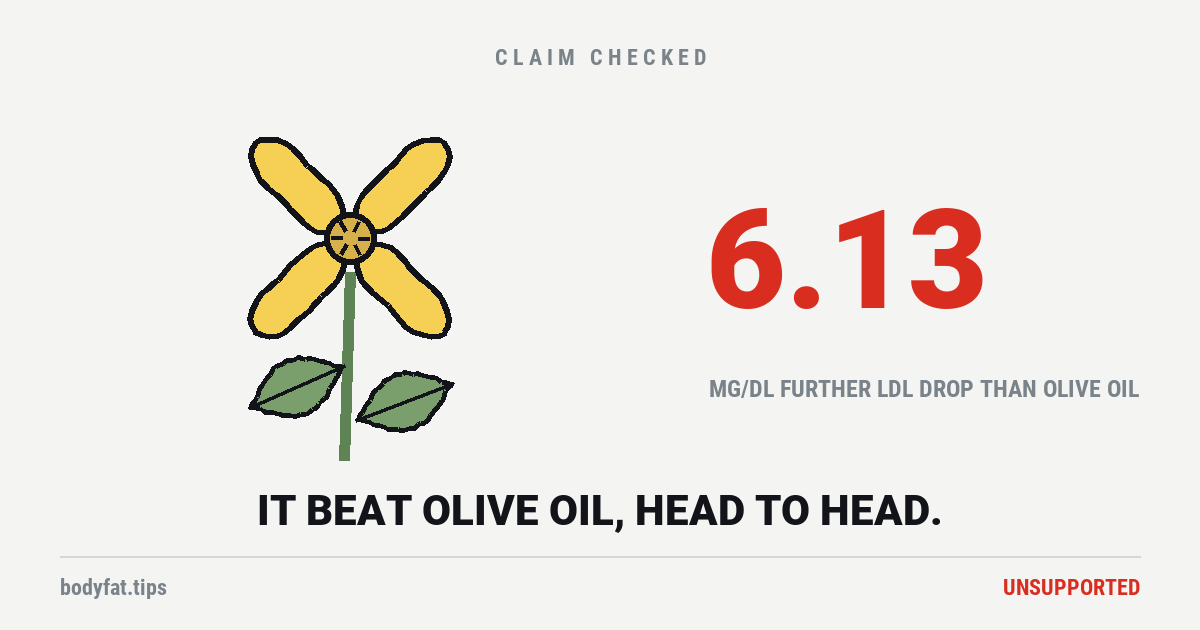
Thirteen randomised trials have compared canola directly against olive oil — the oil with the health halo, the one nobody has to defend. Pooled, canola lowered LDL cholesterol by 6.13 mg/dL more than olive oil did (95% confidence interval — the range the true answer probably sits in — 9.79 to 2.46 lower; p = 0.001, well past the line researchers use for ‘probably not chance’), and total cholesterol by 8.92 mg/dL more [4].
One fence around that number. As far as we can tell from the analysis’s reference list — its own table of trials is behind a paywall — most of those trials ran for a few weeks to six months, in people who already had a condition: metabolic syndrome, type 2 diabetes, fatty liver, obesity, high cholesterol, polycystic ovary syndrome or suspected heart disease.
There was no difference on HDL, triglycerides or VLDL [4] — so this is a specific win on one set of numbers, not a rout. But it is a win, and it belongs to the bottle with the industrial-lubricant reputation.
A network meta-analysis makes the same point from a different angle. It took 54 trials and ranked thirteen fats — from safflower to lard to butter — against each other. Rapeseed came second of thirteen for lowering LDL and second for total cholesterol, behind safflower oil [5].
For what it is worth in the other direction, coconut oil ranked top for raising HDL, and every oil tested beat butter on LDL except hempseed, whose result could not rule out no difference at all [5].
The sentence we are obliged to write
Everything in that last section is about cholesterol. It is not about whether you live longer.
We published a verdict on seed oils the same day as this one, and the most uncomfortable thing in it is that when researchers actually ran the trial — replacing saturated fat with vegetable oil, in thousands of people, with all the meals provided — cholesterol dropped exactly as designed and nobody was saved.
So we are not going to turn round a day later and tell you canola lowers LDL therefore canola extends your life. No trial has ever tested a specific cooking oil against death and produced a clean answer. Anyone who tells you otherwise about any oil, in either direction, is going further than the trials do.
What we can say is narrower and still useful: the specific accusation against canola does not survive contact with the evidence.
On weight, incidentally, the honest answer used to be “barely,” and it is now “no.” A 2019 meta-analysis of 25 studies found canola trimmed body weight by about two thirds of a pound (0.30 kg) and moved nothing else it measured [6]. A 2025 update pooled 30 trials that weighed 1,772 people and found no difference at all: 0.04 lb (0.017 kg), with a range of plausible answers from 0.43 lb lighter to 0.35 lb heavier (−0.195 to 0.161 kg). BMI, weight relative to height, dipped by a sliver (0.13 points) and waist-to-hip ratio rose by a sliver (0.003); fat mass, lean mass and waist size did not move [17]. That is not a weight loss strategy, and we are including it because it is unimpressive.
What we are rating
Unsupported: the claim that canola oil harms you because it is rapeseed and contains erucic acid. The erucic acid was bred down to trace levels before the oil was sold in America, and the law caps what is left: 2% of the fatty acids in the US, 20 g per kg in the EU [8] [16]. In animals, erucic acid does make fat build up in heart muscle at high doses — the effect Europe’s safety limit is built on, and average intakes in Europe stay under that limit [10]. The heart scarring that kept rapeseed under suspicion turned up with low-erucic and soybean oils too, and was traced to the balance of fats in the rat diet [12] [13]. The FDA action people cite was taken against a different oil. And the human evidence is thin and mixed: a hypothesis paper on patients who already had heart-muscle disease found no link with high intake, and two cohorts linked higher blood erucic acid to heart failure without being able to say which food it came from.
Reported but not resolved: the plasma erucic acid and heart failure association across two cohorts, which we have shown you rather than skipped, and which measures blood rather than diet.
Not claimed: that canola makes you healthier or live longer. It improves cholesterol numbers in trials. That is a different, smaller statement, and our own seed oils page explains why the gap between the two matters.
What to actually do
Cook with whatever you like from the unsaturated shelf. Canola, olive, sunflower, safflower — on blood lipids they are all clustered near each other and all clearly ahead of butter [5]. The differences between them are smaller than the difference between any of them and the thing they replace.
Do not pay a premium to avoid canola specifically. Whatever a “no canola” label is selling, erucic acid is not a reason to buy it: breeders cut it to trace levels in the 1970s, and US rules cap what is left at 2% [8].
If you like olive oil, keep using olive oil. Nothing here is an argument against it — it has more going for it than its LDL number, and the difference measured was 6 mg/dL, not a chasm.
And judge the meal, not the bottle. Most cooking oil reaches people inside fried and packaged food, which is where the stronger evidence against a modern diet actually sits. We make the same point about seed oils generally.
This is journalism, not medical advice. If you are managing cholesterol or heart disease with a clinician, that is the conversation that should decide what is in your kitchen.
An independent editorial review on 18 September 2026 found that this page had the animal evidence on erucic acid backwards. We said the rats may not have been poisoned by erucic acid at all, and our rating repeated it. Europe’s food safety authority, whose safety limit we quoted, names the fatty build-up erucic acid causes in heart muscle as its critical effect. What was not down to erucic acid was a later kind of heart scarring in male rats, which also turned up with low-erucic rapeseed and soybean oils, and the experiment we described fed rats a rapeseed oil that was itself low in erucic acid. The section and the rating now keep the two apart. We had also taken the heart-failure cohorts from a review instead of the study: erucic acid’s hazard ratios were 1.34 and 1.57, not a range up to 1.92, which belonged to nervonic acid, and the words we credited to the cohort’s authors were the review’s paraphrase and ran against what they concluded. We now cite the cohort paper itself. The erucic acid food table printed EFSA’s milligrams-per-kilogram figures as milligrams per 100 g, ten times too high, and listed sunflower oil, which does not make erucic acid; it is rebuilt from the test results EFSA gathered, and its heading no longer says nobody warns you, because EFSA flagged children with high intakes and the EU set a lower legal limit in 2019.
The funding row said no industry funding was declared, and industry money was one level down. The reviews are university- or government-funded, but trials they pool were paid for by the Canola Council of Canada, Dow AgroSciences and others, and by UFOP, a German body that promotes rapeseed and protein crops; the row now names them by role. Also corrected: the ten Sichuan cases were patients who already had heart-muscle disease, described in a 1992 hypothesis paper; the weight result is updated to a 2025 review of 32 trials, which found no effect on weight; canola is about 7% saturated fat, not 4%; the 1989 safety review came four years after US approval, not with it; the canola-versus-olive trials were mostly in people with a health condition; hempseed oil did not clearly beat butter; a study of pure erucic acid did find an effect, on blood vessels; the provenance chain now names the chain email and a product sold on the claim; a link to our canned-tuna page, which makes a different point, is removed; our cross-reference to the seed-oils page now says how that page treats its own blood studies; and a line saying anyone who disagrees about oil is selling something is withdrawn. The rating is unchanged: Unsupported.