Does Walking Help You Lose Weight? Yes — 10,000 Steps Was a Trademark

Yes. About 4.7 lb of it, across 22 randomised trials [1].
That is a real number and a modest one, and if you came here hoping for something dramatic, the honest answer is that walking is not dramatic. It is just one of the very few things almost everybody will actually keep doing.
But there is a second number in that analysis that is better than the first one, and nearly nobody quotes it.
The trials lost more fat than weight
Here are the pooled results from those 22 trials, converted into the units you actually think in [1]:
Body weight: down 4.7 lb (2.13 kg).
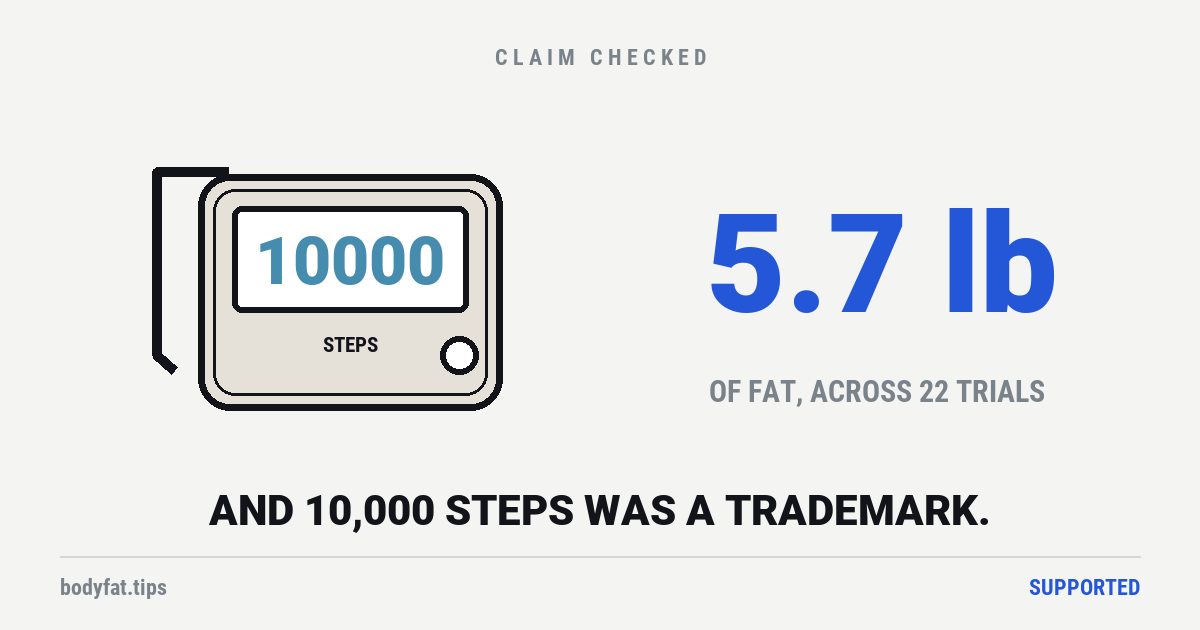
Fat mass: down 5.7 lb (2.59 kg).
Fat-free mass: UP 0.6 lb (0.29 kg).
Waist: down 1.1 inches (2.83 cm). Body fat: down 1.38 percentage points.
Read the first two lines again. They lost more fat than weight.
That is not a typo and it is not a rounding error. Fat-free mass — which is everything you are made of that isn’t fat: muscle, bone, organs, water — went up while fat came off. Walking, of all things, was quietly building something.
So the scale did what a scale does. It took the fat you lost, subtracted the mass you gained, and handed you the leftovers. A pound of your result was invisible before you ever stepped on it.
How fast, honestly?
Slowly. The second meta-analysis is the one to sober you up.
Nine studies, 307 people, pedometer programmes with no diet change at all, running anywhere from four weeks to a full year. Median length sixteen weeks. Pooled result: down 2.8 lb (1.27 kg), with the range of plausible answers running from about 1.5 lb to 4 lb [2].
Learn More:


Which works out to roughly a tenth of a pound a week.
The researchers also found that longer programmes lost more than shorter ones [2], which sounds obvious until you notice what it implies: there is no plateau in this data. It just keeps going, tediously, for as long as you do.
Note the gap between the two analyses, though — 4.7 lb in the brisk walking trials, 2.8 lb in the pedometer ones. Prescribing a pace beats counting steps. Roughly double, on these numbers.
Does it work the same for everyone? No.
The 22-trial analysis went looking for exactly this and found one real split [1].
For men and women with obesity under 50, brisk walking produced clinically meaningful drops in weight, BMI, waist and fat mass.
For women over 50, the weight change was more modest — and here is the good part, because the reason was that they were gaining more fat-free mass, which offset the loss on the scale [1]. The measurement problem again, landing hardest on the group most likely to be told they are failing.
For men over 50, the researchers said plainly that more research is needed [1]. So do we.
And the 10,000 steps? That was a product name.
In 1965, a Tokyo instrument company called Yamasa Tokei Keiki — founded in 1942 making aircraft instruments, of all things — released Japan’s first commercial pedometer [4].
They called it the Manpo-kei. In Japanese, that means “ten-thousand-step meter”. It is the company’s trademark [4].
So the most famous number in personal fitness — printed on watches, built into phones, used to run corporate wellness competitions — is the name of a device that went on sale sixty-one years ago.
What does the evidence say the number should be? The largest study to put a figure on it followed 16,741 women, average age 72, and found the benefit climbing until roughly 7,500 steps a day, after which the curve flattened out. Even 4,400 steps beat 2,700 by a wide margin [3].
One caveat, and it matters: that study measured death, not weight. It is a mortality curve, not a fat-loss curve, and treating it as one would be precisely the sleight of hand we spend most of our time here unpicking. What it tells you is that 10,000 was never the threshold for anything. The paper says so in its own opening line — the goal is “commonly believed by the public to be necessary for health” but has “limited scientific basis” [3].
What to actually do
Walk, and expect a pound a month rather than a transformation. On these numbers that is what walking pays, and it pays it for as long as you keep showing up.
Walk briskly if you can, because prescribing a pace roughly doubled the result compared with counting steps [1][2].
Measure your waist, not just your weight. The trials moved waistlines by over an inch, and given that fat-free mass was going up at the same time, the tape is telling you more than the scale is.
And stop chasing 10,000. It is a sixty-one-year-old trademark, not a finding, and the evidence puts the useful range lower.