Does Sweating Burn Fat? No — 84% of It Leaves Through Your Lungs

No. And the reason is better than a flat no, because it involves you having the wrong organ in mind entirely.
Fat does not leave through your skin. It leaves through your mouth.
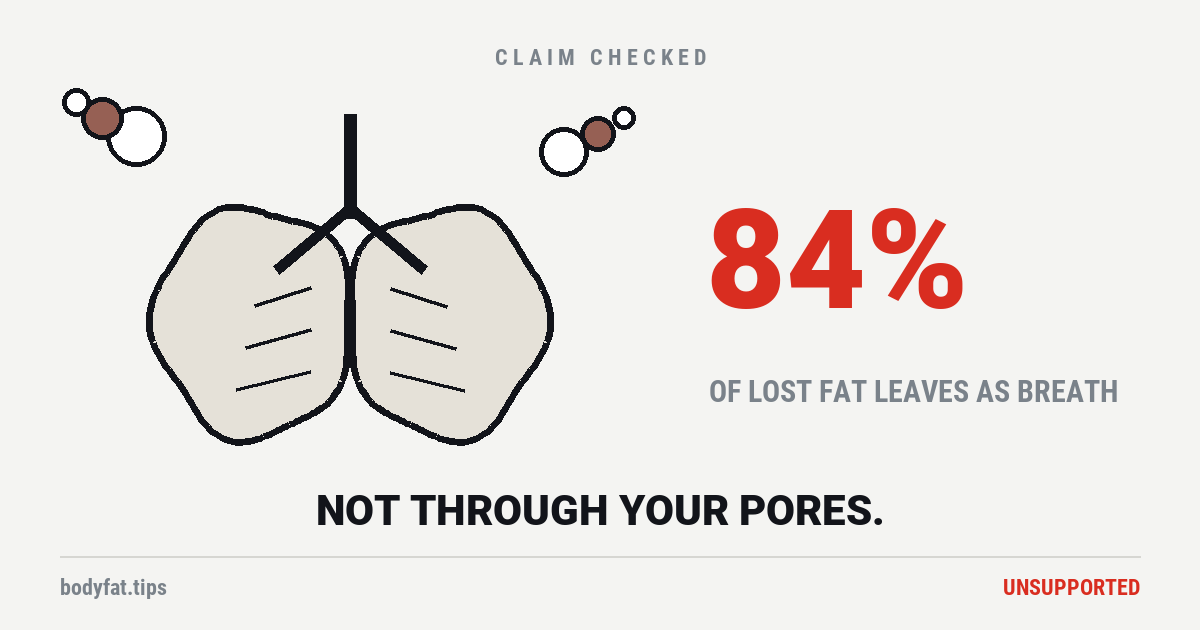
84% of it is exhaled
Work out the chemistry of burning fat and it lands somewhere most people find genuinely surprising. Oxidise 10 kg of fat and 8.4 kg of it leaves your body as carbon dioxide, through your lungs [1].
The other 1.6 kg becomes water — which can then leave in urine, faeces, sweat, breath or tears [1]. Sweat is one exit among five, for the smaller share.
The full accounting, since it is worth seeing: losing that 10 kg takes 29 kg of inhaled oxygen and produces 28 kg of carbon dioxide and 11 kg of water [1]. Your lungs are doing the heavy lifting. As the authors put it, none of this is obvious because the gas you breathe out is invisible.
So what is the fat-burning organ? It is the one you are using right now without thinking about it.
There is essentially no fat in sweat
This is the part that ends the argument.
Eccrine sweat — the kind that produces nearly all your sweat volume — is water and electrolytes. Sodium at 10 to 90 mmol/L, chloride at 10 to 90, potassium at 2 to 8, with lactate, urea and ammonia further down, and trace metals in the micromolar range [2].
Lipid is not a meaningful constituent. Your apocrine glands — a different, far less numerous set — do secrete lipids. The glands responsible for a soaked shirt do not [2].
You cannot sweat out something that is not in the sweat.
Learn More:



So why does the scale move?
Because you are lighter when you are drier. That is the entire mechanism, and it reverses the moment you drink.
We have now checked this claim in three different costumes. The sauna version loses you about a pound and a half of fluid in an hour, and the researchers who measured it called it fluid in their own conclusion. The neoprene-wrap version sells on how wet you get. And the low-carb version is the same water arriving as a first-week miracle.
Same trick, three products. A scale that moves because you are dehydrated is not reporting fat, and everyone selling you the sweat knows which number you will step on afterwards.
The part that is true, and gets stretched
Sweating hard during exercise is not meaningless. It is a signal that you are producing heat, and producing heat generally means you are working.
But it is a signal, not a measure. How much you sweat depends on the temperature, the humidity, what you are wearing, how hydrated you are and how your body happens to be built. Two people doing identical work in the same room will not produce identical puddles, and the wetter one has not burned more fat.
Which is why the trick works so well in reverse: put on a rubber suit and you can sweat enormously while doing almost nothing at all.
What to actually do
Stop using sweat as a scoreboard. It measures your cooling system, not your energy expenditure, and the two come apart the moment anything about your environment changes.
Do not weigh yourself straight after a hot session and count the difference. Rehydrate and the number comes back, because it was water, and the researchers who measure this say so plainly.
And if a product is selling you extra sweat as the mechanism — a suit, a belt, a wrap — it is selling you the one part of the process that has no fat in it.
Breathe out. That is where it actually goes.