Honey for Cough: Maybe a Little Help for a Night. Never Under One Year.

Most of what we check here turns out to be a marketing department with a molecule attached. This one is a folk remedy your grandmother would recognise, and it has a Cochrane review behind it.
Does it work? A little, for a night, in children over one, and not in every trial that tested it against a sweet placebo. And there is one absolute exception that has to come first.
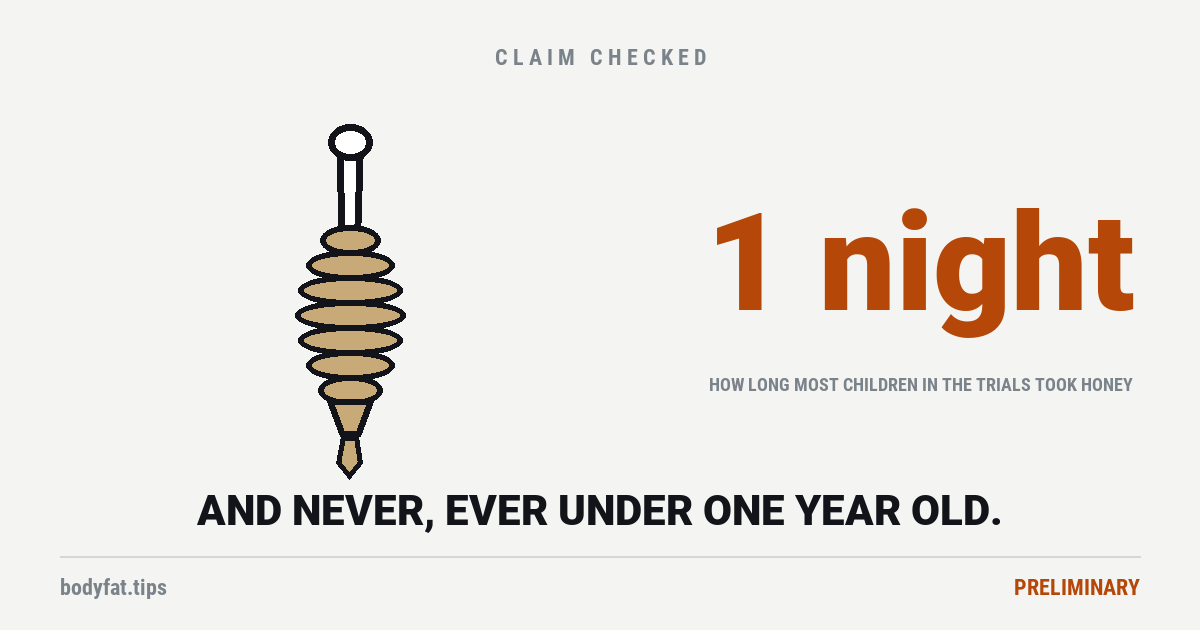
Never give honey to a baby under one year old. Not a taste, not on a dummy, not stirred into anything.
Honey is the only well-established dietary risk factor for infant botulism, a severe neuroparalytic illness which is now the most common form of botulism in the United States and Canada. No trial in the Cochrane review below enrolled a child younger than twelve months, and four of its six started at two years. The evidence does not cover babies, and this is the reason: when one US research team wanted a sweet remedy to test on coughing infants, it used agave nectar, and its trial registration gives infant botulism as the reason honey could not be used [10].
What the evidence actually shows
A Cochrane review gathered six randomised trials covering 899 children, most of them aged one to five, and each of its head-to-head comparisons rests on one or two of those trials. [1] Parents rated their child’s cough on a seven-point scale. Where honey was compared with giving nothing, in two trials, the comparison could not be blinded: the parents knew whether they had given their child anything, and one of the two trials was funded by a grant from a national honey board [1]. The blinding matters more than it sounds. When the US team behind that trial later tested agave nectar in coughing babies and toddlers, with a placebo arm as well, the placebo beat doing nothing and the agave did no better than the placebo [10].
| Compared with | Result | Certainty |
| Nothing at all | honey better | moderate |
| Placebo | honey better*; no difference in a 2022 trial | moderate; low in a 2023 review |
| Diphenhydramine (an antihistamine) |
honey better | low |
| Dextromethorphan (a common cough-syrup ingredient) |
about the same*; honey ahead in both its trials | low |
Against no treatment and against placebo, honey came out better, and the reviewers rated both as moderate-certainty evidence — which in Cochrane language means they are reasonably confident in the direction. Both of those headline figures had zero heterogeneity: the share of the spread between the trials’ results that is more than chance would produce. Zero means the two trials in each comparison differed no more than luck allows. With two small trials that is a weak test, and it is not the same as the trials agreeing.
The placebo figure is about twice what its biggest trial found. The review’s pooled advantage over placebo, 1.62 points on the seven-point scale, rests 85% on a 2012 trial of 300 children in Israel. The review entered that trial as its honey groups’ own improvement, 1.85 points. But the placebo group improved too, by 1.00 point, so honey’s edge over the placebo, a date syrup, was about 0.85 of a point, for one night [5]. An independent 2023 review read the trial the same way, at 0.8 [7]. That edge was statistically significant in the trial itself, which was part-funded by the country’s honey board; its authors say the funders had no role in the study [5]. It is about half what the review printed: on a seven-point scale, less than one step.
And the placebo trials do not agree. The review’s other placebo trial, 102 children in Kenya given honey three times a day for five days, found no clear difference on the first night; honey pulled ahead from the second day [1]. A 2019 trial in Nepal, 90 children aged one to five given one bedtime dose against a sugar syrup, found honey ahead on most measures; it is not indexed in PubMed [9]. And in 2022 a double-blind trial in 13 clinics in Japan gave 161 children aged one to five either acacia honey or a honey-flavoured syrup before bed on two nights: both groups improved, and honey did no better [6]. A 2023 systematic review of ten trials rated the evidence for honey against placebo or no treatment as low quality [7].
So honey may have a small edge over a placebo, for a night or two: three of those four trials found one, and the 2022 trial did not. For something you can buy in any shop, that is still worth knowing. It is just smaller and less certain than the review’s headline number.
Now the three limits, because they matter more than the headline
One: the three-day limit is one trial deep. The review’s summary says honey given for up to three days probably beats placebo, and that beyond three days it probably had no advantage over placebo or salbutamol (albuterol in the US, an asthma drug that opens the airways). All of that comes from the Kenyan trial, the one trial in the review that gave honey for more than a day [1]. And on day four, the review’s own tables still show honey ahead of placebo on every measure. By day five the scores had come together, though cough ended about 0.7 of a day sooner on honey [1]. So this is a remedy for a few bad nights, not a course of treatment, and these trials cannot tell you exactly when it stops helping.
Two: most of the children got one night of it. That is the reviewers’ own stated limitation — “Most of the children received treatment for one night, which is a limitation to the results of this review.” The evidence is about a bad night, and it is thin even there.
Three: against the cough syrup, the evidence is thin, and it leans honey’s way. Compared with dextromethorphan, a common ingredient in over-the-counter cough medicines, the review called it about the same, on low-certainty evidence [1]. But by its own arm-by-arm figures, the children given honey improved more than those given dextromethorphan in both trials that compared them, and one of the two went into the pooled result with its sign reversed: our reading of the review’s tables. A 2026 review that pooled trials of honey against dextromethorphan found honey ahead on cough frequency, by about half a point on the seven-point scale [8].
Read that the right way round. The point is not that honey matches the syrup. It is that the syrup did not beat honey in either trial.
What about adults?
Thinner, and less flattering.
A broader review of 14 studies on upper respiratory infections found honey beat usual care on symptom scores and cough. [2] But nine of its 14 studies were in children only, and its one comparison against a true placebo used two children’s trials, one of them of a cough syrup made with honey and plant extracts. Restricted to its four studies of adults, the review could pool only three, all against usual care, and found no clear difference in cough frequency [2].
And a trial published in 2023 randomised 194 adults with acute bronchitis to honey, two different drugs, or usual care. Median days of moderate-to-severe cough: five on usual care, six on honey. The authors’ conclusion was blunt — the symptomatic treatments tested were ineffective against cough. [3]
That trial was underpowered, because COVID cut its recruitment short, so it is not the last word. But it is not encouraging either, and the honest summary is that the children’s evidence does not transfer automatically to you.
The one real downside
Beyond the infant warning, the trials picked up more stomach upset on honey than on placebo. The review’s totals, 12% against 11%, make that look trivial, but they lump together two trials of very different sizes and very different rates. Trial by trial, the risk on honey was higher, and the review’s pooled figure is a risk ratio of 1.91: nearly twice the risk, across 402 children. Most of it came from the five-day Kenyan trial, where the review records stomach ache, nausea or vomiting in 30 of 57 children on honey and 12 of 45 on placebo. [1] A few children on honey were also reported as nervous, hyperactive or unable to sleep.
The review records no serious side effects. But it is worth knowing before you give a sugary syrup to a child at bedtime, and the higher rate came from the trial that kept giving it for five days.
The verdict
Preliminary. In children over one, honey probably eases a night’s cough a little more than giving nothing, in two trials where the parents knew whether they had given anything. Against a sweet placebo the trials disagree: honey ahead by less than one point on a seven-point scale in the largest, level in a 2022 trial of 161 children. For a cheap thing already in your cupboard, that is worth knowing, and it is less than the headline numbers said.
It is Preliminary rather than Supported because the comparison that matters most, honey against a placebo, does not hold steady: the review’s figure for it was about twice what its largest trial found, a 2022 double-blind trial found no difference, and a 2023 review rated the evidence low. Most children in the trials had a single night of treatment, the adult evidence is weak-to-null, and the Cochrane reviewers themselves concluded there was no strong evidence for or against using it.
The practical version: for a child over one with a nasty cough at bedtime, a spoonful of honey is a reasonable thing to try. It costs nothing extra, it did at least as well as the cough syrup in both trials that compared them, and the price is a higher chance of an upset stomach. In the trials it was usually a single dose shortly before sleep: a third of an ounce (10 g) in the largest, half a teaspoon (2.5 ml) in another [1]. And the cough syrup is not the safer swap for a small child: the FDA does not recommend over-the-counter cough and cold medicines for children under 2, and their makers voluntarily label them “Do not use in children under 4 years of age” [11]. For an adult, do not expect much. For a baby under one, never.
It does not need to be expensive honey, either. The trials used ordinary honeys: eucalyptus, citrus, buckwheat, acacia and local dark honey [1] [6]. We found no cough trial of manuka or medical-grade honey in PubMed, Europe PMC, Crossref, OpenAlex or ClinicalTrials.gov. A supplement-rating website, in an article titled “Manuka honey for pediatric cough: what the trials show and the one-year cutoff”, describes a 2019 New Zealand trial of manuka against ordinary honey for children’s cough; the PubMed number it gives for that trial belongs to a laboratory study of children’s lung cells.
And if a cough lasts more than about three weeks, or comes with fever, breathlessness or weight loss, that is a doctor rather than a cupboard.
Related: zinc for colds, the other kitchen-cupboard remedy with real trials behind it, and vitamin D. For the other end of the spectrum, detox teas.
If you want to know what earns each rating, we wrote down how we read a study, and everything we have checked is in one place.
One clause was corrected on 30 September 2026. We wrote that a heterogeneity figure of 91% “means they were essentially measuring different things”. That is not what the statistic says. It is the share of the gap between the studies’ results that is more than chance would produce. The figure and the result beside it are unchanged, and this page has not yet had its own independent review.
This page was corrected on 7 October 2026 after an independent editorial review. Our headline rested on the Cochrane review’s pooled advantage for honey over placebo, 1.62 points on a seven-point scale. The review entered its largest placebo trial as that trial’s honey groups’ own improvement, 1.85 points; by the trial’s own paper, honey’s edge over the placebo was about 0.85 of a point, for one night. We also left out a 2022 double-blind trial of 161 children that found honey no better than a honey-flavoured syrup, and a 2023 systematic review that rated this evidence low, and we described the trials as agreeing with each other. Against a placebo they do not.
Also corrected: the funding row said funding was not stated, when two of the review’s trials, including that largest placebo trial, were part-funded by national honey boards; the three-day limit, which the review’s own day-four results contradict; the side effects, where the review’s crude totals of 12% against 11% stood in for a risk ratio of 1.91; the adults section, whose placebo comparison was made of two children’s trials and now gives the review’s adult-only result; the infant line, which said every trial started at twelve months when four of the six started at two; the dextromethorphan comparison, where honey improved more in both trials; a gloss that read zero heterogeneity as agreement; and a monthly search figure that none of our saved keyword pulls holds, now replaced by the search itself. The FDA’s age limits for children’s cough medicines now sit beside the advice. The 30 September note above said this page had not yet had its own review: this is that review, and the 91% comparison it mentions has been replaced. The rating changed from Supported to Preliminary.
Corrected again on 7 October 2026. Our provenance chain said that, as this finding is retold, the age floor, the single night and the smallness of the effect all fall out. We had not checked. In an ordinary web search for honey for cough, all eight first-page results we read put honey’s lower age at one year, seven of them with a warning never to give it to a baby under one. The other two held: one of the eight mentions that its key trial gave a single dose at bedtime, and none says how small the effect was, though four say the evidence is weak or mixed. The chain now says what that search showed. The rating, Preliminary since this morning’s correction, is unchanged.