Doomscrolling: Phone Overuse and Bad Sleep Go Together, and Pull Both Ways

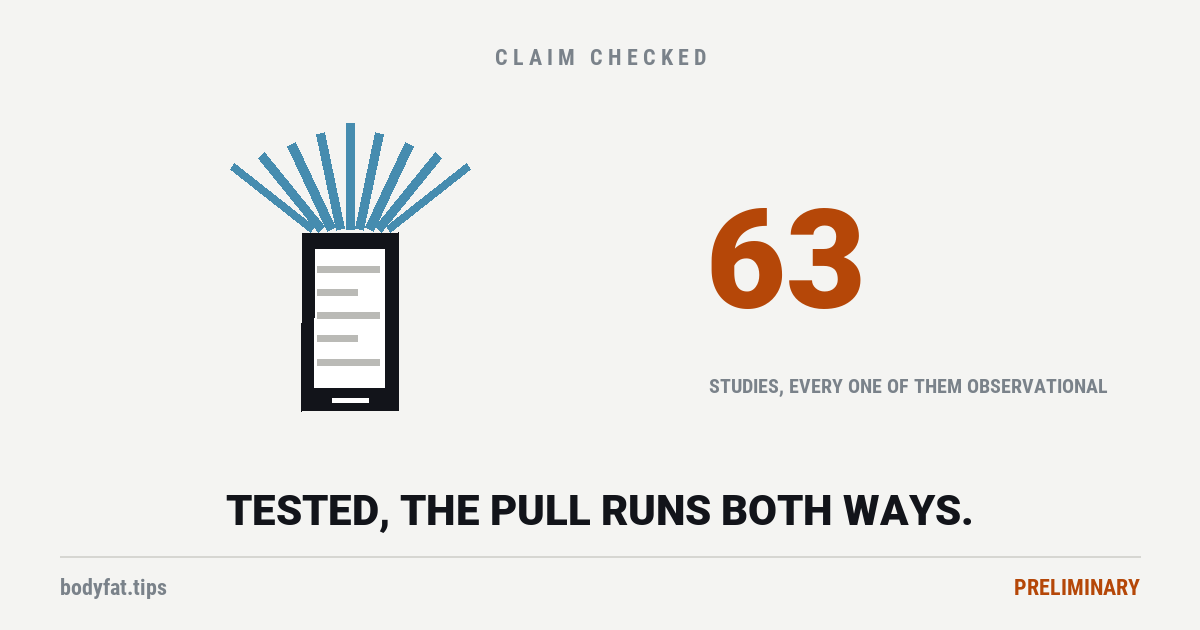
Sixty-three studies, all but one of them of university students and most in China and India, have measured whether feeling hooked on your phone goes with bad sleep. Pooled, they agree it does — a moderate correlation, r = 0.38, and no sign of publication bias when the reviewers went looking for it. [1]
Every single one of them was observational. [1]
So the honest answer to the question you came with is that the two things travel together, and the studies built to test which one does the pulling say it runs both ways.
| Question | Answer |
| Does feeling hooked on your phone go with bad sleep? | yes · r = 0.38 |
| Which one causes which? | some of each · not settled |
| Do the studies agree? | on direction, all 63 · on size, no |
| Does cutting phone use help sleep? | in small trials, yes · self-rated |
Why that is not a technicality
There are at least three stories that fit a correlation this shape, and a correlation on its own cannot separate them.
The phone keeps you up. Or you cannot sleep, so you reach for the phone. Or something else — stress, shift work, a bad month — is producing both, and the phone is a symptom wearing a villain’s costume.
The reviewers who pooled the 63 do pick a direction. Their conclusion calls excessive smartphone use “a potentially modifiable behavioural factor causing sleep disruption” [1]. That is more than their pool can carry on its own. Sixty-four of their 68 studies were one-time surveys, and they concede that “most available evidence is based on cross-sectional studies and self-reported measures”, and ask for longitudinal and intervention studies “to clarify causal pathways” [1]. Studies of both kinds exist, a few of them inside the pool, and they are below.
Self-reported is worth a second of attention too. Most of these studies asked people how hooked on their phone they feel, on an addiction questionnaire, and how well they sleep; six of the 63 measured phone use itself [1]. Someone sleeping badly is not a neutral judge of how much they were on their phone at 2am.
So has anyone tested which way it runs?
Yes. All three stories have been tested, and each has found some support.
The phone keeps you up. In a trial of 38 poor sleepers at a Shanghai university who used their phones in bed, the ones told to put the phone down 30 minutes before bed were falling asleep in about 18 minutes after four weeks, against about 27 for those given no instruction [3]. In 152 Chinese students with problem phone use, keeping the phone out of bed for four weeks improved their sleep scores [4]. And 111 students in Austria who held their phone to two hours a day for three weeks scored 2.6 points better than the comparison group on a 28-point insomnia scale, what the authors call a small to medium effect [5]. In all three, people knew which group they were in and rated their own sleep.
Not every cut helped. Two trials that cut only social media, for one week and for two, found no effect on sleep, one of them measuring it with a wrist sensor [6] [7]. In 89 Danish families who cut all recreational screen use to three hours a week for two weeks, sleep measured by a brain-wave recorder worn at night did not change, in children or adults; the adults’ own reports and a movement sensor did show longer sleep in an analysis added afterwards [16]. And a 2026 review of 25 studies that tracked the same young people, aged 3 to 25, day by day found that on days with more screen time they went to sleep slightly later, with no measurable change overall in how long or how well they slept; screens used after bedtime went with slightly worse self-rated sleep than screens used earlier in the day [8].
You cannot sleep, so you reach for the phone. Three of the 63 pooled studies followed the same students for a year and tested which came first. The phone pulled on sleep in all three; sleep pulled back on the phone in two [1].
Something else drives both. In 6,153 Chinese students surveyed three times over a year, low mood predicted later phone problems and later sleep trouble, while phone problems and sleep trouble did not reliably predict each other [9].
So each story holds a piece of it, which is why the short answer is “both ways”.
The studies agree on direction, not on size
The heterogeneity on that pooled correlation was 99.25%. [1]
Heterogeneity is the share of the difference between the studies’ results that is more than chance would produce. Zero would mean they differed no more than luck allows. Ninety-nine per cent means nearly all of the difference between them is real, and 0.38 is an average drawn through that scatter.
It is still worth knowing the direction of travel is consistent: in the review’s own chart, all 63 results point the same way, more hooked, worse sleep [1]. It is the sizes that scatter. Two of the 63 are drawn far stronger in that chart than the review’s own appendix reports them; leave those two out and the pooled correlation comes to about 0.33 (our arithmetic; the scale runs from 0, no link, to 1, a perfect one), close to the 0.28 an earlier review of 40 studies found [14]. Anyone quoting a precise figure at you is quoting the middle of a cloud.
Something does help, though not what the biggest number says
A separate 2026 review asked whether any treatment helps people whose use of the internet, games, phones, gambling, pornography or social media has become a problem. It found 125 studies, 73 of them randomised. [2]
Structured psychological therapy came out with the most consistent benefit across behaviours. For problem smartphone use, the biggest number belonged to exercise programmes. Apps never entered that contest: the review counts apps and web programmes as digital interventions, and for phones it found too little evidence on those to pool them.
And the exercise number does not survive a reading of its own trials. [2]
Now the caveat, because those numbers are too good
Effect size is a way of comparing how big a difference is, stripped of what was measured. Roughly: 0.2 is small, 0.5 is moderate, and 0.8 is what researchers call large.
The exercise result came in at 3.07. The psychological therapy result for problematic internet use, 2.68. [2]
Those are three to four times the threshold for “large”, which in this line of work is not a reason to celebrate. It is a reason to look harder. Effects that size usually mean small trials, unblinded outcomes, or people who were measured on the same self-report they were coached about. For the exercise figure there is a plainer cause. It rests on a handful of small trials of Chinese college students, entered as five rows [2]. One of those trials printed its scores as averages with standard errors, which measure how precisely an average is known, not how spread out the people are [10]. Read as if they were standard deviations, its exercise group gives exactly the review’s row, an effect of 4.92; read correctly, about 0.87. A second row from the same trial, 8.23, is close to what its therapy group, not an exercise group, gives on the same misreading; the trial had one exercise group. Fix the first and drop the second, and the rows pool to about 0.9 (our arithmetic): still large on the scale above, and smaller than the review’s own figure for therapy on phones, 1.49. A separate 2023 review of 26 trials found exercise and psychological treatment about level, near 1.0 each [11]. And what those trials measured was a questionnaire score for feeling hooked on the phone, not phone time and not sleep [2].
The reviewers flag it themselves: “High heterogeneity and evidence of small-study effects were observed in several studies.” [2] Small-study effects is the polite term for the pattern where tiny trials report enormous results and larger ones do not.
And the thing you actually searched for is the least studied
Here is the irony at the centre of this. The review looked for treatment studies across every kind of problematic digital use, and reported: “There were limited studies to calculate pooled results for social media addiction, pornography use, gambling, screen time, and over-the-top content watching. No treatment studies were found for problematic over-the-top content watching.” [2]
Doomscrolling — lying in bed working through an infinite feed of bad news — sits closest to the categories with the least evidence. The research has concentrated on gaming and general internet use, which are older problems with older literatures.
The sleep evidence has the same gap. None of the 63 studies above measured doomscrolling; they measured how hooked people feel on their phones [1]. Doomscrolling has its own questionnaire now. A systematic review of research using it, published in September 2026, gathered 44 studies; two measured sleep, too few to pool, and in one of those two the reviewers could not tell which way the result ran [13]. Search past that review and you find more one-time surveys pairing doomscrolling with sleep. Most report worse sleep with more doomscrolling, as a survey of 663 adults in Türkiye did [12]; one, a preprint of 390 students in Bangladesh not yet peer reviewed, reports the opposite [17]. It is the same one-time correlation again, with the same three stories behind it.
The verdict
Preliminary. The link between feeling hooked on your phone and sleeping badly is real, consistent in direction and well replicated across 63 studies of students. Which way it runs has now been tested: the phone does some of the pulling, bad nights and low mood do some too, and cutting phone use helped people’s own ratings of their sleep in small trials. “Destroying your sleep” claims more than any of that shows, and the reviewers’ own word, “causing”, goes further than their data. In a September 2026 systematic review of doomscrolling research, the two studies that measured sleep were one-time surveys [13].
If you want the practical version: for feeling hooked, the treatment evidence, for all its problems, points at structured approaches rather than willpower, and exercise’s headline number was inflated by a misread table. For sleep, the tested step is smaller and cheaper. In the small trials above, people who kept the phone out of bed, put it down half an hour before sleep, or held it to two hours a day rated their sleep better [3] [4] [5].
What we would not do is tell you a number of hours to stay off your phone before bed. The trial above tested thirty minutes [3], and a US sleep-medicine society advises 30 to 60 [15]; that is a reason to try it, not a reason to set a stopwatch. If sleep is the actual problem, the sleep hygiene evidence is a better place to start than any screen-time target.
Related: sleep hygiene · melatonin dosage · blue light and deep sleep · all the habits we have checked · every claim we’ve checked
One explanatory sentence was corrected on 30 September 2026. This page said a heterogeneity figure of 99% means the studies “found almost entirely different things”. It means that nearly all of the difference between their results is more than chance would produce, which is not the same as saying how different the results were. The figure itself is unchanged. This page has not yet had its own independent review.
This page was corrected on 1 October 2026 after an independent editorial review. It said, in its title and in three other places, that nobody could say which way the link between phones and bad sleep runs, and that the reviewers who pooled the 63 studies declined to pick a direction. Neither holds. Three of those 63 studies followed students for a year and tested direction: the phone pulled on sleep in all three, and sleep pulled back on the phone in two. Small randomised trials that cut bedtime or daily phone use improved people’s own ratings of their sleep, though sleep measured by a device moved less or not at all, and two trials that cut only social media found no effect. And the reviewers’ own conclusion calls smartphone overuse a factor “causing” sleep disruption, which is more than their mostly one-time surveys can carry; the page had also quoted their summary without the words “most available evidence is”. The page now reports those tests and the reviewers’ conclusion as they stand.
Also corrected: the 63 studies measured how hooked university students feel on their phones, not doomscrolling, and the page now says so and reports what surveys of doomscrolling itself have found. Exercise’s 3.07 was not the best result for phones: one trial’s standard errors were read as standard deviations, and corrected the figure is about 0.9 (our arithmetic). The heading and the table no longer read a 99% heterogeneity figure as disagreement; the funding row reports what each source declares; the follow-up row reports the four studies that followed people for up to a year; a 30-minute screen-free pause, which one trial tested, is no longer called invented; the search figure now gives its query, country and date; and the provenance chain names a dated release, two stories that repeated it and an app sold on it. The note of 30 September said this page had not yet had its own independent review; this was that review. The rating is unchanged: Preliminary, for the claim that doomscrolling is destroying your sleep.
Corrected on 9 October 2026. The provenance chain gave a search figure, 33,100 US searches a month for “doomscrolling”, with only the month of our pull. It comes from a paid keyword database, pulled on 6 August 2026, and the chain now says so. The rating is unchanged.