Confidence tier Unsupported

We looked, and the evidence does not back the claim: either it was tested and did not hold up, or nobody has tested it and nothing that was tested supports it.

0.5 mg/dLhigher fasting blood sugar with peanuts than with the comparison diets, pooled across 8 trials (0.03 mmol/L, our conversion); the range ran from about 1.3 lower to 2.5 higher, so it includes no differenceNOUnsupported

Do Peanuts Raise Blood Sugar? Hardly, in Glycemic Index Tests and 8 Trials
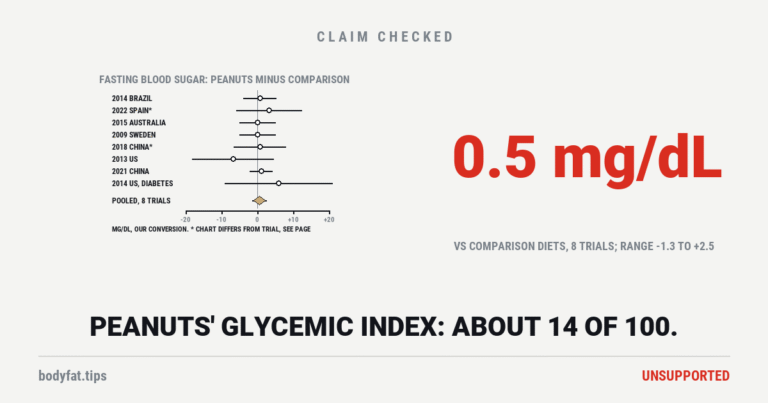
A forest plot of fasting blood sugar with peanuts minus comparison diets in 8 trials, from about 6.8 mg/dL lower to 5.9 higher, every range crossing zero, pooled about 0.5 higher with a range from 1.3 lower to 2.5 higher; beside it the figure 0.5 mg/dL

Hardly. Peanuts' glycemic index averages about 14 of 100 in the published tests, and in 8 trials pooled in 2022, fasting blood sugar with peanuts came out about 0.5 mg/dL higher than on the comparison diets, a range that includes no difference. What to watch is the jar: reduced-fat peanut butter carries more carbohydrate.
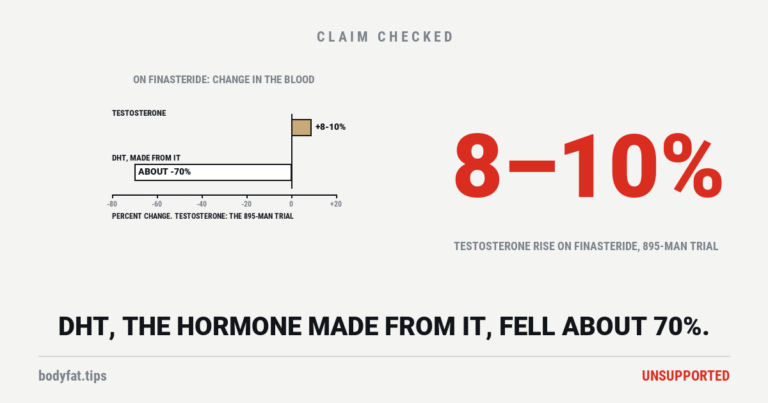
8–10%rise in testosterone within two weeks, held for a year, on finasteride 1 mg and 5 mg in a placebo-controlled trial of 895 men; DHT fellNOUnsupported

Does Finasteride Lower Testosterone? No. It Rose About 8 to 10% in Two Large Trials. What Falls, by About 70%, Is DHT, the Hormone Made From It.

Two bars of change in the blood on finasteride: testosterone up about 8 to 10% in an 895-man trial, and DHT, the hormone made from it, down about 70%; beside them the figure 8 to 10%

No. In the controlled trials, testosterone on finasteride rose modestly, about 8 to 10% in two large trials and more in men who started low, or did not change significantly; DHT, the hormone made from it, fell about 70%. Sexual side effects are a separate question: about 4 in 100 men on the hair dose reported one in the first year, against 2 in 100 on a dummy pill.

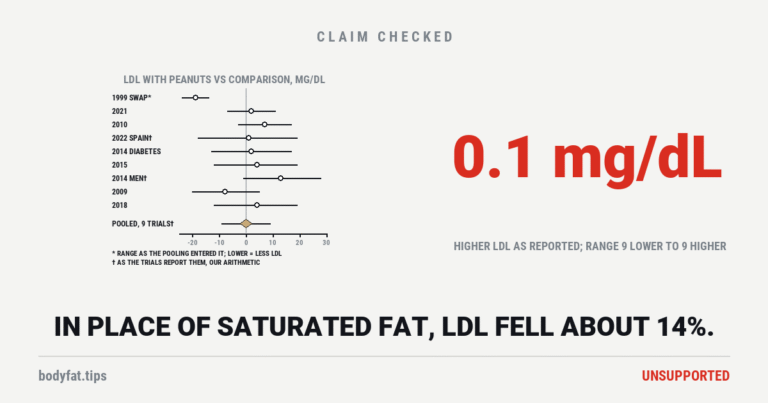
0.1 mg/dLhigher LDL with peanuts than with the comparison diets: the 2022 pooling's 9 trials (3 gave peanut butter) with two rows entered as their trials report them, our arithmetic; range 9 lower to 9 higher. The pooling's own chart gives 2 lower, 11 lower to 6 higherNOUnsupported

Is Peanut Butter Bad for Cholesterol? Not in Nine Trials of Peanuts and Peanut Butter. In Place of Saturated Fat, LDL Fell About 14%; Otherwise It Came Out About Even.

A forest plot of nine randomised trials of peanuts and peanut butter: LDL against the comparison diet from 19 mg/dL lower to 13 higher, most ranges crossing zero, two rows marked as drawn from their trials' own reports rather than the 2022 pooling's chart, pooled about even with a range from 9 lower to 9 higher by our arithmetic; beside it the figure 0.1 mg/dL

Peanuts and peanut butter showed no clear rise in LDL in nine randomised trials pooled in 2022, three of which gave peanut butter. The pooling's chart puts LDL about 2 mg/dL lower than on the comparison diets; with two of its rows entered as their trials report them, it comes out about even, and both ranges include no difference. In place of saturated fat, LDL fell about 14%.

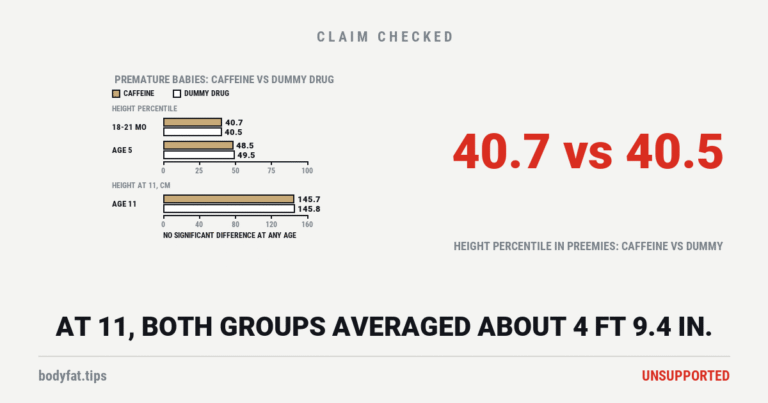
40.7 vs 40.5height percentile at 18 to 21 months in 1,769 very premature babies given caffeine or a dummy drug for weeks; not significantly different (P = 0.88); at 11, both groups averaged about 4 ft 9.4 in (145.7 and 145.8 cm)NOUnsupported

Does Caffeine Stunt Your Growth? The Warning Was Selling a Coffee Substitute in 1900, and the Tests Since Do Not Back It

Paired bars from a randomised trial of caffeine in very premature babies: height percentile 40.7 on caffeine against 40.5 on a dummy drug at 18 to 21 months and 48.5 against 49.5 at age 5, and height at 11 of 145.7 against 145.8 cm, none significantly different; beside them the figure 40.7 vs 40.5

The warning was in a national magazine by 1888 and selling a coffee substitute in 1900. Since then, 81 girls followed to 18 and 1,769 premature babies given caffeine or a dummy drug had heights not significantly different, and those measured at 11 still did. The signals the other way come from the very young and the poorly fed, mostly at far bigger doses per pound.

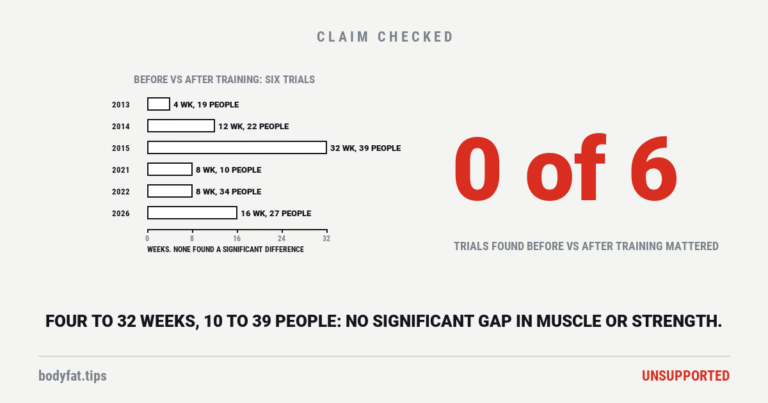
0 of 6randomised trials of creatine taken just before against just after training found a statistically significant difference in muscle or strengthNOUnsupported

When to Take Creatine: Before or After Training, Six Trials Found No Significant Difference in Muscle or Strength

Six bars, one per randomised trial of creatine taken just before against just after training, each as long as the trial ran, from 4 to 32 weeks, with 10 to 39 people finishing; none found a significant difference; beside them the figure 0 of 6

Six randomised trials set creatine taken just before training against creatine taken just after, for four to 32 weeks; none found a statistically significant difference in muscle or strength. Morning against evening was tested once, with no significant difference. Sugar alongside it makes muscle store more creatine; the four trials that tested it directly against creatine alone found no significant difference in performance, and one eight-week trial leans toward sugar without a direct test in the part we could read. Rest days are the open question.

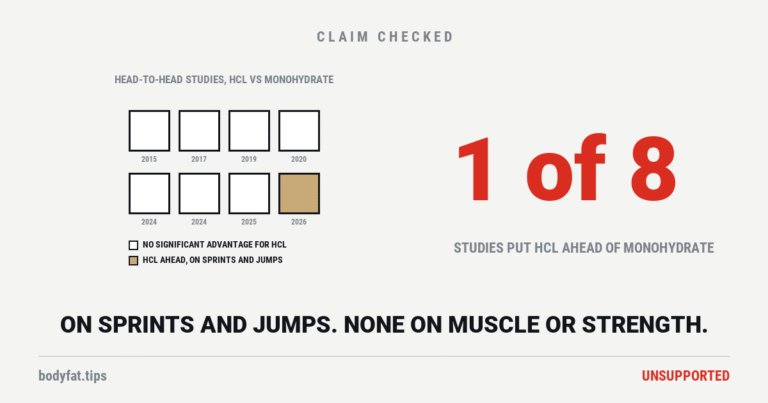
1 of 8studies against monohydrate put HCl ahead, on sprints and jumps; none on muscle or strengthNOUnsupported

Creatine HCl vs Monohydrate: Eight Studies Compared Them, and Only One Put HCl Ahead, on Sprints, Not Muscle

Eight tiles in date order from 2015 to 2026, one per study comparing creatine HCl with monohydrate: seven open, no significant advantage for HCl, and the 2026 tile filled, HCl ahead on sprints and jumps; beside them the figure 1 of 8

Creatine HCl dissolves 38 times better in water. In eight small studies against monohydrate, seven found no significant advantage and one found HCl ahead on sprints and jumps; none found more muscle or strength. The absorption claim rests on a patent's two-hour blood test.

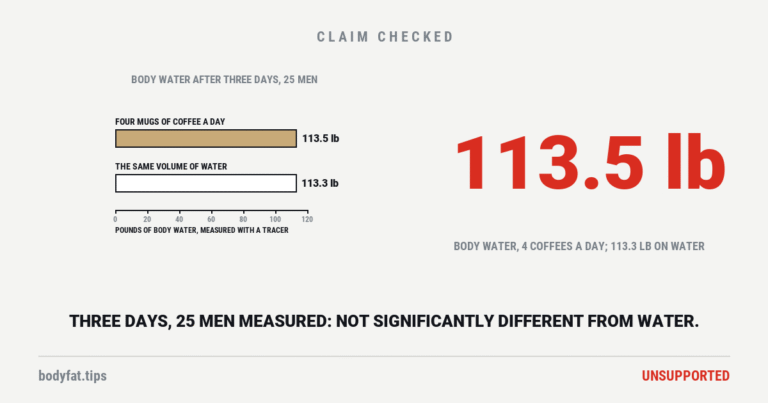
113.5 lbaverage total body water on four mugs of coffee a day for three days, against 113.3 lb (51.4 kg) on water, in 25 of 50 men who already drank coffee: not significantly differentNOUnsupported

Does Caffeine Dehydrate You? Not at Ordinary Intakes: in Trials, Coffee and Tea Hydrated About as Well as Water. The Extra Urine Shows Up at Big Doses.

Two bars drawn to scale from zero: 113.5 pounds of body water after three days of four mugs of coffee a day and 113.3 pounds after three days of water, in 25 men measured with a tracer; beside them the figure 113.5 lb

Caffeine makes you pass a little more urine for a few hours: about 3.7 fl oz on average across 16 studies. At ordinary intakes the cup brings more water than that. In 50 men drinking four mugs of coffee a day for three days, body water, measured in 25 of them, was not significantly different from three days on water. Big doses at once are another matter.

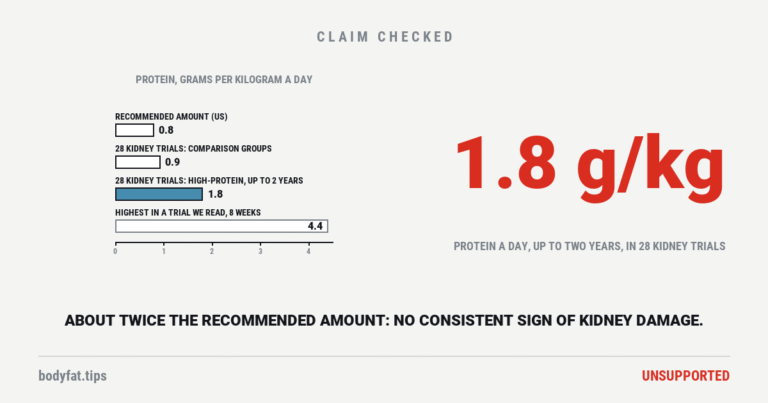
1.8 g/kgprotein a day, about twice the recommended amount (comparison groups 0.9 g), for up to two years in 28 trials of adults without kidney disease; in the 18 that measured filtration before and after, the change was not significantly differentNOUnsupported

How Much Protein Is Too Much? At About Twice the Recommended Amount, for Up to Two Years, Trials Found No Consistent Sign of Damage to Healthy Kidneys

Bars to scale of protein in grams per kilogram a day: the recommended 0.8, the comparison groups' 0.9 and the high-protein groups' 1.8 in 28 kidney trials of up to two years, and 4.4 in an eight-week trial; beside them the figure 1.8 g/kg

There is no official upper limit for protein. In 28 trials, adults without kidney disease ate 1.8 against 0.9 g per kilogram a day, about twice the recommended amount, for up to two years; in the 18 that measured filtration before and after, the change was not significantly different, and no consistent sign of damage appeared. Decades are untested in trials, the long studies of ordinary eaters point both ways, and damaged kidneys are a different question.

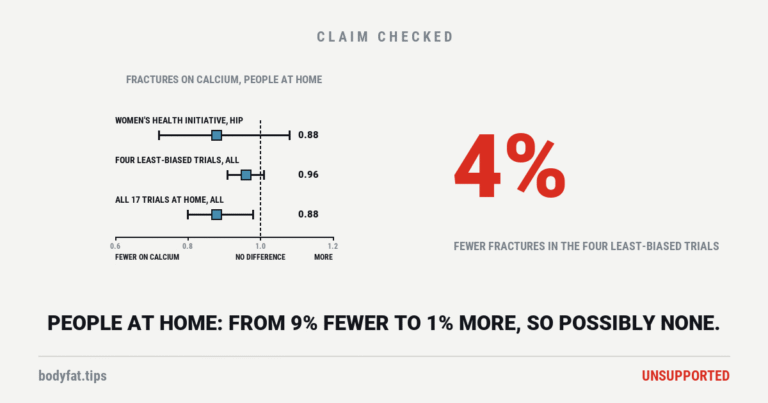
4%fewer fractures on calcium in the four least-biased trials, 44,505 people living at home; the range ran from 9% fewer to 1% moreNOUnsupported

Should You Take Calcium Supplements? The Trial That Cut Hip Fractures Was in French Care Homes. At Home, the Best Trials Found No Clear Drop.

Chart of fracture ratios on calcium against a dummy pill in people living at home: the Women's Health Initiative's hips 0.88 (0.72 to 1.08), the four least-biased trials 0.96 (0.91 to 1.01), and all 17 trials at home 0.88 (0.80 to 0.98); the least-biased result sits nearest no difference. Beside it the figure 4%

Calcium supplements raise bone density by 1 to 2%, once. In the largest, least biased trials of adults living at home, fractures were not clearly fewer; the trial that cut hip fractures was done in French care homes. The heart-attack worry is contested, the kidney-stone risk is measured, and calcium from food goes with fewer stones, not more.

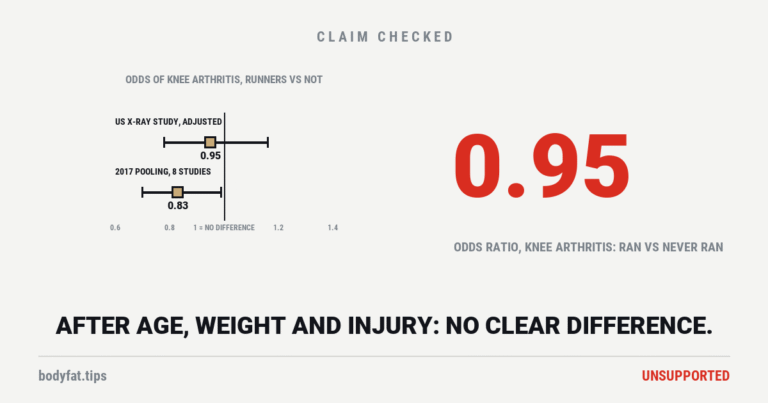
0.95odds of knee arthritis on X-ray, runners against people who never ran, after age, sex, weight, past injury and other activities, in 2,637 US adults; 1 means no difference (range 0.78 to 1.16)NOUnsupported

Is Running Bad for Your Knees? For Recreational Runners, No. That It Protects Them Is Less Certain.

Two odds ratios with their ranges against a line at 1, no difference: a US X-ray study adjusted for age, sex, weight, past injury and other activities, 0.95 (0.78 to 1.16), and a 2017 pooling of eight studies of recreational runners, 0.83 (0.70 to 0.99); beside it the figure 0.95

In studies of thousands of people, recreational runners did not have more knee arthritis than people who did not run; in a US study that X-rayed the knees of 2,637 adults, the difference shrank to one chance could explain once age, weight and past injury were allowed for. Former elite athletes are a less clear story, and the claim that running protects the knee rests on weaker evidence than the headlines suggest.