Do Probiotics Cause Diarrhea? In Trials, About as Often as a Dummy Capsule

“Does probiotics cause diarrhea” is typed into Google about 8,100 times a month in the United States (from a paid keyword database, pulled 22 October 2026) [1]. “Do probiotics help with diarrhea” is typed about 4,400 times a month (from a paid keyword database, pulled 22 October 2026) [1]. Put the two side by side and you have the odd position probiotics are in. The same capsule is sold to stop diarrhea and blamed for starting it.
Google’s own answer to the first question opens: “Yes, probiotics can cause temporary diarrhea.” Then it suggests halving the dose or waiting, because “mild side effects fade within a few days to two weeks” [1].
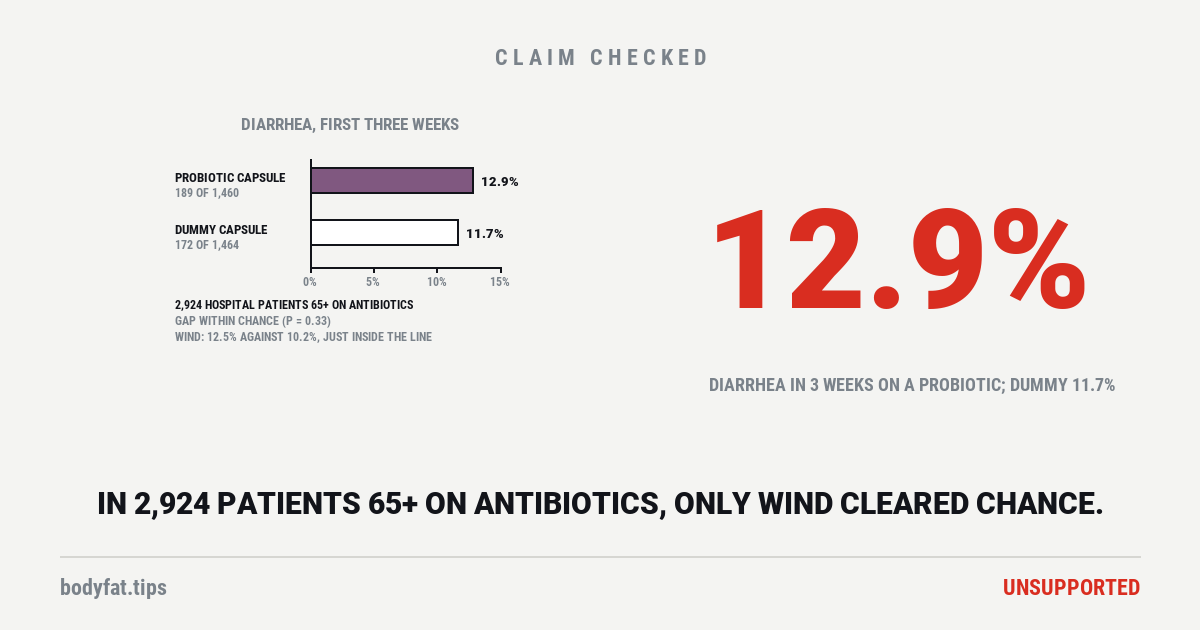
In the trials that counted it, diarrhea was about as common on a probiotic as on a dummy capsule. In a trial of nearly 3,000 older hospital patients on antibiotics, 12.9% had diarrhea in the first three weeks of taking a probiotic and 11.7% of those taking an identical capsule of starch did, a gap chance produces easily [2]. Across 126 controlled trials pooled in a US government review, digestive side effects came out about even [3]. What that big trial did pick up was a little more wind.
Where probiotics do help is narrower than the shelf suggests, and for a few people they are a real risk. Both are below.
This is journalism, not medical advice. Diarrhea with blood in it, a high fever, signs of dehydration, or diarrhea that lasts more than a few days needs a clinician, whatever you have been taking. Anyone who is very ill, has a weakened immune system or a central line (a long-term tube into a large vein), or is caring for a premature baby should not start probiotics without one [4] [5].
Do probiotics cause diarrhea?
You cannot find out by asking people who took probiotics whether they got diarrhea, because plenty of people get diarrhea in any given month. You find out with a randomised controlled trial: give one group the probiotic and another a placebo, a dummy capsule that looks the same, without anyone knowing who has which, and count the diarrhea in both. Whatever is extra in the probiotic group is the probiotic’s doing.
The clearest count of the first weeks comes from a trial called PLACIDE, run in five hospitals in Wales and northern England. It gave 2,981 patients aged 65 and over, all on antibiotics, either a daily capsule of 60 billion live bacteria from four strains or a capsule of maltodextrin, a starch powder, for 21 days [2]. Research staff recorded symptoms every day in hospital and every week by phone after discharge [2]. Here are the first three weeks.
| Symptom | Probiotic capsule | Dummy capsule |
|---|---|---|
| Diarrhea | 12.9% (189 of 1,460) | 11.7% (172 of 1,464) |
| Abdominal pain | 13.7% | 13.2% |
| Nausea | 15.6% | 14.2% |
| Bloating | 10.6% | 9.8% |
| Wind | 12.5% (183 of 1,459) | 10.2% (149 of 1,462) |
The diarrhea gap came with a p-value of 0.33. A p-value is a measure of how easily chance alone could produce a gap that size; researchers usually call anything under 0.05 “probably not chance”, and 0.33 is nowhere near it [2]. Wind came in at 0.045, just inside the line [2].
PLACIDE and an intensive-care trial are the two largest in the newest pooling of this research, each four to five times the size of any other [6]. The intensive-care trial makes the same point from a harder angle. In 44 intensive-care units, 2,650 adults on ventilators were given the probiotic strain Lactobacillus rhamnosus GG, known as LGG, or a dummy, twice a day [7]. Diarrhea, counted as three or more loose or watery stools a day, struck 65.3% of the probiotic group and 64.2% of the dummy group; very ill people on antibiotics get diarrhea constantly, and the gap was within chance on every definition the trial used [7].
Smaller trials, added up, point the same way. In 2011 a US government evidence report, written by an independent review centre under contract to the Agency for Healthcare Research and Quality, read 622 studies of probiotics for their side effects [3]. Pooling 126 controlled trials, it put the risk ratio for digestive side effects at 1.03. A risk ratio is how often something happened on the probiotic divided by how often it happened on the comparison, so 1.00 means equally often. The confidence interval, the range the true average probably sits in, ran from 0.89 to 1.18: a little less often, a little more often, or neither [3].
The newest pooling, a 2025 Cochrane review of probiotics given alongside antibiotics, counted side effects in 37 trials and 11,911 people: 10.9% on probiotics and 12.2% on a dummy or nothing [6]. The commonest complaints were the same in both groups, “abdominal cramping, nausea, fever, soft stools, flatulence, and taste disturbance” [6]. Soft stools turned up in the dummy groups too. That is the point of having one.
There is a second test hiding in plain sight. In those same antibiotic trials diarrhea was not a side effect; it was what the trials counted. Across 40 of them and 13,419 people, 23% of those on probiotics developed diarrhea during or after their antibiotics, against 27.4% in the comparison groups [6]. If probiotics gave people a burst of diarrhea when they started, it would be counted in that 23%. For the total to come out lower, any such burst would have to be smaller than whatever the probiotic prevented. That is our reading of the arithmetic, not a finding of the review.
Can probiotics cause diarrhea and stomach pain?
In PLACIDE’s first three weeks, stomach pain was about as common on the capsule as on the dummy, 13.7% against 13.2% [2]. One group is different. In people with inflammatory bowel disease, Crohn’s or ulcerative colitis, a 2019 pooling of nine small trials and 826 patients found abdominal pain more often on probiotics, with a risk ratio of 2.59 and a range of 1.28 to 5.22 [8]. Across all nine trials, side effects overall leaned the same way without clearing chance, at 1.35, with a range of 0.93 to 1.94; digestive symptoms taken together, reported in seven of the trials and 735 patients, leaned the same way too, at 1.78, with a range of 0.99 to 3.20 that still just includes no difference; in the six trials in ulcerative colitis, 648 patients, side effects overall were significantly more common on probiotics [8]. Nine small trials is not a settled answer, but it is a reason not to assume the general result applies if you have one of those conditions.
Do probiotics give you diarrhea at first?
This is the version most of the pages Google cites lead with: a few loose days while your gut “adjusts” [1]. The trial on this page that tracked the first weeks did not find it as an extra; PLACIDE’s table above is exactly those three weeks [2].
There is one honest thread on the other side. The 2011 report noted that few studies said when side effects began, but that in the few that did, most digestive effects “were observed in the first three days of treatment” [3]. That describes when people in the probiotic groups reported symptoms; it is not a comparison with the dummy groups. It would fit a real start-up effect. It would also fit people watching their stomachs most closely in the first days of something new. That second reading is our surmise.
How long does diarrhea last when starting probiotics?
The pages that answer this give a few days to a few weeks [1]. We tried to find where that comes from, and the trail we could follow runs backwards like this. A synbiotic seller’s guide says mild diarrhea “typically subsides within a few days to a few weeks of consistent daily use”, and cites a 2024 review in a scientific journal [1]. That review says mild side effects “will resolve as the body’s microbiome readjusts”, and cites a 2023 post on a prescription-discount company’s blog [9], where the line is attributed to a single doctor [10]. The review’s next sentence lists diarrhea among “common probiotic side effects”, with bloating, gas, constipation and nausea, citing a 2019 review of probiotic harms and the 2019 pooling of inflammatory bowel disease trials above, and gives diarrhea no timetable. The sentence after that, that gas and bloating “usually improve within a few weeks”, cites that pooling alone [9]. That pooling does say it, once, in its discussion rather than its results: gas, swelling and constipation “in most cases disappears in a few weeks”. For that it cites a 2010 review in a hospital-pharmacy journal and a 2007 commentary in a pharmacy journal, not its own trials [8]. We read those two only as their summaries, and neither summary gives a timetable [11] [12]. None of these lines puts diarrhea on the timetable. The seller’s guide is the first place in this trail where diarrhea is given a few days to a few weeks [1].
So the timetable has no trial behind it that we could find. In the controlled trials we read, diarrhea in the first weeks ran about as high on the dummy capsule. A timetable for start-up diarrhea needs a start-up excess to time, and these trials did not detect one; their ranges still allow a small one [2] [13].
Can too much probiotics cause diarrhea?
The reviews that looked could not tie bigger doses to more side effects. Probiotic doses are counted in colony-forming units, or CFUs, roughly the number of live microbes that can grow. The 2011 report found “no threshold effect or trend” linking a higher dose to more reported side effects, while warning that few studies compared doses and that one study’s high dose was another’s low [3]. In children on antibiotics it ran the other way: the trials giving at least 5 billion CFUs a day prevented more diarrhea, 8% against 23% on the comparison, than the lower-dose trials did, 8% against 13% [4]. That compares different trials with each other, not doses within one trial, so read it as a hint [4].
What can bring on diarrhea at a big dose can be something else in the product. Some products add fibres such as inulin, or sugar alcohols, as Google’s own answer points out [1]. Our fiber verdict found inulin softened stools and brought more wind in the trials it reads, and our sugar alcohols verdict sets out the laxative warnings that sorbitol and its relatives carry. Those are separate ingredients with their own effects.
Do probiotics cause diarrhea in babies?
The trials in children look much like the trials in adults. In the 2019 Cochrane review of probiotics for children on antibiotics, aged 3 days to 18 years, side effects were reported in 4% on probiotics and 6% on the comparison, across 24 trials that counted them [4]. One trial of children in hospital on antibiotics, median age four months, points the other way and belongs here: diarrhea in 20% of 123 children given Lactobacillus reuteri against 13% of 124 given a dummy, which its authors called similar in both groups [14].
For babies born early the worry is not diarrhea. It is infection. In October 2023 the US Food and Drug Administration warned that premature babies given probiotics in hospital “are at risk of invasive, potentially fatal disease, or infection, caused by the bacteria or yeast contained in the probiotics”, after one infant death that year and more than two dozen other reported adverse events since 2018 [5]. It has approved no probiotic as a drug for infants of any age [5]. The warning sits awkwardly beside the American Gastroenterological Association’s 2020 guideline, which suggested certain strains for premature babies to prevent necrotising enterocolitis, a bowel disease in which gut tissue dies [15]; the FDA’s notice acknowledges “conflicting data in the literature” [5]. Either way, it is a decision for the baby’s doctors, not the supplement aisle.
Who should not take probiotics?
For a small group the risk is real, and it is not diarrhea. In the intensive-care trial, 15 of 1,318 patients on LGG (1.1%) had a Lactobacillus turn up in a normally sterile place, mostly the blood, or as the main organism grown from a sample elsewhere, such as urine, against 1 of 1,332 on the dummy (0.1%) [7]. The team could sequence the bacteria from 12 of those patients: all 12 were the probiotic strain, all in the probiotic group [7]. The trial counted two of the cases as serious, and both of those patients died [7]. The 2025 Cochrane review, which includes this trial, lists the eight trials that reported serious side effects and says none was attributable to a probiotic; the intensive-care trial is not on that list, and the review’s text does not mention its Lactobacillus cases [6]. That is our reading of the review’s text; its supplementary data were not read.
In a 2008 Dutch trial of 296 patients with severe pancreatitis, a probiotic mix given through a feeding tube was followed by 24 deaths among 152 patients, against 9 among 144 on a dummy, and by nine cases of bowel ischaemia, the bowel losing its blood supply, against none [16]. The journal later published an expression of concern after three Dutch regulators reported on how the trial was designed, approved and run [16].
These are very ill people. The 2019 children’s review notes that the serious problems reported outside trials have been in severely debilitated or immunocompromised children, with risk factors including a central line [4]. The AGA’s guideline says people with severe illness or a suppressed immune system may reasonably choose no probiotic at all [15].
Do probiotics help with diarrhea?
For two kinds, there are real trials. The answers are less tidy than the labels.
Probiotics for antibiotic diarrhea
Antibiotics kill gut bacteria along with the infection, and diarrhea during or after a course is common: it struck 27.4% of the people in the comparison groups of the 2025 Cochrane review [6].
In children the evidence is the strongest of anything on this page. The 2019 Cochrane review pooled 33 trials and 6,352 children: 8% got diarrhea on probiotics and 19% on a dummy or nothing, a risk ratio of 0.45 [4]. Its authors rated the certainty moderate and found the benefit concentrated at doses of at least 5 billion CFUs a day, of products such as Lactobacillus rhamnosus or the yeast Saccharomyces boulardii [4]. That works out to about 9 children treated for one to be spared a bout of diarrhea, the review’s number needed to treat [4].
Two cautions. Of those 33 trials, 20 were at high risk of bias, and of the 17 that said who paid for them, 9 were paid for by industry [4]. The trial of 247 children above, in which diarrhea was not lower on L. reuteri, is one of the review’s own 33 [14] [4]. Trials published since the review’s search point both ways. In 654 Turkish children aged six months to ten years, given an antibiotic for an ear or sinus infection, the same L. reuteri strain about halved antibiotic diarrhea over the first 14 days, 7.9% against 16.7%; the strain’s maker made and supplied the drops free, and in the trial’s age breakdown the difference was significant only in children under two [17]. A 2026 pooling of that strain’s three trials, by authors of two of them, found less antibiotic diarrhea when it was given for up to 21 days, and no significant difference with courses of 14 days or less or over follow-up to 56 days [18]. In 313 children, half of them given an eight-strain product supplied free by its maker, antibiotic diarrhea on the trial’s strictest definition came out at a risk ratio of 0.81, with a range of 0.49 to 1.33 that includes no difference, though diarrhea from any cause was lower, at 0.65 [19]. And in 255 healthy American children given a yogurt with an added probiotic or the same yogurt without it alongside their antibiotics, diarrhea was too rare to tell the groups apart, 3 cases against 2, and loose stools, an outcome the authors added after the fact, were reported in 25 of 125 children on the probiotic yogurt and 19 of 130 on the plain one, a gap the authors’ test put within chance [20].
Adults and children together, the 2025 Cochrane review found antibiotic diarrhea in 23% on probiotics against 27.4% without, a risk ratio of 0.67 [6]. It rated that low certainty. The trials’ results had an I-squared of 74%, the share of the spread between the trials’ results that is more than chance would produce, and the pattern of small trials suggested positive ones were likelier to be published [6]. Kept to the trials at low risk of bias, the benefit shrank to a risk ratio of 0.82 and held [6]. The review also warns that it searched for trials of C. difficile, not every trial of antibiotic diarrhea [6].
And the two largest trials in it are the two already on this page. Neither found that the probiotic cut diarrhea: 10.8% against 10.4% in the older patients [2], 65.3% against 64.2% in intensive care [7].
Can probiotics help with C diff?
Clostridioides difficile, C. diff for short, is a bacterium that can take over a gut emptied by antibiotics and cause severe diarrhea. In the United States in 2011 it caused almost half a million infections [15].
Across 38 trials and 13,179 people in the 2025 Cochrane review, 1.6% of those on probiotics developed C. diff diarrhea against 3.2% without, a risk ratio of 0.50, or about 65 people taking probiotics to prevent one case [6]. The certainty is low, and the average hides the shape. In trials where more than 5% of the comparison group caught it, the review’s outbreak setting, the risk ratio was 0.30. In trials where 0 to 2% did, which held 10,189 of the 13,179 people, it was 0.92, with a range of 0.65 to 1.31, about one case in a thousand prevented, if any [6]. The two largest trials sat at that low end and found no clear effect [6].
The AGA’s 2020 guideline suggests a few specific products for preventing C. diff on low-quality evidence, notes that the benefit was seen mainly in patients at very high risk, and says patients at low risk may reasonably choose none [15]. For treating an existing C. diff infection it recommends probiotics only inside a clinical trial [15].
Do probiotics help with diarrhea from a stomach bug?
Here the evidence turned over in 2018. Dozens of small trials, mostly in children and mostly outside North America, had suggested probiotics shorten an infectious diarrhea [21] [15]. The 2020 Cochrane review pooled 82 studies and 12,127 people, almost all of them children; across all of them, diarrhea ended about 21 hours sooner on probiotics [21]. But the results varied far more than chance would produce, and the reviewers found signs that small trials with disappointing results had gone unpublished [21].
Then came two large trials built to settle it, in emergency departments in the United States and Canada. In 971 American children aged 3 months to 4 years, five days of LGG left 11.8% with moderate-to-severe gastroenteritis against 12.6% on a dummy, and the last watery stool came at a median of 49.7 hours against 50.9 [22]. In 886 Canadian children, a two-strain product left 26.1% moderate-to-severe against 24.7% on a dummy, and diarrhea lasted a median of 52.5 hours against 55.5 [23].
When the Cochrane reviewers kept only the trials at low risk of bias on every count, those two were what remained for the main outcome: a risk ratio of 1.00, diarrhea lasting two days or more as often with the probiotic as without, with a range of 0.91 to 1.09 [21]. Their conclusion: probiotics “probably make little or no difference” to it [21]. The AGA now suggests against probiotics for children’s gastroenteritis in the United States and Canada [15]. A European paediatric society’s 2023 position paper still recommends specific strains for it; we read only its summary [24]. In adults, five small trials of 393 people pointed consistently toward a benefit [21], which is the thin end of the evidence rather than the strong end.
The Cochrane search ended in December 2019, and the poolings published since have not settled it. A 2024 review commissioned by the World Health Organization, of 98 trials and 17,236 children up to age 10, most of the trials in middle-income countries, put diarrhea about 13 hours shorter on probiotics in the 33 studies using the WHO’s definition of diarrhea, and about 7 hours shorter, with a range from about 1 to 13 hours, in the 11 it judged at low risk of bias. It rated that evidence low certainty, with results varying far more than chance would produce [25]. A 2021 pooling of trials in wealthy countries, searched to September 2019, gave two answers. In the eight trials it judged at low risk of bias, 2,629 children, diarrhea was about 13 hours shorter on probiotics, with a range from about 3 to 24 hours, though the trials’ results varied far more than chance would produce, and a second pooling by a different statistical method, reported beside that result, has a range that includes no difference. In the four trials it judged of the best quality, 1,989 children, diarrhea was about 3 hours shorter, with a range from about 9 hours shorter to 2 hours longer, and about nine-tenths of that result’s weight is the two North American trials above (our sum of the weights printed on its chart). Its authors concluded that probiotics “do not demonstrate sufficient clinical impact” on how long diarrhea lasts in children in wealthy countries [26].
Should I stop taking probiotics if I have diarrhea?
The trials cannot answer that for one person. What they can say is that diarrhea in the weeks after starting a probiotic was about as common in people taking a dummy [2], so a new bout is at least as likely to be something else: the antibiotics, a stomach bug, a change of diet. Nothing in the trials we read supports the seller’s line that the diarrhea “could be a sign your microbiome is responding” [1]. The warning signs at the top of this page are the reason to see a clinician, whatever you are taking.
What are the signs that probiotics are working?
For the uses with evidence, the sign the trials counted was simple: fewer people in the probiotic group got diarrhea [4] [6]. That is a count across hundreds of people. It cannot tell any one person whether the capsule is working for them, because the diarrhea that did not happen leaves no trace. A feeling in your gut is not what these trials recorded.
Is it normal to poop more when taking probiotics?
A little more, with some strains. A 2022 pooling of 13 trials of Bifidobacterium lactis in healthy adults found people went somewhat more often, with an effect size of 0.26 [27]. On the scale researchers use, 0.2 is small, 0.5 moderate and 0.8 large, so: small. Going more often is not diarrhea, but it is one plausible reason people think they have it, which comes up again below.
Who these studies were done on
The two trials that counted diarrhea most carefully were in older hospital patients on antibiotics [2] and in adults on ventilators [7]. The 2025 Cochrane review covers children and adults taking antibiotics, with average ages from 4.5 to 78 [6]; the stomach-bug trials were almost all in children [21]. The 2011 government report is the broadest, pooling controlled trials in every kind of participant, healthy volunteers included, but its search ended in 2010 [3].
So read yourself against them. If you are a healthy adult starting a probiotic, with no antibiotics involved, the closest evidence is the 2011 report’s own subgroup of trials in generally healthy people. Digestive complaints of any kind were reported somewhat more often on the probiotic, a risk ratio of 1.10, with a range from 0.88 to 1.39 that includes no difference. Counted as people, that range runs from about 3 in every 1,000 fewer having a complaint to about 3 in every 100 more, and the report gives no figure for diarrhea alone [3]. A 2022 Cochrane review of probiotics taken to prevent colds, by people of all ages with healthy immune systems, found side effects of any kind about as often on probiotics as on a dummy or nothing, a risk ratio of 1.02, with a range of 0.90 to 1.15, in 8 trials and 2,456 people; the side effects were minor, most often digestive [28]. Neither result cleared chance, and both leave room for a small excess. If you have Crohn’s disease or ulcerative colitis, the small pooling above found more abdominal pain, and the general result may not apply to you [8]. If you are very ill, immunosuppressed or have a central line, the risk worth your attention is infection, not diarrhea [7] [4].
If the trials could not detect extra diarrhea, why do so many people say probiotics gave them some?
This section is the desk’s own reasoning, and it is labelled as such. The controlled trials say diarrhea was about as common on a dummy capsule. Plenty of people ask whether a probiotic gave them diarrhea; that search is nearly twice the search for whether probiotics help. Here are three ways those fit together, each rated.
Answer one: diarrhea is common, and it travels with the reasons people start probiotics. In three weeks of PLACIDE, 11.7% of the people taking a capsule of starch had diarrhea [2]. Of the people on antibiotics in the comparison groups of the 2025 Cochrane review, 27.4% developed it [6]. Google’s own answer recommends probiotics for exactly those moments, alongside antibiotics or during a stomach bug [1], which is when diarrhea is likeliest anyway. The base rates are measured. That people pin the diarrhea on the newest pill is our inference.
Answer two: some probiotics do change your bowels, just not into diarrhea. In PLACIDE, wind was the one symptom more common on the probiotic, 12.5% against 10.2% [2]. In healthy adults, one bacterium went with a small rise in how often people went [27]. More wind and an extra trip to the toilet are real and measured. That people read them as diarrhea is a surmise.
Answer three: the people and the products the big trials left out. PLACIDE excluded, among others, people needing intensive care or isolation for a weak immune system [2]. In people with inflammatory bowel disease, the one pooling found more abdominal pain on probiotics, and side effects overall leaning the same way [8]. And a fibre or a sugar alcohol added to a supplement is a separate ingredient with effects of its own, which a trial of a plain capsule does not test. This one is a surmise with one small pooling on its side.
Put the three together and here is what we think is true, stated plainly so you can disagree with it: probiotics did not give the people in these trials detectably more diarrhea than a dummy capsule did; what they gave some of them was a little more wind, and diarrhea that was coming anyway found a new suspect.
What we could not find, and would like to: a trial that takes people who are sure a probiotic gave them diarrhea and, without telling them which, gives them the probiotic in some weeks and a dummy in others [13]. That would test the claim in the people who make it. If you know of one, the corrections line on this site is open.
Where “probiotics give you diarrhea at first” came from
We could not trace who first said it. The idea underneath is reasonable: digestive complaints are the side effects probiotic studies report most, and the 2011 government report found exactly that [3]. The rest of its finding, that those complaints were about as common in the comparison groups, travels less well [3]. The drug-price site Google cites does print it, a few lines after telling readers probiotics can cause temporary diarrhea [1].
The “adjusting” story has a path we could follow. In June 2023 a prescription-discount company’s blog said mild side effects “will resolve when your body’s microbiome readjusts”, attributing the line to a doctor [10]. In 2024 a review in a peer-reviewed journal repeated the line almost word for word, citing the blog, and in its next sentence listed diarrhea among “common probiotic side effects”, with no timetable [9]. The same review said gas and bloating “usually improve within a few weeks”, citing a 2019 pooling of bowel-disease trials whose discussion said so of gas, swelling and constipation, on the strength of a 2010 pharmacy-journal review and a 2007 commentary [9] [8]. In a guide updated in January 2026, a synbiotic seller cited that 2024 review for “Mild diarrhea, bloating, or gas” that “typically subsides within a few days to a few weeks” [1]. A doctor’s line on a commercial blog became a citation for “adjusting”; a remark about gas in a review’s discussion became the “few weeks”; a seller put the two together and stretched the timetable to cover diarrhea, which the review had listed as a common side effect but never timed.
And it sells. For the first question Google’s AI answer cites the drug-price site, a symptom-checker app that puts the diarrhea at “about 2–10% of users” without a figure for people taking a dummy, a hospital system and the seller, and tells readers to cut the dose or “Wait It Out” [1]. The seller’s guide goes further, on a page that sells its capsule: the diarrhea “could be a sign your microbiome is responding to its new microbial residents” [1]. A side effect sold as a sign of success is a side effect you keep paying for.
None of this is aimed at anyone who has had a bad week after starting a probiotic. The diarrhea was real. The question is only what caused it, and that is the one thing a single week cannot tell you.
What this is rated, and what the rating covers
Unsupported, of the tested kind — for the claim that probiotics give you diarrhea when you start taking them.
It was tested, and it did not hold up. In the controlled trials that counted it, diarrhea and other digestive side effects were about as common on a dummy capsule as on the probiotic: in the first three weeks of a trial of nearly 3,000 older patients [2], in intensive care [7], across 126 trials pooled in 2011 [3] and 37 pooled in 2025, the older-patient trial among them [6]. In generally healthy people, digestive complaints leaned slightly higher on the probiotic without clearing chance, and side effects of any kind came out about even [3] [28]. Where these analyses counted diarrhea, or digestive side effects taken together, none found significantly more of either on the probiotic, though their ranges leave room for a small excess. Three things keep it from being the whole story. Side effects in probiotic studies are poorly reported: 235 of the 622 studies in the 2011 report said only that the probiotic was “well tolerated” [3]. Wind was a little more common on the capsule in PLACIDE [2]. And people with inflammatory bowel disease may react differently [8].
Each related claim, rated alone, in words. That probiotics prevent diarrhea from antibiotics: Supported in children, on 33 trials at moderate certainty, most clearly at 5 billion CFUs a day or more [4], with the caveat that trials since its search point both ways [17] [19] [20]; Preliminary in adults, where small trials point toward a benefit and the two largest found no clear one [6] [2] [7].
That probiotics prevent C. diff: Preliminary. The benefit sits in trials where C. diff was common; at the low risk that most of the trials’ patients faced, the pooled result could not be told apart from no difference [6].
That probiotics treat a stomach bug in children: Preliminary, because the evidence conflicts. The two large trials at low risk of bias, in the United States and Canada, found the probiotic and dummy groups within chance of each other [22] [23] [21], and the smaller trials that found a day’s benefit vary far more than chance and show signs of missing negative results [21]. Poolings published since disagree. Worldwide, the low-bias trials put diarrhea about 7 hours shorter, at low certainty; in wealthy countries, one pooling’s low-bias trials put it about 13 hours shorter, with results varying far more than chance would produce, while its best-quality trials, most of whose weight is the two large ones, found no clear difference [25] [26]. Rated alone, the claim for children in the United States and Canada, where the two large trials ran, would read Unsupported, of the tested kind. In adults the five small trials are too few to rate [21].
That probiotics bring more digestive side effects in people with inflammatory bowel disease: Preliminary, on one pooling of nine small trials, in which abdominal pain, and side effects overall in the ulcerative colitis trials, cleared chance [8]. Serious infections in very ill people and in premature babies are not given a tier here; they are reported above, from a trial and from the FDA [7] [5], and they are why the clinician line sits at the top of this page.
What is not rated here: probiotics for weight loss, irritable bowel syndrome, constipation or anything else, and the frame in the section above, which is this desk’s reasoning from the evidence rather than a result the evidence delivered. It is marked as ours so that you can weigh it as ours. A bacterium sold as a capsule for weight and blood sugar has its own verdict, and other gut supplements are rated in our gut-health ranking.
This is journalism, not medical advice. Diarrhea with blood, a high fever, signs of dehydration or diarrhea lasting more than a few days belongs with a clinician, and so does any decision about probiotics for someone very ill, immunosuppressed or born early. How we read a study, and what each tier means, is set out here.
- Paraxanthine vs Caffeine: Three Small Trials, No Clear Edge
preliminary - Does Collagen Help Hair Growth? Small Trials of Collagen Alone Lean Its Way. None Enrolled People Diagnosed With Hair Loss.
preliminary - Does Low Vitamin D Make You Tired? The Best Trial in Tired, Deficient Adults Found a 2.5-Point Gap at Four Weeks. Genes That Lower It Did Not Clearly Raise Tiredness.
preliminary