Vibration Plate Benefits: The Three Biggest Bone Trials We Found, 1,086 People, Showed No Clear Gain. Stronger Legs Are Another Matter.

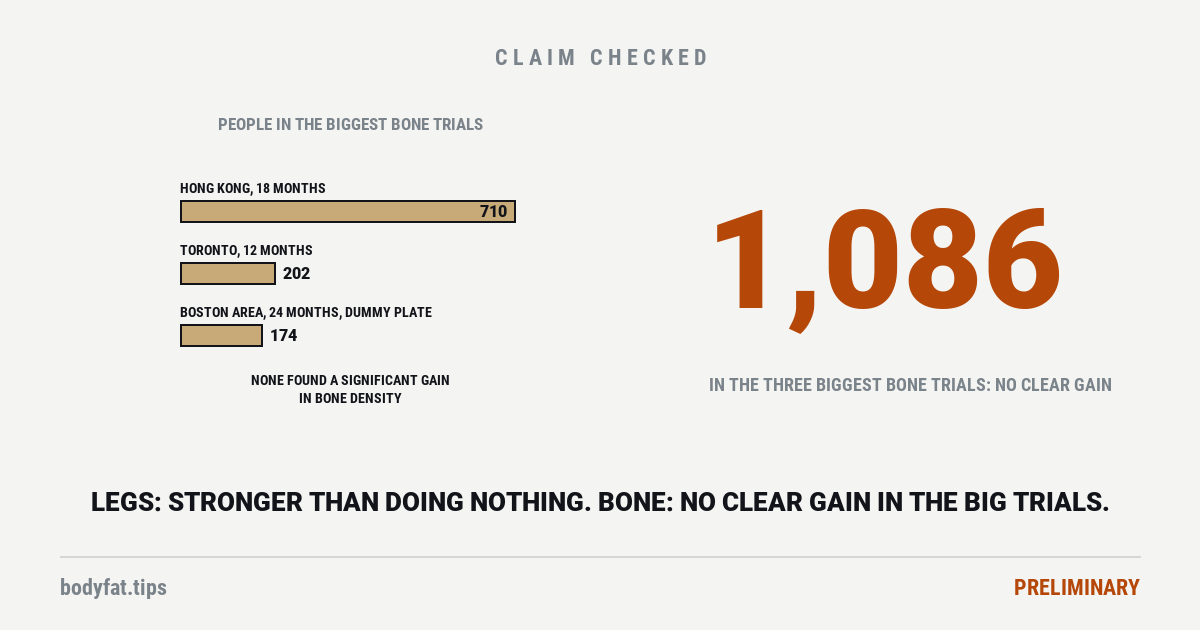
Here is the short answer first. Standing on a vibration plate makes older legs stronger than doing nothing does. It has not been shown to make them stronger than ordinary exercise does. And the claim the channel’s title asks about, that they build bone, is unsettled: some pooled analyses find a sliver of extra bone at one spot or another, and the three biggest bone trials we found, 1,086 people between them, showed no clear gain [1] [2] [3].
“Vibration plate benefits” is typed into Google about 135,000 times a month (from a paid keyword database, pulled 10 October 2026) [4]. In March a physicians’ explainer channel run by two orthopaedic surgeons, with guest specialists, put the question in a title: “Vibration Plates: Do They Actually Build Muscle And Bone?” By 10 October it had 328,128 views [5]. Its description promises “the real answer” without saying what it is, tells viewers the plates were “Originally developed during space research to help address muscle and bone loss in astronauts”, and lists “Why vibration plates may help improve balance and reduce fall risk” among the things you will learn [5]. We read the description, not the video. Google’s AI answer to “vibration plate benefits” cites that video three times, each time beside two other sources: for falls, for bone, and for who should stay off [4].
So here is the answer it promised, claim by claim, with the trials behind each one.
| The claim | What the trials found | Rating |
|---|---|---|
| It builds bone | Small gains at one site or another in some poolings and at the shin in one trial with a dummy platform; none at the hip or spine in the biggest trials, the trials against a still plate or the 2024 overview | Preliminary |
| It builds muscle | One year-long trial in older men: thigh muscle grew as much as with gym training; three poolings found no clear gain | Preliminary |
| Stronger legs than doing nothing | Consistent across poolings of older adults, care-home residents and healthy women | Supported |
| Stronger than the same exercise without it | Poolings disagree; the larger recent ones found no clear edge | Preliminary |
| Fewer falls | One large unblinded trial for; a blinded trial and a care-home trial the other way | Preliminary |
| Fewer fractures | One trial in older adults set out to count them: too few to tell. In a blinded falls trial, most falls with moderate or serious injury, and four of the five that broke a bone, were in the plate group, which also fell more often; the split was not tested | Preliminary |
| Belly fat or weight loss from the plate alone | 20 trials: no significant loss. One small trial since, against a dummy plate: a lower BMI and a smaller waist; body fat, organ fat and lean mass not significantly different | Unsupported |
| “Ten minutes equals an hour” | Measured: about a fifth more energy than the same exercises off the plate; for strength, the two analyses on this page that ranked the options put conventional or resistance training first | Unsupported |
| Lymphatic drainage, diabetes, back pain | Small, early or indirect studies | Preliminary |
Do vibration plates build bone?
The idea is good physiology: bone is living tissue, and it responds to being loaded. In 2001 a team stood adult sheep on a plate that shook their hind legs very gently for 20 minutes a day. After a year the spongy bone inside the top of the thigh bone (trabecular bone, the honeycomb under the hard outer shell) was 34% denser than in sheep that had not stood on it [6]. If a sheep, why not a person?
People have now been tested, many times. Here are the three largest trials in the reviews we read in full.
| Trial | Who and how long | The platform | Bone density |
|---|---|---|---|
| Hong Kong, 2014 [1] | 710 women over 60 living at home, 18 months, assigned in groups rather than one by one | 0.3 g at 35 Hz, standing, 20 minutes a day, five days a week | No significant difference from the women who did not use it |
| Toronto, 2011 [2] | 202 women past menopause with low bone density, 12 months, all given calcium and vitamin D | 0.3 g at 90 or 30 Hz, standing, 20 minutes a day | No significant effect on any bone measure, spine and hip included |
| Boston area, 2015 [3] | 174 men and women averaging 82, 24 months, all given calcium and vitamin D | 0.3 g at 37 Hz, 10 minutes a day, against a platform that looked and hummed the same but did not vibrate | No significant difference at the hip or spine |
Bone density here means bone mineral density: how much mineral a scan finds packed into a patch of bone, the number a doctor uses to diagnose osteoporosis. In Hong Kong, 710 women over 60 took part: 364 were assigned to stand on a platform 20 minutes a day, five days a week, for 18 months, and 346 were not. The trial’s main measure was falls and fractures; bone density was scanned too, and it did not differ significantly between the two groups [1]. In Toronto, 202 women past menopause with low bone density were split three ways: two groups stood on one for 20 minutes a day for a year, at one of two settings, and the third did not; the trial found no significant effect on any bone measure, the spine and hip included [2]. Near Boston, 174 people averaging 82 stood on one for 10 minutes a day for two years: 89 on a working platform and 85 on a placebo platform that looked and hummed the same but did not vibrate; bone density at the hip and spine did not differ significantly between the groups [3]. “Not significant” means the difference was small enough that chance could explain it. The Boston authors add, fairly, that their trial could have missed a small effect [3].
One smaller trial points partly the other way. In Philadelphia, 80 women aged 45 to 65, past menopause and without osteoporosis on a scan, stood on a platform for 10 minutes a day for a year, half of them on a dummy that looked the same and gave off the same tone but did not vibrate; 54 came back for the year’s final visit, fewer from the working platform (25 of 42) than from the dummy (29 of 38), and the results are for those who came back; the authors report that those who left had not differed significantly at the start from those who stayed. At the shin, the bone the trial chose because it sits nearest the plate, the working platform came out ahead: stiffness, a measure of the bone’s strength computed from MRI scans, rose 1.31% while it fell 2.55% on the dummy, and the spongy inner bone gained more density, both significant differences. At the hip and spine, the standard bone-density scan found no significant difference [7]. The Toronto trial’s main measure was the density of that same spongy bone at the shin, and it found nothing it could separate from chance [2].
What about all the reviews that say plates work? They exist, and it is worth reading what they actually found. A 2017 review of 14 trials in people over 50 pooled the bone results: at the spine and the hip the pooled difference was 0.00, inside what chance produces [8]. A 2016 review of 15 trials in women past menopause found no significant difference in its main analysis and some in subgroups [9]. A 2018 review concluded that vibration “is an effective method to improve lumbar spine BMD”, but against the women in its control groups it found no significant difference in total bone density, at the neck of the thigh bone or at the spine; its spine result compares the vibration groups with themselves, before and after [10]. A comparison with yourself cannot tell vibration apart from anything else that happened that year. Against its control groups it found one gain, in a subgroup: at the neck of the thigh bone in women under 65, about 0.01 g/cm² [10].
Other poolings do find something. A 2023 review of 20 trials found gains at the spine and at the trochanter, the knob at the top of the thigh bone, and rated only one recipe as backed by high-quality evidence: about 30 vibrations a second (30 Hz), at about 0.3 g, for about 7,000 minutes in total [11]. That is close to what Toronto’s plate groups were given: 20 minutes a day for a year is 7,300 minutes if every session is done, and they did 65% to 79% of them (our arithmetic) [2]. A 2024 review of 13 trials in women with osteoporosis found 0.018 g/cm² more at the spine and 0.005 more at the neck of the thigh bone, a result just the right side of the line researchers use for “probably not chance” [12]. A 2025 review of seven trials found a small gain at the whole top of the thigh bone and none it could separate from chance at the spine or the neck of the thigh bone [13]. A 2026 review of 14 trials found gains at two small regions of the hip, but both came from the same seven trials with 375 women between them (our sum from its table), three of them published in Chinese journals. It also reported a smaller gain at the neck of the thigh bone (10 studies) and one at part of the lower spine (three studies); at the whole hip, where the 710-woman Hong Kong trial sat, and across the whole lower spine, it found nothing it could separate from chance [14]. A 2022 review of 30 studies put the whole effect at 0.11 on the scale where 0.2 is small, 0.5 moderate and 0.8 large, right at the edge of chance [15], and another found no significant effect on bone or muscle in older people [16].
How big is 0.01 g/cm², the size several of these reviews report at the spine? Against the readings the trials started from, roughly 0.7 to 0.9 g/cm² [13], it is about 1% (our arithmetic). In 2024 a team rated the reviews themselves: of 15, 13 were of “critically low” quality by a standard checklist, the overall finding was that vibration “does not have a significant advantage in improving BMD in postmenopausal women”, and the authors wrote that they “do not recommend” it for that purpose [17].
Now the comparison that matters most, because nobody choosing a plate is choosing between a plate and the sofa. In a German trial of 151 women past menopause, two groups did the same 18-month exercise class, one with its leg exercises on a vibrating plate and one on the same plate switched off. Spine density rose 1.5% with the vibration and 2.1% without it; the vibration added nothing the trial could measure [18]. In an Austrian trial of 65 women with low bone density, neither vibration training nor resistance training changed the bone score significantly over 12 months compared with doing neither [19]. In an eight-week Thai trial, ten women did their exercises on a vibrating platform, eleven in a weighted vest and ten with neither; the T-score (a comparison with a young adult’s bone density) rose only in the vest group, and fell slightly in the platform group as in the plain-exercise group [20]. Eight weeks is short for bone, as our weighted vest verdict says about the same trial’s vest arm.
The UK’s national osteoporosis charity puts it plainly: research “has not proven if vibration therapy can help make bones stronger” [21]. That is where we land too. A sliver at one site in some poolings and at the shin in one trial against a dummy platform, none at the hip or spine in the biggest trials, and no clear gain from adding it to the same exercise in the three trials on this page that tested the addition, over eight weeks to 18 months. Two are the German and Thai trials above. The third is an American trial of 55 women past menopause, assigned to lifting weights three days a week with or without a spell on a vibrating plate before each session, or to neither: after eight months, bone density at the spine and hip did not differ significantly between the groups, though on some lifts the vibration group’s strength rose more [22]. And fractures, the thing bone density is a stand-in for? Only one trial in the 2017 review counted them: 1.1% of the vibration group broke a bone against 2.3% of the others, too few fractures to tell the difference from chance [1] [8]. A blinded falls trial, below, recorded six fractures from falls, and its chart puts four of the five falls that broke a bone in the plate group, a group that also fell more often; the split was not tested (our count from the chart) [23]. In a different group altogether, 20 boys with Duchenne muscular dystrophy, a muscle-wasting disease, all of them on steroids, a trial against a dummy platform counted four fractures in three boys on the dummy and none on the working plate over 14 months. Its authors list as a major limitation that the boys on the working plate were nearly three years older, and its senior author declares being a founder of the company that developed this kind of platform for clinical use [24]. If bone is the goal, lifting and jumping have the stronger record, as does strength training for older adults.
Do vibration exercise plates really work?
For strength, against doing nothing: yes. This is the most consistent finding in the field. A 2023 review of 18 trials in older adults found plate training raised knee strength by an effect size of 0.72 [25]. An effect size puts very different measurements on one scale: 0.2 is small, 0.5 moderate, 0.8 large. So that is a solid gain. The same shows up in care-home residents over 80 (0.59, 14 trials) [26], in healthy women (0.53 for knee strength against women who did no exercise, 21 trials) [27] and in older people with sarcopenia, the age-related loss of muscle (0.50, six trials) [28]. A 2026 review of 36 studies in people over 60 counted about two-thirds reporting a significant gain in leg strength [29]. The biggest trial in one of these reviews was the Hong Kong falls trial, 596 women analysed, and their thigh strength rose too [30] [1].
Against other exercise, the picture changes. A 2023 review of 34 studies in older adults found that vibration training beat control groups on leg strength, but when trials pitted it against another kind of exercise, it found no significant difference in strength [30]. A 2026 analysis ranking options across 27 trials in healthy older adults put conventional training first for strength and vibration first for balance and walking [31]. In the healthy-women review, against women who exercised without vibration, the plate was ahead only on jump height [27]. A 2018 network meta-analysis (a method for ranking several options against each other across many trials at once) of 30 trials in people over 60 found resistance training the most effective for strength, adding about 28 lb (12.8 kg) to the weight people could move compared with usual care [32]. The other direction exists too: a 2013 pooling of 10 studies reported an extra strength gain from vibration, though it pooled trials comparing exercise with and without vibration together with trials comparing vibration with nothing [33].
And muscle size, the “build muscle” half of the title? Less than the strength result suggests. In a year-long Belgian trial of 97 men over 60, the thigh muscle of the plate group grew 3.4% and that of a gym group 3.8%, a difference small enough to be chance, while the men who did neither showed no significant gain [34]. But when reviews pooled muscle or lean mass (everything that is not fat or bone) in older people, they found no clear gain from vibration: not across eight studies in people over 60 [35], not in sarcopenia [28], and in the 2018 network none of the three kinds of exercise moved lean mass by more than chance [32]. The Thai trial’s platform group gained 0.7 lb (0.32 kg) of lean mass while the exercise-only group lost 2.6 lb (1.20 kg), in ten women each over eight weeks [20]. Stronger, then, more reliably than bigger.
Vibration plate benefits for the elderly: balance and falls
This is the strongest case the plates have, and the one the channel’s description chose. In the 2017 review, falls came out a third lower with vibration: a rate ratio of 0.67, meaning 67 falls for every 100 in the comparison groups, with a range of 0.50 to 0.89 — the range the true answer probably sits in [8]. In 2024 a review for Canada’s preventive health task force rated vibration as “probably beneficial for reducing fallers”, moderate-certainty evidence [36]. Balance tests improve too: in care-home residents over 80, by an effect size of 0.41 [26].
Open the trials behind those numbers and one dominates. The Canadian result rests on two trials with 758 people, and 710 of them were in the Hong Kong trial [37]. In that trial the women were assigned in groups rather than one by one (a cluster-randomised trial), nobody was blinded, and the women reported their own falls; 18.6% of the vibration group reported a fall or fracture against 28.7% of the others [1] [8]. Its registry entry names fracture rate as the primary outcome the trial set out to measure; the paper reports “fall or fracture” [1]. In the 2017 review, the two trials that used the stronger, high-intensity platforms showed 0.80, a range from 0.55 to 1.18 that includes no difference at all [8].
And the trials pointing the other way? In a Finnish trial of 130 older people at risk of falling, in which neither the participants nor the assessors were told who got what, ten weeks of plate training was followed by 1.5 times as many falls as in a gentle exercise group over a year, with a range of 0.9 to 2.5, which includes no difference, so chance could explain it; the authors conclude it “did not prevent falls” [23]. Over that year, 16 falls caused moderate or serious injuries, among them 11 head injuries and six fractures. The authors report that 69% of those falls were in the plate group, mostly in the second half of the year. Their chart, which marks each of those falls by group, shows 11 of the 16 in the plate group, and four of the five falls it marks with a broken bone; the text lists six fractures, the chart five falls with one, and the paper does not say why (our count from the chart). The plate group also fell more often, 99 falls against 57, so the share of its falls that caused such an injury was similar: about one in nine, against one in eleven (our arithmetic). The authors give no test of either split [23]. In care homes, authors of the Cochrane falls reviews report two trials: in one of 171 residents, falls were 1.51 times as common with vibration (1.15 to 1.98), and the two pooled give 1.27 (0.83 to 1.95) [37]. The same authors point out that the Canadian estimate for fallers runs from 1 more to 22 fewer per 100 people, and that vibration came with about 5 adverse events per 100, none serious [37]. They advise caution and a health professional’s assessment first [37].
One more trial is the fairest test of the plate itself. In the German 18-month trial, the women whose exercise class included vibration had 0.7 falls each against 1.5 in a low-intensity wellness group, a significant difference; the women doing the same class without vibration had 0.96, not significantly different from the wellness group [18]. That points the plate’s way, in one trial of 151 women, and the trial did not report the two exercise groups as significantly different from each other [18]. Ordinary exercise programmes, built around balance and functional movements, cut falls on much larger evidence, which our squats verdict and sit-to-stand verdict set out.
Vibration plate benefits for women
Most of the bone trials above were in women past menopause, so the bone answer is mostly an answer for them [14] [8]. The strength answer holds for healthy women against doing nothing, not against other exercise [27]. Men are thin on the ground: one of the biggest bone reviews was 4% men [14], and the clearest muscle trial was all men [34].
Do vibration plates help belly fat?
Not on their own. The newest pooling, 20 randomised trials and 585 people, found that vibration training alone did not reduce body weight, BMI (body mass index, weight scaled for height) or fat mass by more than chance would allow [38]. It reported one split that pointed the plate’s way: in people 50 and over, body fat percentage came out 1.79 points lower than in the comparison groups, against 0.46 points higher in those under 50, a gap between the age groups well clear of the line researchers use for “probably not chance” (p = 0.008). The abstract, which is what we read, does not say whether the over-50 result cleared that line on its own, and its authors call it a potential age-related effect [38]. A 2021 review of 23 studies in people with overweight or obesity reported 2.4 lb (1.07 kg) less fat mass, which its own authors called not clinically significant, while weight and BMI did not differ significantly [39]. The newest pooling’s search ended on 25 December 2024, and at least two small trials have reported since. In a Saudi trial, 30 students with overweight or obesity did the same exercises three times a week for six weeks, half on a working plate and half on one that only played a recording of its sound; the working-plate group ended with a significantly lower BMI and a smaller waist, while body fat percentage, fat around the organs and lean mass, read by a smart scale, were not significantly different [40]. Its BMI averages, 31.7 falling to 28.2 in six weeks against 31.9 staying at 31.9 on the dummy plate, would mean the plate group lost about a ninth of its body weight while its body fat percentage was not significantly different from the dummy group’s (our arithmetic); a result that size is one we would want to see repeated. In a Korean pilot, 26 women with overweight or obesity were assigned to eight weeks of hour-long exercise sessions on a plate or to no structured exercise, and 23 finished, 13 of them on the plate; the plate group’s weight, body fat and waist fell significantly compared with the women who did no exercise, and the abstract gives the drops as 5.3 lb (2.4 kg), 6.2 lb (2.8 kg) and 1.4 inches (3.5 cm) [41]. That compares exercise with no exercise, not a plate with no plate. Belly fat specifically? A plate shakes the whole body, so even the theory does not aim at the belly. The vibrating belts that once did aim at it have their own history on this site.
With a diet, the evidence is thin but not empty. In a Belgian trial, 79 adults with overweight or obesity were split four ways for six months; of the 61 who finished, those who dieted and used a plate lost the most visceral fat, the fat packed around the organs: 47.8 square centimetres of visceral fat area at six months, against 24.3 with diet alone and 17.6 with diet and fitness training [42]. The authors call it a preliminary report. A 2021 review pooled five studies and found more fat lost, “especially when combined with” diet and exercise [43]. Exercise of any kind has a much bigger record on visceral fat.
What is 10 minutes on a vibration plate equal to?
Sellers’ answer: an hour. In 2006 a Salt Lake City TV report quoted a wellness centre offering a vibration machine: “ten minutes equals an hour of conventional weight training” [44]. In 2013 a Boston station reported that “proponents say ten minutes” on a vibration machine “is equivalent to one hour of resistance training at the gym” [45].
Then someone measured it. In a 2018 Italian study, 22 active young men did the same 20-minute circuit of exercises on a plate twice, once switched on and once off. With the vibration they burned 174 calories, without it 144: about 30 calories, or a fifth, more [46]. A 2001 German study found vibration added 4.5 mL of oxygen per kilogram per minute [47], which is about 1.3 METs, a MET being the energy you burn sitting still (our arithmetic). A study of ten sedentary women found the oxygen used with and without vibration not significantly different [48]. So ten minutes on a plate is worth roughly twelve minutes of the same exercises off it (our arithmetic from the 20% figure), not sixty. Read as a promise about strength rather than calories, it has not been shown either. The reviews that set plate training against other kinds of exercise found no significant difference in strength, which says those reviews could not tell plate training apart from the exercise it was set against, not that ten minutes did the work of sixty [30]; and the two analyses on this page that ranked the options for strength put conventional training, or resistance training, first [31] [32].
Vibration plate benefits for lymphatic drainage
The lymphatic system is the body’s second set of drains, carrying fluid back from the tissues. Plates are now sold “for Lymphatic Drainage” [4]. What has been tested is close to this, not the thing itself. In 2005, 18 women aged 46 to 63 lay on a tilt table with a vibrating plate under their feet; blood flow in the calf rose 30%, and the pressure at which fluid started to pool in the tissue rose, which the authors put down to better lymph flow, measured indirectly, in single sessions [49]. A 2020 trial in 30 women with lipedema, a fat disorder of the legs, found limbs shrank more when vibration was added to manual lymph drainage; its abstract does not say what device was used, and indexes list a company as its funder [50]. In mice, vibration helped the lymph vessels around the brain drain after a bleed [51].
In PubMed in three wordings, the US trials registry and an ordinary web search, we found no trial testing the drainage claim as it is sold, in people whose lymph systems are healthy. Our lymphatic drainage verdict found no study showing that a healthy person’s lymph system is backed up and needs clearing, and our cellulite verdict covers the one platform trial on cellulite.
Vibration plate benefits for diabetes
Small and mixed. A 2024 pooling of 10 trials, 428 people with type 2 diabetes, found HbA1c (the blood test for average blood sugar over about three months) lower with vibration than with conventional or resistance exercise, but against placebo or no treatment the difference was not significant; only one trial in it used a placebo, and fasting blood sugar and blood fats did not improve significantly [52]. A second pooling of four trials found a moderate effect [53]. One more thing worth knowing: the 2018 Italian study excluded people with diabetes, along with epilepsy, gallstones, kidney stones, joint implants and recent blood clots, “according to the manufacturer’s criteria” for its plate [46]. If you have diabetes, ask your clinician first.
Vibration plate for back pain
A 2023 review found vibration therapy reduced chronic low back pain, with an effect size of about 0.5 in the seven whole-body trials; the certainty was low and the authors call the clinical relevance “questionable” [54]. There is an irony here. Vibration at work, in people exposed on the job, is linked to about twice the odds of low back pain and sciatica [55], and European law limits it for exactly that reason [56]. The dose is very different — minutes against working days — but it is the same body part.
What are the negatives of a vibration plate?
European law caps how much whole-body vibration a worker may take in a day, because it “entails risks” to health, “in particular lower-back morbidity and trauma of the spine”: 1.15 m/s² averaged over eight hours, with action required from 0.5 [56]. Those limits were set for workers over a working day, not for a ten-minute session, so they are a yardstick, not a verdict. Against the international standard behind such limits, a 2013 study measured three platforms: the gentlest delivered a level considered safe for up to eight hours a day, and the strongest “seven times higher than what is considered a safe threshold for even 1 min of exposure each day” [57]. The low-intensity platform it found safe was made by a company its senior author has since declared founding [57] [58]. A 2007 study estimated that a typical ten-minute daily session on a stronger platform exceeds the standard’s recommended daily exposure [59].
In the trials, side effects were mostly minor: aching limbs, nausea, itching, weakness and fear, and no serious events in the reviews that reported them [17] [29], about 5 adverse events per 100 people in the falls trials [37]. Rarer things have been reported outside trials: a 59-year-old man developed a retinal tear and bleeding in the eye after a session, which its doctors describe as the third reported case of bleeding into the eye after vibration training [60]. The UK osteoporosis charity lists people for whom whole-body vibration is not suitable: current or recent blood clots, heart or blood-vessel disease, a pacemaker, pregnancy, dizziness or inner-ear problems, a hip or knee replacement and cochlear implants, and perhaps spinal or many fractures [21]. The trials kept out people with joint replacements, spine implants or poor balance [2] [3].
This is journalism, not medical advice. If you have osteoporosis, an implant of any kind, a pregnancy, a balance problem, eye disease or a heart condition, ask a clinician before standing on a plate. People being treated for cancer search for plates too; that is a question for the team treating you, and this page does not rate it.
If the bones barely moved, why did older legs get stronger, and why did one big trial see fewer falls?
This section is the desk’s own reasoning, and it is labelled as such. The trials say the bone gain is small or absent, yet strength rises and one large trial saw fewer falls. Both can be true. Here are three reasons, with how far the evidence goes for each.
Answer one: a plate is exercise with a tremor added. Most strength trials compared vibration with doing nothing, and against nothing it wins [30] [25] [26]. When the comparison group did the same or other exercise, the edge mostly disappeared [30] [27], and in the one long trial we found that switched the same plate on and off under the same class, bone density did not differ significantly [18]. Measured, with the comparison group doing the work: where people exercised on the plate, its gains look like the gains of the squats and heel raises they did on it. The Hong Kong women only stood, and their legs got stronger too [1], which is where the next answer comes in.
Answer two: the falls trial was also a routine. The Hong Kong women stood on a supervised platform 20 minutes a day, five days a week, for 18 months [37], knowing they were being treated, and reported their own falls [1] [8]. Showing up that often, standing that long and being watched are things that might change how carefully someone moves. The blinded Finnish trial, with a far shorter course, saw no fewer falls [23]. That the routine explains part of the Hong Kong result is a surmise; the trial cannot separate the vibration from the visits.
Answer three: the biggest trials did not use the plates most people buy. The Hong Kong, Toronto and Boston trials all used low-intensity platforms at 0.3 g, barely perceptible [1] [2] [3]. The stronger gym-style platforms measured in the 2013 safety study ran far above that [57], and in the falls review the trials of stronger platforms showed a range that includes no benefit [8]. This is an observation from the trials’ own descriptions; we have no measurements of the home plates sold online, and the idea that results do not carry from one kind to the other, in either direction, is ours.
Put the three together and here is what we think is true, stated plainly so you can disagree with it: a vibration plate is a way of exercising, not a way out of it. Where it beat doing nothing, ordinary exercise matched or beat it, and the bone it is sold to build has not clearly shown up.
What we could not find, and would like to: a year-long trial of the kind of plate sold for home use, used at home, against the same exercises done off the plate, in people with osteoporosis, counting falls and fractures, with a switched-off plate for the comparison group. The long trials we read used supervised classes or low-intensity platforms [18] [1] [3]. If you know of that trial, the corrections line on this site is open. One registered trial comes close in part: in Australia, women past menopause with low bone mass were to be given a low-intensity platform, a lifting-and-impact programme, both, or gentle home exercise for nine months, with falls and fractures among its secondary measures. Its registry entry says it enrolled 252 women and finished collecting data in December 2023; we found no results from it in PubMed or on the registry [61].
Where “it builds bone” came from
The research came first, in animals. The 2001 sheep study gave the idea its mechanism: very small, fast vibrations made bone denser [6]. The story attached to it is space. Three months after the sheep paper, in November 2001, NASA’s own science news site said that NASA-funded scientists “suggest that astronauts might prevent bone loss by standing on a lightly vibrating plate for 10 to 20 minutes each day”, on the strength of experiments in “turkeys, sheep, and rats”. It pictured the sheep study’s lead author with a plate, carried that scientist’s caution that “Animals are different than humans”, and said tests in space had been proposed but none were scheduled [62]. NASA did fund vibration research to fight bone loss in astronauts, and its own account, published in January 2026, says that research “failed to demonstrate that whole-body vibration would benefit the entire human skeleton”, while showing that vibration stimulated bone cell growth “in several different animal groups” [63]. Astronauts on the space station fight bone loss with a treadmill and a weightlifting machine [63].
By the time the story reached the public, it had grown. The UK osteoporosis charity’s page says scientists found “astronauts could prevent bone loss by standing on lightly vibrating plates for 10 to 20 minutes a day” [21], and the channel’s description says plates were “Originally developed during space research” [5]. Neither cites a study. The charity’s sentence matches NASA’s 2001 story almost word for word, with two changes: “suggest” became “found”, and “might” became “could”, a word NASA’s own summary line had already used: the treatment “could reverse bone loss” [21] [62]. A suggestion drawn from animal work became a finding about astronauts. Our searches of PubMed in two wordings, the US trials registry and one ordinary web search did not turn up a study of astronauts standing on plates in orbit.
Then the spread: a 2006 TV report with “ten minutes equals an hour” [44], and in 2026 the channel’s video, which Google’s AI answer cites for bone density: vibration “may stimulate bone cells and help slow bone loss, though evidence remains mixed compared to heavy traditional weight-bearing exercise” [5] [4]. And the product: in the same search results, a retailer’s best-seller list sells a plate “for Lymphatic Drainage” and “Weight Loss”, and Google’s answer cites a bone-health company’s page for bone density [4].
None of this is aimed at anyone who has stood on a plate. If it is how you get your legs working, the trials say your legs are probably stronger for it. It is the bone promise, and the hour in ten minutes, that were sold ahead of the evidence.
What this is rated, and what the rating covers
Preliminary — for the claim that standing on a vibration plate builds bone, in women past menopause and older adults, the people the trials enrolled.
It is rated Preliminary because the evidence conflicts, and the conflict has a shape. In women past menopause and older adults, every trial on this page that was large, or that set a working plate against one that did not vibrate, found no significant gain in bone density at the hip or spine, the sites a standard bone-density scan measures: the three biggest, 1,086 people over 12 to 24 months [1] [2] [3], the German trial that ran the same class on a plate switched on or off [18], and the year-long trial against a dummy platform [7]. Other poolings found no overall difference [8] [16], and a 2024 overview of 15 reviews found no significant advantage and advised against using plates for bone [17]. On the other side are pooled analyses built mostly from small trials: four of the nine on this page find a gain at one hip or spine site or another in their main analysis, at sites that vary from review to review [11] [12] [13] [14], and two more find one only in a subgroup or after setting some trials aside (our count) [9] [10]. At the shin, two trials split: the dummy-platform trial found the bone stiffer and its spongy bone denser after a year [7], and the Toronto trial, measuring that density at the same bone, found nothing it could separate from chance [2]. That is why it is not Unsupported: pooled small trials still find a gain, and one double-blind trial found one at the shin. It is also why it is no higher: at the hip and spine, the large trials and the trials against a still plate found none. To move up, it would need a large trial against a dummy platform finding a gain at the hip or spine. To move down, the pooled gains would have to disappear in a pooling limited to trials at low risk of bias, or a second trial against a dummy platform would have to find nothing at the shin. In the trials of older adults we read, fewer fractures have not been shown.
Rated alone: It builds muscle is Preliminary: one year-long trial found thigh muscle grew as much as with gym training, and three poolings found no clear gain [34] [35] [32]. It makes legs stronger than doing nothing is Supported, in older adults, care-home residents and healthy women [25] [26] [27]. It makes legs stronger than the same exercise without it is Preliminary: one 2013 pooling for, the larger recent ones against [33] [30] [31]. It cuts falls is Preliminary: one large unblinded trial for, a blinded trial and a care-home trial the other way [1] [23] [37]. It prevents fractures is Preliminary: the one trial in older adults on this page that set out to count them had too few to tell [1], and in the blinded Finnish trial most of the 16 falls that caused moderate or serious injuries were in the plate group, among them four of the five falls that broke a bone (our count from its chart), in a group that also fell more often; its authors report the split without a test [23]. A trial in 20 boys with Duchenne muscular dystrophy, which this page does not rate, counted fractures only in the boys on the dummy platform [24]. It burns belly fat or takes off weight on its own is Unsupported, of the tested kind: 20 trials found no significant loss [38], and of two small trials since, the one with a dummy plate, 30 students over six weeks, found a significantly lower BMI and a smaller waist but no significant difference in body fat, fat around the organs or lean mass, read by a smart scale [40]; added to a diet, it is Preliminary [42] [43]. Ten minutes equals an hour is Unsupported, of the tested kind: measured, it is about a fifth more energy than the same exercises [46], and the two analyses on this page that ranked plate training against other exercise for strength put conventional or resistance training first [31] [32]. It drains the lymph is Preliminary: one 18-woman single-session study and one company-funded trial in lipedema [49] [50]. It helps diabetes and it helps back pain are Preliminary: small poolings of low certainty [52] [54].
What is not rated here: use by people being treated for cancer, which is for their clinicians; bone in children and teenagers, the boys with Duchenne muscular dystrophy above among them; and the frame in the section above, which is this desk’s reasoning from the evidence rather than a result the evidence delivered. It is marked as ours so that you can weigh it as ours.
This is journalism, not medical advice. How we read a study, and what each tier means, is set out here.
- Exercise for Osteoporosis: Lifting and Jumping Left Women About 1% Ahead on Bone Density, by Our Reading. Fewer Fractures Is Less Certain
supported - How to Calculate Max Heart Rate: 220 Minus Age Missed 70 of 230 Adults by Over 10 Beats in One Lab (Our Count)
established - Is Running Bad for Your Knees? For Recreational Runners, No. That It Protects Them Is Less Certain.
unsupported