Is Allulose Safe? Diarrhea at Big Doses, an HDL Dip, and No EU Clearance

“Allulose is gaining in popularity but does the latest evidence support the described health benefits? More importantly is it safe?” That is the description under “Is Allulose REALLY the best sweetener? | Safety profile and latest evidence review”, posted on 20 July 2022 by a physician’s health-video channel. It had 443,867 views when we read its numbers on 10 October 2026, and its tags include “allulose diarrhea”, “allulose bloating” and “sweetener for diabetes” [1].
Those are the right two questions, in the right order. The word “allulose” is searched about 135,000 times a month in the United States; “allulose side effects” about 6,600 times, “is allulose safe” about 2,900 and “allulose blood sugar” about 90 (from a paid keyword database, pulled 10 October 2026) [2]. For “allulose side effects”, that video is Google’s first ordinary result [2].
So we read the trials, and the files of the regulators who have had to decide. Here is the short version; the rest of the page is the working.
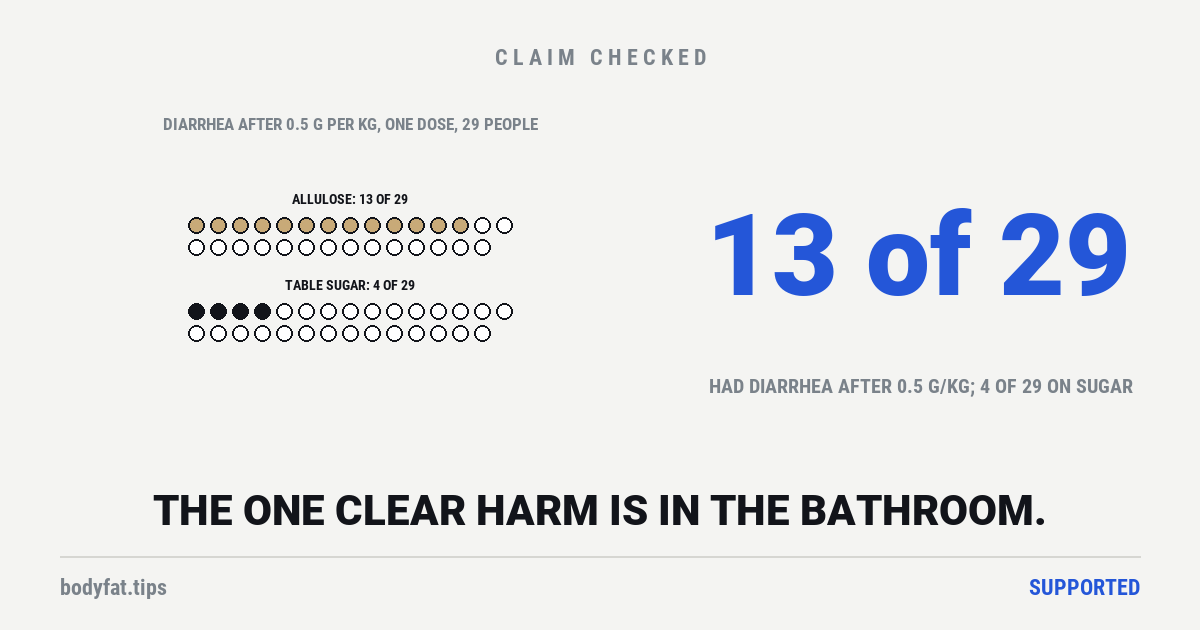
For healthy adults, in trials of up to a year, the one clear harm was in the bathroom. In a tolerance study of 30 young adults, a single dose of half a gram of allulose per kilogram of body weight gave 13 of 29 diarrhea; at each smaller dose, 2 to 4 reported some, about as many as when the same people drank the same doses of table sugar [3]. One other change kept showing up: HDL, the cholesterol carried in the particles usually called “good” cholesterol, fell while people took allulose. In the longest trial, at 15 g a day, it fell about 6 to 10 mg/dL more than on a dummy drink, by our arithmetic from the trial’s own table, and it came back after people stopped [4] [5] [6]. What a fall of that size means for the heart, trials this small and short cannot say.
Europe has not banned it. Its food-safety authority could not clear it, because the company asking stopped answering. The authority’s 2025 opinion says safety “cannot be established” after the applicant did not reply to its requests for data [7]. Australia and New Zealand approved allulose in 2024 [8], and the US Food and Drug Administration has raised no questions about eleven safety filings since 2012 [9].
The blood-sugar benefit is real but small, and the weight-loss evidence is one trial. Added to a sugary drink or meal, a few grams of allulose trimmed the rise in blood sugar by about a tenth in a pooling of trials [10], and by 8% in a trial in type 2 diabetes [11]; in the two trials of it in Western countries with the most people, the overall rise was not significantly different [12] [13]. One 12-week trial found about 1.7 lb (0.78 kg) less body fat than a dummy drink [14].
What is allulose, and is it natural?
Allulose is a sugar. It has the same chemical formula as fructose, the sugar in fruit, and differs from it only in how one group of atoms points, at the third carbon of six; chemists call that an epimer [7]. Its older name is D-psicose, which is how the US safety filings and much of the older research name it [9]. It is about 70% as sweet as table sugar [7].
Your body absorbs most of it and then gets rid of it without using it. In a tracer study the FDA relied on, about 70% of a dose left the body intact within two days, in urine and stool; the agency concluded allulose is “virtually unmetabolized” and lets labels count it at 0.4 calories a gram [15]. Ordinary sugars count at about 4 [15]. Most of what is absorbed leaves in urine [16].
Is it natural? It does occur in nature, in small amounts: the FDA lists wheat, raisins, dried figs, molasses, maple syrup and brown sugar [15]. Europe’s food-safety authority quotes about 71 mg in 100 g of brown sugar and 40 mg in 100 g of ketchup [7]. By our arithmetic from that figure, you would need to eat about 15 lb (7 kg) of brown sugar to get the 5 g used in many of the trials below. The allulose that is sold is made, not harvested.
How is allulose made?
From fructose, with an enzyme. The fructose comes from sugar beet or corn starch; an enzyme called D-psicose 3-epimerase turns some of it into allulose; the two are separated, purified and dried into a powder or a syrup [7]. In the newest US filing, the enzyme is made by a bacterium given the gene for it, and the bacterial cells are fixed in place while the fructose solution is run through them [17]. Europe’s food-safety authority asked the company before it to test for leftover enzyme and DNA in its product; the tests were not supplied [7].
Is allulose safe? What the regulators decided
Several regulators have looked at allulose, and they have not all reached the same place. It helps to know what each was asked.
The United States. Allulose is sold there as GRAS, “generally recognized as safe”: a route in which a company concludes its ingredient is safe for stated uses and can tell the FDA, which replies. Eleven times since 2012 the FDA has replied that it has “no questions”; two more filings are pending, and three were withdrawn at the company’s request before the FDA finished [9]. The latest letter, in July 2026, says what that reply is not: “This letter is not an affirmation that D-psicose is GRAS” [17]. The company behind that filing estimated that if allulose were used in all the foods it proposed, Americans aged two and over who ate them would take about 9.4 g a day on average, and 22.7 g at the 90th percentile, the heavy users [17].
In October 2020 the FDA also decided that allulose may be left out of the “Total Sugars” and “Added Sugars” lines on US nutrition labels, “pending review of the issues in a rulemaking”. It did so after a 2015 petition from an ingredient company that makes allulose, and after its own review, which found that allulose “produces only a negligible increase in glycemic and insulinemic responses”, the rise in blood sugar and insulin after eating [15]. That is why a product sweetened with it can show zero grams of added sugar.
Australia and New Zealand. Their joint food regulator approved allulose as a novel food, a food without a history of being eaten there, in August 2024, for one Korean maker’s product [8]. It found “No toxicological concerns” in animal studies or human trials. The problem it did find was the laxative effect. It recommended that people take no more than 0.4 g per kilogram of body weight at one time, or 0.9 g per kilogram in a day; at approval it kept the amounts the company had asked to put in foods and required an advisory statement about a laxative effect on the labels of some foods [8].
It also flagged a question that, it says, no report has yet investigated. Because most allulose leaves the body in urine, its assessment says, that “does flag potential issues with urinary tract infections”: some bacteria that cause them, such as Klebsiella pneumoniae, can feed on allulose. “The microbiological safety of subpopulations consuming D-allulose has not been established”, it says, and it calls people with diabetes “a potentially sensitive sub-population” [16]. Its overall judgement was milder. Noting what it calls allulose’s history of safe use internationally, it concluded that “the weight-of-evidence suggests adverse microbiological effects are unlikely” [8], and it “noted there have been no reports of adverse events in any individuals in the time that D-allulose has been on the market internationally” [16].
The European Union. This is the one people search for. A company applied to sell allulose in the EU as a novel food on 4 August 2018. Europe’s food-safety authority, EFSA, found gaps in the application, on what exactly the product was, how it was made, how much people would eat, whether it damages DNA, and its effects in people, and asked for more data in 2020 and 2021. “Despite being contacted several times, the applicant did not reply”, the opinion says, and its conclusion, adopted in May 2025, is that “the safety of the NF, i.e. D-allulose, cannot be established” [7].
Four things in that opinion matter beyond the paperwork. EFSA looked past the application to the published research and judged the human trials “insufficient to address the data gaps”, “especially those concerning potentially susceptible population groups, such as diabetic patients, older adults and children”. And it says that, after evaluating the effects seen in 90-day and longer animal studies, it asked for a human study of how allulose is handled by the body, which the applicant never supplied [7]. Why did it want human data on long-term use? It says it asked for them “considering a risk assessment” that its expert panel on nutrition and novel foods had made “based on the body of evidence provided in other allulose dossiers”, and it asked this applicant for any human data “that may address the safety concerns related to long-term consumption of D-allulose by humans” [7]. The opinion does not say what those concerns are, or where that assessment can be read; it is the only EFSA opinion on allulose as a novel food that we found published [7] [18]. EFSA also judged the published toxicity studies the applicant relied on “not performed in accordance with OECD guidelines”, the international rules for running safety tests [7].
Britain and Canada. In Britain, an application from a German ingredient company has been with the Food Standards Agency since June 2021; its advisory committee had a draft opinion before it in November 2024 [19], and we found no decision [18]. Health Canada’s list of novel-food decisions, as it read on 10 October 2026, has no entry for allulose; it does list tagatose, another rare sugar, approved in 2021 [20].
A word on what all of these settle. They are judgements about safety at the amounts each company proposed to use. None of them is a finding that allulose does anything for your blood sugar or your weight, and EFSA’s opinion says outright that it is “not an assessment of the efficacy” [7].
Why is allulose banned in Europe?
It is not banned. It is not authorised: as a novel food in the EU, it needs an authorisation before it can be sold, and no application has yet succeeded [7]. The one assessment EFSA has finished did not find allulose harmful, and it did not find it safe; it could not reach a view, because the company that applied stopped answering questions that included long-term safety. Google’s AI answer for “allulose side effects” says allulose is “not yet approved for general commercial sale in Canada, Europe, or Australia” [2]. Europe and Canada, as far as we found; Australia approved it in 2024 [8].
What are the negatives of allulose?
The one everybody agrees on is your gut. What your small intestine does not absorb pulls water into the bowel, the same way the sugar alcohols do [8].
The clearest measurement comes from a 2018 Korean study of 30 lean adults aged about 24. They drank single doses after a meal, rising by a tenth of a gram per kilogram of body weight every other week. At each dose up to 0.4 g per kilogram, 2 to 4 of 29 reported some diarrhea on allulose, and 1 to 9 on the same doses of table sugar, which the same people also drank (4, 2, 3 and 2 on allulose, against 2, 1, 3 and 9 on sugar); at 0.5 g, 13 of 29 did on allulose, 4 of them severely, against 4 on that dose of sugar, a difference the authors found significant, and 11 reported bloating, against 4 on sugar [3]. When 19 of them took it several times a day, a daily total of 1.0 g per kilogram brought severe nausea, stomach pain, headache, loss of appetite or diarrhea in some, so the authors put the daily ceiling at 0.9 g [3]. An earlier Japanese study of 11 young adults, as Australia’s regulator summarises it, found diarrhea at an average of 0.55 g per kilogram [16].
What does that mean in a kitchen? By our arithmetic, for a 150 lb (68 kg) adult, 0.4 g per kilogram is about 27 g at one sitting, 0.5 g is about 34 g, and the daily ceiling is about 61 g. The heavy US user, on one company’s estimate for all the foods it proposed, would take about 23 g spread across a whole day [17]. Lighter people, and children, reach the threshold sooner: it is set per kilogram. The only study in children we found gave them 2.5 g or 4.3 g in a drink; its authors call it well tolerated, with a statistically significant change in how often the children passed stools at the higher dose and none with unusually frequent stools [21].
Two other things showed up in trials, and they are worth reporting because they point the wrong way. In 16 people with type 2 diabetes who took 7 g of allulose twice a day for 12 weeks, HDL, the “good” cholesterol, fell from 51 to 41 mg/dL [6]. In a 30-day Chinese study of 50 adults taking 24 or 36 g a day, with no placebo group, HDL, red-cell counts and platelet counts all fell a little, within normal ranges, and 48% reported stomach symptoms, mostly in the first three days [22]. Its authors proposed a provisional limit of 0.4 g per kilogram a day for Chinese adults [22].
The longest trial is reassuring on one kind of cholesterol and not on the other. It was run, its authors say, because an earlier 12-week trial with no comparison group had seen total and LDL cholesterol rise: in 18 people with borderline or type 2 diabetes taking 5 g with each meal, LDL went from 149 to 171 mg/dL and HDL from 52 to about 48 [23]. In the 48-week trial, 90 Japanese adults with high LDL took 0, 5 or 15 g a day, 82 of whom were analysed, and neither total nor LDL cholesterol rose against the dummy drink [4]. HDL did fall, and the trial’s own authors count a fall in HDL among the known risk factors for disease of the heart and arteries [4]. At 15 g a day it sat 6.5 to 12.1 mg/dL below where it started at every check from week 8 to week 48, against 0.1 to 2.8 on the dummy drink, a difference the authors report as significant each time; by our arithmetic, that is a fall about 6 to 10 mg/dL bigger than on the dummy drink, from a starting level of about 68. At 5 g a day it sat 4.8 to 7.1 below its start from week 16 on, a fall significantly bigger than on the dummy drink only at week 16. Four weeks after people stopped, the 15 g group was back within 2 of its start [4]. The authors note that HDL stayed within normal ranges. In their introduction, writing about the HDL falls in two earlier trials by the same maker’s researchers, they say that, on a mechanism proposed from liver cells grown in a lab, the fall “was not considered a serious clinical problem”; in their discussion, they call that mechanism protective against atherosclerosis, the hardening and narrowing of the arteries [4]. Five people left the trial because of illness: on 5 g a day of allulose, one after anaphylactic shock, a severe allergic reaction, and one with diabetes; on 15 g a day, one with atrophic gastritis, a long-running inflammation that thins the stomach lining, and one with rheumatoid arthritis; on the dummy drink, one with osteoporosis. The trial’s principal physician, whom the paper does not name, judged all of them unrelated to allulose, and the paper says no more about any of them; adverse events overall were not significantly more common on allulose than on the dummy drink [4]. That trial was paid for by an allulose maker, and four of its five authors work there [4].
So how often has HDL fallen? Against a comparison group, in one study as far as we could read: the 48-week trial. From where people started, in five more: the maker’s 12-week safety trial in 17 healthy adults, where it was not reported as different from the comparison group and was above its starting level at the check after the trial ended [5]; the 12-week open trial above, where it was back above its start four weeks after [23]; the 12-week Thai trial, whose summary gives the fall only from the start of the allulose period (how it compared with the aspartame period is in the part of the paper we could not read), and whose registry entry reports HDL back at its starting level at check-ups months later [6]; the 30-day Chinese study [22]; and, by about 4 mg/dL, all of it in the men, the eight-week study of a diabetes drink that contained allulose among other things [24]. In the largest 12-week trial, 121 Korean adults against a dummy drink, HDL barely moved: down about 0.8 mg/dL (0.02 mmol/L) at the lower dose, and up about 0.4 mg/dL (0.01 mmol/L) at the higher dose and on the dummy drink, with no significant difference between the three groups [14]; and the 2026 pooling found no significant effect on blood fats, without saying in its summary which ones [25]. What a fall of this size means for the heart, trials this small and short cannot say.
Is allulose hard on your liver?
In rats, it makes the liver heavier. Male rats fed a diet that was 3% allulose for 90 days had heavier livers and kidneys, with nothing abnormal under the microscope [26]. The 90-day study Australia’s regulator calls “the most reliable” for its assessment, run to good laboratory practice and the international test guideline, gave rats up to 5 g per kilogram of body weight a day by tube. At that dose their livers weighed 15% (males) and 18.5% (females) more, relative to body weight, with no damage seen under the microscope; in the males, ALP, an enzyme that comes from the liver and from bone, rose with the dose, staying within the range seen in untreated rats in earlier studies [16]. Over 12 to 18 months, at about 1.28 g per kilogram a day, the same happened; at 18 months, 4 of the 8 allulose-fed rats examined showed slight fatty changes in the liver against none of 8 given table sugar, a difference the authors call slight [27]. The rats given allulose also weighed less, and Australia’s regulator notes that organs weighed against body weight look bigger when the body gets lighter [16]. A 2024 study in 40 rats found bigger livers holding more stored sugar, glycogen, on a normal diet with allulose than with stevia; on a fattening Western diet it pointed the other way, with the allulose rats “largely protected from the development of fatty liver” that the stevia rats developed, and raised liver enzymes only in the stevia rats on that diet [28].
In people, liver blood tests have not got worse on average. Over 12 weeks in 121 Korean adults there were no significant differences in them between groups [14], and over 48 weeks they fell slightly on allulose compared with the dummy drink [4]. Two individuals are worth knowing about. In each of two of the maker’s 12-week trials, one man taking allulose was withdrawn after a large jump in ALT, a liver enzyme measured in the blood to check for liver damage, for which both papers give a normal range of up to 45 units per litre: to 332 after 8 weeks in 2010 [5], and to 1,158 after 4 weeks in 2019 [23]. In both, the values were coming down while the man was still taking allulose, and the trials’ reports, written wholly or partly by the maker’s staff, called each rise temporary and unrelated to it [5] [23]. All four trials were tied to allulose makers. EFSA’s request for a human study after the animal findings is the open end of this question [7].
Is allulose cancerous?
Nothing we read suggests it. The genetic-damage tests in the safety files were negative, according to Australia’s regulator, which also wrote that allulose “was not associated with carcinogenicity” in rats [16]. It is worth knowing what that line rests on: the 18-month study above, in 18 male rats a group, which its assessment lists as not run to good laboratory practice or a test guideline, and in which only the liver and kidneys were examined under the microscope [16] [27]. That is not the kind of study designed to find cancer. We found no study in people that has looked [18].
Does allulose lower blood sugar?
Two different claims hide in that question, and they need separating. One is that allulose does not raise your blood sugar the way sugar does. The other is that it lowers the rise from other carbohydrate you eat with it.
The first holds up. In a 2008 Japanese trial, 7.5 g of allulose on its own “had no influence on blood glucose or insulin” [29]. In a Swiss trial run on public money, 25 g put straight into the stomach left blood sugar slightly lower than water did [30]. So, by our reasoning, swapping sugar for allulose removes the sugar’s rise, and that is most of the benefit anyone gets.
The second is smaller and shakier. Here are the trials that tested it, one meal at a time:
| Trial | Who, and what they were given | What happened to blood sugar | Who paid or supplied it |
|---|---|---|---|
| Japan, 2008 [29] | 20 healthy adults; a starch drink (75 g of maltodextrin) with 0 to 7.5 g of allulose, and 7.5 g of allulose alone | Rise smaller with 5 g or more; allulose alone did not change blood sugar [29] | A Japanese allulose maker’s researchers; a regional industry foundation [29] |
| Japan, 2010 [5] | 26 adults, some with borderline diabetes; 5 g in tea with a standard meal | Lower at 30 and 60 minutes, mainly in the borderline cases [5] | The same maker’s researchers; the same foundation [5] |
| Japan, 2017 [31] | 13 healthy adults; 5 g or a sweetener before a meal | Lower blood sugar; more fat burned for fuel in the hours after [31] | The same maker’s researchers [31] |
| Canada, 2018 [12] | 25 healthy adults; a glucose drink with 0, 5 or 10 g | No significant difference at either dose [12] | A research fund an allulose maker set up at the university; that maker made the drinks [12] |
| Canada, 2018 [11] | 24 adults with type 2 diabetes; a glucose drink with 0, 5 or 10 g | Rise 8% smaller at 10 g; 5 g no significant difference [11] | The same fund; the maker helped design it [11] |
| United States, 2021 [13] | 30 adults without diabetes; a sugar drink (50 g) with 0 to 10 g | Lower at 30 minutes with 7.5 and 10 g; the overall rise about the same at every dose [13] | A grant from the Japanese maker; three authors its employees [13] |
| Malaysia, 2022 [32] | 12 adults with type 2 diabetes; 8.5 g before the evening meal in Ramadan, five days against five days without, no separate comparison group | Lower after the meal [32] | The Japanese maker [32] |
| Switzerland, 2023 [30] | 18 healthy adults; 25 g of allulose alone, or water, by tube into the stomach | Slightly lower than after water [30] | Swiss and Flemish public science funds [30] |
| Japan, 2023 [33] | 20 hospital patients with type 2 diabetes; diabetic meals with 8.5 g, against the same meals without | Lower peak after meals [33] | A Japanese prefecture’s rare-sugar research subsidy; the senior author declares intellectual property rights to allulose [33] |
| Thailand, 2024 [34] | 30 healthy adults; a sugar drink (50 g) with 0 to 10 g | Lower peak, more so at higher doses [34] | Kagawa University, a Japanese aid agency and a rare-sugar company [34] |
How big is the effect? Different reviews put it differently. A 2020 Toronto pooling found allulose cut the rise by about 10% [10]. The 2018 Toronto trial in type 2 diabetes found 8% at 10 g [11]. A 2023 review written by an employee of a Japanese allulose maker, with two co-authors holding rare-sugar patents and paid grants by that maker, found a standardised difference of 0.26 at 10 g and 0.28 at 5 g. That is a way of comparing results measured in different units: 0.2 is barely there and 0.8 is large. By its own conversion, about 13 to 14% [35]. The same review reports that taking out one trial, the 2008 Japanese one, left a result that could be chance [35].
The newest pooling, an independent 2026 review of 12 allulose trials, put the standardised difference at 0.66, with a range the true answer probably sits in of 0.39 to 0.92, and called the evidence of moderate certainty [25]. Its own chart is less tidy than that number. Its 24 comparisons came from 9 trials, with some of the same people counted once per dose; the share of the spread between those results that is more than chance would produce, which researchers call I-squared, was 78%; and split by dose, the 5 g and 10 g groups were each not significantly different from no allulose [25]. The largest trials in it had 30 people each [25] [13] [34].
We also could not reproduce one of its rows. The 2018 diabetes trial printed its averages with standard errors, a measure of how precise an average is, not of how much people differ. Converted to the usual spread between people, by our arithmetic, the trial’s own figures give a standardised difference of about 0.3 for 10 g, where the review’s chart prints 0.95 [11] [25]. And the 2018 trial in healthy Canadians found no significant effect at either dose by its own analysis [12], while the review’s chart shows three of its four comparisons in allulose’s favour [25]. The chart errs the other way too. It shows the 2021 US trial’s 5 g and 10 g results as significantly worse than no allulose, where that trial found the overall rise “similar among groups” and a smaller peak at 10 g [25] [13]. Those two rows sit inside the 5 g and 10 g groups above.
Then there is how it might work. The mechanism most often cited is that allulose blocks the gut enzymes that break down sugar and starch. The 2023 review’s citation for it carries the identifiers of a 2009 rat paper [35] that its journal withdrew in 2014 as “a breach of journal’s ethical policy”; the notice says no more [36]. That does not show the mechanism is wrong. It does mean the best-known citation for it is not one to lean on.
And over weeks, the picture flattens. A 2018 pooling of three comparisons from two 12-week trials found no significant change in HbA1c, the blood test for average blood sugar over about three months, and a fall in fasting blood sugar of about 3 mg/dL (0.18 mmol/L) that sat exactly on the line researchers use for “probably not chance” [37]. The 2026 review found no significant effect on HbA1c or fasting blood sugar [25], and in the 48-week trial HbA1c did not differ from the dummy drink [4].
Is allulose safe for diabetics?
For blood sugar itself, allulose is not the problem: in the trials that gave it alone, to healthy adults, it did not raise it [29] [30]. The trials in people with type 2 diabetes are small. Single meals: 24 people in Toronto [11], 20 in a Japanese hospital [33], and 12 in Malaysia over five days with no separate comparison group [32]; a 2024 pooling of six such studies, 126 people, found a smaller rise after meals [38]. The two longest ran 12 weeks. One, in 16 people against aspartame, found no significant effect on blood-sugar control; over the allulose period, from its start, HDL fell as described above and MCP-1, a protein that draws white blood cells into inflamed tissue and is measured as a marker of inflammation, rose from 259 to 297 pg/mL, changes its summary does not compare with the aspartame period [6]; the other, in 18 people with borderline or type 2 diabetes and no comparison group, saw LDL rise and HDL fall, and one man was withdrawn with the liver-enzyme jump described above [23].
The safety question for people with diabetes is open, and two regulators said so. EFSA named “diabetic patients” first among the groups the trials did not cover [7]. Australia’s regulator raised the urinary-infection question with them in mind: there are, it says, “no reports that either establish or specifically investigate if this occurs or would lead to adverse health effects, especially in sensitive subpopulations, such as diabetics”, though on the weight of the evidence it judged such effects “unlikely” [8]. The concern rests on lab and hospital findings, not on any trial of people eating allulose. One study of Klebsiella taken from hospital patients found that a set of genes for using allulose was one of five linked to strains that caused infection rather than simply living in the patient, and in mice it helped the bacteria thrive in the lungs [39], and a 2022 review set out what would need testing [40]. We found no study that has checked for urinary infections in people eating allulose [18]. If you have diabetes, a sweetener choice is a reasonable thing to raise with whoever treats it.
Does allulose help you lose weight?
The claim rests mostly on one trial. In 2018, 144 Korean adults aged 20 to 40 with a body-mass index of 23 or more, whom the paper calls overweight or obese, drank a small grapefruit-flavoured drink twice a day for 12 weeks: with 4 g or 7 g of allulose, or with a dummy sweetener, sucralose. Of them, 121 were analysed, after 10 dropped out and 13 were excluded for taking less than 80% of their drinks [14].
Body fat fell more on allulose: by 1.6 lb (0.74 kg) more than on the dummy at the lower dose and 1.7 lb (0.78 kg) more at the higher [14]. Weight on the scale did not differ significantly between the three groups; the high-dose group lost 2.8 lb (1.28 kg) and the dummy group 0.8 lb (0.36 kg) [14]. The drinks came from a Korean food company that makes allulose, three of the eight authors work for it, and the paper declares no conflict of interest [14].
No later trial we found has repeated it [18]. In the 12-week diabetes trial, body composition, measured by a DXA scan, a low-dose X-ray that sorts the body into fat, lean and bone, did not change significantly [6]. The 2026 review found no significant effect on body composition across its trials [25]. The 48-week trial did not report weight as a result [4]. An eight-week study of a diabetes drink containing allulose recorded a loss of 1.7 lb (0.77 kg), with no comparison group at all, paid for by a Korean food company [24].
The animal studies are more striking, and they are animals. Third in Google’s results for “is allulose safe” [2] is a 2024 paper titled “The Metabolic and Endocrine Effects of a 12-Week Allulose-Rich Diet”. Its title does not say so, but it was a study of 40 rats, given about 1.9 g of allulose per kilogram a day in their water, and it was paid for by an allulose supplier, which provided the allulose [28].
Allulose vs erythritol, stevia and monk fruit
This site has verdicts on most of the alternatives, and they are rated on their own evidence. Erythritol is rated Preliminary for the concern that it raises the risk of blood clots, after studies linked high blood levels of it to heart attacks and strokes. Stevia has its own page, and so do sugar alcohols, sucralose, aspartame, diet soda and maltodextrin, which turns up in some sweetener packets. There is no monk-fruit verdict yet; the artificial-sweeteners verdict covers where monk fruit sits in WHO’s 2023 guideline, and the sweetener ranking puts them side by side.
Has allulose had an erythritol moment? In people, we found no study that has tested clotting itself, how fast blood clots or how readily platelets, the blood cells that start clots, clump together, and none that has counted heart attacks, strokes or clots in people taking allulose [18]. What has been measured is narrower. Two trials measured PAI-1, a protein that slows the breakdown of clots, and neither found it significantly higher than on the comparison drink [14] [4]; the 48-week trial measured the thickness of the neck-artery wall, which grew in all three groups, with no significant difference between allulose and the dummy drink [4]. The nearest things on clotting itself point the other way or nowhere: a 2024 study in mice found that allulose reduced the clumping of platelets, the blood cells that start clots, where erythritol increased it [41], and the 30-day Chinese study counted slightly fewer platelets, which says nothing about clotting [22]. That is an absence of evidence, not a clean bill: we found no one who has run the test.
If the US has said “no questions” eleven times and Australia approved it, why couldn’t Europe clear allulose?
This section is the desk’s own reasoning, and it is labelled as such. Three regulators had much of the same published research in front of them and ended in three different places [9] [8] [7]. That gap is the question the evidence leaves open. Three answers, each rated.
Answer one: they were asked different questions. In the US, the company concludes and the FDA says whether it has questions; its letter says it is “not an affirmation” [17]. In Australia and in Europe, the regulator has to be satisfied, and in Europe the applicant has to answer what the regulator asks; this one did not [8] [7]. This is measured: it is in the regulators’ own documents.
Answer two: the gaps Europe named are real. EFSA judged the published human trials insufficient for people with diabetes, older adults and children [7], and Australia’s regulator, which did approve it, called people with diabetes “a potentially sensitive sub-population” [16]. By our count of the human trials on this page, only one gave anyone allulose for more than 12 weeks: 48 weeks, in 82 Japanese adults with high cholesterol, paid for by the maker [4]. This is measured, with our count added.
Answer three: the pace is set by who applies, and whether they keep answering. We can see that one applicant stopped replying, and that others are in the queue in Europe and Britain [7] [19]. We cannot see why. This is a surmise about the process, not a finding about the sugar.
Put the three together and here is what we think is true, stated plainly so you can disagree with it: allulose has not failed a safety test in Europe, and it has not passed one: the one assessment finished so far ran out of answers before it could settle the questions EFSA had asked, long-term safety in people among them.
What we could not find, and would like to: a trial of a year or more in people with type 2 diabetes that measures blood fats and counts urinary infections. A Thai trial registered in 2016 planned to compare allulose with erythritol for 24 weeks in 60 adults with obesity, measuring body fat; its registry entry was last updated in December 2016, and we found no results [42] [18]. A German federal trial of allulose against aspartame over four weeks has published its plan, which includes the bacteria in urine; we found no results yet [43]. If you know of results for either, the corrections line on this site is open.
Who these studies were done on
Mostly healthy adults in their twenties to forties, in Japan, Korea, Thailand, Canada, the United States, Switzerland and Malaysia, in trials of 11 to 30 people for single meals [25]. The tolerance study was 30 lean Koreans aged about 24 [3]; the weight trial was Korean adults aged 20 to 40 [14]; the 48-week trial was Japanese adults aged 32 to 64 with high LDL [4]. People with diabetes appear in a handful of small trials [38]; children in one tolerance study [21]; older adults mainly in the small diabetes trials, and EFSA names them among the groups the evidence does not cover [7].
Two things change the answer for a reader. Your size: the stomach threshold is per kilogram of body weight, so a lighter adult or a child reaches it on less [8]. And whether you have diabetes: that is the group the regulators flagged, and the one where the evidence is thinnest [7] [16].
Where “allulose is safe and doesn’t raise blood sugar” came from
The research came from Japan. In 2008, researchers at an allulose maker’s institute reported that 5 g or more blunted the blood-sugar rise from a starch drink in 20 adults, and that 7.5 g alone did nothing to blood sugar [29]. Most of the single-meal trials since have been run, paid for or supplied by allulose makers [5] [12] [13].
Then the framing. In 2015 an ingredient company that makes allulose petitioned the FDA to keep it off the sugar lines of US labels, and in 2020 the FDA agreed, pending a rule, because allulose “produces only a negligible increase” in blood sugar and insulin [15]. In 2023 a review led by a maker’s employee concluded that allulose is “a valuable blood glucose management tool for healthy humans and diabetes patients” [35].
Then the spread. The physician’s channel asked whether allulose is safe, in a video with 443,867 views [1], which Google now ranks first for “allulose side effects”. Google’s AI answer tells searchers that allulose does “not spike blood glucose, raise insulin levels, or promote tooth decay” [2]. Among the related searches it offers: “Why is allulose banned in Europe” [2].
Then the product. Allulose is sold as a tabletop sweetener and in “zero added sugar” foods, which US labels may print without it in the sugar lines [15]. Under a 2026 video on the same channel, with 3,068,418 views, an allulose sweetener is linked as “my preferred sweetener”, through an affiliate link [1]. We link no product.
None of this is aimed at anyone who bakes with allulose or stirs it into coffee to cut sugar. On what has been measured, that is a reasonable swap. It is the bigger promises, a blood-sugar fix and a fat burner, that the evidence does not carry.
What this is rated, and what the rating covers
Supported — for the claim that, in adults without diabetes, trials of up to 48 weeks have found no harm their investigators put down to allulose beyond diarrhea and bloating at large single doses. HDL cholesterol fell while people took it, at 15 g a day by about 6 to 10 mg/dL more than on a dummy drink (our arithmetic), and came back after they stopped; trials this small and short cannot say what that means for the heart. The trials are small, most were run, paid for or supplied by its makers, and the longest was written up by four of one maker’s employees and a university researcher.
It is rated Supported because the evidence is consistent. Across trials lasting from one meal to 48 weeks, no serious harm was put down to allulose by the trials’ investigators [4] [22] [5] [13]; the stomach effects appear at the same doses in different studies [3] [16]; and Australia’s regulator found no toxicological concerns [8]. It is not Established, because the limits are large: most trials are small and short, most were paid for or supplied by allulose makers, only one of the trials on this page ran longer than 12 weeks [4], HDL fell while people took it, against the dummy drink in the 48-week trial and from where people started in five smaller studies [4] [5] [23] [6] [22] [24], two men in the maker’s 12-week trials were withdrawn with large liver-enzyme rises that the trials’ reports called unrelated [5] [23], one person on 5 g a day in the 48-week trial was withdrawn after anaphylactic shock, which the trial’s physician judged unrelated [4], rats given it for 18 months had heavier livers with slight fatty changes [27], and Europe’s food-safety authority judged the evidence insufficient for vulnerable groups and wanted human data on long-term use [7].
Rated alone, in words. That allulose on its own does not raise blood sugar: Supported; trials in Japan and Switzerland, and the FDA’s own review, agree [29] [30] [15]. That allulose lowers the blood-sugar rise from a meal: Preliminary; small, short, mostly maker-funded trials, pooled estimates that differ more than twofold, and the two trials with the most participants in Western countries finding no significant difference in the overall rise, and a 2026 pooling whose chart misreads trials in both directions [25] [35] [12] [13]. That allulose helps you lose weight or fat: Preliminary; one 12-week trial found less body fat and no significant weight difference, and a pooling found no significant effect on body composition [14] [25]. That allulose is safe in the long run for people with diabetes, older adults and children: Preliminary; a few small, short trials, one of which saw LDL rise and HDL fall and withdrew a man with a large liver-enzyme rise, and another of which saw HDL fall and a marker of inflammation rise over the allulose period, and two regulators’ stated doubts [6] [23] [7] [16]. That allulose is hard on your liver: Unsupported, of the tested kind; in people, liver blood tests did not worsen on average over 12 or 48 weeks, and the two large rises in individuals were coming down while the men still took allulose and were called unrelated by the trials’ reports, written wholly or partly by the maker’s staff; in rats, livers grew heavier, with no damage under the microscope in the study a regulator calls the most reliable, and with slight fatty changes in the livers of 4 of 8 rats, against none of 8 on table sugar, in an 18-month study [14] [4] [5] [23] [16] [27]. That allulose causes cancer: Unsupported, of the untested kind; we found no study in people that has looked, and the laboratory tests for genetic damage were negative [16] [18]. That it is banned in Europe is not a matter of evidence: it is not authorised there [7].
What is not rated here: the video’s own words, which we did not hear; the other sweeteners, which are rated on their own pages; and the frame above, which is this desk’s reasoning from the evidence rather than a result the evidence delivered. It is marked as ours so that you can weigh it as ours. This is journalism, not medical advice: if you have diabetes, kidney disease or a bowel condition, or you are choosing what to give a child, talk to a clinician. How we read a study, and what each tier means, is set out here.
- Are Emulsifiers Bad for You? They Inflamed Mouse Guts. In People, the Trials Are Small, Short and Split.
preliminary - Is Maltodextrin Bad for You? Gram for Gram, It Does Spike Blood Sugar More Than Table Sugar. “Worse Than Sugar” for Your Liver and Belly Fat Is Not What the Trials Found.
established - Are Sugar Alcohols Bad For You? The Real Problem Is Digestive
supported