Is Breakfast the Most Important Meal of the Day? Not for Your Weight. People Assigned to Eat It Lost No More Than People Assigned to Skip It.

“The most USELESS meal of the day.” That is the title of a 42-second video posted on 4 August 2024 by a physician’s low-carb and fasting video channel. It had 2,039,533 views when we read its numbers on 10 October 2026 [1]. Its description asks which meal is the least important, if breakfast is the most important one, and then: “Is this even true?” [1] We read the description, not the video, and the description never says which meal the title means.
The same channel has made the opposite case, too. Three of its videos make the case for a particular breakfast: “A Breakfast That Will Keep You Full ALL DAY”, “The Healthiest Breakfast in the World” and “Why This Breakfast is NON-NEGOTIABLE for Insulin Resistance”, 513,663 views between them [1]. So which is it?
Plenty of people want to know. In the United States, “is breakfast the most important meal of the day” is searched about 2,400 times a month, “skipping breakfast” and “is breakfast necessary” about 1,300 times each, “is skipping breakfast bad” about 1,000 times, and “is it bad to skip breakfast” and “does eating breakfast help you lose weight” about 590 times each (from a paid keyword database, pulled 10 October 2026) [2].
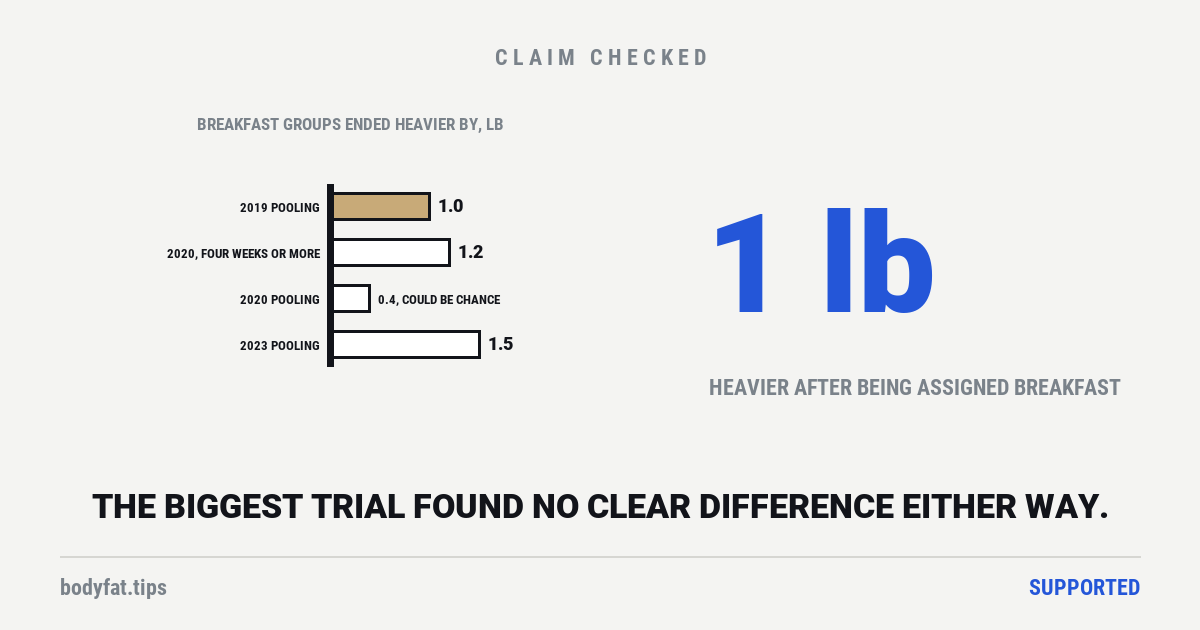
For your weight, breakfast is not the most important meal. In randomised trials, where people are assigned to a group by chance so that the groups differ only in the thing being tested, adults assigned to eat breakfast lost no more weight than adults assigned to skip it. Pooled across seven trials, the breakfast groups ended about 1 lb (0.44 kg) heavier [3]. The biggest trial, 309 adults over 16 weeks, found no clear difference either way [4].
Skipping it is not a weight-loss trick either. The gap in skippers’ favour was a pound or so, came from trials of a few weeks, and was not there in the three breakfast trials that ran eight weeks or longer [5]. Two year-long trials in which a later eating window took breakfast away did end with people lighter than their comparison groups, but they were also eating less, so they do not show what breakfast alone does [6] [7].
For your long-term health, nobody knows yet. People who skip breakfast get type 2 diabetes more often and die sooner, in studies that follow large groups for years [8] [9]. But people who skip breakfast differ from people who eat it in other ways, and no randomised trial we found has counted cases of diabetes, heart attacks, strokes or deaths in people assigned to eat or skip breakfast [10].
Does eating breakfast help you lose weight?
No. This is the part of the question that has actually been tested, and the answer has come back the same way every time it was pooled.
A 2019 review in the BMJ gathered every randomised trial it could find, from 1990 to early 2018, that compared eating breakfast with skipping it in adults in wealthy countries [3]. It found 13. Seven measured weight, in 486 people, over two to 16 weeks. Pooled, the people assigned breakfast ended about 1 lb (0.44 kg) heavier than the people assigned to skip it [3]. The range the true answer probably sits in ran from 0.2 lb to 1.8 lb (0.07 to 0.82 kg) heavier, so in this pooling “breakfast makes you lighter” falls outside the range altogether [3].
Ten of the trials measured how much people ate across the whole day. Pooling the nine with usable figures, people assigned breakfast ate about 260 calories a day more, with a range from about 80 to 440 [3]. The theory that a skipped breakfast makes you so hungry that you more than make up for it later is the theory these trials were testing, and on average it did not happen.
Two warnings come with that review, and its authors give both. Every trial was short. And every trial was judged at high risk of bias, meaning a flaw in the design that can tilt the result, mostly because nobody can be fooled about whether they ate breakfast: people who know which group they are in can act differently [3]. Some of that cannot be fixed in a breakfast trial, but it is why the evidence is rated below the top tier.
Open the list of trials and find the biggest one. It is a 2014 American trial, run at five centres in the United States and Denmark, of 309 adults with overweight or obesity who wanted to lose weight [4]. For 16 weeks, one group got a general nutrition leaflet, one was told to eat breakfast before 10 a.m. every day, and one was told to eat nothing before 11 a.m. [4]. 283 people finished. Every group lost a little, between about 1.2 and 1.7 lb (0.53 to 0.76 kg) on average, and no group lost clearly more than another, whether its members had been breakfast eaters or skippers to begin with [4].
In the 2019 pooling, that one trial carries 38% of the statistical weight, which is how much each trial counts toward the pooled answer, and both of its comparisons have ranges that include no difference at all [3]. By our arithmetic from the review’s chart, its trials add up to the stated 0.44 kg, and most of the pound in skippers’ favour comes from smaller, shorter trials [3]. We come back to the most striking of them below.
Then there is the British pair, the Bath Breakfast Project, the trials built to see how breakfast might work. For six weeks, adults ate at least 700 calories before 11 a.m. every day or nothing but water until noon [11] [12]. In 33 lean adults, the breakfast eaters ate about 539 calories a day more, and burned about 442 more by moving around [11]. Their resting metabolic rate, the calories the body burns at rest, barely moved: it stayed within 11 calories a day of where it started [11]. At the end the two groups were 11 calories a day apart, a gap that could not be told from zero: its range ran from 120 calories lower to 143 higher [11]. Weight and body fat did not differ clearly between the groups [11].
In 23 adults with obesity, the breakfast group gained 2.2 lb (1.0 kg) over the six weeks and the skipping group 0.4 lb (0.2 kg), a gap that could easily have come from chance [12]. Breakfast did not raise their activity across the whole day in any consistent way [12]. So the idea that breakfast kick-starts your metabolism did not show up where it was measured most carefully.
Does skipping breakfast help you lose weight?
A little, sometimes, for a few weeks, and not reliably. Three more reviews have pooled the trials since 2019, with different rules about which trials count, and they do not agree on the size.
| Review | What it pooled | Weight, breakfast against skipping |
|---|---|---|
| 2019, searched to January 2018 [3] | Seven trials of weight, 486 adults, two to 16 weeks | Breakfast groups about 1 lb (0.44 kg) heavier; the biggest trial found no clear difference [3] |
| 2020, searched to October 2018 [5] | Seven trials of four weeks or more, 425 people | Breakfast groups 1.2 lb (0.54 kg) heavier; in the three trials of eight weeks or longer, less than a tenth of a pound (0.04 kg) apart [5] |
| 2020, searched to January 2020 [13] | Twelve comparisons from ten papers, 487 people, six days to 16 weeks | No difference the review could tell from chance: 0.4 lb (0.17 kg), with a range from 0.9 lb lighter to 1.6 lb heavier [13] |
| 2023, searched to April 2023 [14] | Eleven studies, one of them a cohort, 1,118 people aged 11 to 55 | Breakfast groups 1.5 lb (0.66 kg) heavier; the biggest trial is not among its studies [14] |
A 2020 review that kept only trials of four weeks or more found skippers 1.2 lb (0.54 kg) lighter, with a range running from 2.3 lb to less than a tenth of a pound lighter (1.05 to 0.03 kg) [5]. In the three trials that ran eight weeks or longer, the gap was less than a tenth of a pound (0.04 kg) [5]. Body fat, lean mass and body mass index (weight for height) did not differ clearly [5]. A second 2020 review found no difference it could tell from chance: the breakfast groups were 0.4 lb (0.17 kg) heavier, with a range from 0.9 lb lighter to 1.6 lb heavier [13].
The newest pooling, from 2023, found skippers 1.5 lb (0.66 kg) lighter [14]. Open its list of studies, though, and the biggest trial above is not on it [14] [4]. It also lists, as a year-long randomised trial, an analysis in which breakfast was never assigned: a 2017 study that looked back at the breakfast habits of 240 people taking part in a diet trial [14] [15]. That is our reading of its table against the papers it cites.
Now the most striking trial. In 1998 and 1999, a New York team gave 36 adults with overweight a breakfast of oat porridge, a breakfast of frosted cornflakes, or a glass of water, every weekday for four weeks [16]. The skippers lost 2.6 lb (1.18 kg); the cornflake group lost about a quarter of a pound (0.12 kg), and the porridge group gained about half a pound (0.26 kg) [16]. The study was paid for by an oat brand’s research centre at a food-and-drink company, which helped design it, and the porridge was that brand’s own; it was published in 2014, fifteen years after its data were collected [16]. The skippers’ total cholesterol also rose compared with both breakfast groups [16]. What oats do and do not do for weight has its own verdict on this site.
One small trial points the other way, in young people. For 12 weeks, 57 breakfast-skipping adolescents with overweight, aged about 19, either kept skipping or ate a normal-protein or a high-protein breakfast [17]. The skippers gained 3.5 lb (1.6 kg) of fat; the high-protein group lost 0.9 lb (0.4 kg) [17]. The normal-protein breakfast did no better than skipping, and the two breakfasts were not clearly different from each other [17]. The trial was paid for by a pork producers’ marketing programme, and its high-protein breakfasts were egg dishes with pork or ham [17] [5]. Protein and fullness have their own verdict here.
Those are the trials built around breakfast. Someone who skips breakfast to lose weight is usually doing something a little different: eating later, in a shorter window, which is what trials of time-restricted eating test. We read two year-long trials in which a late eating window took breakfast away. In Italy, 20 men who lifted weights ate at 1, 4 and 8 p.m. or at 8 a.m., 1 and 8 p.m. for a year. On the later schedule they ate less, although they had been told to keep eating as before, and ended lighter and with less fat, while the 8 a.m. group put on weight, which the authors put down to added lean mass [6]. In Chicago, 90 adults with obesity, most of them women, were assigned to eat only between noon and 8 p.m., to cut their calories by a quarter, or to eat as usual. After a year the noon-to-eight group had lost about 10 lb (4.61 kg) more than the usual-eating group, with a range from about 4 to 16 lb (1.85 to 7.37 kg); they had cut what they ate by about 425 calories a day, and they were not clearly different from the calorie cutters [7]. Neither trial isolates breakfast: in both, the later window came with eating less. Eating windows have their own verdict on this site.
So: in adults, breakfast does not help weight loss, and dropping it bought a pound or so over a few weeks in some poolings, a gap that the three longer breakfast trials did not find. The year-long trials that dropped breakfast inside a later eating window found more, with people eating less.
Is skipping breakfast bad for you?
This is where “useless” runs into a different kind of evidence. The studies that tie skipping breakfast to disease are cohort studies: measure people’s habits, then wait and see who gets ill. They show what goes together. They cannot show what causes what.
Here is what they show. A 2019 review of six cohorts, 96,175 people and 4,935 cases of type 2 diabetes, found 33% more diabetes in people who ever skipped breakfast than in people who never did; allowing for body weight, 22% more [8]. A 2020 review of seven cohorts and 221,732 people found 22% more heart and blood-vessel disease and 25% more deaths from any cause in skippers [9]. A 2024 review of nine cohorts and 242,095 people found 27% more deaths from any cause, 28% more from heart disease and 34% more from cancer, and graded its own evidence as low or very low in certainty [18].
Those numbers travel. A cardiology society’s patient-news page in 2019 headlined one American cohort, of 6,550 adults followed for 23 years, “Skipping Breakfast Nearly Doubles Risk for Heart Related Death”; a few paragraphs down, it says the findings “can’t prove cause and effect” [19]. The 2020 review’s own conclusion says skipping breakfast “increases” the risk, a cause-and-effect word for a set of studies that cannot show one [9].
Why can’t they? Because the people differ. The Bath team, summing up the earlier surveys, noted that regular breakfast eaters “tend to be nonsmokers”, drink less alcohol, eat more fibre and move more [11]. Among 193,860 people in the UK Biobank study, the most regular skippers were younger, heavier, more often evening people and shorter sleepers [20]. Each of those can matter for diabetes and heart disease on its own.
There is a cleverer test. Mendelian randomisation uses inherited gene variants as a natural experiment: genes are dealt out at conception, before anyone has a breakfast habit, so if the variants that nudge people toward skipping breakfast also go with more weight or more heart disease, breakfast is more likely to be the reason. What it can show is the effect of a lifelong nudge, not of an adult changing a habit for a few months. And it works only if the variants act through breakfast and through nothing else.
We found eleven studies in PubMed that have run it with skipping breakfast as the thing being tested, the 2019 study among them [10]. Nine of them, the 2019 study included, rest on that study’s 193,860 people, and the other two do not say where their genes came from in what we read, so they are many readings of largely one genetic signal, not eleven independent tests. Three matter most here. The 2019 study that found the variants, in the UK Biobank, reported that they went with a higher body mass index, and with smoking, more depressive symptoms and being an evening person [20]. A 2024 study, drawing its gene data from the UK Biobank and other large studies, found no clear link between the genes and heart disease, stroke or type 2 diabetes, but found that the skipping variants went with a higher body mass index, a larger waist relative to the hips and higher LDL cholesterol, the kind doctors try to lower to prevent heart disease; its authors conclude that skipping breakfast is “causally linked to weight gain” [21]. A 2025 study, using the 2019 study’s variants, found a link with heart disease and heart attacks [22]. Of the rest, two more looked at the heart, both by researchers at one Chinese medical university: one found higher odds of a heart attack, the other of heart failure, and both had to loosen the usual bar for which variants count, because too few passed it [23] [24]. Two more looked at type 2 diabetes: one found no clear link [25], and a scan of 97 possible causes of diabetes listed skipping breakfast only as a “suggestive” risk, its main estimate’s range taking in no extra risk at all [26]. So on heart disease, three of the four genetic studies we found point to higher risk; on type 2 diabetes, none of the three found a clear link. The other four looked at mental health, bone and the gullet, which this page does not rate [10].
Why does that not settle it? Look at what the genes were found from. The 2019 study’s main measure was not breakfast: it was the answer to “Did you eat any breakfast cereal yesterday? This could be at any time of the day” [22] [20]. Its authors list that as a limitation: with 94% of people in Britain eating breakfast, they write, the cereal question may misclassify an estimated 48.8% of the people they studied [20]. They add that this error would likely make real signals harder to detect and pull their results toward finding nothing. And they checked the variants two ways: the variants also went with people’s intake of other breakfast foods, among them bread, coffee, fruit and tea, and they showed up again in a British study of 2,006 women twins asked how often they ate breakfast, though not in a pooling of American and Dutch cohorts [20]. The same variants travel with smoking, low mood and late nights [20], and each of those can move weight and heart health without breakfast being involved. The 2024 study’s summary does not say which UK Biobank measure it used [21].
So the genetic studies are weaker evidence about breakfast than the trials, which assigned breakfast by chance and then weighed people. But on weight they point the other way from the trials, and we say so. The breakfast trials ran for weeks; the genes describe a lifetime. That is why the rating below is limited to what the trials tested.
And the trials? They measured markers for weeks, not illness over years. The marker that moved most clearly in the poolings was LDL cholesterol. In three small trials pooled in 2020, it was 9.24 mg/dL higher in skippers [5]; in a 2023 pooling, 9.89 mg/dL higher, though not clearly in the trials longer than four weeks [14]. For scale, and this comparison is ours, that is a little more than the 5 to 8 mg/dL rise this site’s egg verdict rates for eggs. In the year-long Italian trial that moved breakfast to mid-afternoon, LDL went the other way, falling on the later schedule along with weight and the calories eaten [6]. Blood sugar, insulin and blood pressure did not differ clearly in the 2020 pooling [5], although in the Bath trial of adults with obesity, the insulin released after a sugar drink fell over six weeks of breakfast and rose over six weeks of skipping, a difference right at the line researchers use for “probably not chance” [12].
No randomised trial we found has counted cases of diabetes, heart attacks, strokes or deaths in people assigned to eat or skip breakfast [10]. So “skipping breakfast gives you diabetes” is a link that no trial we found has tested, and “breakfast is useless” is a verdict the evidence has not earned.
Does eating breakfast lower BP?
The trials give no clear answer. In the 2020 pooling, only two trials, 69 people, measured blood pressure, and the difference could easily have come from chance; if anything the skippers’ top number was lower [5]. The 2023 pooling found no clear difference in either number across four studies [14].
One pilot trial in Taiwan ran a year. It randomly gave 125 adults advice to eat breakfast every day, to stop late-evening snacks, or both [27]. The breakfast advice went with a smaller rise in the bottom number of blood pressure, the diastolic, by 3.23 mmHg, with a range from 0.17 to 6.28 [27]. Nobody in it was told to skip breakfast: the comparison is advice to eat it against no breakfast advice. Its summary also reports that, in the young adults who were inactive, the breakfast advice went with a larger fall in body fat, measured as a percentage of body weight: 2.99% more, with a range from 0.23 to 5.74 [27]. That is one subgroup of a pilot. We could read that trial only as its summary. Studies that only watch what people already do find high blood pressure more common in skippers, 20% higher odds across six observational studies [28], the same kind of link as the cohorts above.
What’s the best meal to skip?
The direct comparisons are short and few, and they mostly point the same way: with the calories held the same, moving them around the day did little for weight or body fat. When the eating window itself is the treatment, the trials of time-restricted eating are covered in this site’s verdict on intermittent fasting: it works about as well as eating less in any other way.
Two studies come closest. In a German respiration chamber, 17 adults spent one day eating three meals, one day skipping breakfast and one day skipping dinner, with the same calories each day [29]. Skipping either meal raised the day’s energy use a little, by 41 calories for breakfast and 91 for dinner; blood sugar over the whole day did not differ; but sugar after lunch was 46% higher on the day breakfast was skipped than on the day dinner was [29]. In a Spanish trial of 197 adults, an eight-hour eating window early in the day, late in the day or chosen by the participants made no clear difference to the fat around the organs, compared with advice on a Mediterranean diet alone, over 12 weeks [30]. A 2026 report from the same registered trial, covering 99 of its adults, weighed 65 of them a year after those 12 weeks and included all 99 in its analysis; during that year, 26% said they had kept eating in a window. The early-window and late-window groups had both kept off more weight than the usual-care group, so in that trial the window helped whether or not it left room for breakfast [31]. We read all three as their summaries, and the follow-up’s flow diagram as well.
Skipping breakfast or dinner: which is better?
An early trial found a large difference; the best-controlled test, the second below, found no clear one. In a 2013 Israeli trial, 93 women with overweight or obesity and the metabolic syndrome, a cluster of a large waist, raised blood pressure, raised blood sugar and unhealthy blood fats, on a weight-loss diet of about 1,400 calories were told to make breakfast or dinner the big meal, 700 calories at one and 200 at the other, for 12 weeks [32]. Of the 74 who finished, the big-breakfast group lost 19.2 lb (8.7 kg) and the big-dinner group 7.9 lb (3.6 kg) [32]. But the women were given advice rather than food, everyone knew which group they were in, and the paper gives no weights for the 19 who dropped out [32].
In 2022, a Scottish team ran the test with every meal supplied. Thirty adults with overweight spent four weeks on each pattern, the same calories either way: 45% at breakfast or 45% at dinner [33]. They lost 7.3 lb (3.33 kg) on the big breakfast and 7.5 lb (3.38 kg) on the big dinner, no clear difference; what differed was hunger, which was lower on the big breakfast [33]. So if a big breakfast keeps you fuller, that is a real reason to eat one. It is not a metabolic trick.
Is it okay to skip breakfast once?
For a healthy adult, nothing in the trials on this page suggests one skipped breakfast does harm. The Bath trials had people skip it every day for six weeks: in the lean adults, weight, resting metabolism and the heart-health markers measured did not change differently from the breakfast group, though by the last week their blood sugar swung more in the afternoon and evening [11].
The day itself is different. In short laboratory tests, the rise in blood sugar after lunch is bigger when breakfast was skipped [29]. In 22 people with type 2 diabetes, the total rise in blood sugar over the three hours after lunch was 36.8% larger on a day without breakfast [34]. If you take insulin or another medicine that lowers blood sugar, changing when you eat is a conversation for your clinician, not for a website.
If breakfast does nothing for weight in the trials, why does it look so good in the surveys?
This section is the desk’s own reasoning, and it is labelled as such. The trials say breakfast does not help weight loss [3]. Surveys of breakfast eaters keep finding them lighter and healthier, and the belief that breakfast is the reason has outlived every trial. Three answers, each rated.
Answer one: the people who eat breakfast are different people. They smoke less, drink less and move more, in the surveys as the Bath team summed them up [11]; the most regular skippers in the UK Biobank study were younger, heavier, more often evening types and shorter sleepers [20]. This is measured, in how the groups differ. How much of the weight gap it explains is not measured.
Answer two: the research kept measuring the same link, and kept overstating it. In 2013, a team audited this exact question [35]. They gathered 92 observational studies of breakfast and weight and pooled 58 of them. The link had been found so many times over that its p-value, the number researchers use to judge whether a result could be chance, had fallen below 1 divided by 10 to the 42nd power [35]. The link was beyond doubt. It was still only a link. Of 29 papers that cited a 1992 breakfast trial misleadingly, 28 leaned in breakfast’s favour [35]. This is measured, in one audit of the literature, by authors who declare ties to food companies themselves [35].
Answer three: a habit is not an instruction, and six weeks is not twenty years. The surveys watch people who chose breakfast for decades; the trials tell people what to do for a few weeks. A lifelong breakfast may come packaged with regular hours and earlier nights, which the trials do not assign. The British genetic study found that being an evening person leads to skipping breakfast, not the other way round [20]. Its skipping genes also went with a higher body mass index, as did the 2024 study’s [20] [21], which fits this answer whichever way it runs: a lifetime of skipping might do what a few weeks did not, or the genes might be working through late nights rather than through breakfast. This is a surmise, with the chronotype analysis on its side and no trial designed to test it.
Put the three together and here is what we think is true, stated plainly so you can disagree with it: breakfast tells you something about the person who eats it, and in the trials it did very little to their weight.
What we could not find, and would like to. A trial that assigned adults to eat or skip breakfast for a year or more, large enough to count, and measured weight, blood sugar and cholesterol; the randomised trials in the four poolings above ran from a day to 16 weeks [3] [5] [13] [14], and the one year-long randomised trial we found that tested whether to eat breakfast at all was the Taiwanese pilot, which compared advice to eat it with no breakfast advice, and which we could read only as its summary [27] [10]. The year-long trials that took breakfast away did it inside a later eating window, with people eating less, so they cannot say what breakfast alone does [6] [7]. And any trial that counted cases of diabetes or deaths [10]. If you know of either, the corrections line on this site is open.
Who these studies were done on
Adults in wealthy countries, mostly the United States and Britain, with one trial in Japan in the 2019 pooling [3]. Five of its 13 trials were all women, and women were three in four of the biggest trial [3] [4]. Average ages, where the 2019 review reports them, ran from about 22 to 44; the biggest trial took people aged 20 to 65 with a body mass index between 25 and 40 [3] [4]. The 2019 review left out children, and people with diabetes or any illness other than overweight [3], so this page rates nothing about children’s breakfasts or school performance.
Three things can change the answer for a reader. Whether you already eat breakfast: the biggest trial split people by their habit and found no clear difference either way [4]. What the breakfast is: the trials ranged from a lab bowl of cereal to anything over 700 calories [3] [11]. And whether you have diabetes, where a skipped breakfast changes the rest of the day’s blood sugar [34].
Where did “breakfast is the most important meal of the day” come from?
We could not trace the phrase to its first use. The 2019 review dates it to 1917: breakfast, it says, “has been advocated as the most important meal of the day in the media since 1917”, citing an article in Good Health, a health magazine published by the Good Health Publishing Company [3] [36]. The magazine’s 1914 and 1920 volumes, the nearest to 1917 that we could read, were published in Battle Creek, Michigan, and name J. H. Kellogg, M.D., as editor [37]. We could not read that 1917 article [36].
Ask Google and its AI answer says the phrase was popularised in the 1920s by a public-relations campaign for a food company, promoting bacon and eggs, then reinforced by a nutritionist in the 1960s [2]. We read two of the three pages it cites for that line. A hospital system’s article says the campaign promoted a breakfast of bacon and eggs [38]; a health-information site credits the 1960s nutritionist and her advice to “eat breakfast like a king” [39]. Neither says the 1920s campaign used the phrase. The third, a 2017 journal review, we could read only as its summary [40].
The weight story we can trace. In 2002, a registry of Americans who had kept off at least 30 lb for at least a year reported that 78% of its 2,959 members ate breakfast every day, and its authors wrote that breakfast “may be a factor in their success” [41]. It was a survey of people who had already succeeded, with no comparison group. By 2012, of 72 articles that cited it on breakfast and weight, about half described it in stronger terms than that [35]. Dietary advice followed: a British dietitians’ fact sheet in 2016 told readers that “Skipping breakfast won’t help you lose weight”, as the 2019 review records [3].
Then the trials arrived, and the slogan turned around. Google’s AI answer now says breakfast is optional, while still telling readers it helps prevent the hunger “that can lead to overeating” [2]. And one physician’s channel makes both cases: a breakfast that “will keep you full all day”, and breakfast as “the most USELESS meal” [1].
The product at the end is the cereal bowl. A 2023 review of ready-to-eat cereal and body weight, paid for by a cereal maker’s nutrition institute that gave input to the manuscript, reports that cereal eaters weigh less in observational studies; in its 14 trials, 13 of them funded by the food industry, cereal was “not superior to other options” for losing weight [42].
None of this is aimed at anyone who eats breakfast, or anyone who skips it. Both are fine choices on this evidence. It is the promise attached to either one that the trials do not carry.
What this is rated, and what the rating covers
Supported — for the claim that, in trials lasting up to 16 weeks, eating breakfast did not help adults lose weight, and skipping it did not make them gain.
It is rated Supported because four reviews, pooling the randomised trials under different rules, all found that people assigned breakfast lost no more weight than people assigned to skip it; three found them slightly heavier and one found no difference it could detect [3] [5] [13] [14]. The biggest trial found no clear difference [4], and the most careful measurements found no clear difference in the calories burned at rest [11]. It is not Established because every trial was short, a day to 16 weeks; small, 309 people at most; unblinded and judged at high risk of bias; and mostly in American and British adults, many of them women [3].
Why the rating is limited to what the trials tested. Over a lifetime, the surveys and the two genetic studies whose summaries report weight point the other way: skippers weigh more [35] [20], and the variants that go with skipping go with a higher body mass index [20] [21]. Those are weaker designs, and the genes were found from a breakfast-cereal question and travel with smoking, low mood and late nights, so they do not overturn trials that assigned breakfast by chance and weighed people. They are the reason the rating covers the weeks the trials ran and not a lifetime. The year-long trials in which a later eating window removed breakfast found weight loss along with eating less; they test the window, not breakfast, and leave this rating where it is [6] [7]. One year-long trial did test breakfast advice: in the Taiwanese pilot, advice to eat breakfast went with a larger fall in body fat in one subgroup, inactive young adults [27]. It is a pilot, the result is in one subgroup, nobody in it was told to skip, and we read it only as its summary, so it does not move a rating built on the pooled trials; but it leans breakfast’s way, and we say so.
Rated alone, in words. The slogan’s weight claims, that eating breakfast helps you lose weight and skipping it makes you gain: Unsupported, of the tested kind; trials tested both and found neither [3] [4].
That skipping breakfast helps you lose weight: Preliminary; three poolings found skippers a pound or so lighter after a few weeks; one found no clear difference, and so did the biggest trial and the three breakfast trials of eight weeks or longer [3] [5] [13] [14] [4]. Two year-long trials in which a later eating window removed breakfast found weight loss, but with people eating less, and in one of them no clear advantage over plain calorie cutting [6] [7]. That is small, early and conflicting evidence in the claim’s favour, which is what Preliminary means here.
That breakfast is useless for your health: Preliminary; trials of a few weeks found it did nothing clear for weight, blood sugar or blood pressure, but LDL cholesterol rose in skippers in small trials [5], fell on the later schedule in the year-long Italian trial [6] and went up with the skipping genes in the 2024 genetic study [21]; and the cohorts link skipping with more diabetes and earlier death [8] [9] [18]. No trial we found counted those outcomes [10].
That skipping breakfast causes type 2 diabetes, heart disease or early death: Preliminary; the cohorts link them [8] [9] [18]; of the genetic studies we found, three of the four on heart disease point to higher risk, and none of the three on type 2 diabetes found a clear link [21] [22] [23] [24] [25] [26]; and no trial we found has tested it [10]. That is consistent links in the cohorts, genetic studies mostly pointing the claim’s way on the heart, most of them built on the same weak genetic signal, found from a breakfast-cereal question, and no trial: early and indirect evidence in the claim’s favour, which is what Preliminary means here, and why this is not Unsupported.
What is not rated here: what makes a good breakfast; children and school; a high-protein breakfast for appetite, which the protein verdict covers; and the frame above, which is this desk’s reasoning from the evidence rather than a result the evidence delivered. It is marked as ours so that you can weigh it as ours.
This is journalism, not medical advice. Diabetes, blood pressure and cholesterol belong with a clinician, especially if you take medicines that lower blood sugar. How we read a study, and what each tier means, is set out here.
- Can Plaque in Arteries Be Reversed? Diets Slowed It in Small Trials. Drugs That Push LDL Very Low Shrank It About One Percentage Point of Artery Volume.
preliminary - Can Fatty Liver Be Reversed? The Fat, Yes, Within Weeks. In a Year-Long Study, the Scarring Moved Both Ways.
established - The No-Sugar Diet: Cutting Sugar Lost 1.8 lb in the Trials Pooled for the WHO. Swapping It for the Same Calories Changed Nothing. The Sugar Was Never the Point.
supported