Lycopene Benefits: Cook Tomatoes With Oil and More Gets Into Your Blood. In Seven Trials, Tomatoes Didn’t Clearly Move the Scale.

“How to increase lycopene absorption from 20% → 80%.” That line is from the description of “The ONE FOOD Can Repair DNA & Starve Cancer”, posted on 27 May 2026 by a physician-author’s food-and-health video channel. It had 494,395 views when we read its numbers on 10 October 2026 [1]. The advice under it: “Eat cooked tomatoes with olive oil” [1].
Lycopene is the red pigment in tomatoes, one of the plant pigments called carotenoids, the family that also gives carrots their orange. The same channel has made bigger promises for it. A 2025 video offered “The incredible benefits of tomatoes and lycopene for fat loss and metabolism”, and another said a fruit, shown as a tomato, “cuts stroke risk by 55%” [1].
Plenty of people are asking. In the United States, “lycopene” is searched about 27,100 times a month, “are tomatoes good for you” about 18,100 times, “tomato benefits” about 8,100 times, “lycopene benefits” about 6,600 times and “lycopene supplement” about 5,400 times a month (from a paid keyword database, pulled 10 October 2026) [2].
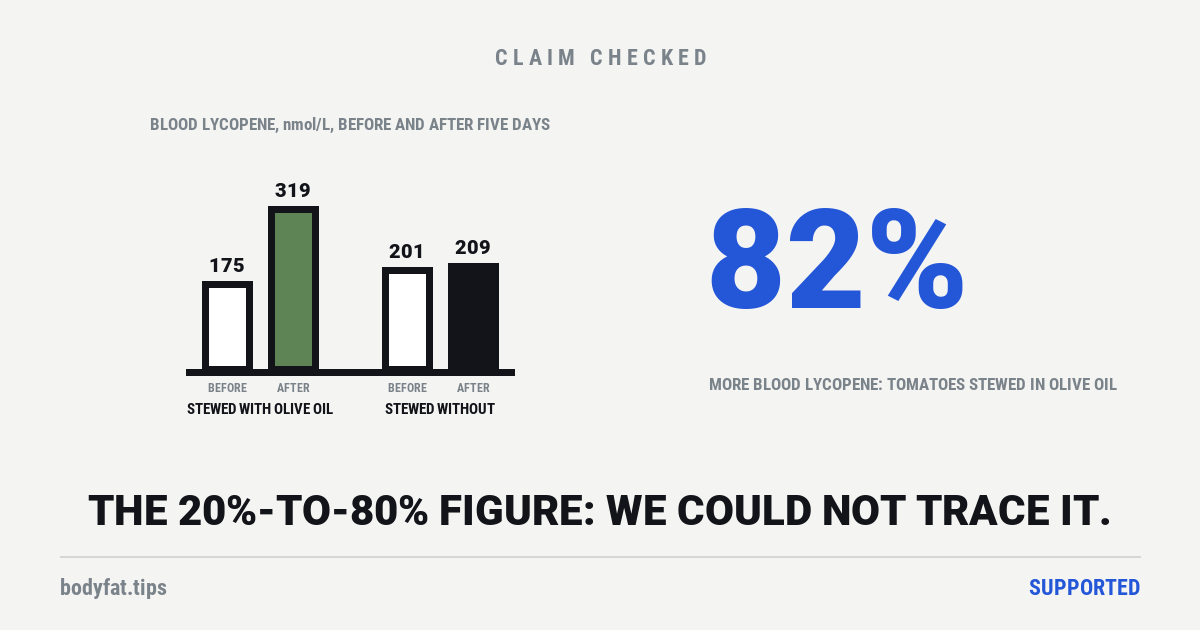
Cooking tomatoes, and eating them with some fat, does get more lycopene into your blood. In a 2005 Australian trial, tomatoes stewed with olive oil raised the main form of lycopene in the blood by 82% in five days; stewed without oil, it barely moved [3].
The “20% to 80%” is not a measurement we could find. The two studies closest to the advice that put a number on the share of lycopene people absorb came to about a third, from a drink of tomato paste and olive oil, and about a quarter, with the lycopene already dissolved in olive oil [4] [5]. Neither used raw tomatoes, and we found no study that measured the share absorbed from them [6].
In trials, tomatoes did not clearly take off weight. Pooled across seven trials, people eating tomato products ended no clearly lighter than people who were not [7]. And the 55% stroke figure describes blood levels in 1,031 Finnish men, not the effect of eating anything [8].
Which food has the highest lycopene?
By weight, dried and concentrated tomato products top the US Department of Agriculture’s tables. In 3.5 oz (100 g), sun-dried tomatoes hold about 46 mg of lycopene, tomato paste about 29 mg, tomato sauce about 14 mg and ketchup about 12 mg, against about 2.6 mg in the same weight of raw red tomato [9]. Outside the tomato, guava holds about 5.2 mg, watermelon 4.5 mg, papaya 1.8 mg and pink grapefruit 1.4 mg [9].
By the portion, from the same tables and by our arithmetic: a tablespoon of tomato paste carries about 4.6 mg, a cup of diced watermelon about 6.9 mg and a medium raw tomato about 3.2 mg [9]. But what a food holds is not what gets into you. That gap is where the cooking advice comes from.
Does cooking tomatoes really release more lycopene?
A 1992 test, from a German lab, boiled tomato juice with a little corn oil for an hour: blood lycopene rose only after the processed juice, not the plain one; we read that study as its summary [10].
In 1997 the same lab gave five volunteers the same 23 mg of lycopene twice, two weeks apart: once as 14 oz (400 g) of fresh tomatoes, once as 1.4 oz (40 g) of tomato paste, each time with about a tablespoon (15 g) of corn oil [11]. They measured lycopene in chylomicrons, the fat-carrying particles the gut releases into the blood after a meal, which show what has just been absorbed [11]. After the paste, the total over 12 hours, what researchers call the area under the curve, was 3.8 times larger [11]. The authors’ own caution: with five people, “these data should not be overemphasized” [11].
An Italian team then gave ten women 16.5 mg of lycopene as about 2.1 oz (60 g) of tomato purée or 10.6 oz (300 g) of raw tomato, each with about two teaspoons (10 g) of olive oil on bread [12]. Both raised blood lycopene. The purée raised it more: about 1.2 times as much after a single portion, and about 1.5 times as much over a week of daily portions, by our arithmetic from the paper’s tables [12]. So raw tomatoes do not “miss” the lycopene, as one of the video’s chapter titles has it [1]. Processed ones deliver more of it.
Is it the heat, or the crushing? A Dutch study, run by a food company’s research laboratory, pulled the two apart using canned tomatoes, which had already been heated in the factory [13]. Breaking the tomatoes up raised the lycopene response significantly, by up to about 1.6 times; an extra hour of boiling only “tended to”, which means the difference could still have been chance [13]. And when an Italian lab tested home cooking directly, in five people eating cherry tomatoes fresh or cooked, blood lycopene did not rise clearly after either meal; we read that study as its summary [14].
So the honest version is this. Tomatoes crushed and cooked in a factory, as paste, purée and sauce, deliver more lycopene than raw ones. A tomato softened in your own pan is the less-tested half of the claim.
| Study | What was compared | What happened |
|---|---|---|
| Australia, 2005; 23 adults, five days [3] | Tomatoes stewed with or without 25 mL of olive oil, about 1.7 tablespoons | Main form of lycopene in the blood up 82% with the oil; no clear change without [3] |
| United States, 2005; 11 adults, one meal [15] | Salsa with or without avocado (24 g of fat) | About 4.4 times as much lycopene reaching the blood with the avocado [15] |
| United States, 2004; 7 adults, one meal each [16] | Salad with raw cherry tomatoes and a dressing with 0, 6 or 28 g of oil | Next to nothing absorbed with no fat; more with a little; more again with more [16] |
| Germany, 1997; 5 adults, one meal each [11] | Fresh tomatoes or tomato paste, both with corn oil | About 3.8 times as much over 12 hours after the paste [11] |
| Italy, 1998; 10 women [12] | Raw tomato or tomato purée, both with olive oil | Both raised blood lycopene; the purée about 1.2 to 1.5 times as much [12] |
| Netherlands, 2000; 33 adults, four days [13] | Canned tomatoes, broken up to different degrees, with or without an extra hour of heat | Breaking them up raised it significantly; the extra heat only tended to [13] |
| Italy, 2004; 5 adults, one meal each [14] | Cherry tomatoes fresh or cooked at home | No clear rise in blood lycopene after either [14] |
| France, 2016; 10 adults, one meal each [17] | Tomato-paste meal with or without a 500 mg calcium supplement | 83% less lycopene response with the calcium [17] |
Does olive oil help you absorb lycopene?
Yes, and this is the stronger half. Lycopene dissolves in fat, not water, and the trials show it. In a 2004 study, seven people ate a salad with raw cherry tomatoes three times, with a dressing holding no oil, a little over a teaspoon (6 g) or about two tablespoons (28 g) [16]. With no fat, the lycopene absorbed was “negligible”; it rose with the small amount of oil and rose again with the larger one [16]. In a 2005 study of eleven adults, adding avocado to salsa brought about 4.4 times as much lycopene into the blood as salsa alone [15].
The trial closest to the video’s advice is the Australian one. Twenty-three adults were assigned by chance to eat about a pound (470 g) of tomatoes a day for five days, stewed either with about 1.7 tablespoons (25 mL) of extra-virgin olive oil or without it [3]. Both groups’ tomatoes were cooked. With the oil, the main form of lycopene in the blood went from 175 to 319 nanomoles per liter, up 82%; without it, from 201 to 209, no clear change [3]. Cooking without oil did almost nothing for that form. The oil did.
A 2022 review of 12 trials of carotenoids in general found the same direction: more fat with the meal, more absorbed, and fats like those in olive oil did better than fats like those in butter; we read it as its summary [18]. In its test-tube studies lycopene was the exception: how much was released for absorption did not rise with the amount of fat. Its trials in people were of carotenoids in general [18]. The oil in these studies was corn, canola, olive and avocado, so olive oil is not the only thing that works. What olive oil does on its own has its own verdict on this site.
One thing went the other way. In a French trial of ten adults who ate the same tomato-paste meal twice, a 500 mg calcium supplement taken with it cut the lycopene response by 83% [17]. That is one small trial, and it tested a supplement, not a glass of milk.
Where does “20% to 80%” come from?
We could not trace it. The video’s description gives no reference [1]. In a clip from another physician’s podcast, posted in August 2025 and transcribed from its captions by a third-party site, the same creator says a raw tomato gives “maybe 20%” of its lycopene and that heating takes you “from 20% absorption to 80% absorption”, after “here’s what research has found”; no study is named [19]. We searched PubMed for studies that measured how much lycopene people absorb, read the newest review of fat and carotenoid absorption, and ran ordinary web searches for the two numbers together, reading the first pages; none gave a source for them [6] [18].
What was measured is something else. The studies above compare one preparation with another: about 1.2 to 4.4 times as much, by the numbers in the table. That is a ratio, not a share of what you ate. A share has been put on it, though, and the test closest to the advice is a 2003 American study: 25 men drank tomato paste blended with olive oil and water, five men at each of five doses [4]. At the smallest dose, 10 mg, they absorbed about a third (33.9%); at bigger doses the share fell, because the amount absorbed barely rose, averaging about 4.7 mg whatever the dose [4]. That share was worked out from a model fitted to their blood levels. A 2015 study estimated it with a tracer, again through a model fitted to blood levels, using lycopene made with a heavier form of carbon, so it could be told apart from the lycopene already in the body [5]. Eight adults took it dissolved in olive oil, about a tablespoon (13.65 g) in all, on an English muffin. On average they absorbed 23%; a group of five averaged roughly 12 to 17%, and a group of three roughly 37 to 44%, depending on the form of the molecule [5]. Its authors note that their figure was lower than the drink study’s, and give possible reasons, from the form of the dose to the tracer’s greater accuracy [5].
So the direction in the video is right, and the numbers are not ones any study on this page measured. Four-fifths absorbed would be more than twice the share found from the tomato-paste drink, and more than three times the share found from lycopene in oil, by our arithmetic. And the 20% for raw tomatoes has no measurement behind it that we could find: neither study used raw tomatoes, and our searches turned up no study that measured the share absorbed from them [6].
Does lycopene help you lose fat?
The fat-loss story leans on a 2014 Portuguese study, the one a 2026 video on the same channel calls the “Portugal Study” in a chapter title, by our reading of the details [1] [20]. Thirty-five women aged 18 to 25 ate one raw tomato, about 3.2 oz (90 g), before lunch for four weeks, and lost an average 2.4 lb (1.09 kg) and 1.5 points of body fat, measured on a body-fat scale [20]. There was no comparison group, so nobody can say what the same four weeks would have done without the tomato [20]. Note the tomato was raw. A Taiwanese study of tomato juice in 25 young women had the same shape and the same gap [21]. How far a body-fat scale can be trusted has its own verdict here.
When tomatoes are tested against a comparison group, the scale barely moves. A 2026 review pooled the trials in people carrying extra weight. Across seven trials and 362 people, those eating tomato products ended 1.5 lb (0.66 kg) lighter than the comparison groups, and the range the true answer probably sits in ran from 4.3 lb (1.94 kg) lighter to 1.4 lb (0.63 kg) heavier: “no difference at all” is still on the table [7]. Body mass index did not move [7]. The biggest trial in the review, 225 middle-aged adults in Britain on a tomato-rich diet or lycopene capsules for 12 weeks, found no difference in body measurements, by the review’s table [7] [22]. An earlier review of 34 trials, read as its summary, found no effect on weight [23].
Among the review’s pooled results, the one positive number was the waist: 0.45 in (1.15 cm) smaller, with a range running to almost nothing, 0.02 in (0.04 cm) [7]. Open its chart of the five waist trials and one carries 88% of the pooling’s statistical weight, which is how much each trial counts toward the pooled answer: 53 postmenopausal women in Taiwan, eight weeks, all on a 1,500-calorie diet, half of them eating about 7 oz (200 g) of raw tomatoes a day in place of two servings of other vegetables [7] [24]. The review entered that trial as 0.43 in (1.1 cm) smaller on tomatoes, with a range from 0.90 in (2.29 cm) smaller to 0.04 in (0.09 cm) larger: on its own, “no difference at all” is still on the table [7]. By our arithmetic from the chart, that one trial supplies about 0.38 in (0.97 cm) of the pooled 0.45 in (1.15 cm) [7].
In the trial’s own report, the tomato group’s waists shrank 1.1 in (2.9 cm) on average and the comparison group’s 0.9 in (2.2 cm), a gap of 0.3 in (0.7 cm), which the paper prints as significant [24]. Its text and its table do not agree. The waist averages before and after, given in its text, have the comparison group’s waist falling 0.7 in (1.7 cm), not 2.2 cm, and the gap between those averages, 0.43 in (1.1 cm), is the figure the review entered. By our arithmetic from the changes and spreads in its table, the table’s gaps, for the waist and for body fat, could easily come from chance alone, although the paper marks them significant [24]. We report the numbers as printed; the paper does not let us tell which of them is right.
Is it the lycopene? The review’s own authors think not. In their analysis, more lycopene did not mean more effect, and a tomato extract with no lycopene in it did about as well as the rest; they conclude the effects “cannot be attributed to lycopene alone” [7]. A Japanese trial gave 28 men vegetable drinks high or low in lycopene for eight weeks: a body-fat scale’s estimate of visceral fat, the fat packed around the organs, fell in every group, including the low-lycopene one, while their weight showed no clear change [25]. Every group drank one of the drinks, so the trial cannot say whether drinking them did it. This site’s visceral-fat verdict covers what does shrink it. And the newest trial we read, in Italy in 2026, gave 79 adults with a fatty liver about 7 oz (200 g) of raw tomatoes and 1.8 oz (50 g) of tomato sauce a day for six weeks: no difference in body weight or body composition from the group eating none [26].
One more title deserves a close read: “If You Want To Lose 75% Of Your Visceral Fat In 90 Days, EAT THIS”, from the same channel in May 2026 [1]. Its description opens with a chapter called “The One Tomato Trick to Burn Visceral Fat (Portugal Study)” and a habit list that begins “Eat 1 tomato daily (before meals)”, but it also names pomegranates, kiwi, matcha, dark chocolate and coffee, and it never says what the 75% belongs to [1]. So we do not pin the 75% on the tomato. The Portuguese study measured weight and body fat, not visceral fat, for four weeks [20].
Does lycopene cut stroke risk by 55%?
The 55% is a real number, and it is about blood, not about eating. It comes from a Finnish study published in 2012: 1,031 men aged 46 to 65 gave a blood sample and were followed for a median of 12.1 years, during which 67 had a stroke [8]. Men in the top quarter for blood lycopene had 55% fewer strokes than men in the bottom quarter, after allowing for age, blood pressure, smoking, cholesterol and some other differences [8]. In the paper’s terms that is a hazard ratio of 0.45: the top group’s stroke rate ran at 45% of the bottom group’s. With 67 strokes in all, the range the true answer probably sits in is wide, from a very large reduction down to about 5% [8]. The paper’s title says lycopene “decreases” the risk [8].
That design is a cohort study: measure people, then wait and see who gets ill. It shows what goes together. It cannot show what causes what, because men with more lycopene in their blood may differ in other ways, from what else they eat to how they live, and a single blood sample cannot catch all of it.
Pooled, the cohorts point the same way, more weakly. A 2014 review of seven cohort studies and 116,127 people found 19% fewer strokes with the most lycopene, with the range of plausible answers running from 32% to 4% fewer [27]. The link held for lycopene measured in the blood, not clearly for lycopene people reported eating; in men, not clearly in women, where there was one study; and it lost its certainty when the biggest single source of strokes, 914 of them among 26,593 Finnish smokers, was left out [27]. A 2019 review, read as its summary, found 26% fewer strokes with the highest lycopene [28].
Is the lycopene doing it? A 2021 study tested that with Mendelian randomisation. It uses inherited gene variants that nudge blood lycopene up or down from birth as a natural experiment: the genes are dealt at random, and diet and illness do not change them [29]. Across 1,058,298 people and 70,791 strokes caused by a clot, genetically higher lycopene went with no fewer strokes: an odds ratio of 1.04 for each step up of 1 microgram per deciliter (µg/dL) of lycopene in the blood, where 1 means no difference at all [29]. Our reading of its limits: its gene markers for lycopene came from a study of only 441 people, which makes lycopene the shakiest of its tests, and it looked only at clot strokes in people of European descent [29]. This site’s erythritol verdict explains the method at more length.
No trial we found gave people lycopene or tomatoes and counted strokes [6]. The nearest tests are in the same chemical family: large trials of beta-carotene, another carotenoid, against a dummy pill. A Finnish trial gave it to 28,519 male smokers for a median of six years: no clear difference in strokes overall, and more bleeding strokes on beta-carotene; we read it as its summary [30]. Three more large trials that counted strokes, read as their summaries, found no clear difference either way: 367 strokes on beta-carotene against 382 on the dummy pill among 22,071 American doctors over 12 years [31]; 61 against 43 among 39,876 American women, whose beta-carotene was stopped after about two years [32]; and 511 against 518 among 20,536 British adults at high risk, who took it with vitamins E and C for five years [33]. Pooled, a 2022 review of the beta-carotene trials found strokes no rarer on it and, if anything, more common: 17% more, with a range running from no difference to 37% more, a result that lost its certainty when one trial of women at high risk was left out [34].
Can lycopene shrink the prostate?
On the trials pooled so far, there is no sign that it does. A 2012 review of eight trials pooled four and found no clear difference in diagnoses of an enlarged prostate or of prostate cancer between men given lycopene and men who were not, and said the evidence could neither support nor refute it [35]. In men already diagnosed with prostate cancer, six trials of lycopene found no clear change overall in PSA, the blood marker doctors track; it fell in the trials whose men started with higher PSA [36], and the 2012 review’s pooling of two trials in men with prostate cancer also found a fall [35].
The cohort studies are mixed. The newest review, of studies running to July 2023, found no link between eating tomatoes and prostate cancer, a link short of certain for lycopene in the diet, and 11% fewer prostate cancers in men with the most lycopene in their blood [37]. That is the same pattern as stroke: the blood measure links, the plate less so.
Is lycopene good for the liver?
One trial is a start. In the Italian trial above, 79 adults with a fatty liver ate raw tomatoes and tomato sauce daily or no tomatoes for six weeks; a scanner’s reading of liver fat fell more in the tomato group [26]. It tested whole tomatoes, not lycopene, for six weeks. The site’s fatty-liver verdict covers what reliably reverses the condition.
What about lycopene supplements?
In the British trial, 10 mg lycopene capsules a day for 12 weeks changed none of the heart-risk markers measured, and neither did a tomato-rich diet [22]. The video says lycopene can “Protect your DNA from damage” [1]. When claims like that were put to Europe’s food-safety authority for use on labels, its panel found that none of the studies supplied showed an effect on reliable markers of oxidative damage, and concluded that a cause-and-effect link had not been established; it reached the same conclusion for the skin, the heart and vision [38].
What are the side effects of taking lycopene?
One side effect reported from food is orange skin. Eating a great deal of lycopene-rich food can tint the skin yellow-orange, a condition the doctors who described one case call “benign and harmless” [39]. Europe’s food-safety authority sets an acceptable daily intake, the amount judged safe to eat every day for a lifetime, of 0.5 mg per kg of body weight from all sources [40]. For a 154 lb (70 kg) adult that is 35 mg a day, by our arithmetic. In its 2026 estimate, lycopene in ordinary food was the main source for most people, supplements roughly doubled the intake of people who take them, and young children were the group most likely to go over [40]. And the calcium result above is worth knowing if you take a calcium supplement with your tomatoes [17].
If cooking with oil gets more lycopene into your blood, why did the trial that carries the waist result use raw tomatoes?
This section is the desk’s own reasoning, and it is labelled as such. The absorption studies say cooked, crushed tomatoes with fat put the most lycopene into the blood [3] [11]. Yet the trial behind the review’s waist result fed women raw tomatoes [24], and so did the Portuguese study [20]. If lycopene were doing the work, that is the wrong way round. Three answers, each rated.
Answer one: the waist effect, if it is real, is probably not the lycopene. In the 2026 review, more lycopene did not mean more effect, and a lycopene-free tomato extract did about as well [7]; in the Japanese trial, a scale’s estimate of visceral fat fell on the low-lycopene drink too [25]. This is measured, in the review’s own analysis, which its authors call exploratory, and in one small trial.
Answer two: the one trial carrying the result could tip on very little. It was open-label, meaning everyone knew which group they were in, and all seven women who dropped out had been in the comparison group [24]. Its text and its table also disagree about how much the comparison group’s waists shrank [24]. This is measured: it is in the trial’s own report. What it did to the result is not measured here.
Answer three: lycopene in the blood may mark a way of eating more than it makes anything happen. The stroke link holds for blood levels, not clearly for diets [27]; genes that raise blood lycopene did not lower stroke risk [29]; and in the British trial, lycopene capsules moved none of the heart markers [22]. This is a surmise with those studies on its side, none of them designed to test it.
Put the three together and here is what we think is true, stated plainly so you can disagree with it: cooking tomatoes in oil gets more lycopene into your blood, and nothing in this page’s evidence shows that the extra lycopene is what any benefit of tomatoes runs through.
What we could not find, and would like to. A trial that gave people the same tomatoes, cooked in oil or raw, for months, and measured waist and body fat; none of the 11 trials in the newest review compared cooked tomatoes with raw ones [7]. And a trial of lycopene that counted strokes [6]. If you know of either, the corrections line on this site is open.
Who these studies were done on
The absorption studies: small groups of healthy adults, five to 33 at a time, in Germany, Italy, the Netherlands, France, the United States and Australia [11] [12] [13] [17] [16] [3]. The 1998 Italian one was all women [12]. How much a person absorbs varies a great deal: in the tracer study, from about an eighth to more than a third [5]. The fat trials: postmenopausal women in Taiwan, young women in Portugal, middle-aged British adults and Japanese men [24] [20] [22] [25]. The stroke figure: Finnish men aged 46 to 65 [8], and in the pooled cohorts the link was clear in men, with one study of women [27].
Three things change the answer for a reader. What the tomatoes are eaten with: fat helps, and a calcium supplement at the same meal may not [16] [17]. Their form: paste and sauce carry and deliver more than raw tomato [9] [12]. And you: the same meal is absorbed very differently by different people [5].
Where “cook your tomatoes in olive oil” came from
The research came from a German lab: tomato juice boiled with oil in 1992, then tomato paste against fresh tomatoes in 1997, a test whose paste came from a food company’s research laboratory [10] [11]. The comparison was always one preparation against another.
The framing, by our reading, turned a ratio into a share. In the 2025 podcast clip, the comparison became “from 20% absorption to 80% absorption”, credited to research and to no study [19]; the two measurements of the share absorbed closest to the advice that we found came to about a third, from a tomato-paste-and-oil drink, and about a quarter, from lycopene in oil [4] [5].
Then the spread. The video in May 2026 promised to show “How to increase lycopene absorption from 20% → 80%” [1]. Google’s AI answer for “lycopene benefits” in October 2026 says “processing and heating actually boosts lycopene bioavailability” and that eating it with olive oil or avocado “significantly increases how much your body absorbs”; among its sources is a YouTube Short titled “You’re eating tomatoes wrong (this affects your skin and aging)” [2]. The same video also passes on advice about turmeric and black pepper, which has its own verdict here [1].
The product is the jar and the capsule: tomato paste and sauce, which carry about 5 to 11 times the lycopene of raw tomato by weight, by our arithmetic from the USDA tables [9], and lycopene supplements. Against about 5,400 searches a month for “lycopene supplement” and 140 for “tomato paste benefits”, “lycopene weight loss” gets about 30 and “cooked tomatoes lycopene” about 70 (from a paid keyword database, pulled 10 October 2026) [2].
None of this is aimed at anyone simmering a pot of tomato sauce. That is a good use of a tomato, and the oil in the pan is doing real work. It is the percentages, the fat loss and the 55% that the evidence does not carry.
What this is rated, and what the rating covers
Supported — for the claim that tomatoes cooked or processed into paste or sauce, and eaten with some fat, get more of their lycopene into your blood than raw tomatoes eaten without.
It is rated Supported because the direction holds across the studies of processing and of fat that we read: processed tomatoes beat raw in the two labs on this page that compared them, in Germany and Italy [10] [11] [12], and a lab in the Netherlands found that breaking canned tomatoes up raised it further [13]; fat beat no fat in three trials [16] [15] [3]; and a review of 12 trials of carotenoids found the same [18]. It is not Established because the studies are small, five to 33 people, and short, one meal to a week; because the processing half rests on two labs; because home cooking on its own is the less-tested half: one five-person test found no clear rise either way, and extra heating of canned tomatoes was only a trend [14] [13]; and because the size varies, from about 1.2 to 4.4 times. Several of the studies were also run, paid for or supplied by companies or by a growers’ commission [11] [13] [16] [15]. Blood lycopene is all they measured, and it is what this rating is about: whether more of it does you any good is a separate question, rated below.
Rated alone, in words. That cooking raises absorption “from 20% to 80%”: Unsupported, of the tested kind; the share absorbed has been estimated, through models fitted to blood levels, for a tomato-paste-and-oil drink, about a third at a small dose and less at larger ones, and from lycopene in olive oil, about a quarter [4] [5]. The 20% for raw tomatoes is a number we found no measurement for at all [6]. That tomatoes or lycopene make you lose weight: Unsupported, of the tested kind; seven trials pooled found no clear change in weight and the biggest found no clear change [7] [22]. That tomatoes trim the waist a little: Preliminary; one pooling found 0.45 in (1.15 cm), with 88% of its weight on one open-label trial of raw tomatoes whose own range in that pooling includes no difference and whose text and table disagree, and its authors doubt it is the lycopene [7] [24]. That lycopene lowers stroke risk: Preliminary; cohorts link higher blood levels with fewer strokes, a genetic test found no protection, we found no trial of lycopene, and trials of beta-carotene, its chemical relative, found no fewer strokes [27] [29] [6] [34]. That it protects the prostate: Preliminary; blood levels link weakly, and the few trials found no clear difference in diagnoses, with mixed results on PSA [37] [35] [36]. That tomatoes help a fatty liver: Preliminary; one six-week trial [26].
What is not rated here: the 75% title, whose description does not say which food it means; the same video’s promise to “boost fat-burning power by 250%” with “one simple cooking method”, which its description does not tie to any study [1]; the video’s claims that lycopene starves cancer, protects DNA, slows ageing and calms inflammation; brown fat; and the frame above, which is this desk’s reasoning from the evidence rather than a result the evidence delivered. It is marked as ours so that you can weigh it as ours.
This is journalism, not medical advice. A stroke risk, a prostate problem or a fatty liver belongs with a clinician, and a supplement taken alongside medicines is worth asking about. How we read a study, and what each tier means, is set out here.
- The Study Behind Clove Coffee’s Blood-Sugar Claim: 13 People, No Comparison Group, Maker-Paid
preliminary - Hibiscus Tea Benefits: A Few Points Off Blood Pressure in Small, Short Trials. Against Prescription Pills, the Trials Split.
preliminary - Kiwi Benefits: For Constipation, Two a Day Kept Pace With Mostly Low-Dose Fiber Supplements Over Weeks, Not 24 Hours. Against a Dummy, No Clear Difference Yet.
preliminary