The Study Behind Clove Coffee’s Blood-Sugar Claim: 13 People, No Comparison Group, Maker-Paid

“Crush 1 clove.” “Add it to your coffee and wait 2 minutes.” “Drink!” That recipe is from the description of “1 CLOVE in Your Coffee Every Morning (Here’s What Happens)”, posted on 16 September 2026 by a chiropractor’s health-video channel whose creator directs a supplement company; every description on the channel advertises its products. The video had 6,176,664 views when we read it on 10 October 2026 [1].
The description says clove coffee “supports digestion and healthy blood sugar”. It says eugenol, the main ingredient of clove oil, “can be beneficial against H. pylori because it survives stomach acid”, and it lists “Fights ulcers” among the benefits that, it says, “Research has shown” [1]. It gives three papers as its data: a trial of a clove mouthwash in intensive-care patients on ventilators [2], a test-tube study of eugenol against H. pylori [3], and a 30-day study of a clove extract and blood sugar [4].
Plenty of people are asking. In the United States, “clove benefits” is searched about 49,500 times a month, “clove coffee” about 2,900 times and “cloves in coffee benefits” about 140 times a month (from a paid keyword database, pulled 10 October 2026) [5]. Ask Google about clove benefits and its AI answer says clove extracts fight “stomach pathogens like H. pylori”; the first page it cites for that line is this video [5].
Nobody has tested a clove in coffee. We searched medical databases and trial registries and found no trial of it, for blood sugar or anything else [6]. The nearest is a Saudi trial of coffee brewed with cardamom, cloves and saffron, which measured blood pressure, not blood sugar [7].
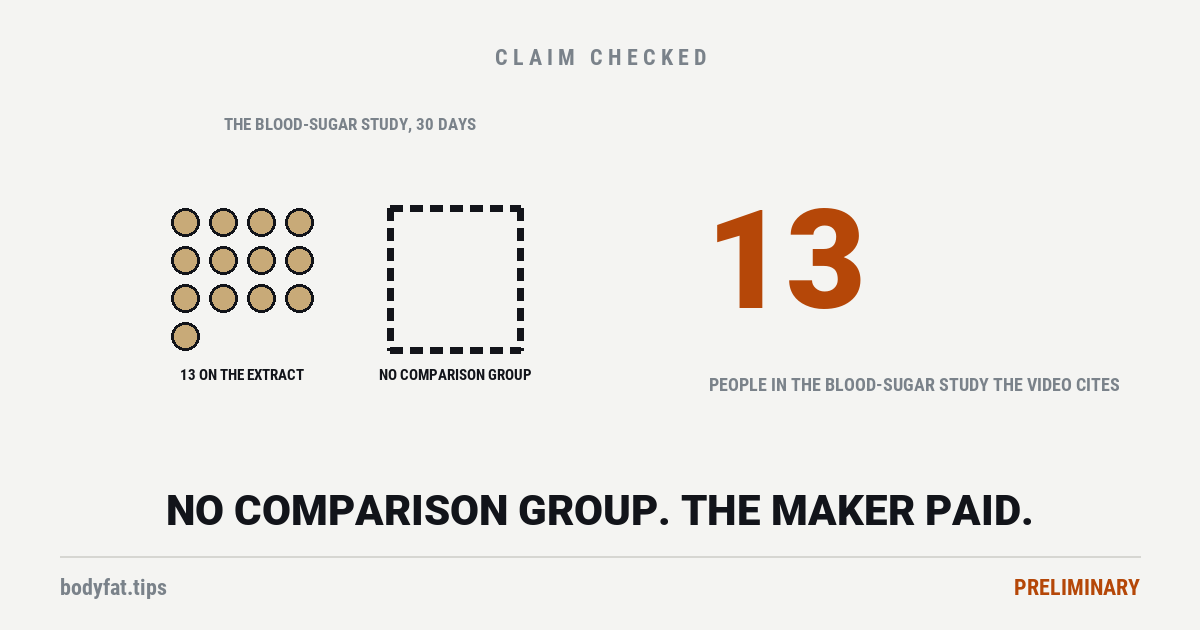
The blood-sugar study the video lists had 13 people and nobody to compare them with. They took a capsule of a clove extract that its maker calls “de-flavoured”, and the maker paid for the study [4] [8]. A larger trial of the same extract, in 2022, did have a comparison group and reported falls in blood sugar; the maker’s staff are among its authors too, and we could read only its summary and charts, which do not all agree with each other [37].
The stomach claims come from dishes and animals. Eugenol stops H. pylori in a flask [3]. The one trial we found of a clove compound in people with the infection cleared nobody’s infection [9].
What is in a clove?
A clove is a dried flower bud, picked before it opens [10]. Most of its smell and bite is in its oil [11], and most of the oil is eugenol: about three quarters of it, in clove-bud oil analysed for Europe’s food safety authority [12]. Measured in cloves as sold, eugenol comes to about 94 to 147 mg in every gram [13]. A teaspoon of ground cloves weighs 2.1 g [14], so it holds roughly 200 to 310 mg of eugenol, by our arithmetic.
And one clove? We could not find a published measurement of what a single dried clove weighs [6]. So the arithmetic on this page works in grams and teaspoons. A kitchen scale will tell you what yours weigh.
Do cloves lower blood sugar?
Here is the study the video lists. In September and October 2014, researchers in Kerala, India, gave 13 volunteers aged 25 to 35, ten men and three women, a 250 mg capsule after lunch every day for 30 days [4] [15]. Seven started with blood sugar of 100 mg/dL or below before lunch. Six started between 101 and 125, a group the paper calls prediabetic: above normal, below the line for diabetes [4]. (mg/dL, milligrams per deciliter, is the scale American blood-sugar meters use.)
Two hours after lunch, their blood sugar fell. In the first group it went from 125.4 to 98.4 mg/dL by day 30; in the second, from 148.3 to 108 [4]. Before lunch it fell only in the second group, from 114.2 to 100.5 [4]. Blood sugar was measured with a finger-prick meter [4].
Now the part the result depends on. Nobody was given a dummy capsule. Everyone knew what they were taking, and so did the researchers: what is called an open-label study, and in the paper’s own words “no investigators were blinded” [4]. With nobody to compare against, a fall over 30 days could come from the capsule. It could also come from people eating a little differently once they knew their sugar was being watched, or from regression to the mean: numbers picked out because they were high tend to come back down on the next reading by themselves. The study cannot tell those apart. That is a limit of its design, and the two other explanations are ours, not findings.
Who paid? The company that makes the extract, an Indian flavor company, under a development program for its spice ingredients. Two of the six authors worked for that company, and two more worked for a US supplement company that, in the paper’s words, “sells finished products containing” the extract [4]. By the paper’s own account, two of the maker’s employees designed the study, the two college authors ran the experiments and collected the data, and one of the maker’s employees and the supplement company’s two analysed the data and wrote the paper [4]. Its registry entry says it was “funded by and will be conducted at” the maker’s research centre [15]. The study was entered in that registry in September 2018, almost four years after it ended [4] [15]. The entry states the study’s hypothesis as falls in blood sugar of 5 mg/dL before meals and 40 mg/dL after them; in the paper, the after-lunch falls were 27.00 in the normal group and 40.33 in the raised group [4] [15]. Registering a trial before it starts is how researchers show they did not pick what to report after seeing the results; registering it afterwards cannot show that.
And what was in the capsule? Not a clove. It was a powder made by soaking dried clove buds in water and alcohol, drying what dissolved, and standardising it to at least 30% polyphenols [4], a large family of plant compounds that, in a clove, carry its bitterness and astringency rather than its smell [11]. The maker’s own papers call it “de-flavoured” [8] and say it was made “without the issues of its characteristic pungency and aroma” [16]. Eugenol is in it, in an amount none of the maker’s papers we read states [11] [4].
So the study the video offers for a clove’s eugenol tested an extract its maker calls de-flavoured, made to taste and smell far less of clove; the maker’s safety paper describes the powder as having a “mild taste and aroma characteristic of clove” [11]. Does that mean eugenol did nothing? Nobody measured. It means this study cannot be evidence that eugenol did something.
Is there a better test of the extract? There is one, and the video does not cite it. In 2022, a team that included two of the maker’s research staff and a contract research company gave 70 adults with metabolic syndrome, a cluster of conditions that includes raised blood sugar, blood pressure and blood fats and a large waist, either 250 mg a day of the same extract or 250 mg of synthetic glutathione, an antioxidant supplement, for 84 days; 64 finished [37]. The paper calls it double-blinded: neither the participants nor the researchers were meant to know who took which. It reports that fasting and after-meal blood sugar, and HbA1c, a blood test that gives a rough three-month average of blood sugar, fell further on the extract than on glutathione [37].
Four things keep it from settling the question. First, the comparison was another supplement, not a dummy capsule, so the trial can show that the extract did better than glutathione; it cannot show how the extract compares with taking nothing. Second, on the paper’s own charts the extract group started higher, at about 6.9% HbA1c against 6.2%, and about 171 against 160 mg/dL after a meal, and numbers that start higher have further to fall [37]. On the extract, the chart has HbA1c falling to about 5.3% in 84 days [37]. Third, the charts do not agree with each other. Researchers often score insulin resistance, how much insulin the body needs to keep blood sugar down, as HOMA-IR: fasting blood sugar in mg/dL times fasting insulin, divided by 405. For the extract group at 84 days, the chart’s fasting sugar of about 93 and insulin of about 12.2 give a score of about 2.8; the chart prints about 1.2. The same sum comes within 0.05 of the chart’s other three scores. The insulin chart shows insulin rising on the extract, from about 8.9 to about 12.2, and the summary lists insulin among the measures the extract improved. And the summary says glutathione showed “no significant effect on blood glucose”, while the charts mark its falls in fasting sugar, after-meal sugar and HbA1c with P < 0.001, which researchers read as very unlikely to be chance [37]. That is our arithmetic, on values we read off the paper’s charts; its tables would show which figure is wrong, and we could not read them. Fourth, we could read only its summary, author list and charts: the paper is free to read on the publisher’s site, but the site refused our automated reading, so we have not seen its tables or its funding statement [37]. It is a trial of an extract, not of a clove.
Has anyone tested whole cloves on blood sugar?
Three times, that we found, and the third is told in two documents that do not agree on how it was run [6]. In 2006, researchers from an agricultural university and a hospital in Peshawar, Pakistan, and a US Department of Agriculture nutrition laboratory presented a meeting abstract, a one-paragraph summary given at a scientific conference [17]. Thirty-six people with type 2 diabetes took capsules holding 0, 1, 2 or 3 g of cloves a day for 30 days. With the three clove groups put together, their blood sugar fell from 225 to 150 mg/dL; “There were no significant changes in the placebo group” [17]. One to three grams is about half a teaspoon to a teaspoon and a half of ground cloves, by our arithmetic [14].
Hold it loosely. A meeting abstract is not a full paper checked by reviewers in the usual way, and this one never compares the clove groups with the dummy group directly; it says only that one changed and the other did not [17]. We found no full paper of it in the twenty years since [6]. And a 2003 cinnamon trial by three of the same four authors, which had a similar design (several doses in capsules against dummy capsules, then a break), is now under an expression of concern, a formal warning a journal attaches to a paper it has doubts about. In August 2025 its journal said independent statisticians had found differences between the groups at the start “inconsistent with proper randomization”, unclear reporting of how people were assigned, and “unusually high reported participant adherence” with nobody lost along the way, and that it could not reach the authors [18]. That concern is about the cinnamon paper, not the clove abstract. It matters here because the clove abstract reports even less than the cinnamon paper did, so it cannot answer those questions either.
The second test is Danish, and it is the only one we found of cloves on their own eaten as food [6]. For the Christmas issue of the Danish medical journal in 2021, hospital doctors gave 12 healthy adults, mostly women, aged 25 to 63, the same rice pudding on different days, plain or topped with spices, and tracked their blood sugar with a sensor worn under the skin [19]. On the clove day, 1 g went on breakfast and 3 g on lunch. Against plain pudding there was no difference in how far blood sugar rose or how high it peaked [19]. It is one meal, in healthy people, with the days in a fixed order rather than a random one, and the paper is written partly in fun: eight of the twelve said they would rather risk the complications of higher blood sugar than eat the spices on their pudding [19]. It reports no funding and no conflicts [19].
The third is told twice. The later telling is a 2014 report from a college of arts and home science in Surat, India, in a pharmacy journal that PubMed does not index [38]. It says 45 adults with diabetes and raised blood fats were split into three groups of 15: one took 4 g of powdered cloves a day in capsules, about two teaspoons by our arithmetic [14], one took turmeric, and one took capsules of roasted rice-flake flour as a dummy [38]. On cloves, it reports fasting blood sugar falling from 163.9 to 124.2 mg/dL and HbA1c from 8.1% to 7.25%, with almost no change on the rice flakes [38]. That is close to the trial this page would ask for. We cannot rely on it, for reasons printed on its own pages.
It gives the trial’s length as three months in some places and two months in others [38]. Its table of after-meal blood sugar does not subtract: the clove group went from 265.33 to 215.67 mg/dL, a fall of 49.66 by our arithmetic, and the table prints the fall as 42.47 [38]. It does not say how people were put into groups, and it states no funding, no ethics approval and no consent [38]. Its description of its 45 participants repeats, figure for figure, the description a 2012 paper by two researchers at a women’s university in Coimbatore, India, gives for a survey of 500 adults employed at an industrial firm there: the same 30.4% aged 40 to 45, the same 47% in joint families and 53% in nuclear ones, the same 45% practising yoga [38] [39]. By our arithmetic, 30.4% of 45 people is 13.7 people; no whole number of people out of 45 makes 30.4%. That 2012 paper’s own trial gave 45 of those workers with raised blood fats 2 g of cloves or turmeric a day, or capsules of powdered sugar, for three months, and measured blood fats, not blood sugar [39]. And the same two researchers have a paper listed in the April 2010 issue of an Indian nutrition journal under the 2014 report’s exact title [40]. We could not read it: the journal’s site served a bot check, and no index or archive we tried holds a copy [40].
The earlier telling is a 2008 doctoral thesis written at that Coimbatore university by the first of those two researchers and supervised by the second; the university holds it in an open repository [46]. The 2014 report’s table of blood sugar and HbA1c repeats, to the second decimal, the thesis’s rows for cloves, turmeric and the dummy capsules, and its weight and blood-fat figures for those three groups are the thesis’s too [38] [46]. That includes the after-meal fall printed as 42.47: the thesis prints the same figure, and the readings for each man in the thesis’s own appendix put the average fall at 49.67, by our arithmetic [46]. It includes the dummy group’s change in fasting blood sugar, printed in both as a rise of 0.4, where those readings give a fall of 0.53 [46]. But the thesis describes the trial differently. Its 75 men all worked for one government-run company in Coimbatore; the 2014 report says its adults lived in Surat. They took 2 g of cloves a day, not 4 g. The dummy capsules held roasted Bengal gram flour, a chickpea flour, not rice flakes. It ran for three months throughout. And it had five groups of 15, with groups on cinnamon and garlic that the 2014 report leaves out [46].
None of that tells us what happened, or why, and we draw no conclusion about it. It tells us the 2014 report does not add up on its own pages and repeats the thesis’s results rather than adding to them, and that is enough for this page not to lean on it.
So the thesis is the trial to weigh, and it comes close to the one this page would ask for. Men with diabetes and raised blood fats, picked out by a doctor, took four capsules a day holding 2 g of powdered cloves, about a teaspoon by our arithmetic [14], for three months. Their fasting blood sugar went from 163.9 to 124.2 mg/dL and their HbA1c from 8.1% to 7.25%; on the dummy capsules, from 165.9 to 165.3 and from 7.85% to 7.84% [46]. We do not rely on it either, for reasons in its own methods chapter. The men were chosen for their “willingness to participate and co-operate” and then “divided” into groups, with no randomisation described, so the clove group and the dummy group may have differed from the start in ways that matter. No blinding is described: nothing says whether the men, or the people measuring them, knew who was taking what. It was men only, at one workplace. It does not say what diabetes treatment the men were on or whether it changed during the three months; in the survey the trial drew its men from, all but 7.5% of the 255 adults with both conditions were already being treated [46]. A university ethics committee approved it, it names no funder, and it is a thesis, not a paper checked by a journal’s reviewers [46].
Cloves have also been eaten in spice mixes, and the tests we found point both ways. In a 2015 American trial, 20 overweight adults, 6 of them women, ate a high-fat meal with and without 14.5 g of nine spices, about 0.6 g of it cloves (under a third of a teaspoon, by our arithmetic [14]), in random order, each after two days of matching meals; the spices made no difference to blood sugar or insulin afterwards [41]. It was supported mainly by a research institute funded by a spice company, whose sample programme donated the spices, and in part by US government grants [41] [42]. An earlier test of the same nine spices, with the same amount of cloves, in six overweight American men in 2011, found no difference in blood sugar but 21% less insulin after the spiced meal; the same institute supported it and supplied the spices [47]. In Japan in 2014, a curry made with eight spices, 0.9 g of them cloves, made no difference to blood sugar or insulin an hour after the meal in 14 healthy men; a Japanese food company ran it and paid for it, and six of the seven authors worked for that company or its group [48]. In Singapore in 2019, 20 young Chinese men ate rice with a vegetable curry made with two doses of seven spices, clove among them, or a control meal matched for calories and vegetables: the rise in blood sugar over the three hours after the meal was 19% smaller on the lower dose and 32% smaller on the higher, the fall in insulin was not clear enough to rule out chance, and blood fats after the meal rose with the dose; a Singapore government research agency paid for it [49]. And a 2025 conference abstract from Malaysia gave 30 people with type 2 diabetes, none of them on diabetes medicine, capsules of eight spices and herbs, cloves among them, at 2, 4 or 6 g a day for 30 days, with no comparison group; it reports only faint links between the dose and blood sugar or HbA1c [50]. In every one of these, cloves were one ingredient among several, so none can say what cloves did, and we count none of them for or against cloves.
Two reviews have looked for more. A 2024 review searched three databases to September 2023 for trials of a dozen Mediterranean spices, clove among them, in people with type 2 diabetes; for clove, “not enough studies were found” [20]. A 2023 review of spices at kitchen doses, three of whose four authors work for an herbal-tea company, says in its summary that it found “No relevant research” for cloves [21]. Neither review found anything to analyse, which is an absence of evidence, not evidence against.
For comparison, the site’s apple cider vinegar verdict finds vinegar’s effect on blood sugar after a meal in a pooled analysis of controlled trials, and its berberine verdict reports a double-blind trial of 300 adults in which berberine lowered fasting blood sugar more than a dummy did. Whole cloves have nothing like either that we can rely on.
Does clove help with H. pylori?
H. pylori is a bacterium that lives in the stomach lining of about half the world’s people and is a major cause of stomach ulcers [3]. The video’s reference for it is a 2005 study from India. In flasks of broth, eugenol stopped the growth of all 30 strains (genetic varieties) it was tried on at 2 micrograms per milliliter, worked better when the broth was made acidic, and the bacteria did not become resistant to it over 10 rounds of growth [3]. That is where “survives stomach acid” comes from. It was a flask, not a stomach, and its authors wrote that “clinical trials would be needed” [3].
Since then there have been more dish studies of clove extracts [22] and studies in mice [23]. The mouse study tested beta-caryophyllene, another compound found in cloves, and six of its ten authors give a Korean biotechnology company as their employer, and the paper says the compound it tested was obtained from that company [23].
In people we found one trial [6]. In Korea, 66 adults with the infection took a capsule of beta-caryophyllene, 126 mg a day, or a dummy capsule of corn oil, for eight weeks; 59 finished [9]. The infection cleared in nobody, in either group. The compound group reported less nausea and less upper-stomach pain at eight weeks than at the start. But the dummy group’s nausea fell at least as far, both groups started at about 1 or less on a 0-to-10 scale, and the paper compares the groups only at the start, never in how far their symptoms changed [9]. The paper declares no funding and no conflicts, and does not say where its beta-caryophyllene came from; it names cloves as one of several plants that contain it [9]. We found no trial that gave people cloves, clove water, clove oil or eugenol for H. pylori [6].
Do cloves heal stomach ulcers or help digestion?
In rats, often. Clove oil and eugenol protected rats’ stomachs against ulcers caused by alcohol and by an anti-inflammatory drug [24], and the extract’s maker reported the same for its extract in rats [16]. But the dose matters, and not in the direction a daily habit would want: in a 2021 rat study, a low dose of eugenol sped the healing of ulcers made with acid, while a dose a hundred times higher made the ulcers 49% bigger [25].
In people, the only report we found is from 1951: eugenol given to patients with peptic ulcers [26]. We could not read it. It has no abstract, the publisher refused automated reading, and the Internet Archive holds no copy [26]. We found no modern trial [6].
“Supports digestion” has even less. We found no study we could rely on that gave people cloves on their own and measured anything about digestion [6]. The 2014 report above lists constipation among the symptoms it says were gone after three months of cloves, with no numbers, and for the reasons above we do not lean on it [38]. The thesis it repeats counted one man with constipation among the 15 on cloves before, and none after, with none in the dummy group either time [46]. Trials of herbal mixtures that include cloves exist; in the one we read, a 2019 Iranian capsule that eased constipation in women after menopause, cloves were a small share of nine ingredients that included senna, itself a laxative [43]. The Korean trial’s nausea and stomach-pain result, for a single compound in a capsule, was a change within the group that the paper never compared with its dummy group, whose nausea fell at least as far [9]. What points the claim’s way is in animals and dishes. A Thai herbal remedy whose largest ingredient is clove buds stopped diarrhea in mice, and in cell tests its clove and agarwood extracts did most of the work of blocking the channels the gut lining uses to pour out fluid in diarrhea [44]. And eugenol relaxed segments of mouse gut in a dish [45].
The description adds that eugenol works on the upper gut “because the vast majority of this compound doesn’t make it past the liver” [1]. Here is what was measured. In volunteers, eugenol was absorbed quickly and almost all of it left in the urine within a day, nearly all of it after the body had bound it to other molecules to clear it [27]. So eugenol does not stay in the gut: it is absorbed, changed and cleared within a day. Whether any of it acts on the upper gut on the way through is not something those measurements show, and none of the three papers the description lists measured it [2] [3] [4].
Did anyone test clove in coffee?
Not that we could find [6]. The closest is a 2023 trial in Saudi Arabia of Arabic coffee, brewed from a liter of water, three tablespoons of coffee, a teaspoon of cardamom, half a teaspoon of ground cloves and a quarter teaspoon of saffron [7]. In all, 140 adults with mildly raised blood pressure were split between drinking 1 oz (30 mL) of it four times a day for four weeks, and avoiding it [7]. It measured blood pressure and blood fats; it did not measure blood sugar [7]. By our arithmetic, the coffee group’s daily cups were brewed with about an eighth of a gram of clove [14].
How much eugenol does a crushed clove give a cup of coffee in two minutes? We found no measurement [6]. The description also says “Coffee has its own benefits and supports healthy blood glucose levels” [1]. Coffee and blood sugar is a separate question that this page does not weigh; the site’s coffee verdict covers coffee and weight.
Is it good to eat cloves, or drink clove water, every day?
In the amounts used to flavor food, the regulators see no problem. The expert committee on food additives run jointly by two UN agencies, the Food and Agriculture Organization and the World Health Organization, set an acceptable daily intake for eugenol in 1982: up to 2.5 mg per kilogram of body weight a day [28]. That is the amount a person could take every day for life without appreciable risk, and here it is a hundredth of the highest daily dose that did no harm in rats [28]. Europe’s food safety authority agreed in 2009 that eugenol used as a flavoring raises “No safety concern at estimated levels of intake” [29], and the US Food and Drug Administration lists cloves and eugenol as generally recognized as safe as flavoring agents [10].
Put that in kitchen terms. For a 154 lb (70 kg) adult, 2.5 mg per kilogram is 175 mg of eugenol a day. At 94 to 147 mg of eugenol per gram of clove, that is 1.2 to 1.9 g of cloves, a little over half a teaspoon to just under a teaspoon of ground cloves, by our arithmetic [13] [14]. The 2006 abstract’s top dose, 3 g a day, would carry 1.6 to 2.5 times that intake for the same adult, also by our arithmetic [17]. A clove steeped for two minutes gives up some share of its eugenol; we found no measurement of how much [6].
What the regulators settle is flavoring. A daily medicinal dose of cloves is not what they assessed; clove oil swallowed by the spoonful is not covered; and a safety listing is not evidence of a benefit [29] [10]. Clove water is the same arithmetic in a different cup, and we found no trial of it [6].
What not to mix with cloves?
Clove oil and small children, first. A 3-month-old who swallowed under two teaspoons (less than 8 mL) of clove oil went into liver failure and recovered after treatment [30]; so did a 15-month-old who swallowed two teaspoons (10 mL) [31]; a 2-year-old developed a dangerous clotting disorder alongside liver damage [32]. That is concentrated oil, not a clove. By our arithmetic, two teaspoons (10 mL) of clove-bud oil carries about 7.7 to 8.0 g of eugenol, the amount in roughly 2 to 3 oz (53 to 86 g) of whole cloves [12] [13]. Keep clove oil where children cannot reach it.
Blood thinners. In a dish, eugenol stops blood platelets clumping, more strongly than aspirin in one test [33]. A pharmacists’ review of herbs and warfarin lists clove among those that “may potentially” raise the risk of bleeding, and says nearly all such warnings rest on dish studies, animal studies or single case reports [34]. We found no reported case of anyone bleeding from cloves taken with a blood thinner [6]. That is a gap, not a clearance: if you take one and plan a daily medicinal amount of cloves, tell whoever prescribes it.
Diabetes medicine. Google’s AI answer warns that eugenol can drop blood sugar too low alongside diabetes medications [5]. The evidence near that warning is the thin blood-sugar record above and a rat study, in which eugenol raised blood levels of the diabetes drug repaglinide and lowered blood sugar further in diabetic rats [35]. We found no such case in a person [6]. The same advice applies.
Cloves are sold for one more stomach job. The site’s parasite cleanse verdict found them in a 1993 book’s parasite-killing recipe and on the label of capsules named in a 2023 FDA warning letter, and found no trial of clove against parasites in people.
Who these studies were done on
| Who | What they took, and for how long | What happened |
|---|---|---|
| 13 adults aged 25 to 35 in India, 10 men and 3 women; 6 with raised blood sugar before lunch [4] | A 250 mg capsule of a clove extract after lunch for 30 days; nobody given a dummy capsule | Blood sugar two hours after lunch fell in both groups; before lunch, only in the raised group |
| 70 adults with metabolic syndrome; 64 finished [37] | 250 mg a day of the same clove extract, or 250 mg of synthetic glutathione, an antioxidant supplement, for 84 days | Fasting and after-meal blood sugar and HbA1c fell further on the extract, by the paper’s summary and charts; we could not read its full text |
| 36 adults with type 2 diabetes in Pakistan [17] | Capsules of 1, 2 or 3 g of cloves, or dummy capsules, for 30 days | Blood sugar fell in the clove groups and not in the dummy group; a meeting abstract, never published in full |
| 75 men with diabetes and raised blood fats at one workplace in Coimbatore, India, in five groups of 15 [46] | 2 g of powdered cloves a day in capsules, or cinnamon, garlic or turmeric, or capsules of roasted Bengal gram flour, for three months | HbA1c fell from 8.1% to 7.25% on cloves and stayed at about 7.85% on the dummy; no randomisation or blinding described, and we do not rely on it |
| 45 adults with diabetes and raised blood fats in Surat, India, by the report’s own account [38] | 4 g of powdered cloves a day in capsules, or turmeric, or rice-flake capsules, for three months or two (the report says both) | Repeats the thesis’s blood-sugar and HbA1c results to the decimal, with a different dose, dummy, town and length; does not add up on its own pages, and we do not rely on it |
| 12 healthy adults in Denmark, mostly women, aged 25 to 63 [19] | 1 g of ground cloves on rice pudding at breakfast and 3 g at lunch, one day | No difference from plain rice pudding |
| 59 adults with H. pylori in Korea, average age about 55 [9] | 126 mg a day of beta-caryophyllene, a compound found in cloves, or a dummy capsule, for eight weeks | Nobody cleared the infection in either group; symptoms eased from the start on the compound, and nausea fell at least as far on the dummy |
| 140 adults with mildly raised blood pressure in Saudi Arabia [7] | Coffee brewed with cardamom, cloves and saffron, or no such coffee, for four weeks | Measured blood pressure and blood fats; did not measure blood sugar |
Readers search for clove benefits “for women” and “for men” [5]. None of the studies we read in full reported its results for women and men separately [4] [17] [19] [9] [38] [41], and the 2022 extract trial’s summary and charts do not either [37], so there is no answer to either search here. The 2008 thesis, which we do not rely on, chose men only, on purpose [46]. The 13-person study, the one the video cites, was in young adults in India eating a south Indian lunch [4]; the same extract was tested again in 2022 in adults with metabolic syndrome, with the limits set out above [37].
So what lowered blood sugar in the study the video cites?
This section is the desk’s own reasoning, and it is labelled as such. The 13-person study found a fall; its design cannot say why. Here are three answers, each rated for how much evidence sits under it.
Answer one: possibly nothing the capsule did. With no comparison group, the fall could be people eating differently once they were watched, or high first readings drifting back down by themselves, and the second group was picked precisely because its first reading was higher [4]. The 2022 trial of the same extract, against another supplement, reported falls too, which would make this less likely to be the whole story if that trial could be taken at face value; it had no dummy group, and its charts do not all agree with each other, as set out above [37]. This is a surmise, and the study’s design cannot rule it out.
Answer two: if the capsule did it, probably not eugenol. The extract was made to minimise a clove’s taste and smell, in the maker’s words [8] [16], and a clove’s smell and bite are in its oil, which is mostly eugenol [11] [12]. That the extract was built this way is measured, in the maker’s own descriptions; that its polyphenols rather than its leftover eugenol did the work is a surmise, because nobody measured either.
Answer three: a crushed clove in coffee is a different dose of a different thing. The capsule held 250 mg of extract at 30% to 41% polyphenols [4] [11], about 75 to 103 mg of polyphenols. Buds used for the extract were 11.5% polyphenols in the maker’s safety study [11], so the capsule matches roughly 0.65 to 0.9 g of cloves, if every polyphenol came out. How much a crushed clove gives up to coffee in two minutes, nobody we found has measured [6]. This is arithmetic with a hole in it, and we mark it as ours.
Put the three together and here is what we think is true, stated plainly so you can disagree with it: a clove in your coffee is a flavor, and the blood-sugar study the video attaches to it tested a capsule of an extract its maker calls de-flavoured.
What we could not find, and would like to: a trial we can rely on that gives adults with raised blood sugar whole cloves or a clove drink, or a dummy that tastes the same, for three months or more, and measures HbA1c, reported so that its numbers can be checked. One trial of nearly that design is reported, in a 2008 thesis that describes no randomisation or blinding, and again in a 2014 report that repeats its results with a different account of the trial; for the reasons above we rely on neither [46] [38]. Also a measurement of how much eugenol and polyphenol a crushed clove gives up to a cup of coffee in two minutes, and a published weight for a single dried clove. If you know of any of them, the corrections line on this site is open.
Where “a clove in your coffee” came from
The research came first, from the extract’s maker. The 13-person study ran in 2014 and was published in 2019; its conclusion says the findings “underscore the therapeutic utility” of the extract and, in the same sentence, that they “warrant further larger-scale clinical trials” [4]. A larger trial of the extract followed in 2022, again with the maker’s staff among its authors, against another supplement rather than a dummy [37].
The framing came with it. The study’s title says the extract “lowers” blood sugar, a verb that needs a comparison group behind it, and a US supplement company that sells finished products containing the extract had two employees among its authors [4].
Then the spread. The video, on 16 September 2026, put the study among its three references and turned it into a clove in your coffee [1]. Google’s AI answer for “clove benefits” now cites the video [5]. Eleven days after the video, a fitness website’s “research brief” on the clove-coffee claims listed one as “30-day eugenol supplementation reduced blood sugar in pre-diabetics” and marked it “Mixed evidence”, naming no study [36]. The 30-day study was of an extract its maker calls de-flavoured, not of eugenol [4] [8].
And the product. The study’s own paper says the US supplement company whose employees co-wrote it sells finished products containing the extract [4], and the video’s description advertises its creator’s own supplement line [1].
None of this is aimed at anyone with a clove in their coffee. It is a pleasant way to flavor a cup, and in those amounts the regulators see no harm. It is the step from a 13-person capsule study to a daily fix for your blood sugar that the evidence does not carry.
What this is rated, and what the rating covers
Preliminary — for the claim that a clove a day, in coffee or otherwise, lowers blood sugar.
It is rated Preliminary because the evidence is early, small and conflicting. In its favor: two studies of an extract that is not a clove, both with the maker’s staff among the authors: a 13-person study with no comparison group, paid for by the maker [4], and a 70-person trial against another supplement, whose charts do not all agree with each other and which we could read only as its summary and charts [37]. For whole cloves: a 2006 meeting abstract of 1 to 3 g in 36 people that was never published in full [17], and a 2008 doctoral thesis in which HbA1c fell over three months in 15 men taking 2 g of cloves a day and not in 15 taking dummy capsules, in a trial that describes no randomisation or blinding [46]; a 2014 report repeats the thesis’s results, with a different account of how the trial was run, and adds no evidence of its own [38]. Against it: the one test of cloves on their own eaten as food, which found nothing after a meal [19]. Tests of spice mixes with cloves in them point both ways, and none can single out cloves, so none is counted [41] [47] [48] [49] [50]. Two reviews looked and found too little to analyse, which is an absence of evidence, not evidence either way [20] [21]. Of the whole-clove trials we found, only one lasted more than 30 days or measured HbA1c, the thesis’s, which the 2014 report repeats, and we do not rely on it; none put a clove in coffee [17] [19] [46]. So for cloves themselves the rating sits low in that tier: what points their way is an abstract and a thesis, neither of them a paper checked by a journal’s reviewers, and the one meal test of cloves alone found nothing. A randomised, blinded trial of whole cloves against a dummy for three months, measuring HbA1c and reported so that its numbers can be checked, could move it either way.
Rated alone, in words. That cloves or eugenol help against H. pylori: Preliminary; no trial we found gave people cloves or eugenol for it, dish studies of eugenol and clove extracts and a mouse study of beta-caryophyllene point its way, and the one trial of that compound in infected people cleared no infections [3] [22] [23] [9]. That cloves heal ulcers: Preliminary; untested in people since a 1951 report we could not read, mostly protective in rats, and in rats a high dose of eugenol made ulcers bigger [26] [24] [25]. That clove coffee supports digestion: Preliminary, and only just; untested in people in any form we could rely on, with animal and dish evidence in its favor, a remedy made mostly from clove buds that stopped diarrhea in mice, and eugenol relaxing mouse gut [44] [45]. The one human result for a clove compound, less nausea and stomach pain than at the start, was matched on nausea by its dummy group [9].
What is not rated here: the description’s other claims (dental pain, antifungal, liver and anti-inflammatory effects, antioxidants), coffee’s own effect on blood sugar, clove oil as a treatment for anything, and the frame above, which is this desk’s reasoning from the evidence rather than a result the evidence delivered. It is marked as ours so that you can weigh it as ours.
This is journalism, not medical advice. None of this is a reason to stop, skip or swap a diabetes medicine, and if your blood sugar is raised, that belongs with a clinician. How we read a study, and what each tier means, is set out here.
- Hibiscus Tea Benefits: A Few Points Off Blood Pressure in Small, Short Trials. Against Prescription Pills, the Trials Split.
preliminary - Kiwi Benefits: For Constipation, Two a Day Kept Pace With Mostly Low-Dose Fiber Supplements Over Weeks, Not 24 Hours. Against a Dummy, No Clear Difference Yet.
preliminary - Resistant Starch: Chilled Rice Cut the Blood-Sugar Rise 18% in the Study a 3-Million-View Video Cites. A 40-Person Rice Trial Found No Difference.
preliminary