Time Under Tension: 14 Studies Put Slow Reps Against Fast. The Slow Group Grew the Same — If Anything, a Shade Less.

Every gym has somebody lowering the bar like it owes them money. Four seconds down, a pause, drive up. Time under tension. The idea is that the muscle does not know how much weight is on the bar, only how long it is working — so stretch the seconds and you stretch the growth.
It is a tidy theory. And it has now been tested about as directly as a training theory can be.
Fourteen studies that changed one thing
The trouble with most tempo research is that when you slow a rep down you usually change something else too — the load, the number of reps, whether you hit failure. So a 2025 meta-analysis went looking only for studies that held everything else constant and varied the speed of the rep alone [1]. It found fourteen.
| Slower group | 1.7 to 4.5 seconds per rep, averaging about 3.5 s |
| Faster group | 0.3 to 2 seconds per rep, averaging about 1 s |
| Everything else | held the same — load, sets, reps, rest, failure |
| Growth, slower | effect size 0.34 (range 0.22 to 0.47) |
| Growth, faster | effect size 0.43 (range 0.29 to 0.58) |
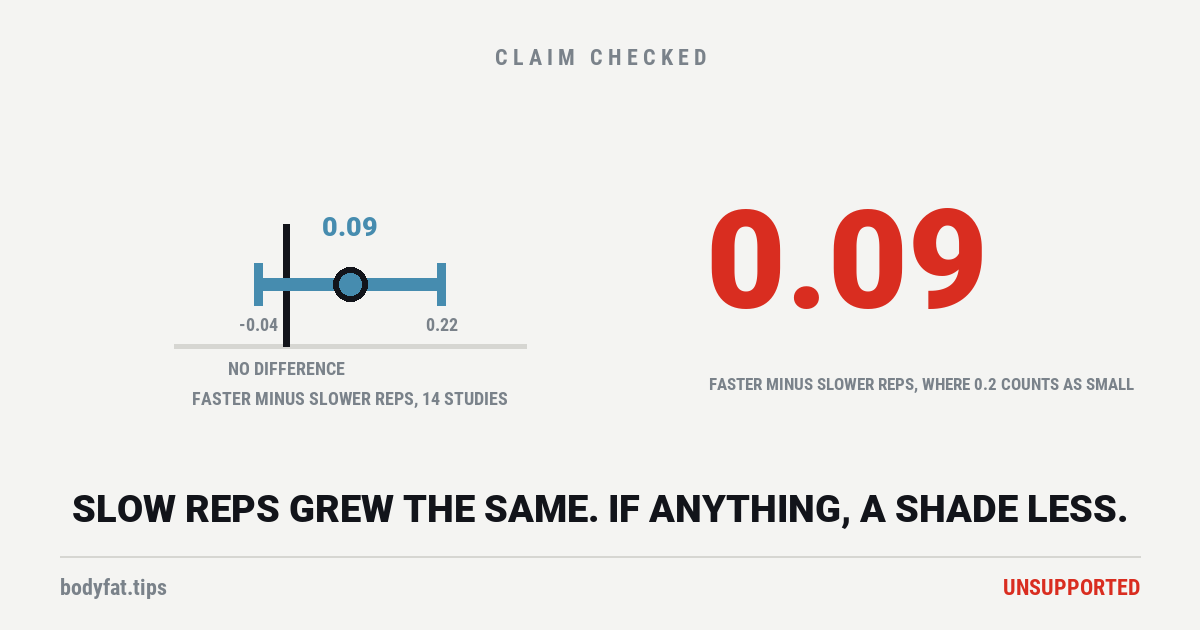
| Difference | 0.09, leaning faster — range −0.04 to 0.22 |
| Chance it is even a small effect | 45%. Medium: 0.1%. Large: under 0.1% |
The slower groups averaged about three and a half seconds a rep. The faster groups averaged about one. Both grew — that part is not in question. The question is whether the slow groups grew more.
They did not. Pooled across all fourteen, the difference between them was 0.09 [1]. On the scale researchers use, 0.2 is a small effect, 0.5 is moderate, 0.8 is large. So 0.09 is under half of small — and the range the true answer probably sits in runs from −0.04 to 0.22, which includes zero. “No difference at all” is still on the table.
And the direction? It leaned toward the faster group. Trivially, but toward it [1].
The authors put a number on how likely it is that slow versus fast makes even a small difference: 45%. A coin flip. The chance of a medium difference was one in a thousand [1].
Does time under tension actually work, then?
Here is the precise answer, because the sloppy one gets people hurt.
Time under tension works in the sense that a muscle under load for a reasonable stretch of time grows. It does not work in the sense it is sold — that more seconds per rep buys more growth per set. Within the range anyone has properly tested, from a brisk one-second rep to a deliberate three-and-a-half, the seconds are not the variable that matters [1].
A 2015 review of eight earlier studies reached the same place with a wider net: growth was similar anywhere from half a second to eight seconds per rep [2]. That is a sixteen-fold range of tempos producing about the same muscle.
So if slow does not beat fast, should you go fast? No — and this is the line to read twice. Faster did not meaningfully beat slower either. A trivial lean is not a recommendation. Tempo is simply a free variable: pick the speed at which you can actually control the weight, and stop spending attention on it.
Is TUT better than heavy lifting? Somebody ran exactly that
This is the second thing people search, and there is a trial that answers it head-on.
Thirty-four untrained women trained for six weeks in three groups [3]. One did super-slow reps — ten seconds up, four down — which forced them to use a light load, around 40 to 60% of their maximum. One trained at normal speed with the same light load. And one trained at normal speed with a heavy load, 80 to 85% of maximum.
Two results, and both matter. Against the same light weight, the super-slow group did better — muscle fibres grew where the light-and-normal group’s did not [3]. Slowing down rescued a load that was otherwise too light to do much.
But the heavy group beat everybody. Every fibre type grew, and the adaptations were the largest across every measure the researchers took [3].
Read those together and the trade-off is visible. Going slow forces you to go light. Slowness can partly compensate for lightness. It does not compensate for it fully, and if you can lift heavier at a normal speed, that is where the growth is.
What about the 3-3-3 rule?
If you have arrived here from a video: three seconds down, three seconds paused, three seconds up. Nine seconds a rep.
Nobody has tested that prescription specifically, and this page will not pretend otherwise. What can be said is where it sits. Nine seconds is at the far slow edge of the range where growth was similar [2] and well beyond the slowest group in the 2025 analysis [1]. Past ten seconds, the 2015 review found training looked inferior for growth — while noting there were too few controlled studies to say so firmly [2].
So the 3-3-3 rule is not dangerous, and it will make a light weight feel brutal. It is just standing at the slow end of a range where the evidence says the speed was never what mattered, right next to the point where slower starts to cost you.
Where the idea came from, and why it sounded so right
The slow-rep protocol has a birth certificate. In 1982, a Nautilus-funded osteoporosis study at the University of Florida needed a way to train older women safely on machines, and its exercise supervisor, Ken Hutchins, formalised a ten-seconds-up, ten-seconds-down cadence for it. He trademarked it as SuperSlow. A safety protocol for a bone study became a growth method.
Then, in 2012, it got a mechanism. Eight men did knee extensions at 30% of their maximum — a light load — either at six seconds up and six down, or one and one, matched for total work [4]. A day later, the slow leg was building muscle protein faster. Myofibrillar protein synthesis — the rate at which the muscle assembles its contractile machinery — was significantly higher in the slow condition at 24 to 30 hours [4].
That is a real finding and this site is not going to sneer at it. It is also a measurement of one day’s building rate in eight people, not a measurement of muscle. Building rate and muscle are different things, and this site has already spent a page on the difference: an acute rise in protein synthesis does not reliably predict what you keep. The fourteen-study analysis is what happened when somebody checked whether the slow legs ended up bigger [1]. They did not.
Between those two papers the idea acquired its notation. Around 2000, strength coaches including Ian King and Charles Poliquin popularised the tempo code — 4-0-1-0, four seconds down, no pause, one up — and it has been printed in programmes ever since, which is how a rep speed came to feel like a prescription rather than a preference.
And where it lives now: ask Google this question and its AI Overview answers by citing an apparel brand on three regional domains, a meal-replacement company, two workout apps and a personal-trainer certification body, sitting alongside Harvard Health and Healthline. The physiology has a 2025 meta-analysis. The overview has Gymshark.
None of that is a knock on anyone who lifts slow. The theory is genuinely intuitive, it was handed to you with a number attached, and slow reps feel like they are doing more. Feel is not the instrument, which is a recurring theme around here.
What actually moves the number
If tempo is a free variable, what is not?
Load and effort. The heavy group in the six-week trial won on every measure [3], and the 2025 analysis restricted itself to studies where sets were taken close to failure — because that is where the growth signal is [1].
Total hard work over time. Sets, reps, weeks. How long it actually takes is its own page, and the answer is longer than a tempo tweak will fix.
Protein — though probably less than you have been told.
Control. This is the one legitimate use of tempo. If slowing the lowering phase is what lets you keep a heavy weight where it belongs, slow it down. That is a coaching decision about safety and skill, not a claim about growth, and it is a perfectly good one.
What this is rated, and what the rating covers
Unsupported. The claim is that slower repetitions build more muscle than faster ones.
It is rated Unsupported because the only meta-analysis restricted to studies that varied tempo alone found a pooled difference of 0.09 with a range including zero, leaning the wrong way for the claim [1]; because an earlier review found similar growth across a sixteen-fold range of tempos [2]; and because the head-to-head trial that pitted slow reps against heavy ones found heavy won [3].
What is not rated here: reps slower than ten seconds, where there is a signal they are worse but not enough controlled studies to be sure [2]; tempo for strength or power, which are different outcomes with their own literature; and tempo as a control or safety tool, which is a coaching call rather than a growth claim. The 2025 authors also note “potential differences emerging under specific conditions” in their subgroups, with varying certainty [1] — a door left ajar, and this page reports it as ajar rather than open or shut.
Related: what lifting actually does to your fat. How we read a study, and what each tier means, is set out here.
- Does Soreness Mean Muscle Growth? 110 Men Did 12, 24 or 60 All-Out Reps and Hurt About the Same.
unsupported - Weighted Vests: About 1.6 lb of Extra Fat Loss. And in the Best Trial, the Bones Went Anyway.
supported - Zone 2 Cardio: The Fourteen Experts Who Defined It Also Said the Benefits Might Not Be Unique to It
unsupported