Resistance Training for Seniors: Clearly Stronger, Slightly Better Day to Day

Lifting weights in your seventies works. The question worth asking is: works at what?
The Cochrane review this page is built on pooled 121 randomised trials and 6,700 older people. [1] Two of its findings sit side by side. When it came out in 2009, its publisher’s press release said the training “not only helps older adults become stronger but also makes their everyday life easier”, and only further down that the gain in complex daily activities, such as bathing or preparing a meal, was “small but statistically significant”. [5]
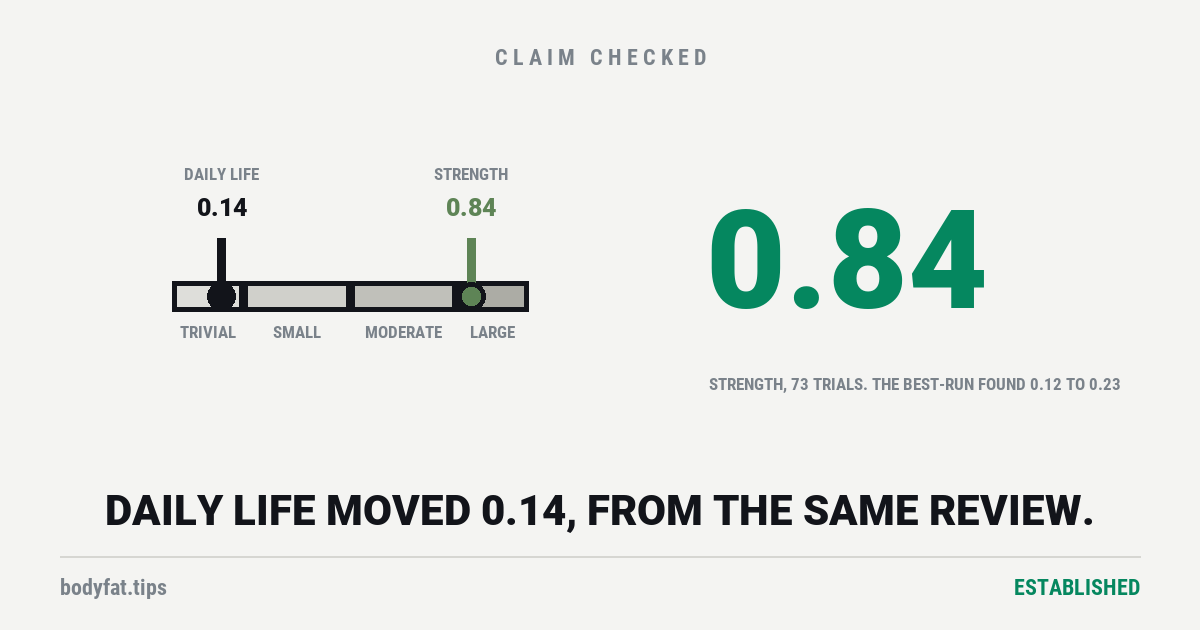
The effect on muscle strength was 0.84. The effect on everyday physical ability was 0.14. [1]
Those are effect sizes, and here is the scale researchers use for them: 0.2 is small, 0.5 is moderate, 0.8 is large. So the strength result is a big one, and the everyday-life result falls below the line for “small”. The review itself calls it small; the drawing at the top of this page puts it in the band below that line.
Both numbers came out of the same review. You should have been given both.
The whole table
| Outcome | Effect | Evidence |
| Muscle strength | 0.84 — large | 73 trials, 3,059 people |
| Getting out of a chair | 0.94 — large | 11 trials, 384 people |
| Osteoarthritis pain | 0.30 less — small | 6 trials, 503 people |
| Walking speed | +0.08 m/s | 24 trials, 1,179 people |
| Everyday physical ability | 0.14 — below small | 33 trials, 2,172 people |
Notice the second row. Getting out of a chair improved by 0.94 — a large effect, and about as concrete as an outcome gets. [1] Walking speed moved by 0.08 metres per second, which is real and modest.
So the picture is not “it barely does anything”. It is that specific capabilities improve a lot, and the broad questionnaire measures of how you manage day to day improve a little. Those are different things, and the gap between them is where every overclaim about this lives.
Two cautions from the same review, before 0.84 is read as a promise. The first is about the trials. The review combined them in two standard ways. The 0.84 comes from the one that lets small trials count for more; on the other, which lets the biggest trials count most, the same 73 trials give 0.53, moderate. The review itself calls the effect “moderate-to-large”. [1]
And the more carefully a trial was run, the smaller the gain it found. Where the people measuring strength did not know who had trained, it was 0.23. Where everyone was counted in the group they were put in, including people who dropped out, it was 0.18. In the six trials where nobody could know in advance who would be put in which group, it was 0.12, and the range the true answer probably sits in there still includes no gain at all. The reviewers note that the better-run trials tended to be the bigger ones. [1]
The second caution is about who you are when you start. In trials of healthy older adults the gain was 0.77; in people with a specific health problem it was 0.37. In people with a physical limitation it was 0.30, against 0.81 in people without one, though almost every programme for people with a limitation was a lighter one, so the reviewers could not tell which of the two made the difference. These figures come from the second way of combining trials, where the biggest count most. Sliced every one of these ways, the trials still pointed to a gain. What changes is its size. [1]
How hard the trials trained, and with what
Here is what the reviewers recorded about how those 121 trials trained people: two to three times a week in almost all of them, and in most of them, 83, at a high intensity, usually on exercise machines. [1]
The evidence base for older adults is built on progressive, meaningful loads — weights that get heavier as you get stronger. That includes bands. Thirty-six of the trials trained at a low to moderate intensity, most of them with elastic bands or tubing, and they still made people stronger, by less: in the 19 of them pooled for leg strength the gain was 0.39, against 0.60 in the high-intensity trials, both counted the way where the biggest trials count most. [1]
Ten trials put heavy and light training head to head. In the nine that reported leg strength, heavy built more of it, a moderate difference (0.48). But eight of the ten were healthy people in closely supervised gyms, so the reviewers could not say whether heavy beats light for less fit people, or for training at home or in hospital. [1] The question is not band or dumbbell. Every trial in the review raised the resistance as people got stronger, bands included, and a band that never gets harder is not what was tested.
What about safety? The review is direct: joint pain and muscle soreness were reported, serious adverse events were rare, and none was reported as directly related to the exercise programme. [1] The reviewers do add that adverse events were poorly recorded across the literature, which is a real limitation and not a reassurance. Their advice is that frail or recently ill older people doing this kind of training should be watched for problems, and their plain-language summary says the evidence was not enough to comment on its risks. [1] When the review came out, its lead author recommended doing it with a health or exercise professional. [5]
How much, and what more buys
A separate line of evidence — 16 studies following people forward rather than assigning them to training — looked at muscle-strengthening activity and what happened to people afterwards. They were adults of every age from 18 up, free of serious illness at the start, followed for at least two years. [2]
It found 10–17% lower risk of dying of any cause, and of cardiovascular disease, cancer and diabetes. [2] Each of those figures pools five to seven of the 16 studies, and the review’s authors graded the evidence very low certainty, the bottom rung of the scale used to say how far a finding can be trusted (low, one rung up, for diabetes), mainly because most of the studies were American. [2] And then the useful part:
The biggest benefit landed at about 30 to 60 minutes a week. [2] Not an hour a day. An hour a week, near enough — say, two sessions, though that is our arithmetic: the studies counted minutes, not sessions. [2]
Past that the curve turned back up rather than continuing down, which the reviewers describe as a J-shape and are careful about: they say the effect of higher volumes is unclear. [2] That is not evidence that more is harmful. It is a guide to how little it takes to see the association, not a ceiling on training.
A later, larger study puts the low point higher. Three American cohorts of health professionals and nurses, 147,374 people, most of them women, with a median age of 54 at the start, were asked about their training every two years for up to 30 years. The lowest risk of dying from any cause went with 90 to 119 minutes a week, 13% below people who did none, and there was no further gain above two hours; for deaths from cancer, the lower risk showed up only below an hour a week [6]. The authors note that the earlier reviews put the peak lower [6]. So the dose that goes with lower risk is an hour or two a week, not an hour a day; exactly where the curve bottoms out is not settled.
And this half is observational. These are people who already lifted, compared with people who did not, so some of the gap belongs to whatever else is different about them. How we weigh that kind of evidence.
For strength itself, more bought more in the trials. In the 121-trial review, heavier training built more strength than lighter training, as the section above sets out. [1] And a 2025 analysis of 151 trials in people aged 60 and over sorted the programmes by weekly volume, meaning sessions times exercises times sets. Moderate and high volumes did best for leg strength. Low volume did best on the six-minute walk, on the timed up-and-go (standing from a chair, walking a few metres, turning and sitting back down), and on lean mass and muscle size. [4] Its results held mainly for healthy older adults; for people with physical impairments, its authors say, the evidence was limited. [4]
The trials counted deaths too, where they reported them. In 13 of the 121 trials in the review this page is built on, 20 people died in the training groups and 21 in the comparison groups, among 1,125 people who were nearly all frail, in care or living with a diagnosed condition. That is too few deaths to show a difference either way. [1]
Bones: smaller than you have been told
Fourteen randomised trials looked at strength training and bone density in older people, average age 70. Fewer than one in ten of the people in them were men (92% of those whose sex was recorded were women), and most were described as healthy, so a man reading this has little of it to go on. [3]
Hip bone density, pooled from 11 of the 14 trials, rose by 2.77%. [3] The spine did not move in a way that could be distinguished from chance. And the trials disagreed with each other enormously — the reviewers grade their certainty as clearly lower for bone than for strength, and say so.
Real, small, hip only, and much less certain than the strength result. If you have been sold a programme on the promise of reversing osteoporosis, that is more than this evidence carries.
What this actually adds up to
Established is the highest rating on this site and this claim earns it: 121 randomised trials, plus a review of 16 cohort studies whose pooled estimates point the same way, plus a separate bone analysis. The direction is not in doubt.
What is worth carrying away is the shape of it, not a slogan:
— Strength goes up. That is the most certain effect here and the biggest: clearest in healthy people training hard, smaller in people who start frail or unwell, and smaller in the most carefully run trials.
— Specific hard things get easier — standing up out of a chair most clearly of all.
— The broad measures of daily life move a little, not a lot.
— Two to three sessions a week is what almost all the trials used. In the 16 studies that followed people over years in one 2022 review, the biggest benefit went with 30 to 60 minutes a week, and a larger 2026 analysis put it at 90 to 119; in the trials, heavier and higher-volume training built more strength.
The last one matters most if you have been putting this off. The dose it takes to see a benefit is small, the training that produced these results was progressive training, made harder as people got stronger, rather than a token version of it, and the protein evidence says the same thing about doing the work first — in older adults who did not train, extra protein moved neither lean mass nor grip strength by an amount the pooled trials could detect.
Elsewhere on this: your metabolism does not fall off a cliff at 40, grip strength predicts a lot, and we found no trial of grip training that set out to measure deaths or heart attacks, lifting and fat loss are a different question, and the blood-pressure ladder where resistance training also earns its place. If two sessions is too big a first step, this is the smaller one.
One honest caveat about the anchor. That 121-trial review searched the literature up to 2008 and has never been updated — we checked, and there is no newer version. It is no longer the largest by number of trials: a 2025 analysis pooled 151 randomised trials in 6,306 people aged 60 and over, searching to April 2023, and it agrees that training works; where it adds something is on how much, as the section on dose sets out. [4] The two 2022 papers here point the same way too, but the anchor is old and you should know that rather than find out later.
Corrected on 30 September 2026. Three things changed here after an independent editorial review of our grip strength verdict, which shares a source with this page. We said “16 cohort studies pointing the same way”. The review of those studies pooled five to seven of them for each outcome, and its authors graded that evidence very low certainty, low for diabetes; the page and the evidence panel now say so. The panel said the sources did not state their funding. All three do, none of it commercial, and the panel now lists it. And a link described grip strength as something “squeezing a gripper does not fix”; nobody has tested that, and the link now says so. The rating is unchanged.
Corrected on 30 September 2026. This page said protein supplements “did nothing measurable” without training. Our protein verdict was corrected today after an independent editorial review, and the accurate version is narrower. In the review of older adults it cites, extra protein without exercise did not move total lean mass, arm and leg lean mass or grip strength by an amount the pooled trials could detect; one trial in frail participants did find a gain in knee strength, which the review’s authors set aside as a single result. The sentence now says what was measured. This page’s rating is unchanged.
Corrected again on 30 September 2026. Our earlier note today said nobody has tested whether squeezing a gripper fixes what grip strength predicts, and the link said the same. That was broader than the search behind it. Our grip strength verdict, corrected a second time today, reports what we did find: no trial of grip training that counted deaths or heart attacks (searched 30 September 2026), and trials of strength training in general that did count deaths and found no clear difference. The link now says we found no such trial, and the section on how much training adds the death counts from the 121-trial review this page is built on. The rating is unchanged.
Corrected on 9 October 2026 after an independent editorial review of this page. We said the evidence for older adults was built on heavy training, “not on the light dumbbells and coloured bands”. The review this page rests on says otherwise: most of its 121 trials trained hard, usually on machines, but 36 trained at a lighter intensity, mostly with elastic bands or tubing, and those still made people stronger, by less. We also said two sessions a week was where the evidence sat and that more had not been shown to buy more. The 30 to 60 minutes a week comes from studies that followed adults of every age, measured death and disease rather than strength, and counted minutes rather than sessions; in the trials, heavier training built more strength, and a 2025 analysis of 151 trials found moderate and high weekly volumes did best for it. The page now says both, and no longer calls the 2009 review the largest on the question, because the 2025 analysis pooled more trials.
And “You will get much stronger” was addressed to every reader. In the same review the gain was half as big or less in people who started with a health problem or a physical limitation, and small, 0.12 to 0.23, in the trials run most carefully. The page now says so, adds the reviewers’ advice that frail or recently ill people be watched while they train, and drops “large” from the headline. Also changed: the evidence panel gives the programme lengths and the populations of the cohort and bone reviews, where it said follow-up was not consistently reported; the table labels the everyday-ability figure by the page’s own scale, and the text says why the review calls it small; the provenance chain now names the two press releases behind it; and a sentence pointing at the chair row now counts the rows correctly.
One more, from our own notes. Our third note of 30 September described our grip strength verdict as finding no trial of grip training that counted deaths or heart attacks. One did record a death: a trial published in July 2026, in 54 people with advanced kidney disease, in which one person in the comparison group, who squeezed a rubber ball rather than a grip strengthener, died and was counted among those who left. Deaths were not what it set out to measure. The grip strength verdict was corrected on 7 October to say that no trial we found set out to measure deaths or heart attacks, and the link here now uses the same words. This page’s rating is unchanged. The provenance chain’s search figure now says where it came from and when we pulled it.
Corrected on 17 October 2026. Our summary said that in the studies following people over years, the biggest benefit went with 30 to 60 minutes of strength training a week. That is what the 2022 review this page cites found across 16 cohort studies, and we wrote it as if it were true of the cohort evidence in general. A larger 2026 analysis of three American cohorts, which we had not found, put the lowest risk of death at 90 to 119 minutes a week. The page now gives both, and says the low point is not settled. The rating is unchanged.