Creatine Gummies: Tested, and Split. 13 of 27 Nearly Empty, 9 Met the Label.

We are going to do something unusual on this page: tell you what we could not find out, and what we should have found and did not.
The twenty most relevant videos YouTube returned for creatine gummies on 21 August 2026 had 6,571,036 views between them. (Two of the twenty are general creatine videos, and they hold a little over half of those views.) Six of the twenty are titled around what is actually inside the product.
So we went looking for the analysis. Somebody must have bought a jar, run it through a lab, and published what came out.
Somebody had. Three groups had, and this page missed all of them. From 22 August to 30 September 2026 it said nobody had published a test of a creatine gummy. We had searched the medical and food-science journals, and the tests are not in journals: they are in a company news release, a company report and a folder of laboratory certificates. Four of the twenty videos we had just counted pointed to them in their descriptions.
So this page now does two jobs. It reports what those tests found, who ran each one and what each tester sells. And it keeps the chemistry, because the molecule itself has been studied carefully, and what it does under the conditions you need to make a gummy explains part of what the tests found. Not the largest part.
What the tests found
Our searches turned up four sets of tests, each published under the tester’s own name, in which somebody other than the maker bought creatine gummies at retail and had them measured. None of the four has been through peer review, the check a journal runs before it prints a study, and every tester has something of its own to sell. Here is each one, with who ran it and what the tester sells.
A supplement maker, February 2024. A company that sells its own supplements, creatine powder among them, bought twelve brands of creatine gummy, from a marketplace or from the brands directly, and measured one lot of each in its own laboratory by HPLC (high-performance liquid chromatography, the standard way to separate a mixture and weigh what is in it). It published every reading with its lot number. Six met their labels, at 112% to 126% of the stated dose. Six did not: three showed no creatine at all, one 8.7 mg where the label said 1,000 mg, one 28.3 mg where it said 250 mg, and one 1,278 mg where it said 1,500 mg, which is 85% and which the tester also counted as a failure. In those six it also measured creatinine, the substance creatine turns into when it breaks down. The company says none of the outside laboratories it normally uses could test gummies, so its readings went unchecked. Two makers disputed them. One called the results inaccurate and produced outside certificates for other lots; the other published an outside laboratory’s readings of 93.6% to 101.6% for three of its flavours. The tester replied that it had tested a single lot, and stood by the result. [8]
A supplement-rating company, June 2025. A company built around its own quality score for supplements bought six gummies and five powders from an online marketplace and sent unopened samples to an outside laboratory, which it does not name, for the same kind of measurement, creatinine included. It published each product’s result. All five powders passed, at 98% to 103% of their labels. Four of the six gummies failed: two with no creatine detected, two with under 1% of a 5 g dose. The two that passed held 102% and 126% of their labels. The report states no pass mark for gummies, and with results like those it did not need one. One failing product displayed its own “certified” test results on its shop page; the tester bought a second lot, and that failed too. The report uses the results to promote the company’s scoring system. [9]
A fitness influencer, 2025. A British fitness influencer, whose video description advertises a creatine product of his own above the link to the results, sent gummies from nine brands to a contract laboratory in Wisconsin, which measured creatine and creatinine by HPLC, and he published its certificates: one sample of most brands, and two samples of two of them. Four brands held between 2.95 and 5.55 g of creatine monohydrate a serving; the trade press reported that as one above its label and three at 95%, 86% and 73%. Five read below the laboratory’s reporting limit, reported as under 2% of the label. He sent two flavours of one of the five to a second laboratory, which detected no creatine either. He set no pass mark: the question, he told the trade press, was whether the gummies “have creatine in or not”. Some of the failing brands dispute the method, and a formulator told the trade press that a laboratory which has not adapted its method to pectin gummies can return a false failure. [10]
A subscription testing company, June 2026. A company that sells subscriptions to its product tests, and runs a certification programme for manufacturers, reviewed about a dozen creatine products, one gummy among them. Its public release says most met its standards and one failed for too much creatinine, “indicating that creatine had degraded”. The release does not say which product that was, and the per-product results are behind its paywall; we have not read them. [11]
Put the three sets with public results side by side and the picture is a split.
| Who tested | Products | Met or beat the label | Short of it | Almost none |
| A supplement maker (its own laboratory, February 2024) |
12 | 6 | 2 | 4 |
| A supplement-rating company (an outside laboratory, June 2025) |
6 | 2 | 0 | 4 |
| A fitness influencer (a contract laboratory, 2025) |
9 | 1 | 3 | 5 |
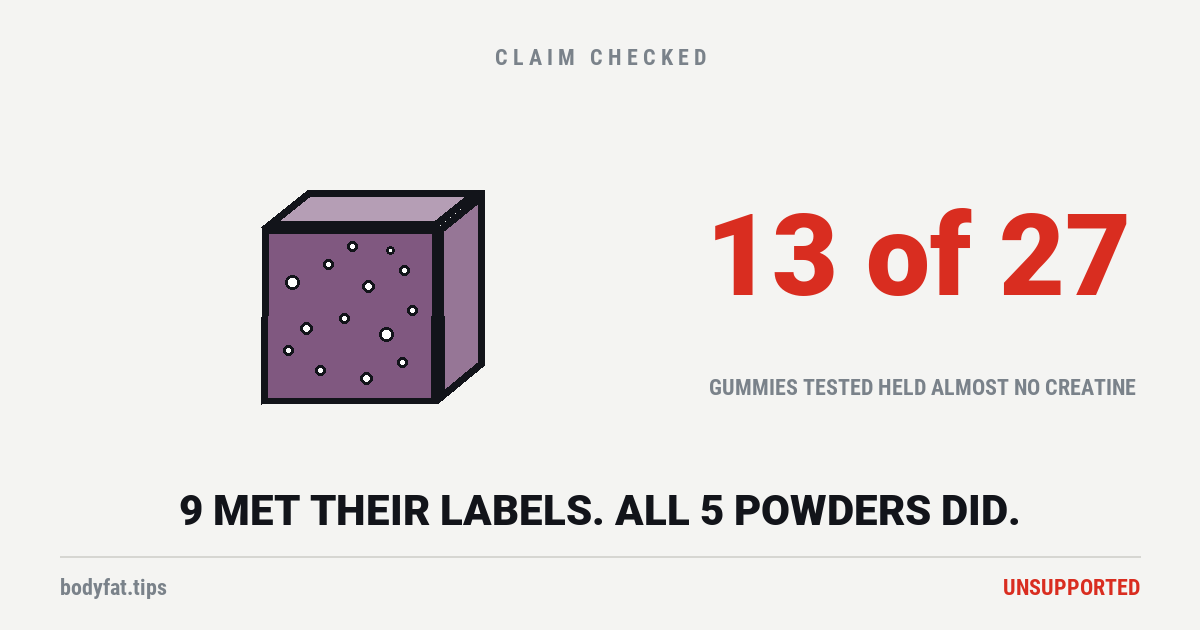
| All three | 27 | 9 | 5 | 13 |
So gummies that hold what they promise turn up in every set of tests, and about half the products tested held next to nothing. Both halves of that sentence matter. And the second half is not something a careful shopper could have seen coming: the four that failed the 2025 test were marketplace best-sellers. [9]
The tests also show how little one reading settles. One brand was bought by all three testers. It read 85% of its label in the first test, 73% in the influencer’s and 102% in the rating company’s: different lots, different laboratories, a spread of about 30 points. [8] [9] [10]
One more document turns up if you search. An unsigned press release, carried by syndication sites on 22 July 2026, says a contract laboratory found 13 of 15 marketplace gummies short of their labels. It names no issuer and publishes none of the certificates it cites, and most copies of it have since been taken down. We have not counted it. [17]
What the tests cannot say on their own is why a gummy comes up short. For that you need the chemistry, and then the one thing the testers measured that the chemistry predicts.
Creatine is stable, right up until it dissolves
Creatine breaks down into a substance called creatinine. Researchers describe creatinine as having no biological activity. [1] It is simply not creatine any more: a waste product your body makes at a steady rate and your kidneys clear. One of the testers above calls it “a relatively harmless byproduct” and a marker that some creatine has broken down. [8] [9]
How fast that happens depends on three things: whether the creatine is dissolved, how acid its surroundings are, and how warm. A 2009 study dissolved creatine in mildly acid liquids (pH 4 to 5; pH is the acidity scale, and lower is more acid) and tracked the breakdown at three temperatures across a wide range of water activity, which is how much of a food’s water is free to take part in chemistry, on a scale from 0 to 1. At 73°F (23°C), half the creatine was gone in 43 days in the wettest liquid and in 182 days in the driest. At 95°F (35°C) half was gone in under a month at every level; at 39°F (4°C) it took more than a year. Each step more acid on the pH scale made the breakdown about 2.6 times faster. And when the same liquids were set into solid gels, the creatine in them broke down at almost exactly the same rates. [1] Its conclusion about the powder in your tub is reassuring:
“creatine stability in the crystal form is very high as long as it does not reach the deliquescence state” [1] — deliquescence being the point at which a dry crystal pulls in enough moisture from the air to start dissolving itself.
So: dry crystal, very stable. Dissolve it, and a clock starts. Acid and warmth make the clock run faster. In the same study, dry crystals kept for three months in humid air lost nothing measurable, or about a tenth of a percent at the dampest setting. [1]
| Condition | What was measured |
| Dry crystal | very stable, unless it draws in moisture |
| Dissolved, mildly acid, at 73°F (23°C) (laboratory liquids and gels, not a gummy) |
half gone in 43 to 182 days |
| An acid drink mix dissolved in water, 45 days (a drink, not a gummy) |
90% gone at room temperature |
| Canned at 259°F (126°C) for an hour (dog food, not a gummy) |
36% recovered |
| Dry kibble stored 15 months at 77°F (25°C) (dog food, not a gummy) |
creatine down 54% |
| Gummies that held their creatine when tested (six products, from the tests above) |
creatinine at 1% to 8% of the creatine |
A separate study dissolved a commercial fizzy creatine drink mix in water and left it. The mix made the water acid (pH 3.6, drifting up to 4.5), and after 45 days at room temperature 90% of the creatine was gone. In the refrigerated bottles the creatine in the liquid fell too, but crystals of creatine had been settling out since the seventh day, so that figure mixes creatine that left the liquid with creatine that broke down, and we no longer quote it. The mix’s maker gave the study financial support. [3]
And a 2025 analysis put creatine through heat of 140 to 392°F (60 to 200°C), ultraviolet light, various acidities and several drink mixers, and reported that temperature was the most significant factor affecting its stability. [4]
Now consider how you make a gummy
You need water. You need heat, to melt the gelatin or pectin. Some recipes are acid as well: a patent application for a creatine gummy, published in 2024, describes a finished product at pH 2.5 to 4, which is more acid than anything the 2009 study tested. Then the product sits at room temperature in a jar for months. [13]
Water, acid, heat and time are the four things dissolved creatine is documented to be least happy about.
A recipe does not have to supply all four. A patent from 2006, for a gummy-like sweet meant to carry supplements, says acid speeds the breakdown of some ingredients and that for those the sweet should be kept neutral to mildly basic, at about pH 6 to 8.5. Its creatine version had the creatine stirred in last, at 122 to 176°F (50 to 80°C), and its applicant reports no loss of creatine after 35 days at 95°F (35°C). That is an applicant describing its own recipe, not a test of anything on a shelf. But it makes the point: a gummy is not one chemical environment. It is whichever one its maker chose. [13]
The 2009 study is closer to a gummy than it sounds: it says the supplement industry was already trying to make “gummy bears”, and it tested solid gels as well as liquids. [1] For what a factory’s heat does to creatine, we went to an unexpected place, and we want to be very clear about what it is. It is a study of dog food. [2]
Researchers added creatine monohydrate to dog food and put it through real manufacturing — retorting, which is moist heat processing in a sealed can, and extrusion, which presses a drier dough into kibble. Then they measured what survived. The company that makes the creatine paid for the experiment, ran the measurements and employed one of the four authors. [2]
After retorting, 36% of the creatine was recovered. That was wet food, about 82% water, held at 259°F (126°C) for an hour. The same maker’s other additive came through the same cans at 79% and 89%, so this was not a measurement problem. Extrusion was gentler: 85% of the creatine came through. Storage then went two ways. In the cans, creatine climbed back by about half over 15 months as creatinine turned back into it. In the dry kibble it fell, from 2.41 to 1.11 g per kg of dry matter over 15 months at 77°F (25°C): 54% less by the paper’s own table, where its abstract says 63%. It fell faster in a warmer, damper chamber at 104°F (40°C). Each storage reading is a single sample.
The researchers’ own conclusion is the sentence that matters here. Creatine monohydrate, they write, is relatively unstable, particularly during storage, which “makes it difficult to establish a guaranteed Cr content in finished” products made this way. [2]
Difficult to establish a guaranteed content. In a peer-reviewed paper about heat-processed pet food, published in 2019 and paid for by the creatine’s own maker. It is not a paper about gummies, and a can held at 259°F for an hour is a harsher place than the 2006 patent’s kettle.
What this does and does not tell you
Being scrupulous, because this is where a page like this can go wrong.
It does not tell you creatine gummies are empty. The tests say some are and some are not. Nine of the 27 products tested beat their labels, by 2% to 26%, which is what adding extra at the factory looks like; one gummy maker told the trade press it adds 15% to 25% to cover losses in production. A manufacturer who understands this chemistry can formulate around it — lower water activity, less acid, gentler processing, overage at fill, protective coatings. Some have. [15]
It does not tell you the missing creatine broke down, either. When creatine breaks down it leaves creatinine behind, and the testers measured that too. In none of the thirteen nearly empty products did creatinine make up the difference: each held next to nothing of either. The first tester’s own reading is that those makers “apparently failed to add sufficient creatine”; the second calls its trace results “label dressing”. Breakdown does show up in the products that held something. One gummy, made with a different form of creatine (the hydrochloride), held 63.8 mg of creatinine beside 28.3 mg of creatine on a 250 mg label; its maker disputes the reading. And in six products that held most of their creatine, the testers’ figures let us compare the two: the creatinine came to about 1% to 8% of the creatine by weight. So on the numbers published so far, the common failure is creatine that was not in the gummy to begin with. Breakdown is real, and in the gummies that held their creatine it was small, at whatever age each jar was when it was tested. [8] [9] [10]
Our reading, and it is only a reading. The 2009 study found that dissolved creatine breaks down and crystals hold. The first tester noted that five of its six failing products were translucent and the other seven products opaque, and a formulator told the trade press that intact creatine gives a gummy a gritty, chalky texture, so that a smooth, clear one is a reason to ask for test results. That fits a simple picture: the creatine that lasts in a gummy is the creatine that stays undissolved. None of the tests measured how much of any gummy’s creatine was dissolved, so this is a line of reasoning, not a result. [1] [8] [10]
What it tells you is where the burden of proof sits. This is a molecule with documented instability when it is dissolved, in acid and warm, and a gummy recipe can put it in all three. Under those circumstances, the label number is a claim about the day of manufacture. What matters is what is in the jar when you eat it, eight months later. Every test described above took jars as they were bought, at whatever age they happened to be. We found no published measurement, from a seller or from anyone else, of a commercial gummy at the end of its stated shelf life (searched 30 September 2026). What we found instead points both ways: the 2006 patent’s 35 warm days with no loss; a gummy maker telling the trade press in February 2026 that in its own unpublished tests the loss comes during manufacture and is “minimal thereafter”; and another gummy maker saying in the same report that “probably none” of the gummies on sale would hold up if tested at their expiry date. [13] [15]
A certificate of analysis that a seller sends you is the seller’s own claim about one batch. One of the four failing gummies in the 2025 test displayed its own “certified” results; the tester bought two lots and found no creatine in either. [9] A check that does not depend on the seller exists. One certification scheme says it verifies that “the contents of the supplement actually match what is printed on the label”, and its public list includes creatine gummies from several companies. Its page does not say how late in a product’s shelf life it looks. [14]
Meanwhile, the boring option is fully evidenced
Here is the thing that makes this whole category strange. Creatine is one of the best-evidenced supplements in existence — it survived a screen of 250 products where only two worked, and we rate it Established.
But that evidence was built on creatine monohydrate powder. That is what was in most of the trials. A gummy is a different delivery format, and we found one trial that has put it to that kind of test. Published in March 2026, it gave 5 g a day as gummies to 17 women who play beach volleyball and nothing to 15 others. After ten weeks the gummy group jumped 0.8 inches (2.1 cm) higher and the others 0.7 inches (1.7 cm) lower, and the gummy group ran a shuttle drill a third of a second faster while the others did not change. Lean mass, muscle mass and body weight did not differ. [5]
Read the small print before leaning on it. There was no placebo, so everyone knew who was taking creatine, and the authors say that leaves room for expectation to do the work. The trial was not registered in advance, and the paper counts the 32 who finished without saying how many started. It declares no outside funding; the gummies were donated by their maker, and two of the six authors declare advisory roles with gummy sellers, one of them with that maker. And the paper says the gummies were “independently verified” to contain the labelled amount without reporting a measurement. So it shows what happened to athletes who took one brand’s gummies. It does not show what was in them. [5]
Whether a gummy puts as much creatine into your blood as the same dose stirred into water has been asked and not answered. A crossover study in 16 adults, comparing three gummies with the same dose of powder in water, was registered in May 2026; when we looked on 30 September 2026 it was still recruiting and had posted no results. [12] Older work on other solid forms says the answer is not automatic. In 2002, creatine crunched as a lozenge gave a peak blood level 20% lower, and about a third less in the blood over the following hours, than the same dose in solution, though still five to six times the starting level. [6] In 2008, creatine mixed into food bars was absorbed four to eight times more slowly than from a drink, and the total reaching the blood was the same. [7] The 2006 patent reports blood levels in seven people and says they favoured its sweet over capsules; a patent is its applicant’s own account, not a reviewed study. [13]
A search also turns up a 29-page document on one gummy seller’s website describing a 140-person randomised trial of its gummies against powder. It names no researcher, university or journal, and the two trial-registration numbers it gives are in neither of the registries they belong to (checked 30 September 2026). We have not counted it as a trial. [16]
You also do not need much. We looked at how much creatine you actually need and the answer is small, cheap, and you are already most of the way there from food.
The verdict
Unsupported — for the claim that a gummy delivers creatine the way the powder does. Until 30 September 2026 this page gave the reason as “it has never been tested at all”. That was wrong. It has been tested, and the results split: of 27 products in three sets of tests, 13 held almost no creatine, 9 met their labels and 5 fell short by less. So the claim fails for about half the jars tested and holds for a third, on the word of testers who each have something to sell, and the one trial we found in people had no placebo. The number on the label does not tell you which kind of jar you are holding.
A format in which about half the tested products were nearly empty is a strange thing to choose when the powder passed every time: all five powders in the 2025 test held 98% to 103% of their labels, one of them at 15 cents a serving. [9]
If somebody publishes an analysis of finished gummies at the end of their shelf life, or any test of a gummy in a peer-reviewed journal, or the results of the registered blood-level study, we will update this page and say so. We made a promise like that once already, on a page that had missed three sets of tests. We also wrote that the study “would take an afternoon and would settle it”. It would take a shelf life, and one reading settles one lot.
Related: whether creatine is safe, creatine for women, and the full supplements-for-muscle scoreboard.
If you want to know what earns each rating, we wrote down how we read a study, and everything we have checked is in one place.
This page’s central claim was wrong, and it was corrected on 30 September 2026 after an independent editorial review. From 22 August 2026 it said, in its title and in about twenty other places, that nobody had published a test of a creatine gummy. Three groups had, before the page went up: a supplement maker tested twelve brands in February 2024, a supplement-rating company six in June 2025, and a fitness influencer nine through a contract laboratory in 2025. A testing company reviewed creatine products, a gummy among them, in June 2026. A randomised trial of gummies in 32 athletes had been published in March 2026 and a blood-level study registered in May. Four of the twenty videos in our own saved sample pointed to the tests. We had searched the journals. The tests are not in journals; the trial is, and we missed it as well. The page now reports it: of 27 products, 13 held almost no creatine, 9 met their labels and 5 fell short by less; none of the tests is peer reviewed and every tester has something to sell.
Also corrected. The evidence panel said the sources did not state their funding. Three of the four do, in the paper or in the publisher’s record: the dog-food study was paid for by the maker of the creatine it tested, which also ran the measurements and employed one of the authors, and the drink-mix study had financial support from the maker of the mix. The chemistry left out acidity, called a dog-food study the closest thing to a test when the 2009 study had named gummy bears and tested gels, and gave a refrigerated loss of 80% that was partly creatine settling out as crystals. It quoted the dog-food paper’s abstract, 63% less creatine in stored kibble, where the paper’s own table gives 54%, and it set the canned food’s loss beside the other additive’s result from a gentler process. A figure of 74,000 monthly searches has been removed because we could not trace it to a saved data pull; “13 of 20” videos with a sales link is 12 when the descriptions are read; and the line that a test “would take an afternoon and would settle it” is gone, because the same brand read 85%, 73% and 102% of its label in three testers’ hands. The title, search description, evidence panel and provenance chain were rewritten. The rating is unchanged; the reason for it is not.