Beta-Alanine: A Small Edge in Hard Efforts, and No Change in Body Composition

This is the hundredth claim we have checked on this site. It is also one where the answer is yes, with conditions attached.
Beta-alanine works, a little. Two meta-analyses five years apart agree that it does something measurable, though they are not independent checks: they share two authors, and twelve of the earlier one’s 15 studies are among the later one’s 40 [1] [2]. Other teams have pooled smaller sets of trials since. A 2024 analysis of trained men found a gain in the same direction [6]; two other teams’ poolings found effects too uncertain to call [7] [8]. There is a plausible mechanism and a serious safety review behind it. And there is a limit: the EU’s food-safety authority, answering the ingredient maker’s own application in 2014, concluded that an effect on performance, finishing a set task faster, had not been established [9]. Four years earlier it had said the same of claims that beta-alanine lengthens time to exhaustion, on the three small trials then before it [10].
So this page is not about whether it works. It is about the four qualifiers that come attached, because every one of them changes whether you should bother.
What it does, and how much
The largest analysis pooled 40 studies covering 1,461 people, double-blind and placebo-controlled throughout, from a search that ended in February 2016. [1]
Overall effect size: 0.18. On the scale researchers use, 0.2 is considered small, 0.5 moderate and 0.8 large — so 0.18 sits just under the line for small. Real, and real is not the same as big.
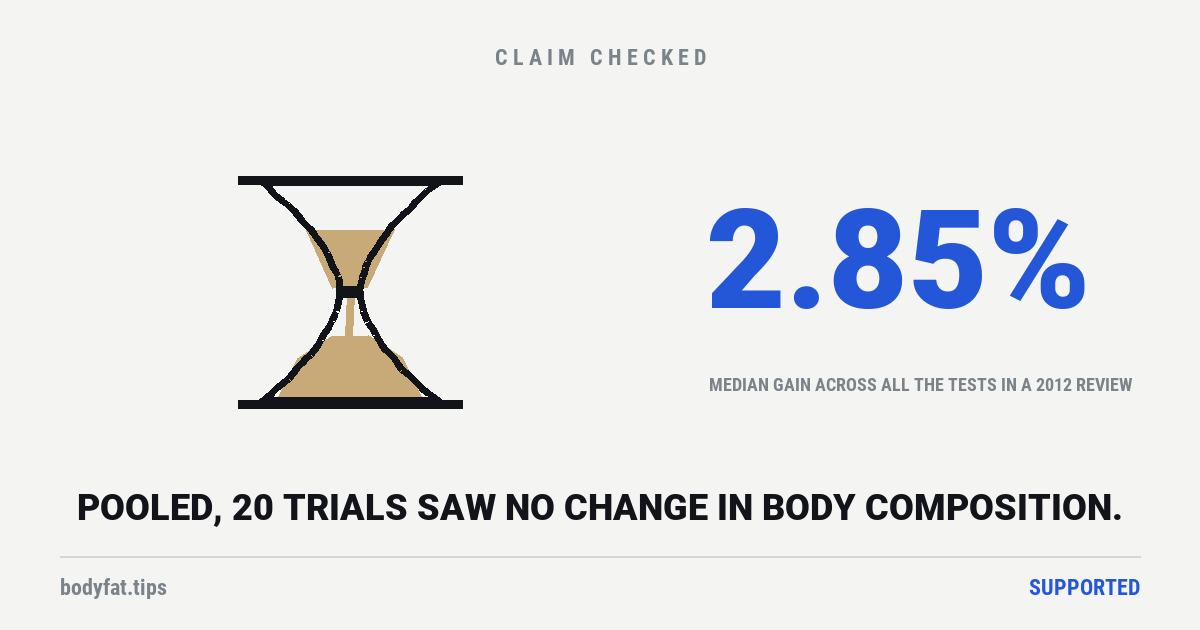
The earlier meta-analysis put a friendlier number on it: a median improvement of 2.85% in whatever was being measured. [2] That is the honest headline. Not a transformation. A nudge that a competitive athlete would take and most people would never notice.
The distinction that changes the answer
Here is the part worth the price of admission, because both meta-analyses found it, and it changes what you are buying.
Researchers separate two things that sound identical:
Exercise capacity is how long you can keep going before you stop. Ride at a fixed hard pace until you cannot any more, and see what the clock says.
Exercise performance is how fast you complete a set task. Ride four kilometres as quickly as you can, and see what the clock says.
Beta-alanine improves the first. The second does not reach significance. In the big analysis, for efforts of half a minute to ten minutes, capacity came out at an effect size of about 0.50 — a genuinely moderate effect — while performance came out at 0.11 with a range that comfortably included zero. Across every duration together, the two came out at 0.24 and 0.13, the second again too uncertain to call. [1] The earlier analysis found exactly the same split. [2]
Which means beta-alanine may help you hang on longer at a given intensity, without necessarily making you faster over a fixed distance. Those are different things to buy, and only the first shows up clearly in the big analyses.
And only in a particular window
| Effort | Result |
| Under 60 seconds | nothing |
| One to four minutes | improved |
| Over four minutes | improved; past ten minutes, not clearly |
| Body composition | no change when pooled, 20 trials |
Efforts lasting one to four minutes improved most clearly in the 2012 analysis, and longer ones more weakly [2]. The larger 2017 analysis re-ran those bands and found no such drop: efforts over four minutes improved at least as much, though past ten minutes the gain was no longer clear [1]. In trained men, the 2024 analysis found its clearest gain in tests of four to ten minutes, a band that held three studies [6]. And in all three, efforts under 60 seconds showed nothing at all.
That fits the proposed mechanism, which is a point in its favour. Beta-alanine raises muscle carnosine, and carnosine helps mop up the acidity that builds during hard efforts. A five-second lift never gets acidic enough for that to matter. A four-minute effort absolutely does.
So: rowing, 400 to 1500 metre running, intervals of a minute or more, cycling and swimming events of a few minutes. Not a one-rep max, not a single set in the gym, not repeated short sprints [11], and not a long slow run. The one-rep max is the least settled of those: a 2025 review of nine small studies in men who lift found gains in two, both splitting 4.8 to 6.4 g a day into small servings, and no strength gain in five; it pooled no numbers [16].
Two more things the label will not tell you
More is not clearly better. The big analysis tested whether studies that gave more beta-alanine in total found bigger effects. They did not [1]. That is a comparison between studies, not a dose rule: the same analysis notes that the rise in muscle carnosine depends on the dose [1], and a 2020 pooling concluded that the usual doses may not come close to the most carnosine muscle can hold [12]. Training status was not a significant dividing line either, but the trained athletes’ effect on its own was smaller (0.14) and not significant in the 2017 analysis, where the untrained people’s (0.21) was [1]. The 2024 analysis, all in trained men, did find a gain [6].
Pooled, the trials find no change in body composition. A separate meta-analysis pooled 20 trials and 492 people looking at body composition. Body mass, fat mass, body fat percentage, fat-free mass — pooled, every one came back null, and the trials’ results differed from one another no more than chance alone would produce. Slicing by exercise type, duration and dose changed nothing. [3] But the review itself graded that evidence low, and very low for fat-free mass, because most of its trials were at high risk of bias and the estimates were imprecise. The fat-mass result rests on 154 people, and half of its weight comes from one six-week trial of 34 inactive women with overweight, taking 1.6 g a day with no training [3]. A separate team’s 2024 pooling of 12 trials also found no change in any of the four [13].
If it is in your pre-workout and you are taking it to look different, that part is not happening.
The tingling, and whether it matters
If you have taken a pre-workout you may have felt it: the prickling across the face, neck and hands about twenty minutes in. That is beta-alanine, and it has a name — paraesthesia.
A systematic risk assessment pooled 101 human studies and 50 animal studies looking specifically for harm. [4] In the human studies, paraesthesia was the only side effect reported. In the higher-quality trials, 18.6% of the people taking beta-alanine reported the tingle, against 5.7% on placebo: a bit over three times as often. The review graded most of its side-effect evidence moderate or low, because side effects were rarely what the trials set out to measure [4]. People taking it dropped out of trials at the same rate as people taking placebo, so it was not driving anyone away.
There was a small rise in one liver enzyme, with the reviewers noting the averages stayed well within normal clinical ranges. No effect on muscle taurine, which had been a theoretical worry. Their conclusion: at the doses studied, it does not adversely affect the people taking it.
So the tingle is harmless and it is also the most reliable thing about the product. Worth knowing that feeling it tells you the dose arrived. It does not tell you it is working.
One gap worth flagging
Most of this evidence comes from men, or from mixed groups. A 2026 review looked specifically at women: 11 trials, 312 participants. Time to exhaustion did improve, at a moderate effect size. But every other outcome was imprecise, and the reviewers graded the certainty of all outcomes as very low after downgrading for risk of bias, imprecision and publication bias. [5]
That is not evidence it works differently in women, and not yet good evidence that it works the same. A 2017 trial that gave 26 men and women 6 g a day for 28 days found muscle carnosine rose and fatigue eased in both, with no clear difference between the sexes; the ingredient’s maker funded it [14]. And a 2020 pooling found sex did not appear to change how much muscle carnosine rose [12].
The verdict
Supported. Beta-alanine does something real and small. The two largest analyses come from overlapping research groups, but a separate team’s 2024 pooling found a gain in the same direction [6], the mechanism predicts the pattern the data shows, and a safety review covers a hundred human studies.
It is Supported rather than Established because the overall effect is at the small end of small; the benefit shows up in one type of measurement, how long you can keep going, in efforts of roughly one to ten minutes; other teams’ smaller poolings are mixed; most of the trials whose declarations we could read took product or money from the ingredient’s maker or another supplement company, or had a consultant to the maker among their authors; and the evidence in women is graded very low certainty.
Worth it if you train or compete in hard efforts lasting roughly one to ten minutes and want to hold a pace a little longer. Whether it gets you over a set distance faster is less clear. Performance did not reach significance in either big analysis [1] [2] or in a 2017 pooling of seven studies using race-style tests of 45 seconds to 8 minutes [8]; a 2019 pooling of 2,000-metre rowing trials reported a gain of about 1.4% [15]; and the EU’s food-safety authority, answering the maker’s own application, found it not established [9].
What the trials gave: beta-alanine every day, usually for about four weeks or more. Across the safety review’s 94 longer studies the median was 6 g a day for 28 days, ranging from 1.6 to 12 g a day and from a week to 24 weeks [4]. The big analysis left out single-dose studies, because one dose does not raise muscle carnosine in any meaningful way [1]. So the gains on this page come from weeks of daily dosing, not from a scoop before a session. Most of the people studied were young men [4].
Not worth it if you are lifting heavy for low reps, running long and slow, or hoping it changes how you look. Pooled, twenty trials say the last one is not happening.
Related: caffeine before a workout, which also survives contact with the evidence, and so does creatine — along with whether it is safe and how much you actually need. For what builds muscle, the scoreboard is supplements for muscle growth, ranked by evidence; beta-alanine is rated here for endurance, not for growth.
If you want to know what earns each rating, we wrote down how we read a study, and everything we have checked is in one place.
This page was corrected on 7 October 2026 after an independent editorial review. It said two independent meta-analyses, a decade apart, had found the effect. They were published five years apart, share two authors, and twelve of the earlier one’s 15 studies are among the later one’s 40, so they are not independent checks; the page now says so and adds the poolings by other teams, which are smaller and mixed. The title and search description put the benefit in two-minute efforts and gave it as a 2.85% gain in how long you last. The larger analysis found efforts over four minutes improved at least as much, and 2.85% was the earlier review’s median across every kind of test, so both now say what the sources say. The funding row said funding was not stated in the sources read. Four of the five state it, all five declare their authors’ conflicts, and most of the trials we could read took product or money from the ingredient’s maker or another supplement company; the row now says who, by role.
Also corrected: an odds ratio of 8.9 had been written as “nine times more likely”, when the tingle was reported by 18.6% of people on beta-alanine against 5.7% on placebo. “More does not work better” and “trained and untrained people responded similarly” went further than their source. The women paragraph said the question had not been looked at hard enough to answer, when a direct comparison and a pooled analysis exist. The body-composition result now carries its review’s own low-certainty grade, the examples of suitable efforts no longer include a single set in the gym and now rule out repeated short sprints, and the EU food-safety authority’s two opinions, a paragraph on what the trials gave, and the newer pooled analyses are added. The provenance chain now starts in 2006, with the first study of the maker’s ingredient, rather than with the 2017 analysis, and its claim step keeps only the half of the claim this page rates. An overall effect size of 0.18 is now described as just under the line researchers call small, rather than at the bottom end of it, and the page no longer says that only lasting longer has been demonstrated, since a 2019 pooling of rowing trials reported a gain over a set distance. A heading that said almost nobody explains the difference between lasting longer and going faster, which we had not checked, now says why the difference matters. A 2025 review of dosing for strength, found in our own searches, is now cited where the page says what beta-alanine does not help: its trials split on the one-rep max. The rating is unchanged.
Corrected again on 7 October 2026. Our provenance chain still said that three qualifiers on the pooled result do not travel with it: the size of the effect, that it applies to lasting longer rather than going faster, and that it disappears below sixty seconds. We had not checked. In an ordinary web search for beta-alanine’s benefits, three of the nine first-page results we read give the window of about one to four minutes and two call the effect small; none says that the large analyses found a clear gain in lasting longer and not in going faster. The chain now says so, in words that match this morning’s correction, which stopped the page saying only lasting longer has been shown. The rating is unchanged: Supported.
Corrected on 9 October 2026. The provenance chain gave a search figure, 49,500 US searches a month for “beta alanine”, with only the month and without saying where it came from. It comes from a paid keyword database, pulled on 21 August 2026, and the chain now says so. The rating is unchanged.