Beef Tallow for Skin: Better Than Your Moisturiser? We Found No Trial

Let us be fair to beef tallow before we are unfair to the people selling it.
It is a fat, and an oily layer on the skin is how moisturisers slow water escaping from it [3]. In small tests of creams made with tallow, volunteers said their skin felt moisturised [1]. If you have been rubbing tallow on dry patches and your dry patches got better, you very likely did not imagine that, and nothing here is going to tell you otherwise.
The question this page is about is narrower and much more interesting: is tallow better than the moisturiser you were using before?
Because that is the actual claim. Nobody is going viral saying “this works roughly as well as the cream in your bathroom cabinet”.
What has been studied
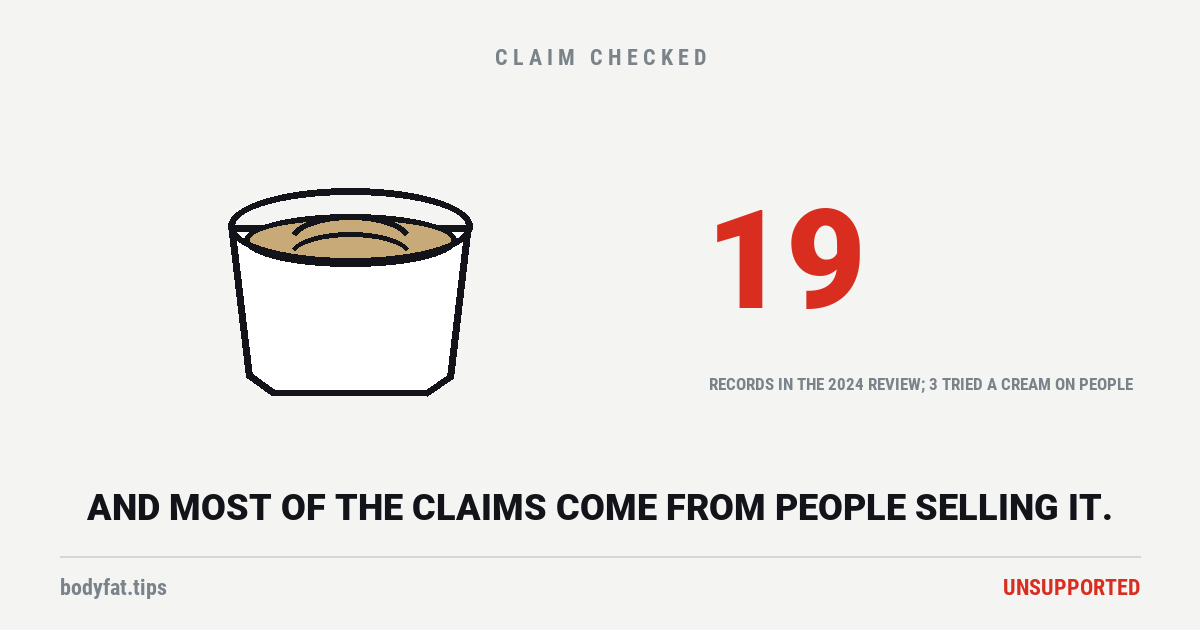
Several teams have now gone looking, and this page leans on two. In 2024, researchers ran a formal scoping review (a structured search that maps what has been published on a question, without pooling the results) of tallow and skin, in two research databases and in English. They screened 147 studies and found 19 that qualified — a mix of comparative work, basic science, and animal studies. [1]
| Question | Answer |
| Records the review included | 19, from 147 screened; 5 make a tallow-based cream |
| Tallow as a cosmetic, in humans | named as a research gap; 3 small tests, one research group |
| Side effects | the objective with the most disagreement between sources |
| Who is making the claims | mostly people with a financial interest and no health credentials |
Their conclusion comes in two halves. The first leans toward tallow: it was found to offer hydrating and moisturizing properties, and may be beneficial for dermatitis, psoriasis, dry skin and wounds [1]. The second is the gap. There are, in their words, significant research gaps in how it can be used on human skin, and what is needed is research geared towards tallow as a cosmetic product in humans.
Look at what the hopeful half rests on and the two halves stop disagreeing. Of the 19 records, five make a cream from tallow, all from one research group, and three of those put it on people [1]: 83 volunteers, 78 women with dry, sensitive skin and no signs of eczema [4], and 10 volunteers [5]. The two whose methods we read dabbed the cream on a small patch of forearm and measured the skin’s moisture for 90 minutes and for under three hours. The tallow was mutton tallow, blended with plant oils and in two of the tests reworked with enzymes, not the whipped beef fat in the jar. All three were studies of how to make a cream rather than controlled trials, and none set it against a moisturiser you could buy. The review’s gap, in other words, is a polite way of saying the thing being sold to you has not, as far as we can find, been through a controlled trial. We searched the main research indexes and two trial registries for one between 30 September and 7 October 2026 and found none.
Someone went and read the posts
The second study is the one we find genuinely useful, because instead of studying tallow it studied the claims. In a study published in 2025, a dermatology team took 200 posts about beef tallow skincare from YouTube, Instagram and TikTok, gathered in December 2024, and analysed what they asserted, what they cited, and who was posting. [2]
Three findings, and they compound.
One. Claims that tallow treats acne, atopic dermatitis and psoriasis were common — and largely lacked cited evidence. Not weak evidence. Of 200 posts, nine cited any evidence at all.
Two. The majority of posts promoting tallow showed financial bias, and were uploaded by people without healthcare credentials.
Three, and this is the structural one. The team also searched the research literature itself, and found that most of the evidence for tallow is evidence about tallow’s ingredients rather than about tallow.
That third move is worth learning to spot, because it is everywhere. A fat contains certain fatty acids; certain fatty acids have been studied; therefore the fat works. It is the same reasoning that would let you claim a brownie is a health food because cocoa flavanols have a literature. Ingredients are not products, and the product is what you are putting on your face.
The comparison that ends the argument
Here is where it gets properly interesting, and it is not really about tallow at all.
Moisturising for eczema has been studied to death. A Cochrane review gathered 77 trials and 6,603 people. Against a comparison cream or no moisturiser at all, moisturisers lowered eczema severity as scored by the doctors running the trials, and the reviewers graded that evidence high quality, which is rare. Against no moisturiser at all, the evidence is thinner. Two small six-month trials, 87 people between them, found fewer flares, and in both the median time to a flare went from about a month (28 and 30 days) to more than six months, the length of the trials. Two trials found people needed about a third of an ounce (9.3 g) less steroid cream for the same result. The reviewers graded those results low quality, and one of the two flare trials was unblinded and counted staff of the cream’s maker among its investigators [3]. A 2021 pooling of six trials in children put the average gain in time to a flare at about two weeks (13.5 days), with the range of plausible answers running from almost nothing to about four weeks [6].
So: moisturising works. Properly established, and worth knowing.
And then the reviewers add one sentence:
“We did not find reliable evidence that one moisturiser is better than another.” [3]
Seventy-seven trials. Six and a half thousand people. Creams, ointments, urea, glycerol, oat, proprietary formulations — and no reliable winner.
That is the context tallow has to be judged in. Twenty-nine of the review’s comparisons set one moisturiser against another, and each was tested in a single trial. A few found a winner. A cream with 5% urea beat a plainer cream in a trial the reviewers rated at low risk of bias, though both creams came from the company that sponsored it and the gain in median time to a flare was a week (22 days against 15). Coconut oil beat mineral oil in 117 children and olive oil in 52 adults, in two trials in the Philippines. One trial each is not enough to settle it, and the reviewers concluded there is no reliable evidence that one moisturiser beats another [3]. Since then, a 2022 trial gave 550 children with eczema a lotion, a cream, a gel or an ointment and found no difference in how their eczema went over 16 weeks [7], and a 2023 pooling of two trials put ceramide creams ahead of other moisturisers by about 1 point on a 103-point eczema score, where the smallest change that matters to patients is 8.7 [8] [3]. Tallow arrives at that table with the three small tests in its scoping review, none of them set against a moisturiser you could buy, and claims to be the best one.
What about the risks?
We are not going to overstate this, because the honest answer is that nobody knows properly.
The scoping review looked specifically for side effects of topical tallow, and reported that this was the question with the most disagreement between sources. Their recommendation is for more research with controlled variables on exactly this point. [1] Look at what sits behind that disagreement, though. Every one of the five records the review filed under side effects is about an industrial chemical (herbicide ingredients made from tallow, a solvent, a treated clay) or an injected vaccine ingredient; none of them put tallow balm on anyone’s skin [1].
What the dermatologists behind the second study raise is narrower and more practical. Some of tallow’s fatty acids may clog pores. One of them, oleic acid, has increased water loss from skin when applied on its own, in studies on people and on lab-grown skin, which could make eczema worse. Rendered animal fat may pick up microbes and go rancid. And people with eczema or sensitive skin may react to beef-derived products [2]. A 1990 safety assessment of tallow as a cosmetic ingredient called it safe in the uses of the time, but by its own abstract it reasoned from earlier reviews of tallow’s fatty acids and from tallow’s approval as a food, the same step from ingredients to product this page warns about [9].
So: not a documented danger, and not a clean bill of health either. An open question, reported as one.
The verdict
Unsupported. Not because tallow does nothing — it is a fat, a greasy layer usually helps dry skin, and in small tests volunteers said tallow creams left their skin moisturised. Because the specific claims being made for it, that it treats acne and eczema and psoriasis and outperforms other moisturisers, are made almost entirely without citation, mostly by people who profit from them and hold no health credentials, and rest on studies of ingredients rather than of the product.
The most useful thing in this whole literature is the Cochrane sentence. For eczema, where the trials were done, moisturising helps, and the trials so far have not reliably shown that a particular moisturiser is the one. Which means the cheapest one you will actually keep using is a defensible choice — and if that happens to be a jar of rendered beef fat, it is not the tallow doing something special. The 2022 trial’s authors landed in the same place: people need a range to choose from, to find one they will actually use [7]. That advice is for dry, eczema-prone skin. If you break out easily, the dermatologists behind the second study point out that some of tallow’s fatty acids may clog pores, and say its “non-comedogenic” (won’t clog pores) label on social media needs testing [2]. A heavy animal fat is a poor place to economise.
If you have persistent acne, eczema or psoriasis, those are diagnosable conditions with treatments that have beaten placebo in trials. A dermatologist is a better bet than a jar.
One last thing worth naming, because it helps explain the timing. Both tallow papers tie its rise to the demand for “natural” skincare [1] [2], and it arrived alongside the backlash against seed oils. Some of what looks like enthusiasm for animal fat may really be hostility to the alternative, and those are different arguments that deserve to be checked separately. We checked that one too.
Related: collagen, where the skin trials are real, mostly have a company in them and are rated Preliminary, and castor oil packs and lymphatic drainage massage — the same shape of promise, that something natural applied to the outside fixes the inside.
If you want to know what earns each rating, we wrote down how we read a study, and everything we have checked is in one place.
Corrected on 30 September 2026. The Related line at the end of this page described the skin evidence for collagen as “genuinely real but narrower than advertised”. We re-rated that verdict from Supported to Preliminary today, after an independent editorial review of it: the trials are real, but a company is named in 21 of the 26 and they disagree with one another. The line now says so. Nothing else on this page has changed, and its rating is unchanged.
Corrected again on 7 October 2026, after an independent editorial review of this page. We wrote that no moisturiser has ever been shown to beat another, “even for the ones with dozens of trials each”. The Cochrane review this page leans on reports single trials in which one did (a urea cream over a plainer cream, coconut oil over mineral oil and over olive oil), and every one of its 29 head-to-head comparisons was tested once; what its authors found is no reliable evidence that one moisturiser beats another. The page, its title and its search description now say that, and cite a 2022 trial of 550 children that found no difference between four types. We also presented the flare figure (30 days to 180) as the convincing result of 77 trials; it comes from two small trials the reviewers graded low quality, one of them unblinded and counting staff of the cream’s maker among its investigators, and the page now says so beside a 2021 pooling of trials in children that puts the average gain at about two weeks. The evidence panel said the sources did not state their funding; all three do, and the funding row now gives each.
We wrote that tallow was “the thing nobody has tested”. The scoping review includes three small tests in which volunteers tried creams made from mutton tallow; what we did not find, in the research indexes and trial registries we searched between 30 September and 7 October 2026, is a controlled trial of tallow as it is sold, and the page now says that and reports the review’s own, more hopeful, conclusion. Also changed: the 19 records are described for what they are, most of them not about tallow on skin; nine of the 200 posts in the social-media study did cite evidence, not none; the risks section adds what the dermatologists and a 1990 safety assessment say; tallow’s rise is tied to the demand for “natural” skincare that both tallow papers name, rather than to seed oils alone; and a footnote explaining a view count that appeared nowhere on the page was removed. The note above said nothing else on the page had changed, which was true of that correction. The rating is unchanged.
Corrected again on 7 October 2026. The provenance chain gave a search figure, 49,500 US Google searches a month for “beef tallow skin”, without saying where it came from or when. It comes from a paid keyword database, pulled on 15 August 2026, and the chain now says so. The rating is unchanged.