Carnivore Diet: In Lab Reports From 14 People, LDL Rose a Typical 36 mg/dL

A 2026 scoping review searched four databases, in November 2025, for human studies of the carnivore diet published in English or German since 1970.
It found nine. [1]
Seven of the nine had people in them; the other two were meal plans worked out on paper. [1] Nine, for an eating pattern that drew about 165,000 US Google searches a month for “carnivore diet” on average over the year to July 2026 (Google’s advertising estimate, from a paid keyword database pulled 15 August 2026; July itself was down to 90,500), and that had about 2.6 million Instagram posts under #carnivore on 28 November 2025, by the review’s count. And the reviewers add that the studies were small, short, and that the body of evidence suffers from “the absence of control groups”. [1]
The weight loss is probably real
Let us do the fair part first, because it usually gets left out of articles like this one.
Across those nine studies, the reported effects included weight reduction, increased satiety, and possible improvements in inflammatory and metabolic markers. [1] The weight evidence comes from two of the nine. The bigger is a 2021 survey of 2,029 people recruited through carnivore-diet communities on social media, all of them on the diet for at least six months, whose own reports took their median BMI (weight scaled for height; 25 is where overweight begins) from 27.2 to 24.3. [4] The other is a case series of people with bowel disease, two of whom lost weight. [1] The fullness is self-reported too. People who had side effects or no benefit and gave up were likely not in the survey at all, as its own authors point out. [4]
That the weight comes off is not mysterious, and this is our reasoning, not a result from these studies: strip out an entire macronutrient and most of the supermarket and you have built a calorie restriction with extra steps. It still counts as weight loss, though on any very-low-carbohydrate diet some of the first drop is water, which our page on cutting carbs sets out with the measurements.
So this page is not going to tell you nothing happens. Something happens. The question is the whole bill.
Then somebody measured the blood
One study asked 24 German carnivore-diet followers for lab reports from before they started and from while they were on it. They had been recruited at a carnivore-diet convention; 16 of the 24 had at least one diagnosed condition, and 8 had been on a ketogenic diet before switching. [2]
| Marker | Before | On the diet |
| LDL cholesterol | 157 mg/dL | 256 mg/dL |
| Total cholesterol | 224 mg/dL | 305 mg/dL |
| Everything else measured | no significant difference | |
Median LDL cholesterol went from 157 to 256 mg/dL. Total cholesterol, 224 to 305. Both changes were strongly statistically significant, meaning very unlikely to be chance, and by the authors’ own strict cut-off no other blood parameter differed significantly at all. HDL, the cholesterol usually counted as protective, rose from 64 to 78, which would pass the more usual test but not theirs. [2]
The authors’ own word for it is “striking”, and they call for further investigation into potential adverse effects. [2]
Two caveats, both real. This is 24 people who volunteered, filled in a questionnaire and sent in their own lab results — it is a survey, not a trial. And whether LDL raised this way carries the same risk as LDL raised any other way is argued over: the German survey’s authors call it “currently the subject of scientific debate”. [2] Among the work they cite on the reassuring side is a one-year imaging follow-up of 100 people on ketogenic diets with very high LDL, which reported that plaque already in the arteries, not LDL, predicted plaque growth. That paper was retracted in May 2026, at the request of its authors and the journal’s editors, after concerns were raised about its methods; the notice says the errors were too great to fix with a correction. [5] For scale, the 2026 US cholesterol guideline calls an LDL of 190 mg/dL or more severe hypercholesterolemia, lists ketosis and a high saturated-fat intake among the secondary causes of high LDL, and says people whose LDL got there on a ketogenic diet, which is how 15 of the 24 German volunteers described theirs, should be counselled on ways to bring it down while keeping the goal of the diet. [6] Settling the wider argument is beyond this page.
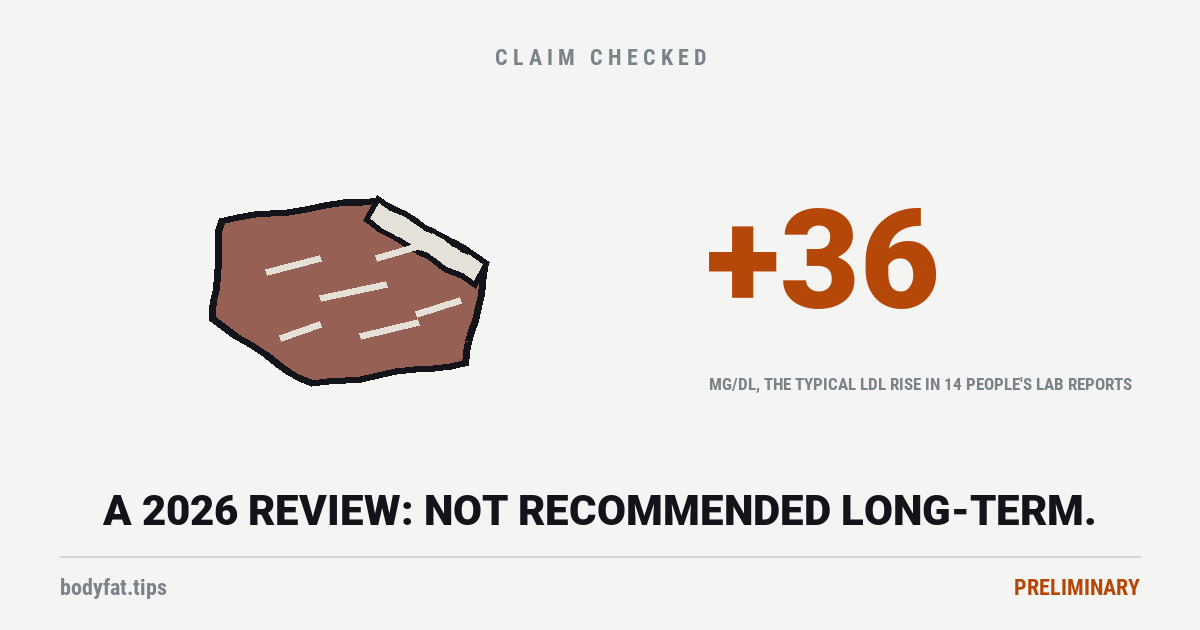
What we can tell you is what was measured, and it is smaller than the two medians make it look. They come from the 14 people with an LDL result from both periods, not all 24, and they sit 63% apart, which is our arithmetic, not a figure in the paper. The typical person’s own LDL went up by 36 mg/dL, and the changes ran from a fall of 3 to a rise of 195. The paper’s reference limit for LDL is 160 mg/dL. [2]
And be fair again: some things improved
In the same group, the two participants who started with a raised HbA1c — a marker of blood sugar over months — saw it come down, and one of the two had a diagnosis of diabetes. So did all six who started with triglycerides above 130 mg/dL. The paper reports the other half too: some who started low saw the same markers go up (four of the eight HbA1c results rose), which is why neither changed significantly across the group. [2]
That is a small number of people and no control group, so it is a signal rather than a finding. High first readings drifting down while low ones drift up is also what measuring anything twice tends to produce on its own, a pattern statisticians call regression to the mean, and the 2,029-person survey’s authors raise the same caution about their own results. [4] But it is a signal in the direction its advocates claim, and leaving it out would make this page dishonest.
What the diet does not contain
A separate 2024 analysis built four carnivore meal plans for hypothetical average Australian adults and ran them against Australian and New Zealand nutrient reference values. [3]
Plenty was covered: B12, B6, zinc, selenium, niacin, riboflavin, phosphorus, vitamin A. Sodium came in over the threshold.
What fell short: thiamin, magnesium, calcium and vitamin C, with iron, folate, iodine and potassium short in some versions. And: “Fibre intake was significantly below recommended levels.” [3]
Important limit, and the authors are straighter about it than most: this was modelling of hypothetical meal plans, not blood tests in real people. They say plainly that whether the metabolic context lowers the requirement for some of these nutrients, or whether it poses real risks of inadequacy, “remains to be determined”. [3] A modelled shortfall is a reason to look, not a diagnosis.
The verdict
Preliminary. There are real human studies and they do report weight loss and satiety. The review counted nine, seven of them with people in them; they are small, they are short, and none of the nine is a controlled trial of health outcomes. At least two randomised trials of a carnivore diet were registered in 2026; neither had results when we checked on 1 October 2026. On the claim this page rates, that eating only meat improves your health markers: they moved both ways, the improvements the big self-report survey described did not repeat in the German lab reports, and LDL went up in both. That is not enough to tell you what this diet does over years, which is the timescale people are attempting it on.
The reviewers put it in one sentence, and we cannot improve on it: “At this time, long-term adherence to a CD cannot be recommended.” [1]
If you are doing it and feeling better, that experience is real and this page does not dispute it. What we would say is that LDL going up is the finding that repeats, in both of the review’s surveys that compared readings from before and during the diet, and it costs very little to go and get your own lipids checked rather than assume.
Journalism, not medical advice. Cholesterol is a clinical matter and a doctor can see your actual numbers, which we cannot. If you want to know how we grade this sort of evidence, here is how we read a study.
Related: does fibre help you lose weight · how much protein to build muscle · how much vitamin D should I take · every claim we’ve checked
This page was corrected on 1 October 2026 after an independent editorial review. It called the German survey “the one that measured blood” and said it had found “the single most alarming number in the whole literature”. Both were wrong on the page’s own sources: the 2026 review lists lab tests in five of its nine studies, one of them a 2,029-person survey in which LDL rose from 126 to 172 mg/dL, and the German survey’s own highest on-diet LDL reading was 374 mg/dL. The page also called the nine “human studies”; two were meal plans worked out on paper. Its headline “63% rise” compared two group medians drawn from 14 of the 24 volunteers; the typical person’s rise was 36 mg/dL. And the funding row said funding was not stated in the sources: all three state it, the German survey’s first author declares a tie to a supplier of supplements for carnivore dieters, and its volunteers were recruited at a carnivore-diet convention.
Also changed: the HbA1c and triglyceride section now reports both halves of the result; the line about a debate we had not read now says that a follow-up study the German survey’s authors cite for the reassuring view was retracted in May 2026, and gives the 2026 US cholesterol guideline’s advice on high LDL from a ketogenic diet; the weight evidence, the German volunteers and the meal-plan study are described with their populations; the search-volume figure is sourced and dated; the follow-up and replication rows give the real durations and say what has repeated; the provenance chain now says where the claim spreads and names a seller’s “trial” whose DOI does not exist; and the source note no longer says every figure came from abstracts. Three sources were added: the 2,029-person survey, the retracted paper with its notice, and the guideline. The rating is unchanged.
Corrected on 9 October 2026. This page gave a search figure, about 165,000 US Google searches a month for “carnivore diet”, without saying when we pulled it. It comes from a paid keyword database, pulled on 15 August 2026, and the sentence now says so. The rating is unchanged.