Creatine for Women: Under a Pound After Menopause. No Leg-Strength Gain.

You have been told creatine will make you bulky. So here is the number.
In trials of women past menopause, a 2026 review puts creatine’s edge at 0.8 lb of lean mass (0.37 kg): five trials, 338 women, anything from twelve weeks to two years. [1]
Under a pound. That is the bulk, and it is the generous version of the number.
| Measure | Creatine vs placebo |
| Lean mass on a scan, water included | +0.8 lb · 0.37 kg |
| Leg press or squat, one-rep max | no gain over training alone |
| Bone density | no difference |
| Stomach complaints and cramps | more in one trial, not in the largest |
What that pound is made of
Start with what was measured. Lean mass is what a body scan calls everything that is not fat or bone, and that includes water. [7] [10] In each of these trials whose methods we could read, the first scan was taken before the first dose and the last at the end, so whatever creatine does to body water in the first weeks is inside the 0.8 lb. [6] [7] [8] [9] None of the four trials we read in full measured body water.
How much could that matter? In 2025 an Australian team scanned 63 untrained adults, 34 of them women, gave half of them 5 g of creatine a day for one week with no training, and scanned everyone again. The women on creatine were up 1.2 lb (0.55 kg). The women taking nothing had not moved. [10] One week, no lifting, and more than this page’s headline figure. Its authors are careful about that result, and so should you be: the split by sex was made after the fact, the gain is no bigger than the scanner’s own error from one scan to the next, the authors trace it to the trunk, the comparison group took nothing at all in place of a dummy powder, and the creatine came from a supplement company. The trial did not measure water either. Fluid is the authors’ explanation, which they call plausible. [10]
So is the 0.8 lb muscle or water? These trials cannot say. Two of them also measured the muscle itself, by ultrasound, and found no difference between creatine and placebo. [6] [7]
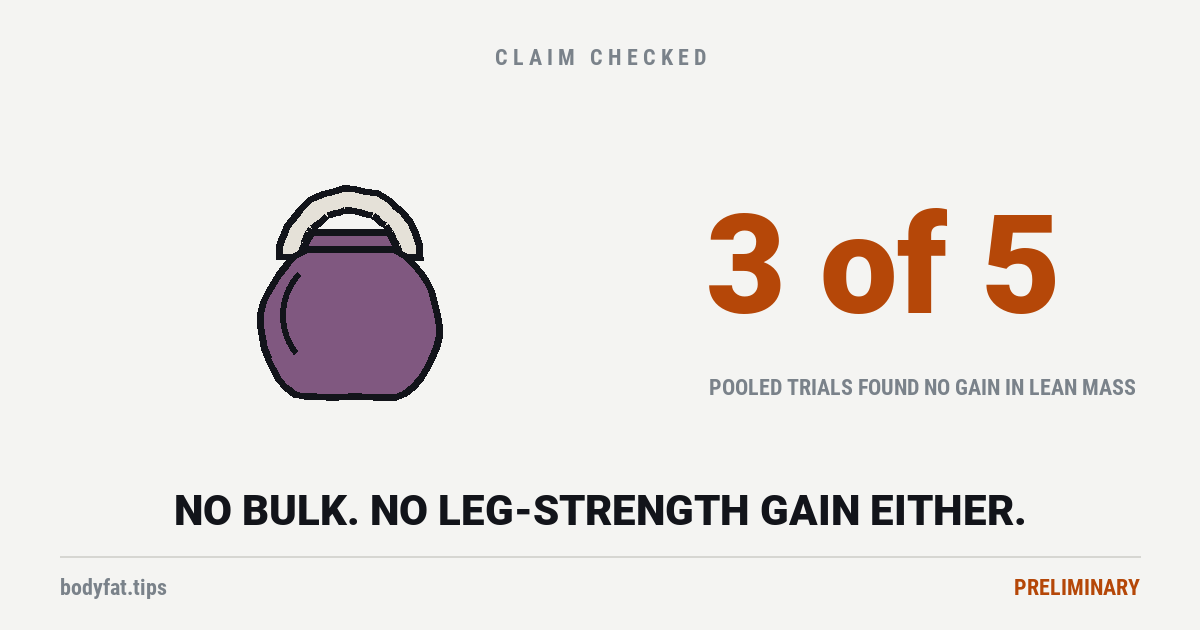
Now the five trials behind it. Three found no gain: a one-year trial of 109 women on 1 g a day, a two-year trial of 200 women on 3 g a day (the review’s table counts 112 of them), neither with any training, and a twelve-week trial of 5 g a day with elastic-band training that 39 of its 50 women finished. [5] [8] [7] The two that found a gain had 18 women and 60. [3] [4] Take the 18-woman trial out and the review’s figure drops to 0.6 lb (0.28 kg) and lands on the wrong side of the line researchers use for “probably not chance” (p = 0.08). [1]
The biggest trial in the review is not in that figure. It put 237 women through two years of lifting three times a week, half of them on creatine. Lean tissue rose 4.6 lb with creatine (41.4 to 43.5 kg) and 4.0 lb with a dummy powder (40.3 to 42.1 kg). Counting everyone who started, the trial could not tell that gap from chance (P = 0.11); counting only the women who finished, it could (P = 0.046). [9]
And the review’s own chart does not add up to its headline. It plots seven trials, not five. Three of the seven estimates sit at or below zero, and averaged by the weights printed beside them the seven come to about 0.35 lb (0.16 kg), and the five the review says it pooled to about 0.4 lb (0.19 kg). Those sums are ours, made from the published chart; they are not published figures. The review says its data are in a public repository. On 30 September 2026 the repository was closed to the public, and the data sheet published with the paper lists the trials without the numbers that were pooled. [1]
The strength number, and the three trials behind it
Lean mass is the number everybody worries about. Strength is the one worth having, so we went to the trials for it.
The review reports a pooled gain of 16.5 lb (7.5 kg) on a leg press one-rep max — the heaviest load you can move once — from three trials and 111 women. [1] So we read the three trials.
The first, 18 women, did not test a leg press. Its one-rep-max tests were bench press, knee extension and biceps curl, and creatine did better on all three. [3] [13] The second, 60 women in four groups, did test it: leg press rose 19.9% with creatine and training and 15% with training alone, a gap its authors report as not significant (p = 0.357). [4] The third, 33 women, tested a hack squat, which is a squat done in a machine, and found no difference between the groups. [6]
The biggest trial in the review is outside that pool as well. Its 237 women took their hack squat from 127 lb to 186 lb on creatine (57.6 to 84.4 kg) and from 125 lb to 182 lb on placebo (56.6 to 82.7 kg). [9] Two years of lifting did that. Creatine added nothing the trial could detect (P = 0.97), and nothing on the bench press either (P = 0.20). What that trial did find in creatine’s favour was speed: timed over about 87 yards (80 m), the women on creatine got a second and a half quicker, from 48.6 seconds to 47.1, while the women on placebo went from 48.3 to 48.2 (P = 0.0008). [9] The review’s chart still shows that trial with a leg-press gain of 13 lb (6.0 kg). [1]
So where does a strength gain show up? In the upper body, in the small trials. Bench press improved more on creatine in the 18-woman trial and the 60-woman trial, and in the 33-woman trial as a percentage though not in pounds. [3] [4] [6] A separate pooling of eight trials in 176 older women who trained, published in 2021, found a similar shape: a small edge in upper-body strength; a lower-body result it could not tell from zero overall, though it could in the four trials that ran 24 weeks or longer; nothing it could detect in muscle mass; and all of it graded low certainty by its own authors. [11] That pooling was done before the 237-woman trial reported, and that trial ran two years. A 2025 analysis of 69 creatine trials in adults of all ages split the leg press by sex: in men a gain of about 22 lb (9.79 kg), in women 5.6 lb (2.53 kg) across just three comparisons, with a range of plausible answers running from a 14 lb loss to a 25 lb gain. [19]
Two reviews published in 2026 came at these trials from outside the creatine field, and neither declares any tie to a creatine seller. One, led from Taipei Medical University, pooled 14 trials of supplements taken alongside exercise in 763 women, three of them creatine trials. On the hack squat, where its only two trials were the two Canadian creatine trials, the pooled effect size was 0.04, where 0.2 is what researchers call small, and the range of plausible answers ran from a little below zero to a little above it (−0.20 to 0.28). On the bench press it found a small edge, 0.28, across four trials of which three tested creatine, and it graded that evidence low. [20] The other, a review registered in advance and led from the German Sport University Cologne, covered four small creatine trials in postmenopausal women who lifted, the 237-woman trial not among them. It reports bigger strength gains in the 18-woman trial and, in the other three, “no clear effects on body composition, strength, or BMD”, BMD being bone mineral density. [21]
A regulator has ruled on part of this. In February 2016 the European Food Safety Authority concluded that creatine taken daily alongside resistance training improves muscle strength in adults over 55, and since April 2017 EU law has allowed that claim on products aimed at over-55s who train, at 3 g a day with lifting at least three times a week. [13] It is a judgment about older adults of both sexes, made on an application from a creatine maker. Two of the ten trials the panel weighed were in women alone: it counted the 18-woman one as showing an effect and the 60-woman one as not showing a consistent effect. It came before the 200-woman and 237-woman trials reported, and it says nothing about lean mass, bone or side effects.
And the scale may notice. Across 27 comparisons in women, in a 2024 analysis of 143 trials, the creatine groups finished 1.9 lb (0.86 kg) heavier than the placebo groups, with no change in fat the analysis could detect [17]. That figure does not hold up. Two-thirds of the weighting behind it is one five-day trial of 15 women, which the analysis entered with its standard errors, the uncertainty around a group’s average, read as standard deviations, how widely individual women scatter; that made it look nearly three times more precise than it was [23]. Entered as that trial reports them, the women’s average comes to about 0.8 lb (0.37 kg), with a range from nothing to 1.6 lb (0.74 kg), on our arithmetic from the analysis’s own chart. By coincidence that is the same 0.8 lb as the lean-mass figure at the top of this page; the two come from different analyses and measure different things. Our weight verdict takes that number apart.
Where a gain showed up: with a dose and a stimulus, mostly
This is the reviewers’ own summary: “Benefits were evident when creatine ≥ 5 g·day−1 was combined with RT; trials using ≤ 3 g·day−1 without RT showed no measurable effect.” [1] RT being resistance training, and the units meaning grams a day.
Read it for what it does not say. It does not say only. The two trials with no training were also the two on the lowest doses, 1 and 3 g a day, and they ran one and two years against twelve to twenty-four weeks for the rest of that pool, so low dose, no training and long duration all arrive together; the review says it cannot separate dose from duration with confidence. [1] Inside the 60-woman trial, the women who took creatine and did no training held on to more arm-and-leg lean mass than the women on placebo, up 0.3% against down 1.2%. [4] And going the other way, three of the five trials that paired about 5 g or more with training found no clear gain in lean mass. [6] [7] [9]
Which should sound familiar if you read our protein verdict: the supplement is the material and the training is the stimulus. For protein, no clear gain has been shown in people who neither train nor diet, though the pooled trials are too imprecise to rule one out. Two different supplements, two different research groups, a similar conditional.
On water, and on side effects: 684 trials, counted trial by trial
The other half of the warning is water — that you will puff up. The trials in older women cannot settle that, because the ones we read in full did not measure body water. A trial in thirty younger women did. After five days on a loading dose, in the second half of the menstrual cycle, total body water was up about three and a half cups (0.83 L) on creatine and down on placebo, the water outside the cells included, while the scale showed no difference the trial could detect. [18] Our weight verdict has the detail.
For everything else there is a very large analysis: side-effect reports from 684 randomised controlled trials. [2] It is not about water. It did not measure body water or weight, and the word bloating does not appear in it.
It counted trials, not people. A trial scored a yes if anyone in its creatine group reported a side effect, and 591 of the 684 reported nothing at all. [2] Counted that way, a creatine group was no more likely than a placebo group to report some side effect. On two specific ones it was more likely: about two and a half times the odds of a stomach complaint, and about three times the odds of muscle cramps. [2] The paper’s own summary is “placebo groups often reporting similar or greater SE frequencies at the study-reporting level”, SE being side effects. [2] That holds for side effects taken all together. It does not hold for stomachs and cramps, and it is a statement about trials, not about how many people were affected. The same group had counted people a year earlier, in a paper on the same set of trials whose publication fee the creatine maker Alzchem paid: stomach complaints in 5.51% of people on creatine and 4.05% on placebo, muscle cramps or pain in 0.52% and 0.07%, and its authors could tell neither gap from chance. [22] The paper pooled no blood tests for the kidneys or liver, and just three of its 684 trials reported a kidney or urinary problem. That is too few to learn from: the odds ratio the paper prints for kidney-related reports has a range of plausible answers running from about a fifth of placebo’s odds to more than nine times them. [2]
The trials in older women give counts of people. In the one-year Canadian trial, five women on creatine reported stomach complaints and two reported cramps, against one woman with nausea on placebo; grouped together, that was significantly more on creatine. [6] The two-year trial, five times the size, found no difference: stomach complaints in 13 women on creatine and 14 on placebo, bloating among the complaints listed, and cramps in two women in each group. [9] A 2020 review that counted women, 951 of them across 29 studies and none of them pregnant, found no deaths or serious events and could not tell total or stomach side effects apart from placebo. [16]
One blood test does move. In that two-year trial, six women on creatine and none on placebo were flagged for high blood creatinine, and four for a low estimated filtration rate, the usual gauge of how well the kidneys are clearing the blood, which is calculated from creatinine. [9] Creatinine is what creatine turns into, so the reading rises without the kidneys doing anything wrong; the trial’s authors say so, and our safety verdict explains the test and why it is worth telling your doctor you take creatine before one. Kidney-related flags of all kinds were raised for 15 women on creatine and 21 on placebo. [9]
One honest caveat the paper makes and its own title does not. Dose and duration were statistically associated with side-effect reporting — but “the effect sizes were uniformly small, events were infrequent, and the reported symptoms were primarily mild and nonspecific”, with no consistent pattern. [2] That is a more careful claim than “no association”, and it is the one the evidence supports.
Why this is Preliminary and not Established
Our main creatine verdict is rated Established. This one is two steps below. Part of the reason is who was studied: that page’s figure for older adults, about 3 lb of lean mass, comes from trials of men and women together, and the women-only figure here is 0.8 lb, from five trials of which three found nothing. Part is the strength result, which did not survive a reading of its own trials. The rest is a piece of statistics worth explaining.
The meta-analysis reports two ranges for the lean mass result. The confidence interval — +0.11 to +1.52 lb — is about the average effect across these trials, and it does not include zero, though it stops a tenth of a pound short of it. The review gives p = 0.05, which sits on the line researchers use for “probably not chance” and not past it. [1]
The prediction interval is different. It asks what the next trial would probably find. That one runs −0.22 to +1.85 lb [1] — and it does include zero. A new study finding nothing at all would not be surprising.
Seven trials. The review rates most of them “some concerns” for bias, one at high risk and one at low. [1] The low-risk one, going by the review’s text and the domain-by-domain colours of its chart, is the two-year trial of 3 g a day with no training, which found no effect of creatine on lean mass. [8] Real trials. Not settled evidence.
Four limits worth having
These were postmenopausal women, mean age about 62. [1] That is who was studied, and we are not going to quietly stretch it to cover every woman. If you are thirty, this is not evidence about you. There is evidence about women nearer your age, and its own authors rate it low. A 2026 pooling of 34 studies in girls and women in their teens and twenties, most of them athletes or otherwise active, found small positive effects on performance and on body composition, graded both low certainty, and said its body-composition result “does not establish muscle hypertrophy” (muscle growth) and that short-term gains “may partly reflect water-related changes”. [12] The one-week scan trial above was in adults averaging 31. From first scan to last, thirteen weeks and a lifting programme later, its women on creatine had gained 5.7 lb (2.60 kg) of lean mass on the scan against 3.1 lb (1.40 kg) for the women taking nothing, and about half of that lead was already there after the first week. [10] And a trial built for this question, 55 women of 38 to 60 going through the menopause transition, creatine or a dummy powder alongside six weeks of heavy lifting, with a leg-press one-rep max as a main outcome, was registered in June 2025 and finished that December. On 30 September 2026 its registry entry (ClinicalTrials.gov NCT07027800) held no results, and we found no published report of it in PubMed.
Creatine made no difference to bone density. [1] In both two-year trials density fell over time with creatine and without it. [8] [9] The review’s abstract calls the bone effect unclear; its body rates “no important benefit” for bone density at high certainty. [1] Creatine is sold to older women on the bone argument anyway. One product page we read on 30 September 2026, for a $40 product titled “Daily Creatine Gummies for Postmenopausal Women”, says: “Studies show creatine helps maintain bone mineral density during menopause.” One trial did find that: the one-year pilot, in which 33 women were analysed and the loss at one hip site was slower on creatine. [6] The same group’s two-year trial in 237 women did not find it again, and its authors say the earlier result was most likely chance in a small sample, or perhaps better compliance. [9] What the bigger trial did find is a change in shape: two measures of the hip bone at its narrowest point, both tied to how well it resists bending and buckling, held up better on creatine. Its authors call the difference “most likely below the threshold for clinical prevention of fracture”. [9]
The field is small, and the creatine industry is in it. These two papers share an author, who chairs a scientific advisory board backed by the creatine maker Alzchem. [1] [2] That company paid part of the review’s publication fee, and the review appeared in the journal of a sports-nutrition society whose chief executive is another of its authors and which, by the paper’s own statement, takes money on occasion from companies that sell creatine. [1] The review says all seven trials were publicly funded apart from some donated supplement. Two of them name Alzchem among their funders, and one of those two has an author who gives the company as their workplace. [5] [8] Both of those trials found no effect, which belongs in the same breath. It is the same caution we apply anywhere a literature is produced by a tight-knit group, and it is why the two outside reviews above matter: neither found a clear effect on muscle mass. [20] [21] The review also notes it was not registered in advance.
None of this covers pregnancy, breastfeeding or kidney disease. The two Canadian trials excluded women with kidney abnormalities and women who had taken hormone therapy in the past year, the two-year Brazilian trial excluded women on hormone therapy, and the Chilean one excluded anyone with evident kidney disease. [6] [9] [8] [7] Health Canada’s creatine monograph, dated 28 June 2024, requires labels to say “When using this product you may gain weight” and to tell buyers to ask a health care practitioner before use if they are pregnant or breastfeeding, or have a kidney disorder. [14] LactMed, the US National Institutes of Health’s database on drugs and breastfeeding, in a record revised on 15 July 2025, says milk levels of creatine “have not been measured after supplementation in humans” and that “it is probably best to avoid creatine supplementation unless it is prescribed by a healthcare professional”. [15] This desk reads research and reports what it found. That is journalism, not medical advice. If any of those describes you, the person to ask is a clinician who knows your history.
The verdict
Preliminary, for the claim creatine is sold to women on: that it builds muscle and strength after menopause. In trials of women past menopause the pooled gain in lean mass is under a pound, on a scan that counts water; three of the five trials behind that figure found no gain, and the largest trial could not tell its gain from chance when it counted everyone who started. The strength gain this page used to lead with is not in the trials it was said to come from. No trial in the review found creatine adding to a leg press or a squat beyond what the lifting did; the edge that does appear is in the upper body, in small trials, and the largest trial did not find it. The warning is a separate claim with a plainer answer: that creatine makes women bulky would be rated Unsupported on its own, because nothing in these trials looks like bulk. On side effects, creatine groups report stomach complaints and cramps somewhat more often, the blood test used for kidney function reads higher with no sign of kidney harm in these trials, and none of it covers pregnancy, breastfeeding or kidney disease.
The bulk you were warned about is under a pound on a scan that counts water. The strength you may have been promised is thinner than the sales pages say, and thinner than this page said. Whoever told you creatine would bulk you up was wrong. So was anyone who told you the trials in women show a big gain in leg strength, and that included us.
Related: creatine benefits · how much creatine should you take · is creatine safe · does creatine make you gain weight · every claim we’ve checked
Corrected on 30 September 2026. This page said of our protein verdict that without training the supplement “does nothing measurable”, and called the two findings the “same conditional”. That verdict was corrected today after an independent editorial review: in people who neither lift nor diet, the pooled trials show no clear gain from extra protein and are too imprecise to rule one out. The comparison now says that. That edit changed nothing this page said about creatine and left its rating alone. The correction below, made later the same day, changed both.
This page was corrected on 30 September 2026 after an independent editorial review, and most of what it told you has changed. We wrote it from two abstracts and said the papers were paywalled. They are free to read, and read in full they do not say what we said. The 0.8 lb of lean mass came from five trials and 338 women, not seven and 608; those five ran from twelve weeks to two years, not “nine months”; three of the five found no gain; and a body scan counts water as lean mass, which we never mentioned. The 16.5 lb on a leg press, which we called the finding that is actually big and said three trials agreed on completely, does not survive the three trials it is attributed to: one tested no leg press, one found no significant difference from training alone, and one tested a squat and found no difference. The largest trial in the review, 237 women over two years, found no strength gain, and we had left it out. The review’s own charts do not add up to either of its headline figures, and the data it says are public were closed when we tried to open them.
We also told you side effects were “the same as placebo”, kidney and liver markers included, on the strength of a paper that pooled no such markers, counted trials and not people, did not measure water or bloating, and itself reports about two and a half times the odds of a stomach complaint and three times the odds of cramps in creatine groups. The funding row said “not stated”; both papers state ties to a creatine maker, and two of the seven trials name it among their funders. We said that for a woman of thirty this was “the closest good evidence there is”, when a pooled analysis of 34 studies in younger women exists, graded low by its own authors. A figure for monthly searches has been removed because we could not trace it to any saved data. Added: the largest trial’s results, the trials’ own side-effect counts, two reviews from 2026 by groups with no declared tie to a creatine seller, a European regulator’s 2016 opinion on strength in over-55s, and who the evidence does not cover. The title, the summary figure and the search description have changed with it. The rating has changed with it, from Supported to Preliminary. Supported rated a gain in lean mass and strength in women; for that claim the trials are small, mixed and early, which is what Preliminary means here. The warning that creatine makes women bulky is a separate claim, and these trials do not support it.
One passage was corrected on 1 October 2026, after the desk re-checked the 143-trial meta-analysis it quotes. We gave that analysis’s figure for women, 1.9 lb (0.86 kg) across 27 comparisons, as the weight creatine adds. Two-thirds of the weighting behind it is one five-day trial of 15 women that the analysis entered with standard errors read as standard deviations; entered as that trial reports them, the figure comes to about 0.8 lb (0.37 kg), with a range from nothing to 1.6 lb, on our arithmetic from the analysis’s own chart. The passage now says so, and the trial is added as a source. A line saying almost nobody explains a piece of statistics, which we had not checked, now just explains it. The rating, Preliminary, is unchanged.