Does Lifting Weights Increase Testosterone? Yes — And It Made No Difference

Yes. Lift heavy with enough muscle — a big leg session will do it, arm curls on their own did not — and your testosterone goes up. It is real, it is measurable, and it has been documented for decades.
It also appears to do little or nothing for the muscle you are building.
The best evidence for that comes from an experiment designed specifically to find out — one of the cleverest in exercise science. Not everyone who has tried a version of it got the same answer, and we will get to them too.
They trained one man’s two arms under different hormones
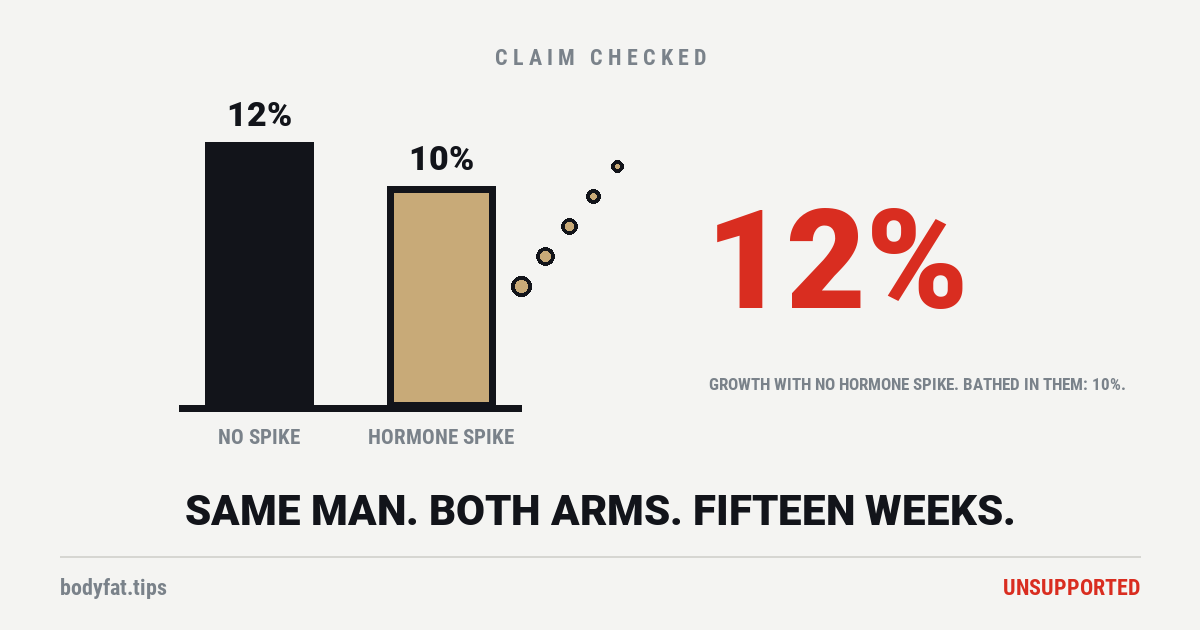
In 2010, twelve young men trained their elbow flexors for fifteen weeks. Each man trained both arms, on separate days, doing the same arm exercise — but under deliberately different hormonal conditions. [1]
On one day: arm curls, and nothing else. Blood tests confirmed no rise in testosterone, growth hormone or IGF-1.
On the other day: the identical arm curls, immediately followed by a large volume of heavy leg work — leg presses, then leg extensions and leg curls — purely to flood the bloodstream with hormones. That worked: significant elevations in all three, measured straight after and again at 15 and 30 minutes, and the same pattern showed up at both the start and the end of the fifteen weeks. [1]
So the same arm exercise, in the same man, with the same genetics, sleep, diet and training history — the only difference being whether the arm then recovered in a bath of anabolic hormones.
| Arm | Hormones after training | Muscle gained |
| Curls only | no rise | +12% |
| Same curls, then heavy leg work | big rise in testosterone, growth hormone and IGF-1 | +10% |
The arm that got no hormone spike grew 12%. The arm bathed in testosterone, growth hormone and IGF-1 grew 10%. The difference was not statistically significant. Strength went up in both, equally. Type I and type II fibres both grew, with, in the paper’s words, “no effect of hormone elevation”. [1]
If the post-workout hormone surge were what drives muscle growth, this is the experiment built to show it, and it showed nothing. It is about as direct a test as you can run in a human being, though twelve men make it a small one.
Then they did it again, bigger, in people who already lift
The obvious objection is that twelve untrained men and one arm exercise is a narrow test. So the same group ran it wider.
In 2016: 49 resistance-trained men, twelve weeks of whole-body training, with muscle biopsies, DXA scans, strength testing and hormone measurement before and after. Its abstract’s verdict: “No significant correlations between the acute postexercise rise in any purported anabolic hormone and the change in strength or hypertrophy were found.” [2] Its own results table is a little messier. Of the 70 hormone-and-outcome pairings in it, three came up significant: cortisol, negatively, with type II fibre growth (twice), and free IGF-1, a growth factor, with leg-press gains. Outside the table, LH, the signal that tells the testes to make testosterone, tracked bench-press gains. Three in 70 is about what luck alone produces: at the usual one-in-twenty line for “probably not chance”, 70 tries should turn up three or four by accident, by our arithmetic. None of them involved testosterone [2].
Their summary sentence leaves no room: acute post-exercise hormonal rises are “not related to or in any way indicative of” the muscle and strength you gain. [2]
And in a separate cohort of 56 men, measuring hormone responses at the midpoint of a twelve-week programme: no significant correlations between growth hormone, free testosterone or IGF-1 and gains in lean mass or leg press strength. No correlations with strength at all. [3]
The funny part
In that cohort of 56, growth hormone did track fibre growth, weakly, though not lean mass. But only one hormone did correlate positively with gains in both lean body mass and type II fibre size.
Cortisol. [3]
The hormone marketed to you as catabolic — the one whole supplement categories exist to suppress — was the one that tracked upward with growth. The correlations were weak (r = 0.29 and r = 0.35, which is to say cortisol accounted for about 8% of the variation in lean-mass gain and 12% in type II fibre growth), and we are not going to build a theory on them.
That is exactly the point. They are weak, they are the wrong sign, and they are as good as anything testosterone managed. In the 49-man study cortisol ran the other way, weakly negative with type II fibre growth [2], which is one more reason not to build a theory on either. When your framework predicts one hormone matters and the data hands you a different hormone pointing the wrong way, the framework is the problem.
Did any other lab try the arm-and-leg trick and get a different answer?
Yes, twice, and mainly on strength.
In a Danish study from 2001, sixteen untrained young men were split into two groups. Both trained one arm for nine weeks; one group also trained their legs straight afterwards, which raised their testosterone, at least at the start. In that group the trained arm’s isometric strength (pushing against something that does not move) rose 37%, against a 9% rise in the arm-only group that was too small to tell from chance. But the leg group had started with 20 to 25% less isometric strength, and the authors themselves warn the result “may only indicate a possible link”. On their measure of “functional” strength, the trained arms gained about the same in both groups, 20% and 19%. [6]
In a Norwegian study from 2011, nine volunteers trained each arm in separate sessions for eleven weeks, one arm straight after leg exercises that raised testosterone and growth hormone, the other with no leg work first. Both arms got stronger and both gained muscle volume, the same calculated amount according to the 56-man paper’s account of it [3]. But the hormone-raised arm made the bigger relative gain on the one-rep-max curl (the heaviest weight lifted once) and was the only one to grow at the thickest part of the muscle [7]. One difference from the 2010 experiment: there, the leg work came first, so the arm trained with its hormones already up.
Why do those two not change the rating? Because the claim rated here is that the spike is how you build muscle, and neither shows that. In both, the arm trained without the rise got stronger too, and in the Norwegian study it gained as much muscle volume. What they point to is something smaller, that the rise might add a little strength, and the two larger studies above found no link between testosterone and strength gains.
Newer studies from other labs split as well. In 2022 a Brazilian study of 29 men found their gains in muscle size and strength over eight weeks were not associated with their hormone levels after exercise, though in that study testosterone went down, not up, after a session [8]. In 2023 a Finnish study that sorted men by how much they grew found the biggest growers were, in its words, “more sensitive to acute increases” in testosterone and growth hormone, in groups of seven to ten men; its conclusion names growth hormone, not testosterone, as the possible marker [9].
So what does predict who grows?
This is the part that makes the page worth reading, because the answer is not “nothing”.
In 2013 a study followed 23 men through sixteen weeks of training and measured things inside the muscle as well as in the blood. Average fibre growth was 20%, but the range ran from −7% to +80% — at the top, fibres grew by four-fifths; at the bottom, they shrank. [4] Plenty of variation to explain.
Blood hormones explained none of it. Free testosterone, growth hormone and IGF-1 all showed “no relationship” with how much anyone grew. [4]
Three things did correlate. The change in androgen receptor content in the muscle itself (r = 0.60). The activation of p70S6K, a signalling protein that switches on muscle protein synthesis, measured five hours after training (r = 0.54). And the interleukin-6 response (r = 0.48), though the authors are candid that they do not know why.
Their conclusion: this implicates “intramuscular rather than systemic processes in mediating hypertrophy.” [4]
In plain terms: within the normal range, it is not how much testosterone is floating in your blood after a session. It is how well the muscle you just trained can hear the testosterone that is already there — how many receptors it adds — and what the machinery inside that muscle does in the hours afterwards. The signal that tracked growth was local, so for the post-workout spike the blood test is looking in the wrong place. The same researchers still call blood hormones “permissive” [4], meaning they have to be there for growth without being what drives it. A resting level that is genuinely low is a different matter, and whether to get tested is a question of its own.
And the spike may not even be extra production
One more detail, from the study that measured this properly. Using stable isotope dilution — tracking a labelled version of the hormone to separate how fast it is made from how fast it is cleared — researchers found the post-exercise rise “appeared to be induced by decreased metabolic clearance rate of T.” [5]
Your body was removing it more slowly for a while. The paper’s own summary says training may also have had a short-term effect on how fast testosterone was made, so extra production is not ruled out, but it puts the rise in the blood down to the slower exit. [5] The spike looks more like a traffic jam than a surge in production.
The same study also looked at what twelve months of resistance training did to testosterone metabolism overall. Answer: “No changes were observed… indicating a homeostatic stability for this hormone in men of different ages.” [5] That study had thirteen untrained men in it, five aged about 28 and eight about 70, which is worth saying plainly — it is a mechanistic study, not a population one.
The verdict
Lifting raises your testosterone briefly, and in the best evidence available the rise made no difference. It is a transient rise, which the one study that traced it put down to slower clearance; in the two larger studies it did not track how much muscle or strength men gained; and when a fifteen-week within-subject experiment manipulated it directly, the arm that got it grew no more. Two small experiments from other labs saw a strength edge, so the question is not closed, but neither showed the rise is how muscle gets built. Over a year of training, resting testosterone did not move. Every study this verdict rests on was done in men, mostly young ones; none tested women.
What lifting does is build muscle. Every one of the five studies this verdict rests on found that — 12% here, 20% there, up to 80% in one man. The mechanism just is not the one on the supplement label. In the one study that looked, what tracked growth was inside the trained muscle, in its receptors and signalling, not the post-workout number in your bloodstream. That is a correlation in 23 men rather than a proven mechanism, and it does not make your resting level irrelevant: gains are blunted when it is too low [1].
Which is quietly good news. It means the thing that determines your results is the training you did, not a hormonal lottery you were hoping to game. Nobody needs to chase a post-workout window, take a booster to amplify a spike nobody has shown builds muscle, or arrange their programme around a hormone response.
If you want your resting testosterone to move, the evidence points at body weight, not at the barbell. Lift because it works. Just not for that reason.
Part 6 of a series on testosterone. Earlier: whether to get tested, what normal means, free versus total, what actually raises it, and whether boosters work.
Related: how to increase testosterone naturally · do testosterone boosters work · is creatine safe · normal testosterone levels by age
This page was corrected on 18 September 2026 after an independent editorial review found that its evidence panel made the result sound more settled than it is. The panel said the finding had been replicated by more than one research group and that every study found no relationship between the post-workout hormone rise and gains. All four of those studies came from one laboratory, two of them did find weak links for other hormones though none for testosterone, and the page left out two experiments of the same arm-and-leg kind, from Denmark in 2001 and Norway in 2011, that found bigger strength gains with the hormone rise. A new section now reports them, with two newer studies that point in opposite directions, and the page’s certainty has been brought into line with the evidence. The funding row said funding was not stated; all five papers state it, and the row now names the grants, the whey protein donated or supplied for two of the studies, and the US National Dairy Council grant behind the milk-versus-soy trial the 56-man data came from.
Also corrected: in the 56-man cohort growth hormone tracked fibre growth as well, and cortisol accounted for 12% of the variation in fibre growth, not under a tenth; the 2010 experiment’s leg work was leg presses, leg extensions and leg curls, not squats, and it came after the arm training; the tracer study is described as its own summary puts it, with extra production not ruled out, and its thirteen men are described; the line about the number in your bloodstream now applies to the post-workout rise, because a resting level that is too low does hold gains back; the study-design row no longer calls the two-arm experiment randomised, which its paper does not describe; and the provenance chain now names the dated documents the idea travelled through. The rating is unchanged.