Berberine Benefits: “Nature’s Ozempic” Is 1.9 Pounds. Semaglutide Is 28.

One point nine pounds.
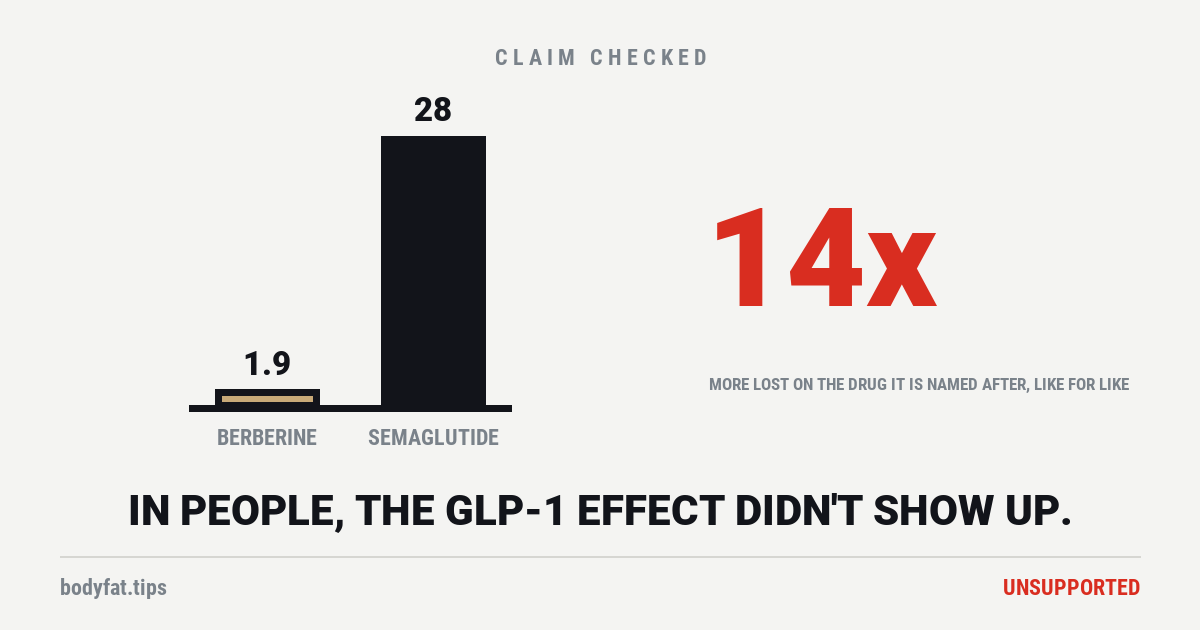
That is how much more weight people lost on berberine than without it, when fifteen randomised trials were pooled together last year. [1] Not per week. Total.
Semaglutide — the drug in Ozempic, at the weight-loss dose sold as Wegovy — beat a dummy injection by 28 pounds in the trial that made it famous. [2]
So let us put those next to each other, because nobody selling you the first one ever does.
“Nature’s Ozempic” against the drug in Ozempic
Both bars come from the strongest evidence that exists for each compound. The berberine figure is a mean difference of −1.9 lb (−0.88 kg) from the 15 randomised controlled trials that reported weight, out of 23 in a review published in the International Journal of Obesity in 2026. Five of the 15 tested barberry, one of the plants berberine comes from, as a dried fruit or an extract, and one tested a drug that pairs berberine with a bile acid; the trials the review classed as berberine give the same 1.9 lb on their own. The trials were mostly in adults who already had a health problem: type 2 diabetes or high blood fats (five trials), fatty liver (three), polycystic ovary syndrome (two) and others, including one in people with schizophrenia-spectrum disorders. [1] The semaglutide figure is STEP 1 — 1,961 adults without diabetes, 68 weeks, double-blind, placebo-controlled, in the New England Journal of Medicine. The 1,306 given semaglutide 2.4 mg lost 33.7 lb (15.3 kg) and the 655 given a placebo lost 5.7 lb (2.6 kg): a difference of 28.0 lb (12.7 kg). [2]
A mean difference is just the average gap between the treated group and the control group, in the units of the thing being measured. Here that is pounds on a scale.
About fourteen times, measured the same way: both bars are the gap between people given the treatment and people who were not. Is it unfair to berberine that its trials mostly lasted about three months and semaglutide’s ran 68 weeks? A trial that gave berberine for six months to 337 adults with obesity and fatty liver, double-blind — neither the patients nor the researchers knew who was getting what — ended with the berberine group no lighter than the placebo group. [15]
In STEP 1, half the people on semaglutide lost 15% or more of their body weight. [2] Nothing in the trials behind the berberine figure comes close: the biggest gap any one of them found between berberine and its comparison group was 5.3 lb (2.4 kg). [1]
The name is borrowed from a mechanism that has not shown up in people
“Natural GLP-1” is the whole pitch. GLP-1 is a gut hormone released after you eat; it tells your pancreas to release insulin and tells your brain you have had enough. Semaglutide is a manufactured molecule that mimics it and stays in your system for days.
So does berberine raise GLP-1?
In rats, yes. In 2009, researchers gave streptozotocin-diabetic rats berberine for five weeks and measured more GLP-1 in plasma and intestine, more proglucagon messenger RNA, and more of the intestinal L cells that make the hormone. [12] A follow-up in 2010 repeated it in normal rats and in NCI-H716, a cell line grown in a dish. [13]
That is where the idea comes from. It is genuine science and it is interesting.
In people, it has not shown up. In a double-blind trial published in 2021, 300 adults in China with newly raised blood sugar were split four ways for 16 weeks: berberine (500 mg twice a day), a probiotic (a bacteria supplement), both, or a placebo. GLP-1 in their blood was measured at the start and at the end. Berberine moved it no more than the placebo did; in the authors’ words, the changes “were similar among the groups”. [16] The authors add a caution worth keeping: GLP-1 does its work in the vein that carries blood from the gut to the liver, and is broken down within about 90 seconds, so a blood test could miss an effect there. Their conclusion is that evidence that berberine regulates GLP-1 in people “is still absent”. [16] A smaller trial in 16 healthy men, registered to measure the same hormone after a single 1 g dose, finished in April 2023 and has posted no results; we found no paper from it. [17]
A 2025 review in European Journal of Medical Research subtitled “from pharmacological mechanisms to clinical evidence” tabulates berberine’s obesity mechanisms in detail. [14] Every GLP-1 entry in it is an animal: obese mice, overweight mice with induced polycystic ovary syndrome. Not one is a person, and the 2021 trial is not among its references.
Read that back against the marketing. The category is named after a hormone effect demonstrated in rodents and cell culture, not found when it was measured in people, and sold to humans as an alternative to a drug whose own effect on humans was measured in 1,961 of them over 68 weeks.
This does not mean berberine does nothing: in that trial it lowered fasting blood sugar more than the placebo did. [16] It means the specific story being told about how it works — the story the nickname depends on — was looked for in the species buying it, and did not turn up. That makes this verdict stronger than when we first wrote it. The mechanism is no longer untested in people. It was tested, and it did not show up.
The awkward part: the berberine studies disagree with each other
Here is where most coverage picks the number it likes and moves on. We are going to show you five of them.
| Analysis | Trials with weight data | Weight change |
| Xiong 2020 | 5 of 10 | −0.2 lb — not significant |
| Amini 2020 | 12* | −0.2 lb — not significant |
| Asbaghi 2020 | 12* | −4.6 lb |
| Zamani 2022 | 21 of 49 | −1.9 lb |
| Elahi Vahed 2026 | 15 of 23 | −1.9 lb |
Five pooled analyses of substantially the same literature. [1][3][4][18][19] One of them — Xiong 2020, pooling the five of its ten trials that reported weight — found no significant effect on body weight at all: −0.11 kg, with a confidence interval running from −0.99 to +0.76 and a p-value of 0.79. [3] A confidence interval is the range the true answer probably sits inside. When it crosses zero the way that one does, “does nothing” is still very much on the table.
Another from the same year, which also counted trials of barberry, found the same −0.2 lb (−0.11 kg), not significant either. [18] A third, also from 2020, found −4.6 lb (−2.07 kg). [4] A 2022 analysis found −1.9 lb (−0.84 kg) [19], and the newest lands at −1.9 lb (−0.88 kg). [1]
When five teams pool overlapping sets of the same trials and get answers ranging from nothing to 4.6 lb, that is not a signal being refined. That is a small effect being pushed around by which studies you let in.
Why the effect is so small: almost none of it gets into you
Berberine has a pharmacokinetic problem that is not a matter of opinion. Its oral bioavailability — the fraction of a swallowed dose that actually reaches the bloodstream — is less than 1% [7], a figure that comes from studies in rodents. [14]
If people absorb it the same way, a gram swallowed puts under ten milligrams where it could do anything systemic. The amount measured in people’s blood after a 500 mg dose is counted in billionths of a gram per millilitre [14], and a 2022 review of what the body does with berberine puts the share that passes out in the feces at 11% to 23%. [7] The same review names its poor solubility and absorption as what restricts its clinical use [7], and that is a plausible mechanical reason a compound with genuinely interesting activity in a petri dish keeps producing modest results in people.
So what does it actually do?
Something. Mostly to blood sugar and blood lipids, and mostly in people who already have a metabolic problem.
The claim that berberine “works like metformin” rests on small trials like a 2008 study in Metabolism that its own authors call a pilot study. [6] Thirty-six adults with newly diagnosed type 2 diabetes were randomised to berberine or metformin for three months. The result, in the authors’ words: “The hypoglycemic effect of berberine was similar to that of metformin.” HbA1c — a rough three-month average of blood sugar — fell from 9.5% to 7.5%.
That is a real result and it is worth taking seriously. It is also thirty-six people, for three months, in one trial, in 2008. In the same paper, 20 of the 58 people who took berberine across its two studies (34.5%) had gastrointestinal side effects.
The finding that should decide this for you
In 2025 a team did something more useful than another meta-analysis: they assessed the quality of fifty-four systematic reviews of berberine, using the standard tools for the job. [5]
AMSTAR-2 rates how well a review was actually conducted. Of the 54, one came out high quality. Eight were low. Forty-five were rated very low. Separately, GRADE — which rates how much confidence the evidence itself deserves — rated 312 of the 452 outcome results it graded as very low, its lowest band, and another 110 as low.
And then the part that ought to be printed on the bottle. The review sorted outcomes by disease. Gastrointestinal conditions: 95% of outcomes improved. Type 2 diabetes: 93%. Dyslipidaemia: 100%. Metabolic syndrome: 91%.
Obesity: 57%. Four outcomes out of seven. The worst of all nine categories.
Berberine improved the smallest share of outcomes in precisely the area it is marketed for hardest, although its body-mass-index result was one of only eight in the whole overview rated high certainty. The reviewers also noted that the obesity reviews heavily overlap — they are re-pooling the same handful of trials, which makes a stack of papers look like a stack of evidence.
Berberine versus metformin, since that is the other comparison
Metformin is a prescription drug with sixty years of use, a known dose response, and outcome data running to cardiovascular events and death. Berberine has a handful of small, short trials against it. A 2012 review found seven that compared berberine with metformin or other diabetes pills — 15 to 51 people each, 8 to 13 weeks, all in China — and found no significant difference in blood sugar, while judging the trials’ methods generally low in quality. [20] The 2008 pilot is one of the seven. [6]
“Similar in a pilot” and “equivalent” are not the same statement. A trial of 36 people is large enough to detect a big difference and far too small to rule out a meaningful one. No regulator anywhere would licence a diabetes drug on it, and the authors themselves called it a pilot study in the abstract.
There is also a practical problem that has nothing to do with efficacy. Metformin arrives at a known dose of a known compound, and berberine arrives at whatever the manufacturer put in the capsule. The 2026 meta-analysis said this plainly when listing what future trials need to fix: purity, potency and gram amounts are not being reported. [1] If the trials cannot tell you what they tested, a bottle cannot tell you what you are taking.
Dose, timing, and how long before anything happens
These are the questions people actually type, so here is what the evidence supports and where it runs out.
Dose. The trials cluster around 500 mg taken two or three times a day — the 2008 study used 0.5 g three times daily. [6] That is the tested range. It is not a recommendation. Two bottles both saying 500 mg are not necessarily delivering the same thing, because of the purity problem above, and, as the safety section below explains, Europe’s food-safety authority has not found any intake it can call safe.
Timing. Split doses with meals is what the trials did, and there is a mechanical reason it makes sense rather than a mystical one: berberine is poorly absorbed and hard on the stomach. In the 2008 study, 20 of the 58 people who took it had gastrointestinal side effects, short-lived and in most cases confined to the first four weeks; most of those whose dose had to be cut were also taking metformin or acarbose, and nobody taking berberine on its own had severe ones. [6] Spreading it out and taking it with food is about tolerating it. The popular claim that a particular hour of day unlocks the effect is not something these trials tested.
How long. Most of the fifteen trials pooled for weight ran about three months (the range was 7 to 20 weeks), and the pooled effect at the end of them is the 1.9 lb above. [1] If you are asking how long until it works, the honest answer is that the studies measuring the thing you are hoping for ran about three months and found about two pounds. The six-month trial found no difference: people on berberine lost 4.0 lb (1.8 kg), people on the placebo 4.2 lb (1.9 kg). [15]
The safety conversation nobody has
“Natural” is doing a lot of work in this category, so here is what has actually been measured.
It changes how much of other drugs gets into you. In 52 kidney-transplant recipients taking cyclosporin A — the drug that stops the body rejecting the new organ — adding berberine left trough blood levels 29.3% higher than in 52 patients randomly assigned to go without it, and raised total drug exposure by 34.5% in a separate study of six patients that measured how much of the drug reached the blood over time. [8] That is a real interaction in real patients with a drug where the dose window is narrow.
How does it do that? Probably in more than one way. In rats, berberine produced “no significant changes in CYP3A activity” — CYP3A being the family of liver and gut enzymes that break down many drugs — but blocked intestinal P-glycoprotein, a pump in the gut wall whose job is to push absorbed drug molecules back out. Block the pump, more drug stays in: in those rats, exposure to the heart drug digoxin rose to as much as 170% of what it was without berberine. [9] In people, the enzymes did move. In a randomised crossover trial, 17 healthy men took berberine (300 mg three times a day) for two weeks and a placebo for two weeks, in random order. On berberine, their exposure to midazolam, a sedative used to measure the enzyme CYP3A4, rose by about 40%, and two other drug-clearing enzymes, CYP2D6 and CYP2C9, slowed as well. [21] The transplant study’s own authors put their result down to CYP3A4. [8]
It can drop blood sugar in people who are not diabetic. In 2025, an athletic man in his forties arrived at an emergency department after collapsing, with a blood glucose of about 16 mg/dL (0.9 mmol/L) — profoundly low. He was taking berberine as a performance supplement. His clinicians noted that berberine-induced hypoglycaemia had previously only been reported in people with diabetes, and believe this was the first reported case involving exercise. [10]
That is one case report. One. It is not evidence that this happens often, and it should not frighten anybody off. It is evidence that the compound is pharmacologically active enough to matter, which is the opposite of the thing being sold as gentle because it comes from a plant.
Europe’s food-safety authority has not found a safe intake. In January 2026 the European Food Safety Authority’s nutrition panel endorsed a draft opinion on supplements made from 13 berberine-containing plants, among them barberry root and bark and goldenseal. It found signs, in laboratory tests on cells, that berberine can damage genes — a concern it says still has to be checked in living animals — and concluded that “no safe intake can currently be established for any of these berberine-containing plant preparations”. [22] It is a draft, not a final opinion: the public consultation ran from March to May 2026, and the authority’s deadline for the final version is February 2027. [22]
France’s food-safety agency, ANSES, had already concluded in 2019 that the safety of these supplements “cannot currently be guaranteed”, and advised children and adolescents, pregnant and breastfeeding women, people with diabetes, and people with liver or heart disorders not to take them. Unable to set a proper safe limit, it set a provisional one: 0.1 mg a day for a 132 lb (60 kg) adult, a level it said a large number of supplements on sale in France probably exceed. Belgium, it noted, caps berberine in supplements at 10 mg a day. The trials on this page mostly tested 1,000 to 1,500 mg a day. [23] Neither agency’s view is a finding about weight, and neither changes this page’s rating.
And if it arrives as a patch, it is not legal
A 2026 paper in Annals of Pharmacotherapy went looking at the transdermal end of this market and found 24 “natural GLP-1” patch products plus one gel, carrying an average of seven ingredients each, with berberine among the most commonly listed. [11]
The finding is not subtle. Under the Dietary Supplement Health and Education Act, a dietary supplement has to be swallowed. A supplement you stick on your skin does not meet the definition, which means, in the authors’ words, “all these products are illegal.” [11] None posted a certificate of analysis. Many were missing the required FDA disclaimer. Many, the authors write, used deceptive advertising.
Set aside whether a patch could push through intact skin a compound that barely reaches the blood even when swallowed. The products are not lawful supplements in the first place.
The verdict
Berberine is not nature’s Ozempic, and the gap is not a matter of degree. In a double-blind trial of 1,961 adults, the 1,306 given semaglutide lost an average of 33.7 lb, 28 lb more than the placebo group. The supplement moves about 1.9 lb more than a comparison group across 15 trials, in pooled analyses that cannot agree with each other, off a literature where 45 of 54 reviews were rated very low quality and obesity had the smallest share of improved outcomes in the set. A six-month double-blind trial in adults with obesity found no difference at all. [15]
What berberine plausibly does is nudge blood glucose and blood lipids in people who have a metabolic problem to begin with. That is a genuine and unglamorous finding, and it is not what anybody is buying it for.
If you have type 2 diabetes, or take any regular prescription medicine — above all one where the dose has to be exact, such as cyclosporin — this is a conversation with your doctor before it is a purchase. Berberine demonstrably changes the amount of some other drugs in your bloodstream, and Europe’s food-safety authority, in its January 2026 draft, could not name any intake of berberine-containing plant preparations it considers safe. France’s food-safety agency advises pregnant and breastfeeding women, children and teenagers, and people with diabetes or liver or heart disorders not to take it at all.
And if what you actually want is the thing the nickname is borrowing from, the honest answer is that the nickname is borrowing from a prescription drug, and that is a conversation with a clinician too.
What would change this verdict: a large, properly blinded trial of a standardised, purity-tested berberine preparation, running longer than twelve weeks, in people whose weight is the primary endpoint. The 2026 reviewers asked for exactly that — they specifically flagged that trials are not reporting purity, potency, or gram amounts. [1] The nearest thing so far is the six-month trial above, which set out to measure the fat packed around the abdominal organs and the fat in the liver rather than weight; neither those nor weight moved more than on the placebo. [15] Until a trial like that says otherwise, the best estimate for this claim is about two pounds, and the range the true average probably sits in runs from just under one pound to three. [1]
Related: apple cider vinegar benefits · is creatine safe · does coffee help you lose weight · do detox teas work
An independent editorial review on 18 September 2026 found that this page’s central comparison did not compare like with like, and that the mechanism we said nobody had measured in a person had been measured. Berberine’s 1.9 lb is already a difference against a comparison group. We set it against semaglutide’s own loss of 33.7 lb, called the gap seventeen-fold, and wrote that measuring both against placebo would widen it. It narrows it: semaglutide beat placebo by 28 lb (12.7 kg), about fourteen times berberine’s figure, and the headline, chart, search description and verdict now use that number. The trial tested semaglutide at 2.4 mg, the dose sold as Wegovy; Ozempic is the same drug sold for type 2 diabetes. We also wrote that we had searched for a trial measuring GLP-1 in people given berberine and found none. A double-blind trial published in 2021 did, and berberine moved GLP-1 no more than placebo; GLP-1 is not mentioned in its PubMed abstract, which is how our search missed it. That makes the verdict stronger. And we called the usual CYP3A explanation for berberine’s drug interactions wrong, on the strength of a study we did not say was in rats; a trial in healthy men found berberine does slow CYP3A4, so the page now gives both.
Also corrected. The 1.9 lb pooled the 15 of the review’s 23 trials that reported weight, five of them testing barberry and one a berberine-based drug; Xiong 2020’s weight result pooled five trials, not ten; there are at least five pooled analyses, not three, and the table now shows five; GRADE rated 312 of 452 outcome results very low, not 110 of 140, and obesity had the smallest share of improved outcomes, not the weakest evidence; berberine has several small trials against diabetes drugs, not one; the 34.5% with gut side effects was 20 of 58 people across both parts of the 2008 study; the under-1% absorption figure comes from rodents; and the transplant comparison group was randomised, not matched. The funding row said nothing was stated: Novo Nordisk funded and designed the semaglutide trial, and drug companies supplied the tablets for two berberine trials now cited. We said berberine is not dangerous. Europe’s food-safety authority, in a January 2026 draft, found no intake of berberine-containing plant preparations it could call safe, and France’s agency advises pregnant and breastfeeding women, children and teenagers, and people with diabetes or liver or heart disorders not to take it; the safety section now says so, and the page adds a six-month trial published in January 2026 in which weight did not move. We removed an unsourced comparison with weight swings between a Tuesday and a Friday, and “the ceiling on this claim is two pounds”, which treated an average as a limit. The headline changed from “Ozempic Is 34” to “Semaglutide Is 28”. The rating is unchanged: Unsupported.