Apple Cider Vinegar Benefits: Real for Blood Sugar, About 2 lb for Weight. The Headline Trial Was Retracted.

Something real is in here.
It is smaller than advertised, it is not the benefit printed on the gummy bottle, and the single most-quoted study behind the weight-loss claim has been retracted.
It is still online, marked as retracted, but it no longer counts as evidence. Not everything built on it has caught up.
The trial behind the headlines was retracted
In March 2024, BMJ Nutrition, Prevention & Health published a randomised, double-blind, placebo-controlled trial of apple cider vinegar in 120 overweight and obese adolescents and young adults, aged 12 to 25, in Lebanon. Twelve weeks. Weight down, blood glucose down, triglycerides down, cholesterol down. The paper concluded that apple cider vinegar “could be a promising antiobesity supplement that does not produce any side effects.” [2]
It went everywhere. Its findings were press-released on publication, and when the publisher, BMJ Group, retracted the paper, it said they had “generated widespread international attention at the time, and continue to be frequently referred to in media coverage” [19].
On 23 September 2025 the journal retracted it. [1]
The retraction notice is public, and it is specific. On what prompted the review: “Wide ranging concerns were raised about the quality of the work after publication, including the approach to statistical analysis of the dataset; implausible values; concern about the reliability of the underlying dataset; inadequate reporting of the work; and absence of prospective trial registration.”
And on the decision itself: “The paper is being retracted because the authors’ analyses could not be replicated and multiple errors were identified. The authors supplied dataset also demonstrated patterns inconsistent with random allocation of participants to treatment groups, improbably small p-values given the limited number of participants included in the study.”
Two of those phrases do real work, so here is what they mean. Patterns inconsistent with random allocation — when you split people into groups at random, the groups come out slightly lumpy, the way coin flips do. Data that looks too tidy is a sign that something other than chance did the arranging. Improbably small p-values — a p-value is roughly how surprised you should be by a result if nothing were really happening. Very small ones are hard to produce from 120 people. Several of them is harder still.
The authors’ response is in the notice too, and it belongs here: they say the discrepancies were “honest mistakes that arose from version mismatches, data rounding or formatting differences when exporting from statistical software to reporting spreadsheets.” They agreed with the decision to retract, and the notice records that they were upfront about the missing trial registration. The paper was withdrawn with their agreement, not over their objection.
So that is one study, corrected. The system worked. Why is this still the most interesting thing on the page?
Because a retraction does not reach backwards
Four days before the retraction — on 19 September 2025 — a systematic review and meta-analysis appeared in Nutrients. It pooled ten randomised trials of apple cider vinegar and body composition, 789 participants in total, and concluded that daily intake significantly reduced body weight, BMI and waist circumference. [3]
The retracted trial is in it. Reference 44.
And it is not a bit player. The review singles it out by name as one of only four trials that “reported a significant reduction in both in body weight and BMI and in metabolic parameters.”
Concerns about the trial were in print before that review ran its search. In December 2024 the journal published the trial authors’ reply to what its title calls “statistical and data concerns”, and in February 2025 a letter headed “Improbable data characteristics and extreme effects of apple cider vinegar on weight loss” [2]. The review’s last search ran on 27 March 2025; it was submitted in July and published on 19 September, four days before the retraction [3]. It rated the trial one of its two at low risk of bias, so the trial stayed in when the review tested its own result by setting aside the trials at high risk [3].
What happens next is the problem. We checked on 3 August 2026 — ten months after the retraction. The meta-analysis carries no correction, no editor’s note, and no flag of any kind, in either PubMed’s corrections record or Crossref’s. It still carried none when we checked again on 18 September 2026. PubMed correctly labels the original trial a Retracted Publication. The meta-analysis that pooled it is still labelled a systematic review and meta-analysis, as though nothing had happened.
And it has already moved upward. A 2026 umbrella review in Food Science & Nutrition — an umbrella review being a review of other reviews, which sits near the top of the evidence pyramid — discusses the Nutrients meta-analysis in its own assessment of whether vinegar changes body weight. [4]
To be precise, because the stronger version of this claim would be wrong: the umbrella review cites that meta-analysis, it does not pool it. Its own search closed in January 2025. But the citation is there, unqualified. So is the retracted trial itself, which the review cites in its introduction as research on obesity, though it is not among the 38 trials the review pooled. The review was submitted in November 2025, two months after the journal published the retraction, and revised in April 2026, a month after the retraction notice reached PubMed; the word “retraction” appears nowhere in its text [1][4].
This is the thing worth taking away, and it is bigger than vinegar. A retraction removes a paper. It does not go back through everything built on top of that paper and take the brick out. The literature keeps the shape the brick gave it.
So does it actually do anything to your weight?
With the 2024 trial gone, the load-bearing study is much older, and it is a better piece of work.
Kondo 2009. [5] A hundred and fifty-five Japanese adults finished it, aged 25 to 60 and on no medication, with a BMI — weight relative to height — of 25 to 30. Japan’s criteria count that as obese; the World Health Organization, whose line for obesity is 30, does not. To take part, their triglycerides, a blood fat, had to be between about 100 and 250 mg/dL (1.13 to 2.83 mmol/L). Twelve weeks, double-blind, three groups: a daily drink containing one tablespoon of vinegar, two tablespoons, or none. Everyone kept food diaries and wore a pedometer, and there was no significant difference between the groups in calories, protein, fat, carbohydrate, fibre or steps walked. Visceral fat — the fat around your organs, as opposed to the fat under your skin — was measured by CT scan, not estimated.
At twelve weeks, against a placebo group that gained 0.9 lb: one tablespoon a day lost 2.6 lb (1.2 kg), two tablespoons lost 4.2 lb (1.9 kg). Dose-dependent, statistically significant, visceral fat down. As trials in this corner of nutrition go, that is a good one.
Two things about it rarely travel with the numbers.
First, who ran it. All five authors list the same affiliation: the Central Research Institute of the Mizkan Group Corporation. Mizkan is one of the largest vinegar manufacturers in the world. That does not make the result false, and the trial’s design is genuinely careful. It does mean that the most-cited human evidence that vinegar causes weight loss was produced by a vinegar company, and you are entitled to file it accordingly.
Second, and this is the one nobody quotes: the study kept measuring after people stopped drinking it.
| Group | At 12 weeks | 4 weeks after stopping |
| Placebo | +0.9 lb | +0.7 lb |
| 1 tbsp a day | −2.6 lb | 0.0 lb |
| 2 tbsp a day | −4.2 lb | −0.9 lb |
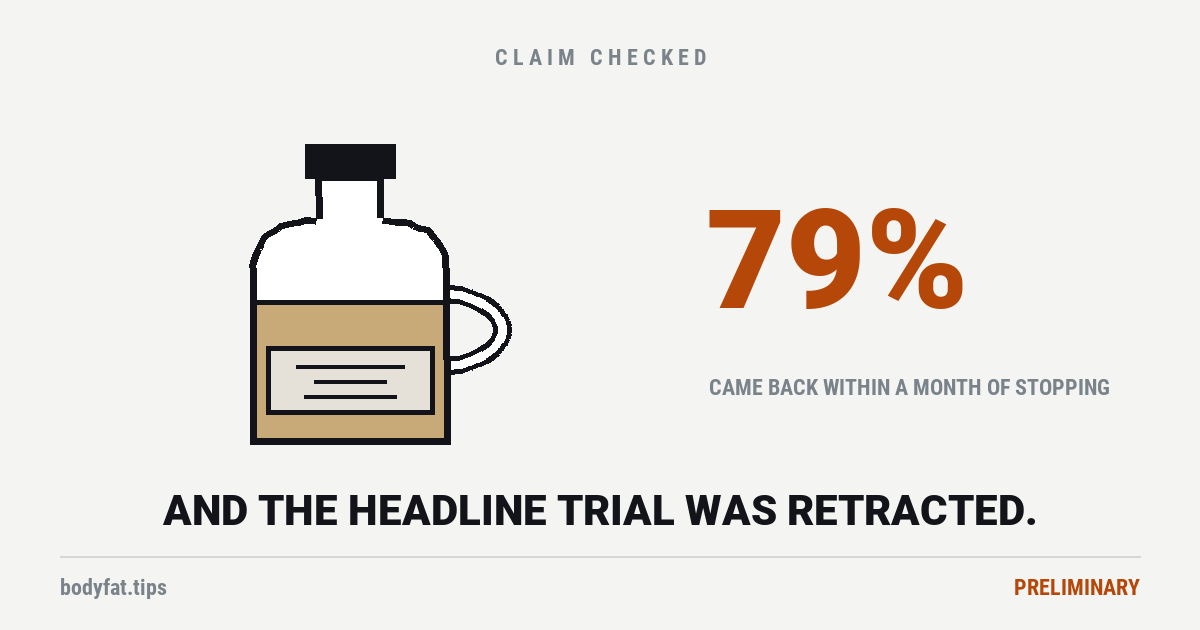
Four weeks after the vinegar stopped, the one-tablespoon group weighed 74.9 kg. That is exactly what they weighed on day one. Every pound back. The two-tablespoon group gave back 3.3 of their 4.2 lb — about 79% of the loss, in a month — though, allowing for where each group started, they were still lighter than the placebo group by more than chance would explain [5].
So the honest version of the best trial available reads: roughly four pounds over three months on two tablespoons a day, most of which comes back shortly after you stop.
Why would it come back? What follows is our reasoning, not a finding, and it is labelled as such. The popular explanation is fullness: vinegar can slow how fast the stomach empties — measured directly in a small study of people with gastroparesis that we come back to below [9] — and a fuller stomach might mean eating a little less. But this trial’s food diaries found no difference in calories between the groups [5], and in a study of 16 young adults of normal weight, the appetite vinegar took away came with nausea, which the researchers judged largely responsible [14]. The trial’s own authors point instead to animal studies in which acetic acid slowed the body’s fat-making, and say that still needs confirming in people [5]. So if vinegar takes weight off, nobody has shown how. What the trial does show is that whatever it does stops when the vinegar stops.
The pooled numbers point the same way and are smaller still. The 2026 umbrella review puts vinegar’s effect on body weight at −2.3 lb (1.06 kg), from twelve trials and 918 people, none of them the retracted trial; the range the true average probably sits in runs from about 1.1 to 3.5 lb (0.52 to 1.60 kg) [4]. The twelve agreed closely. Their heterogeneity score — the share of the spread in their results that reflects real disagreement rather than chance — was 11%. And the reviewers rated the figure high certainty, their top grade, meaning they are confident the true effect is close to it [4].
So why is this page not rated higher? Because of what sits under that grade. The review’s grading table, in its supplement, marks the risk of bias in those twelve trials “very serious”, noting that more than a fifth of them were at high risk on at least one count and that “those biases had a significant effect on the results of RCTs”. It still rates the result high, crediting a pattern of bigger doses doing more, and a judgement that anything it could not account for would make the effect look smaller, not bigger [4]. Its own check of the individual trials rated nine of the twelve low quality, two high and one, the Japanese trial above, fair. They lasted eight weeks on average and twelve at most. The one that kept weighing people after the vinegar stopped saw most of the loss come back within a month. And in the same analysis, BMI and waist circumference showed no significant effect; the reviewers suggest the BMI result differs because different study populations were pooled for it [4].
The benefit that is real is the one nobody sells
Blood sugar. Specifically, what your blood sugar does in the hour or two after you eat.
A 2017 meta-analysis of controlled trials found that taking vinegar with a meal significantly reduced both the glucose and the insulin response afterwards. [6] The glucose effect came out at a standardised mean difference of −0.60, the insulin effect at −1.30. A standardised mean difference is a way of putting different studies on one scale: 0.2 is small, 0.5 is moderate, 0.8 is large. So that is a moderate effect on glucose and a substantial one on insulin.
The 2026 umbrella review, working across ten meta-analyses and 38 underlying trials, lands in the same place and grades its confidence outcome by outcome. [4] Fasting blood glucose down 9.40 mg/dL and after-meal glucose down 14.59 mg/dL, both rated moderate certainty. HbA1c — a rough three-month average of your blood sugar — down 0.70 points, also moderate certainty. Systolic blood pressure down 2.94 mmHg, rated high certainty.
And the things it did not find: no significant effect on fasting insulin, insulin resistance, LDL, HDL, triglycerides, BMI, waist circumference or diastolic blood pressure. Total cholesterol did move, but the reviewers rated that one very low certainty, which is their way of saying do not lean on it.
One caveat that deserves to be visible rather than buried. The HbA1c result carries enormous disagreement between studies. An earlier meta-analysis put the figure at −0.50 with a heterogeneity score of 91%. [7] Heterogeneity is how much the individual trials disagree with one another beyond what chance would produce; at 91%, nearly all the spread in their results is real disagreement rather than noise. The umbrella review’s glucose results are no steadier: 93.6% to 98.1% for fasting glucose, after-meal glucose and HbA1c [4]. An average computed across studies that found wildly different things is still an average, but it is a shakier object than a single number looks.
That same analysis contradicts itself on one point, and it is worth knowing which half to believe. Its summary says that in apparently healthy participants, vinegar appeared to raise fasting glucose. Its own results table and results section say the opposite: the only non-diabetic data it pooled, the two vinegar groups of the Japanese weight trial above, came out 3.53 mg/dL lower than placebo [7], and that trial itself found no significant difference in fasting glucose between its groups [5]. What the analysis did find is that the higher people’s fasting glucose was to start with, the bigger the fall [7] — which suggests that someone whose blood sugar is normal has the least to expect from vinegar.
None of this makes vinegar a treatment. It is a food that nudges a curve. If you have diabetes, this is a conversation to have with the person managing your care, not a substitution to make on your own — and there is a specific reason for that, coming up next.
The gummy problem
Almost nobody asking this question is drinking vinegar. They are buying gummies.
Here is the uncomfortable history. In 2005, after an adverse event was reported to them, a group of researchers tested eight apple cider vinegar tablet products for pH, acid content and microbial growth, and compared what they found with the labels. [8]
They found “considerable variability… between the brands in tablet size, pH, component acid content, and label claims.” Then they wrote the sentence that ought to have ended the category: “Doubt remains as to whether apple cider vinegar was in fact an ingredient in the evaluated products.”
They could not confirm the products contained apple cider vinegar.
That was tablets, it was 2005, and eight products is eight products. Gummies have been tested since, by a testing company rather than in a journal. In 2020 ConsumerLab, a US company that tests supplements and sells its full reviews to members, bought popular apple cider vinegar tablets, capsules and gummies, along with bottled vinegars, and tested each for real apple cider vinegar, by its chemical fingerprint, and for acetic acid, the compound thought to do the work [15]. Its public summary: the supplements held 14 to 51 mg of acetic acid, “just a small fraction” of the 700 to 800 mg or so in most of the bottled vinegars, and two held 20% less than their labels promised. Getting 750 mg of acetic acid — what the one-tablespoon group in the Japanese trial drank each day [5] — cost 6 cents from a bottled vinegar and more than $20 from one of the supplements [15]. We have read only the public summary and methods; the full results are for paying members. We found no test of these products in a journal, and no trial of a vinegar gummy for weight or blood sugar.
But the logic runs the other way from how it is sold. Everything above — the glucose curve, the slowed stomach, the modest weight effect — depends on acetic acid, in a measured dose, taken with food. The trials gave vinegar as a drink: in the weight trial, a flavoured, artificially sweetened one after breakfast and after supper [5]; in the blood-sugar trials, with a meal [6]. A sweetened gummy taken whenever is a different object, and the evidence does not transfer to it just because the label uses the same three words.
What it can do to you
The adverse event that prompted that 2005 product test was an oesophageal injury caused by an apple cider vinegar tablet. [8] Mayo Clinic’s advice for patients warns that a vinegar tablet that gets stuck in the throat “may cause long-lasting pain”, because of the acid [16].
Teeth are the everyday risk: acidic drinks can weaken enamel, the outer layer of the teeth, over time [16]. In 2012 a Dutch dental journal published the case of a 15-year-old with erosive tooth wear that was traced, after a full workup and a study of the erosion pattern, to a daily glass of apple cider vinegar. [10] The same paper contains a detail worth keeping: in North African culture, the authors note, women have used apple cider vinegar for weight loss for generations, and bodybuilders are known to use it the same way. This practice is much older than the industry currently selling it.
The gastric emptying finding is the one that matters clinically. A 2007 crossover study in ten people with type 1 diabetes and diabetic gastroparesis — a condition where the stomach already empties too slowly — measured emptying by ultrasound with and without 30 mL of apple cider vinegar. The rate fell from a median of 27% to 17%. [9] The authors concluded this “might be a disadvantage regarding to their glycaemic control.” The mechanism that helps a healthy person is a liability if your stomach is already the problem.
Two case reports round it out, and they are case reports — single patients, no control group, no way to know how common any of it is. In 1998, a kidney journal described low blood potassium, elevated renin and osteoporosis in a patient who had been ingesting large amounts of cider vinegar. [11] In 2025, a case report described liver injury in a 60-year-old man with a long history of vinegar consumption, which improved after he stopped. [12]
Neither is a reason for alarm. They do not even share a dose. The 1998 patient had been taking large amounts [11]. The 2025 patient reported about 2 tablespoons (30 mL) after meals, three times a week, for four years — less, week by week, than even the lower dose in the Japanese trial — and the report’s authors call liver damage an uncommon side effect of long-term use [12]. So “more is better” is not a plan, and a habit kept up for years is worth mentioning to your doctor.
If you are going to do it anyway
Nothing here says don’t. It says know what you bought.
The weight trial tested one or two tablespoons (15 or 30 mL) a day, each day’s dose split between a drink after breakfast and one after supper [5]; the blood-sugar trials gave it with a meal [6]. The morning-on-an-empty-stomach routine you may have read about is what the retracted trial tested [2]. Within the tested range, two tablespoons did more than one [5]; nothing here shows that going higher helps. Dilute it — never shots. Use a straw if you can, rinse with water afterwards, and do not brush your teeth straight away: the American Dental Association’s advice is to wait an hour before brushing after acidic foods, to give saliva a chance to wash the acid away and the enamel time to harden again [17].
Take it with food. That is where most of the glucose evidence sits. The before-bed ritual has one small trial behind it: eleven adults with type 2 diabetes took 2 tablespoons of apple cider vinegar or water at bedtime, each with an ounce of cheese, for two days apiece, and their waking blood sugar fell 4% after the vinegar and 2% after the water [13]. That is two days of morning blood sugar in people with diabetes. It says nothing about weight.
And talk to a doctor first if you take medication for diabetes, including insulin; if you take a diuretic, the water pills common in blood-pressure treatment; if you have gastroparesis or any condition that slows digestion; or if you have low potassium. Those are not generic disclaimers — each one maps to a finding above, and Mayo Clinic names diuretics and insulin because, taken with vinegar, they may leave potassium too low [16].
The verdict
Apple cider vinegar does something. It blunts the blood-sugar rise after a meal, reliably enough to have survived several meta-analyses, and it probably nudges body weight down by a couple of pounds over a few months. How, nobody has shown: the careful trial found no drop in calories.
It is not a fat burner. The trial that made it look like one was retracted, the best surviving trial was run by a vinegar company and showed most of the weight coming back within a month of stopping, and the pooled effect on your waistline is not statistically distinguishable from nothing.
We have it at Preliminary rather than Unsupported, because there is a real signal here: twelve trials agree on a small weight loss, and the blood-sugar effect has survived several pooled analyses. Pretending otherwise would be its own kind of dishonesty. And Preliminary rather than Supported, because those weight trials ran twelve weeks at most, the umbrella review’s own grading marks their risk of bias very serious, the trial this page leans on was run by a vinegar company, and in the only one that kept weighing people after they stopped, most of the loss came back within a month. What would move it: a large, independently funded, pre-registered trial running well past twelve weeks, with a follow-up period after the vinegar stops. That last part is the one that keeps not being done — and on the evidence of Kondo’s own four weeks after stopping, it is the part that would settle it.
If you want a version of this that costs nothing, there is one, though its evidence is thinner, not better: eat the vegetables before the starch. Pooled across 18 small trials, that lowered blood sugar in the first hour after a meal, at what the reviewers rated very low certainty — their lowest grade, meaning the real effect could be quite different — and blood sugar ran slightly higher at two hours [18]. Nobody has to sell you a gummy for it.
Related: does lemon water help you lose weight · does drinking water help you lose weight · do detox teas work · is oatmeal good for weight loss
An independent editorial review on 18 September 2026 found that this page understated the weight evidence and got three facts wrong. We gave the 2026 umbrella review’s certainty grade for every result except body weight, which it rated high certainty — twelve trials agreeing closely, none of them the retracted one — and our evidence panel called the weight effect heterogeneous. The page now gives that grade, and why we still rate the claim Preliminary: the same review marks those trials’ risk of bias very serious, and none ran past twelve weeks. We said a 2021 meta-analysis found that vinegar appeared to raise fasting glucose in healthy people; its summary says so, but its own results show a small fall. We said nobody had tested today’s gummies; a testing company did in 2020, and its public figures are now on the page. And we called the retracted trial’s place in a 2025 meta-analysis “just the calendar”, and said a 2026 review had “nothing in the record to point at”. In fact the journal had published concerns about the trial’s data before the 2025 review’s search closed, and the 2026 review cites the retracted trial itself and was submitted two months after the retraction.
Also corrected. We said vinegar probably works by making you fuller and called that a demonstrated mechanism; the trial found no drop in calories, and the fullness explanation is now labelled as our reasoning. The before-bed habit has one small trial behind it, in type 2 diabetes, where we said it had none. We said eating order had better evidence than vinegar; its reviewers rate theirs very low certainty. The dose advice now says what the weight trial actually did, after breakfast and supper in a flavoured, sweetened drink, and that two tablespoons did more than one; the wait before brushing is the American Dental Association’s hour, not half an hour; diuretics and insulin join the reasons to see a doctor first, and “kidney problems”, which matched no finding, comes off. The 2025 liver case involved about 2 tablespoons three times a week, not large amounts. The retracted paper is still online, marked as retracted, not gone. We now say who the 2009 trial studied, that its two-tablespoon group was still lighter than placebo a month after stopping, and we no longer say two things we could not confirm in the 2005 tablet study: that its authors bought the tablets, and how the injury happened. The claim our provenance chain traces is now the weight claim the rating is about, stated in our words rather than in quotation marks, because we found no one to quote. And our headline, “One Is Real, One Was Retracted”, read as if the weight effect had been retracted; the twelve trials that remain find about 2 lb, and the headline now says so. The rating is unchanged: Preliminary.