Is Red Meat Bad For You? Processed Meat Is The Real Answer

Two things are true and people keep picking one.
Processed meat has a consistent, dose-responsive association with cancer, replicated across dozens of cohorts and formally classified by the World Health Organization’s cancer agency.
And the size of that effect, once you convert it into what actually happens to people, is small — small enough that in 2019 a panel of researchers who reviewed six million participants’ worth of data concluded most adults could carry on as they were.
Neither of those is spin. Both come from the same kind of research: cohort studies, which follow large groups of people for years, record what they eat and count who falls ill. Getting why they coexist is the most useful thing on this page, and it will serve you for every health headline you read afterwards.
Is processed meat worse than red meat?
Yes, and this is the distinction almost every article blurs by saying “red meat” and meaning both.
Processed meat is meat preserved by smoking, curing, salting or adding chemical preservatives — bacon, ham, salami, hot dogs. Unprocessed red meat is mammal muscle that has had none of that done to it: a steak, a lamb chop, mince.
They are separate exposures with separate evidence, and every serious review analyses them separately. When you see a single number for “red meat”, somebody has usually averaged a bacon sandwich with a Sunday roast.
Does red meat cause cancer?
Here is the number everything rests on, from the 2011 meta-analysis that pooled the prospective cohorts [1].
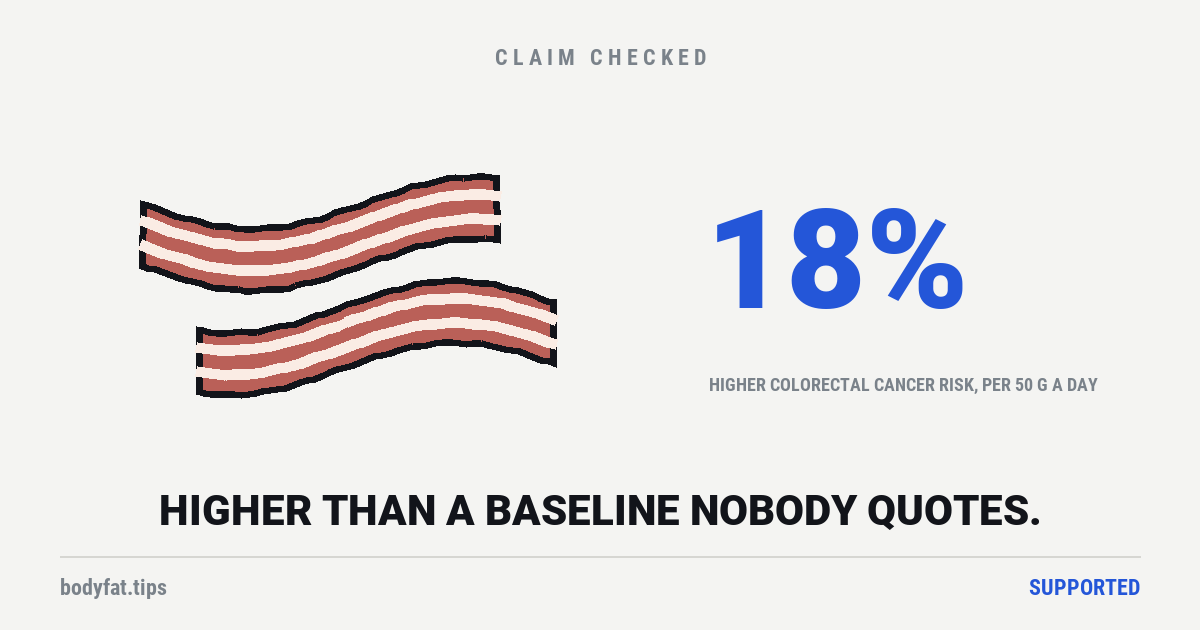
| Processed meat, per 50 g a day | 1.18 | 1.10–1.28 |
| Fresh red meat, per 100 g a day | 1.17 | 1.05–1.31 |
| Both combined, per 100 g a day | 1.14 | 1.04–1.24 |
| Rectal cancer: processed meat, per 50 g a day | 1.12 | 0.99–1.28, not significant |
| Rectal cancer: both combined, per 100 g a day | 1.31 | 1.13–1.52 |
Processed meat: 18% higher colorectal cancer risk per 1.8 oz (50 g) a day [1] — about six medium slices of cooked bacon, or a little less than one regular hot dog [11]. That is the figure the World Health Organization’s cancer agency cited, and it is the figure that went around the world.
Two details from the same paper almost never travel with it. For red and processed meat counted together, the risk climbs roughly in a straight line up to about 5 oz (140 g) a day and more slowly above that; the paper fitted that curve only for the two combined, not for processed meat alone [1].
And rectal cancer is a split result, not a blank. Taken separately, neither processed meat nor fresh red meat quite cleared the line researchers use for “probably not chance” in the dose analysis for rectal cancer: processed meat came out at 1.12 per 1.8 oz (50 g) a day, with a range of plausible answers from 0.99 to 1.28, which still includes no effect. The authors suggest that may be because there were fewer rectal studies. Counted together, red and processed meat was linked to rectal cancer at least as strongly as to colon cancer, 1.31 per 3.5 oz (100 g) a day against 1.25, and the paper’s conclusion names rectal cancer alongside colorectal and colon cancer [1].
What “Group 1 carcinogen” actually means
In 2015 the International Agency for Research on Cancer put processed meat in Group 1 and unprocessed red meat in Group 2A [2]. Group 1 also contains tobacco smoking, and the headlines wrote themselves.
They were wrong, and in a specific way worth learning.
An IARC group describes how confident the agency is that something can cause cancer. It does not describe how much cancer it causes. Processed meat and tobacco share a category because in both cases the evidence is strong, not because a bacon sandwich is a cigarette. Hazard is the question “can this do it at all?” Risk is “how likely is it to do it to you?” The classification answers the first and is silent on the second.
If that sounds familiar, it is because we have written it before. It is the same confusion that produced the aspartame cancer scare, where the same agency made the same kind of statement on the same day another WHO body said safety was not a major concern at normal doses.
The 18% is real. It is also not what you think.
A relative risk is a ratio. It tells you how much bigger one number is than another, and it tells you nothing at all about how big either number was to start with.
Eighteen percent more of a large risk is a lot. Eighteen percent more of a small risk is a small amount. The figure alone cannot tell you which situation you are in, which is precisely why it travels so well and informs so little.
So somebody did the other calculation. In 2019, two enormous systematic reviews — reviews that gather every qualifying study by a fixed, published method — went back over the cohort studies, casting a wider net than the 2011 analysis, and asked what the absolute effects look like: out of 1,000 people, how many end up with a different outcome.
The cardiometabolic review covered 55 cohorts and more than four million people, followed for anywhere from two to twenty-eight years [4]. The cancer review covered 56 cohorts and more than six million, followed for three to thirty-four years [5].
Their conclusions, in their own words. On heart disease and death: “The magnitude of association between red and processed meat consumption and all-cause mortality and adverse cardiometabolic outcomes is very small, and the evidence is of low certainty” [4]. On cancer: “The possible absolute effects of red and processed meat consumption on cancer mortality and incidence are very small, and the certainty of evidence is low to very low” [5].
But they did not ask it at the same dose, and the difference matters. The reviews did not rescale the 18%. They asked what goes with eating three fewer servings a week, counting a serving of processed meat as 50 g and of unprocessed red meat as 120 g [4][5]. For processed meat that is about 0.75 oz (21 g) a day, well under half the 1.8 oz (50 g) behind the 18%. For unprocessed red meat it is about 1.8 oz (51 g) a day, half the 3.5 oz (100 g) behind the 2011 figure for fresh red meat.
Their answer for processed meat, on low-certainty evidence: eating three fewer servings a week went with 1 fewer case of colorectal cancer per 1,000 people over a lifetime, out of about 20, and 8 fewer cancer deaths of all kinds per 1,000, out of about 105 [5]. For unprocessed red meat: 7 fewer cancer deaths per 1,000, and no difference in colorectal cancer, where the best estimate was zero, with a plausible range from 2 fewer to 2 more [5]. The review’s “lifetime” is the chance of getting or dying of each cancer before age 75, taken from worldwide cancer statistics [5].
So are these the same associations as the 18%? For processed meat and colorectal cancer, yes. The review’s relative risk for eating less, 0.93, or about 7% lower, is what the 18% shrinks to when it is scaled down to the smaller dose — our arithmetic, assuming the risk climbs steadily with the amount eaten, as the 2011 analysis modelled it [1][5]. Same association, smaller dose, different question. For unprocessed red meat, no: the 2011 analysis linked it to colorectal cancer, and the 2019 review did not [1][5].
Newer work has not moved the picture much. A 2025 “Burden of Proof” analysis, a method built to report the smallest effect the evidence can support rather than the average, found processed meat linked to a colorectal cancer risk at least 7% higher, compared with eating none, across intakes up to about 2 oz (55 g) a day, and rated the evidence two stars out of five: “weak relationships or inconsistent input evidence” [13].
Why they rated the evidence “low certainty”
This is the part that makes the 2019 reviews more than an opinion, and it is buried in their full text rather than their abstracts.
They assessed how likely each underlying study was to be biased, and the answer depended on the outcome. At the bad end the results are startling: 17 of 22 studies on cardiovascular mortality were rated at high risk of bias. Ten of thirteen on fatal stroke. Fifteen of twenty-seven on type 2 diabetes. At the other end, 10 of 31 on death from any cause and 3 of 8 on cardiovascular disease [4]. “High risk” meant a serious problem on at least two of the seven things the reviewers checked, a cut-off they themselves call “somewhat arbitrary” [4].
The two commonest problems were a lack of repeated dietary measurement using a tool validated for meat specifically, and inadequate adjustment for confounders [4]. In plain terms: people were often asked once what they ate, years before anyone got ill, and the analysis could not fully separate meat-eating from everything that travels with it.
And the reason certainty fell further for some outcomes is the cleanest statement of uncertainty you will find. The confidence intervals “around absolute effect estimates included appreciable benefit as well as no effect or appreciable harm” [4] — the range of plausible answers ran from this helps through this does nothing to this hurts.
The guideline that started a fight
On the strength of those two reviews and three more (one of randomised trials, one of overall eating patterns, and one of what people value about eating meat), a consortium published a recommendation that adults could continue their current red and processed meat consumption — both as weak recommendations on low-certainty evidence [6].
“Weak” is the grading system’s word for advice the panel expected most people to take and a minority, fully informed, to reject: it judged that for most people the possible benefit of cutting down probably does not outweigh the cost of changing how they eat [6]. Two of the panel’s inputs rarely get mentioned. The randomised evidence came mostly from one trial of a low-fat diet in 48,835 postmenopausal women, in which the diet group ended up eating about 1.4 fewer servings of red meat a week; the review of the trials found that eating less red meat may make little or no difference to deaths, heart disease or cancer [7]. For processed meat, the guideline found no trials that qualified [6]. And the panel’s reasons included, in its words, “peoples’ attachment to their meat-based diet”: if the effect is real but very small, the risk reduction “is not likely to provide sufficient motivation” for fully informed people to cut down. The panel voted 11 to 3 on each recommendation; the three wanted a weak recommendation to eat less [6].
It drew objections at once. The World Cancer Research Fund, which advises eating little, if any, processed meat, said the new results “seem to verify” its own findings, and called the guideline “a confusing interpretation of the results which has led to this unnecessary recommendation to the public” [9]. (World Cancer Research Fund International paid for the 2011 analysis this page opens with [1].) The Nutrition Source, published by Harvard’s T.H. Chan School of Public Health, said the new guidelines were “not justified as they contradict the evidence generated from their own meta-analyses”, and objected to the grading system itself, GRADE, a standard method for rating how far evidence can be trusted, as “mainly developed for evaluating evidence from drug trials” [10].
Some details worth having. The panel had 14 members from 7 countries and included three community members — not researchers, people who eat food — and applied strict conflict-of-interest criteria [6]. Both reviews say they “received no external funding or other support”, and the guideline lists no primary funding source; one of its authors lists Brazilian public research funding and support from Dalhousie University’s medical faculty [4][5][6]. And the journal has since published a correction covering the guideline, both reviews and the trials review, among six papers from the same project. The disclosure forms of the author who led the guideline, and was senior author of both reviews, had not listed “a grant from Texas A&M AgriLife Research to fund investigator-driven research related to saturated and polyunsaturated fats”, whose funding began within the 36-month period the forms cover. The corrected forms add it, and also note funding from the International Life Science Institute (North America) that ended before that period [6]. We mention it because we mention corrections. The correction concerns the disclosure forms.
It also states plainly that “considerations of environmental impact or animal welfare did not bear on the recommendations” [6]. Those are real arguments about meat. They are just not what this guideline, or this page, is about.
Our read: the disagreement was never really about the numbers, which both sides broadly accept. It was about how much certainty you should demand before telling people to change, and about whether a small effect spread across a population matters more than a small effect in a person. Reasonable people genuinely differ, and a page that told you the fight was settled in either direction would be lying to you.
Is bacon bad for you?
Bacon is the clearest case in the whole subject, because it is squarely processed meat — cured, salted, usually smoked.
A daily 1.8 oz (50 g) is about six medium slices of cooked bacon or four thick ones, by US Department of Agriculture weights, or a little less than one regular hot dog [11]. That is the amount attached to the 18% figure [1], and it is a daily amount, not an occasional one. Nor is colorectal cancer the only one on the list. An umbrella review, which pools the published meta-analyses rather than the studies, gathered 72 of them and links processed meat to ten cancer outcomes, oesophageal, gastric and bladder cancer among them; its list for red meat is just as long and includes those three as well [3].
If you are going to reduce one thing, this is the one with the most consistent evidence behind it. Not because a bacon sandwich is dangerous, but because daily processed meat is the exposure the data keeps finding.
Is steak healthy?
Unprocessed red meat sits in a genuinely weaker evidence position than bacon, and that is not a technicality.
IARC put it in Group 2A — probably carcinogenic — rather than Group 1 [2], on what it calls “limited evidence”: a link has been seen, but chance, bias or confounding — the pull of everything else that travels with eating meat — “could not be ruled out”. Its own Q&A says eating red meat “has not yet been established as a cause of cancer” [8].
The rest of the evidence does not line up. Chan’s 2011 dose-response put fresh red meat at 1.17 per 3.5 oz (100 g) a day for colorectal cancer — a bigger portion for a similar number [1]. The 2019 cancer review found that eating three fewer servings a week went with a very small drop in cancer deaths, but no significant difference in getting colorectal cancer or any other single cancer it examined [5]. A 2022 analysis built to report the smallest effect the evidence supports found a weak link with colorectal cancer, a risk at least 6% higher than eating none across intakes up to about 3.5 oz (98 g) a day, and gave it two stars out of five [12]. And in the largest randomised trial, the review found that eating less red meat may make little or no difference to colorectal cancer (a hazard ratio of 1.04, where 1 means no difference) [7].
Meanwhile steak is one of the more nutrient-dense foods available: protein, iron in its most absorbable form, B12, zinc. Those are real and they belong in the accounting.
A steak a couple of times a week is not the thing to worry about. It is very hard to read this literature and conclude otherwise.
Is red meat bad for your heart?
The cardiometabolic review is the direct answer, and it is the same shape: low-certainty evidence that eating three fewer servings a week goes with very small reductions in cardiovascular death, stroke, heart attack and type 2 diabetes — an association across cohorts, not the result of anyone being asked to cut down [4]. In absolute terms, the guideline built on it puts that at 1 to 6 fewer events per 1,000 people over about 11 years for unprocessed red meat, and 1 to 12 fewer for processed meat [6].
Note what that sentence does and does not say. It is a reduction, so the direction favours eating less. It is very small, and the evidence behind it is rated low, which is one of the reasons the guideline built on it did not turn it into an instruction.
On cholesterol specifically, the relevant comparison is usually what replaces the meat rather than the meat itself — the same lesson our seed oils verdict reached from the opposite direction, where swapping saturated fat for vegetable oil lowered cholesterol and did not save lives in the trials.
What we are rating
Supported: that processed meat is associated with higher cancer risk, consistently, with a dose-response relationship, across dozens of cohorts and multiple independent reviews.
Weaker, and not consistent: the same question for unprocessed red meat. IARC calls the evidence “limited” [8]; the 2019 cancer review found no significant link with getting colorectal cancer or any other single cancer it examined [5]; a 2022 analysis found a weak one with colorectal cancer [12]; and the largest trial found that eating less red meat may make little or no difference [7]. Our Supported rating is for processed meat and does not extend to it.
Not supported: that the size of the effect justifies the alarm. Two reviews covering four and six million people respectively both concluded that the absolute effects of eating three fewer servings a week are very small and the certainty low; for processed meat and colorectal cancer, about 1 case in 1,000 over a lifetime [4][5].
Actively misleading: “processed meat is as bad as smoking”. That reads a confidence category as a danger ranking, and it is the single most repeated error in this subject.
What to actually do
If you change one thing, make it daily processed meat. Bacon, ham and salami most days is the exposure with the most consistent evidence behind it, and 50 g a day is the amount the numbers are attached to [1].
Do not extend that to steak. Unprocessed red meat sits in a weaker evidence position and carries nutrition that has to count on the other side of the ledger.
Official advice has pointed two ways since January 2026, so here it is in its own words. The Dietary Guidelines for Americans, 2025–2030, issued that month by the US Departments of Health and Human Services and of Agriculture, say: “Consume a variety of protein foods from animal sources, including eggs, poultry, seafood, and red meat, as well as a variety of plant-sourced protein foods, including beans, peas, lentils, legumes, nuts, seeds, and soy.” And: “Consume meat with no or limited added sugars, refined carbohydrates or starches, or chemical additives.” They do not use the phrase “processed meat” [14]. The World Health Organization’s healthy-diet fact sheet, dated 26 January 2026, says: “For many adults, a shift towards more plant-based sources of protein may bring health benefits, particularly when the shift is away from red meat.” It names “processed meats such as bacon, ham and salami” among the foods most salt comes from [15]. These are advice documents, not new evidence, and neither moves this page’s rating.
Ignore any sentence comparing meat to cigarettes. You now know exactly what that comparison is confusing, and it is a reliable signal that whoever wrote it did not read the classification.
And be equally suspicious of the opposite sell. The 2019 guideline did not endorse eating more meat. It was a weak recommendation, on low-certainty evidence, to carry on as you are [6]. Anything that cites it as permission to eat more is making a claim it does not make.
This is journalism, not medical advice. If you have had colorectal cancer or have a family history, that changes your baseline and the conversation belongs with a clinician. Our related work: aspartame and the same IARC confusion, erythritol and marker-versus-cause, and canned fish.
An independent editorial review on 18 September 2026 found that this page’s central comparison changed the dose without saying so, and never gave the absolute numbers it promised. The 18% is per 1.8 oz (50 g) of processed meat a day. The 2019 reviews we set against it asked about eating three fewer servings a week, about 0.75 oz (21 g) of processed meat a day, across a wider set of studies, and we had called them the same studies and the same associations. That section now gives each dose and the reviews’ own absolute figures: for processed meat, 1 fewer case of colorectal cancer per 1,000 people over a lifetime and 8 fewer cancer deaths; for unprocessed red meat, 7 fewer cancer deaths and no difference in colorectal cancer. We also said rectal cancer showed “no significant association at all”. The 2011 paper found red and processed meat, counted together, linked to rectal cancer at least as strongly as to colon cancer, and its conclusion names rectal cancer; only the separate analyses fell short.
Also corrected. The slower rise above about 5 oz (140 g) a day was found for red and processed meat combined, not processed meat alone. The umbrella review lists oesophageal, gastric and bladder cancer for red meat as well as processed meat. The follow-up row described one review only; the cancer review ran to 34 years. The funding row now says what each paper states, and that the journal has corrected the disclosure forms of the guideline’s lead author, also senior author of both reviews: a grant from Texas A&M AgriLife Research had not been listed, and the corrected forms also note earlier funding from the International Life Science Institute (North America). We have added the review of randomised trials and the panel’s own reasons, IARC’s description of the unprocessed red meat evidence as limited, two later analyses, and the January 2026 US and WHO advice; replaced “two rashers” with US bacon and hot dog weights; shown the risk-of-bias counts at both ends; quoted the objections to the guideline from their sources; and named dated sources in the provenance chain. A superlative, a count of our own pages and two claims about what sellers do, which we could not source, are gone. Our Supported rating now covers processed meat only, and unprocessed red meat is described as weaker and not consistent. The rating is unchanged: Supported.