Is Stevia Bad For You? “Natural” Is Not a Safety Category

Probably not. But almost certainly not for the reason you picked it.
Stevia sells on one word: natural. It comes from a leaf, so it feels like it should sit outside the argument about artificial sweeteners entirely.
It does not. And the organisation everyone quotes on sweetener safety wrote that into its definition on purpose.
The WHO put stevia in the same list as aspartame
Here is the guideline, word for word: the recommendation covers all non-sugar sweeteners, “defined in this guideline as all synthetic and naturally occurring or modified non-nutritive sweeteners that are not classified as sugars. Common NSS include acesulfame K, aspartame, advantame, cyclamates, neotame, saccharin, sucralose, stevia and stevia derivatives” [1].
Read the phrase and naturally occurring again. That is not an oversight or a technicality. Whoever drafted it anticipated exactly the assumption you are making and closed the door on it.
Whatever the WHO says about aspartame, it is saying about the green packet too.
Which means everything on our artificial sweeteners verdict applies here unchanged: it is a conditional recommendation, graded low certainty, where the harm signal comes from observational studies and the WHO itself names reverse causation as a possible explanation.
Now the part that surprised us
If “natural” carried real safety information, you would expect stevia to be the best-studied of the bunch. Reassurance has to come from somewhere.
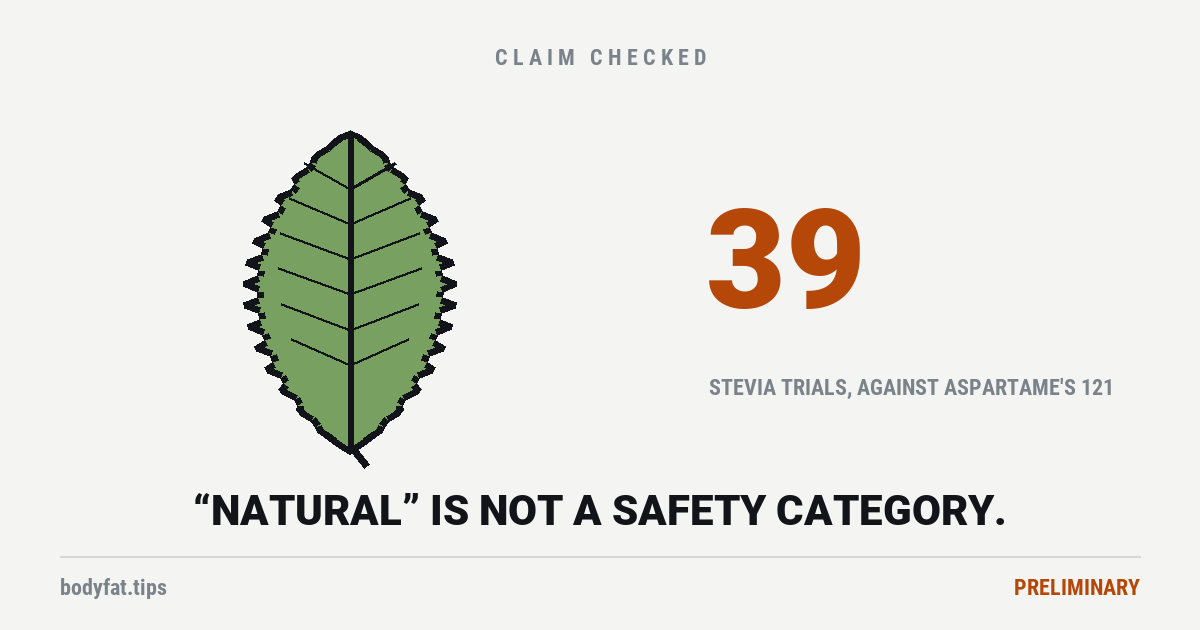
So we counted. PubMed indexes randomised controlled trials with a publication-type tag, which makes this a question anyone can answer in about ten seconds.
| Sweetener | Randomised trials indexed |
|---|---|
| Aspartame | 121 |
| Sucralose | 100 |
| Stevia | 39 |
The sweetener marketed as the natural, safer choice has roughly a third the randomised trial evidence of the one people are most frightened of [2].
Be careful how hard you lean on that. A database count is a crude measure: it does not weigh how big those trials were, how well they were run, or how long they lasted, and indexing is imperfect. It will not tell you stevia is riskier. What it does tell you is that the confidence people feel about stevia is not coming from a deeper evidence base, because there isn’t one. It is coming from the word on the packet.
What “natural” actually tells you
Very little, and this is worth internalising well beyond sweeteners.
Natural is a statement about where a molecule came from, not about what it does in you. Foxglove is natural. So is asbestos. The route by which something arrives in a packet carries no information about its dose response, and treating it as if it does is one of the most reliable ways to be sold something.
Meanwhile the actual regulatory position is more reassuring than the marketing: the Joint FAO/WHO Expert Committee on Food Additives has set acceptable daily intakes for most sweeteners in commercial use, and the evidence the WHO reviewed came from studies where people consumed amounts within those limits [1]. Nobody is basing this on overdose experiments.
What to actually do
Use stevia if you prefer how it tastes. That is a completely legitimate reason and the only one the evidence clearly supports.
Do not use it believing you have stepped outside the sweetener question. You have not — the WHO put it in the same sentence as aspartame, and it has less trial evidence behind it than the alternatives you were avoiding.
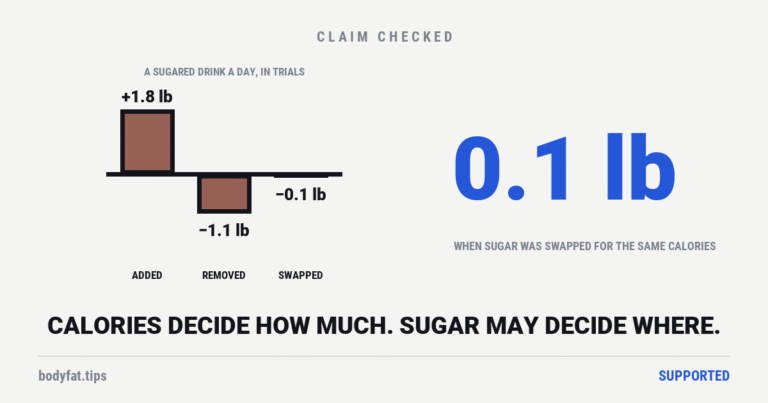
And if you are switching away from sugary drinks, that swap is the part with real evidence behind it, whichever sweetener you land on. We covered the trials on that in the sweeteners verdict, and the in-vitro scare stories in the one on sucralose.