Does Lifting Weights Burn Fat? Yes — Your Scale Can’t See It

Yes. And the proof is a number your bathroom scale is physically incapable of showing you.
Which is why so many people conclude it doesn’t.
54 trials, and nobody was dieting
Researchers at the University of New South Wales went looking for every randomised trial that put healthy adults on full-body resistance training for at least four weeks and compared them against a group doing nothing. Not cardio. Nothing. From 11,981 records they ended up with 58 studies, 54 of which had usable data [1].
A meta-analysis, if the word is new to you, is what happens when somebody pools the results of every trial on a question instead of quoting whichever single one they liked best. It is the difference between an anecdote and a count.
Three things got measured. All three moved.
The three numbers
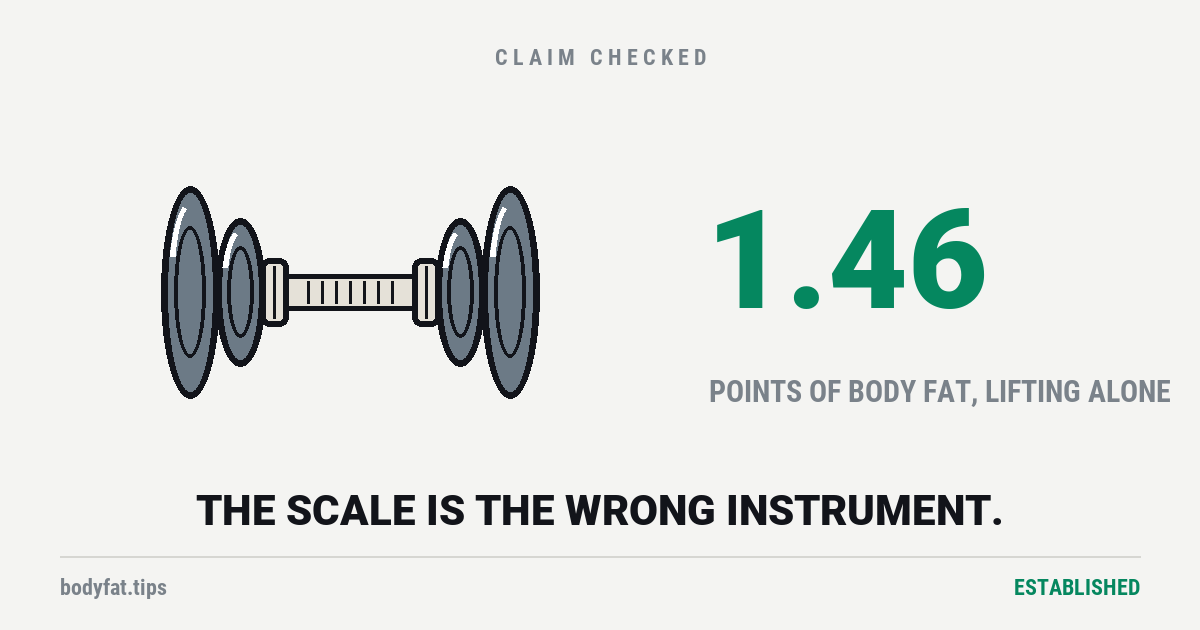
Body fat percentage fell 1.46 points. The range of plausible answers ran from −1.78 to −1.14 [1] — which is worth pausing on, because that range never touches zero. “Nothing happened” was not on the table.
Fat mass fell 1.2 lb (0.55 kg). Also nowhere near zero, statistically speaking [1]. Also, let’s be honest, not very much.
Visceral fat fell too — that’s the fat packed around your organs rather than under your skin, the kind that actually predicts illness. The effect there was moderate [1].
Now look at the first two numbers again, because they do not agree with each other, and the disagreement is the whole story.
Why did the percentage fall further than the fat?
Body fat percentage is a ratio. Fat, divided by all of you.
Learn More:


So there are two ways to make it go down. Take fat off the top. Or add something that isn’t fat to the bottom.
Lifting does both at once. That is the entire trick. You lose a bit of fat and you build a bit of muscle, and the ratio moves further than either change alone would move it.
Your scale weighs the top and the bottom together, adds them up, and reports one number. A pound of fat off and a pound of muscle on is a genuine change in what you are made of, and your scale will report it as zero.
Twelve weeks. Visibly different body. Same number. This is the single most common reason people quit lifting, and it is a measurement problem, not a training problem.
So where did “cardio burns fat, weights build muscle” come from?
Somewhere real, as these things usually do.
The aerobics boom of the 1980s did something no amount of exercise science has undone: it assigned the jobs. Sustained rhythmic movement became the fat-loss method. Weights became the other thing, the thing that made you big. And the word toning arrived to describe a third activity that does not exist — lifting weights so light they can’t provoke the adaptation you are lifting for.
You can still buy the artefact. Three-pound pastel dumbbells, sold beside the resistance bands, priced for people who have been told that going any heavier will turn them into something they didn’t ask for.
The trials above used full-body resistance training against people doing nothing at all. Every one of the three fat measures moved. Nobody in the training groups was on a diet.
The honest limits
Two of them, and the paper states both.
The effect is small. A pound of fat, on average, is not a transformation. Anyone selling you lifting as the fast route to fat loss is overselling this literature.
How you measure changes the answer. The researchers checked, and the type of measurement was a significant moderator for both fat outcomes [1] — a scan and a pair of skinfold calipers do not return the same result, and the pooled number is a blend of both. The direction is solid. The exact size is softer than one decimal place makes it look.
What did not change the answer: sex. Men and women were not significantly different [1], which retires the oldest excuse in the pastel-dumbbell aisle.
What to actually do
Lift, and stop asking the scale whether it worked. It cannot tell you. It is adding two numbers that are moving in opposite directions and handing you the sum.
Use something that separates them. A tape measure round your waist. A photograph in the same light every four weeks. The fit of one specific pair of trousers. Any of those detect a swap; the scale detects none of them.
And give it more than four weeks. The trials that found this ran longer than the average person’s patience, which may be the most useful thing in the whole analysis.