Does Cardio Burn Muscle? No — the People Doing Both Still Gained

No. And the number that settles it is sitting in the middle of a meta-analysis that people usually quote to argue the opposite.
The people doing both still built muscle
Researchers pooled 21 studies that had put people into three groups: lifting weights only, lifting plus cardio, and cardio only. Then they measured how much muscle each group built [1].
Before the numbers, one piece of vocabulary, because everything hangs on it. When researchers compare results across lots of different studies they convert everything to a common yardstick called an effect size. Zero means nothing happened. Around 0.2 is a small effect, 0.5 is moderate, and 0.8 or above is what they call large. A negative number would mean the thing went backwards — in this case, that people lost muscle.
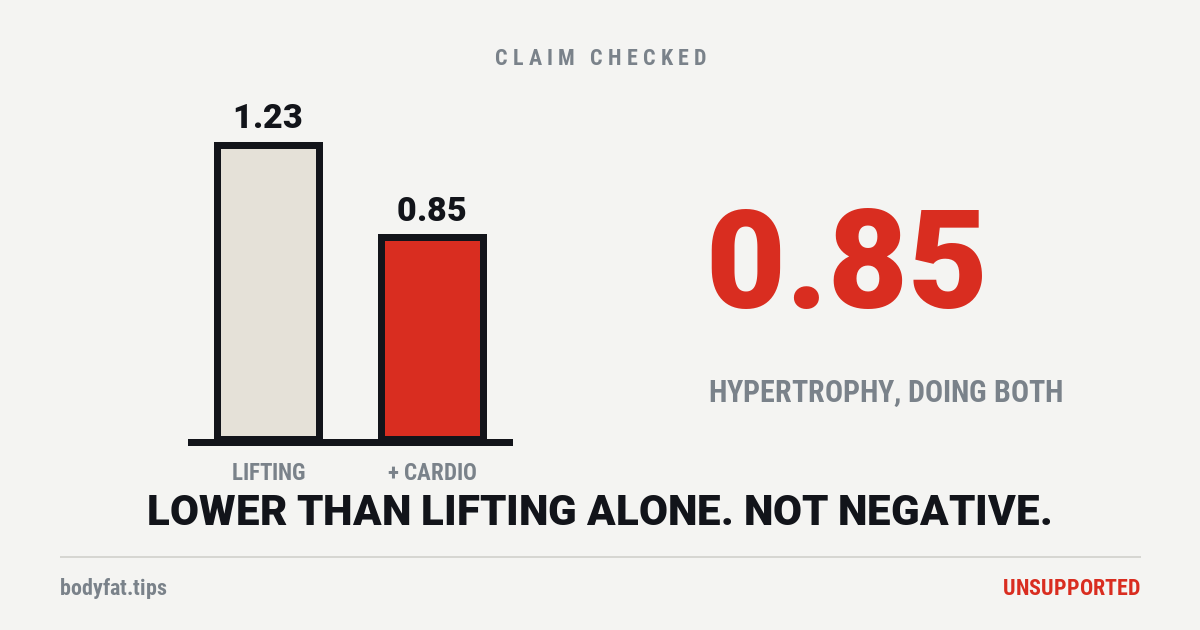
Now the results for muscle growth. Lifting alone: 1.23. Lifting plus cardio: 0.85. Cardio alone: 0.27 [1].
Look at the middle number against that scale. It is not negative. It is not zero. 0.85 is a large effect — the people doing cardio alongside their lifting built a meaningful amount of muscle. Less than the lifting-only group, but firmly in the gaining direction.
Strength tells the same story: 1.76 for lifting alone against 1.44 for lifting plus cardio [1]. Both large. One a bit larger.
So the honest version of the claim is not “cardio burns muscle.” It is “cardio can cost you some of the muscle you would otherwise have built.” Those are different sentences, and only one of them should change what you do on a Tuesday.
Where the cost is real: power
Power means explosive ability — how hard you can jump, how fast you can accelerate. It is a different quality from raw strength, and it is where the cost of doing both actually shows up.
On power: 0.91 for lifting alone, 0.55 for lifting plus cardio, 0.11 for cardio alone. This was the one measure where all three groups came out genuinely different from each other rather than overlapping [1].
So the drop is from large to moderate. If you play a sport that involves jumping, sprinting or throwing, that is the gap worth taking seriously. If you are training to look better and feel healthier, it is not what you are measuring.
Learn More:

Running interferes. Cycling mostly doesn’t.
This is the finding that should change what people actually do, and almost nobody repeats it.
From the same analysis, verbatim: resistance training concurrently with running, but not cycling, resulted in significant decrements in both hypertrophy and strength [1].
Same amount of cardio, different machine, different outcome. The likely reason is unglamorous — running is eccentric, it involves landing, and landing does damage that your legs then have to repair instead of growing. Cycling is concentric and lands on nothing.
If you are worried about your legs and you like cardio, that is a fairly actionable sentence.
And it is a dose, not a switch
The cost scaled with how much cardio people did. The researchers looked for a relationship between cardio volume and muscle results, and found a consistently negative one — more cardio, smaller gains. Session length mattered more than how often people trained [1].
Longer sessions, more often, worse outcome. Which means the question was never whether cardio is allowed. It is how much, of what kind, next to what else.
We are not going to hand you a threshold, because the paper reports correlations rather than a cut-off, and inventing “keep it under three sessions a week” would be exactly the fake precision we correct in other people.
The part that inverts the whole question
There is a second literature that the gym-floor version of this argument does not know exists.
A review in Exercise and Sport Sciences Reviews opens by naming the assumption directly — “current dogma suggests that aerobic exercise training has minimal effects on skeletal muscle size” — and then argues the opposite: that aerobic exercise alters protein metabolism and induces skeletal muscle hypertrophy [2].
Look back at the cardio-only group in the pooled studies: 0.27 for muscle growth [1]. On the scale above that is a small effect — but it is a small positive one. People who only did cardio still put on a little muscle.
Which makes “cardio burns muscle” roughly the opposite of what the measurements say.
What to actually do
Do your cardio. Your heart, your blood pressure and your ability to recover between sets all want it, and the muscle cost at ordinary volumes is a slightly smaller number, not a negative one.
If you are chasing size or power specifically: bias toward cycling over running, keep the sessions from sprawling, and put the hard cardio as far from your leg training as your week allows.
And if someone tells you they skip cardio to protect their gains: the cost they are avoiding is the difference between a large effect and a slightly smaller large effect. The thing they are giving up in exchange is their heart and lungs.