Negative Calorie Foods: Celery Gets 86% of the Way There

No. But celery gets closer than we expected, and closer than we said the first time we published this.
Somebody actually measured it, in people, and the number is worth your attention.
86% of the way there
Fifteen healthy women, an overnight fast, and a ventilated hood over the head measuring every breath. Resting metabolic rate first, then 100 g of celery — 16 calories — eaten in ten minutes, with energy expenditure tracked for the next three hours [1].
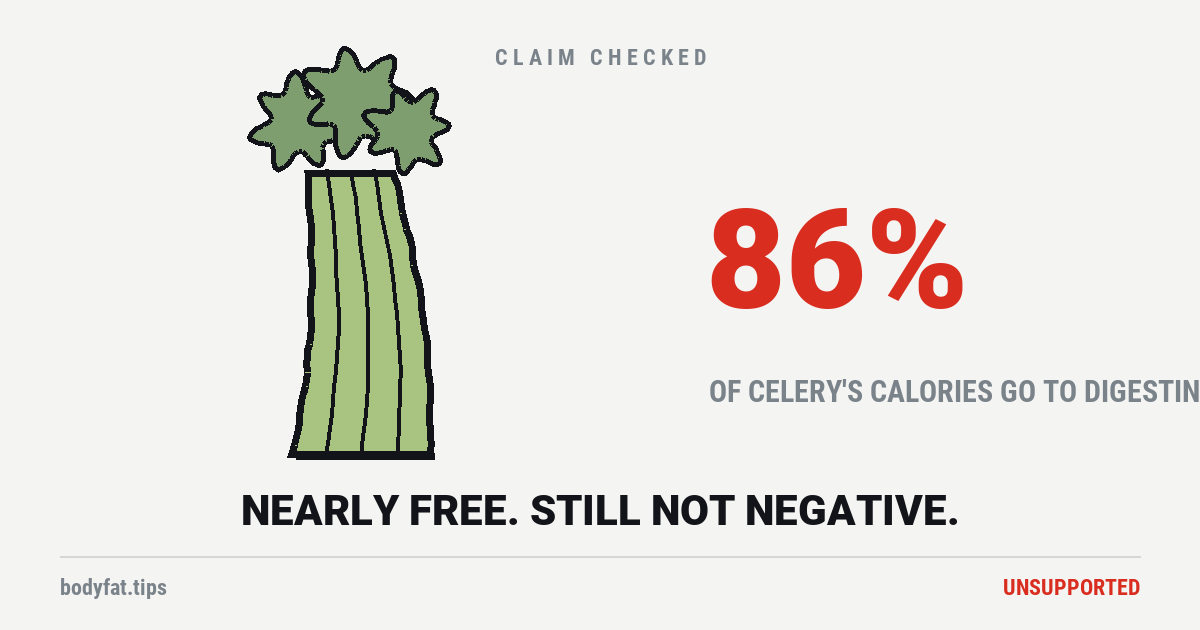
Digesting that celery cost 13.76 calories. Against the 16 it delivered, that is 86% [1].
Eighty-six percent. The stalk very nearly pays for itself. Anyone who told you celery is basically free was not far off, and we would rather say that plainly than pretend the folklore had nothing in it.
Then read the last two words of the arithmetic: nearly free. Sixteen minus 13.76 leaves about 2.2 calories in your favour, on the wrong side of the ledger for the claim. The researchers’ own conclusion is that eating celery “did not induce a negative energy balance” [1].
Close is the interesting finding here. It is still not negative.
Why celery does so much better than a steak
This is the part we got wrong first time round, so here it is properly.
Measured by macronutrient, digestion is cheap. Protein is the priciest at 20 to 30% of the energy it carries. Carbohydrate runs 5 to 10%. Fat is almost free, 0 to 3% [2].
So how does celery reach 86%, three times the best macronutrient figure? Because celery is barely made of macronutrients. It is water and fibre with a rounding error of carbohydrate, and much of what it does contain you cannot absorb. The percentage looks enormous because the denominator is tiny, not because your body is working unusually hard.
Learn More:


Which is exactly why quoting the macronutrient ranges as a ceiling — as we did — is the wrong move. Those describe what happens to nutrients you absorb. A stalk of water and string is a different question.
Is popcorn a negative calorie food?
No, and it is not close in the way celery is close.
Popcorn is a whole grain heated until it explodes: it is mostly starch, and starch is a carbohydrate you absorb efficiently at a digestion cost of 5 to 10% [2]. Air-popped popcorn is genuinely low in calories per cup because it is mostly air — but the calories that are there, you keep.
Low-density and negative-calorie keep getting swapped for each other, and they are not the same idea.
Is any food actually zero, or below?
Not one that has been measured. The best documented case in a human laboratory is the celery above, and it landed at 86% [1].
There is one other empirical attempt and it is stranger than you would guess: researchers fed celery to bearded dragons and measured what the lizards kept. They came out ahead — a net energy gain [3].
Straight with you on that one: we could not get the full text. bioRxiv refused us, the publisher’s certificate has expired, the mirrors were empty. So we will tell you the study exists and which way it pointed, and we will not print the percentage breakdown that circulates around it, because we did not read it.
How a real 86% became a fake 100%
There is no villain in this one. There is a rounding.
Start with a measurement that genuinely surprises: a food that spends almost all of itself being eaten. Round “almost all” up to “more than,” and you have flipped the sign on the whole claim — from a food that is nearly free to a food that pays you.
Then the format takes over. “Ten negative calorie foods” is a list you can screenshot. “Diet-induced thermogenesis was 86% of energy intake in fifteen women” is not. The list travels; the measurement stays home.
Search the phrase today and Google’s own AI summary assembles its answer from a hospital site, Healthline, a fitness app’s blog, the Tufts nutrition letter, a research-summary tool — and four YouTube videos, one of them a daytime-television segment. The Tufts newsletter files it under “Myth of the Month.” It is sharing the citation list with daytime TV.
What to actually do
Eat the celery. At roughly two net calories a stalk it is as close to free as food gets, and the water and fibre do real work on fullness. The same goes for most of the list — cucumber, lettuce, courgette. They are excellent, and they are excellent for the boring reason.
Just do not build a plan on the idea that they run a deficit for you. They do not. Nothing does. The best-measured case in the literature keeps 14% of what it gives you, and 14% of not-very-much is still not less than nothing.
Nearly free is a genuinely good deal. It is just not the deal that was advertised.
An earlier version of this article, published the same day, argued that no food can cost more than about 30% of its energy to digest, citing the thermic effect of protein, carbohydrate and fat. That reasoning was wrong. Those ranges describe absorbed macronutrients, not whole foods, and celery is mostly water and indigestible fibre. Clegg and Cooper measured celery's diet-induced thermogenesis at 86% of its energy — nearly three times any macronutrient figure. The verdict is unchanged, because 86% is not 100% and the researchers concluded there was no negative energy balance. But the claim is much closer to true than we originally said, and the article has been rewritten around the measurement instead of around our arithmetic.