Does Drinking Water Help You Lose Weight? A Little. Just Not How They Said.

A little. Probably. In one specific way, and not the way you have been told.
Let us start with the part that is definitely wrong, because it is the part doing all the selling.
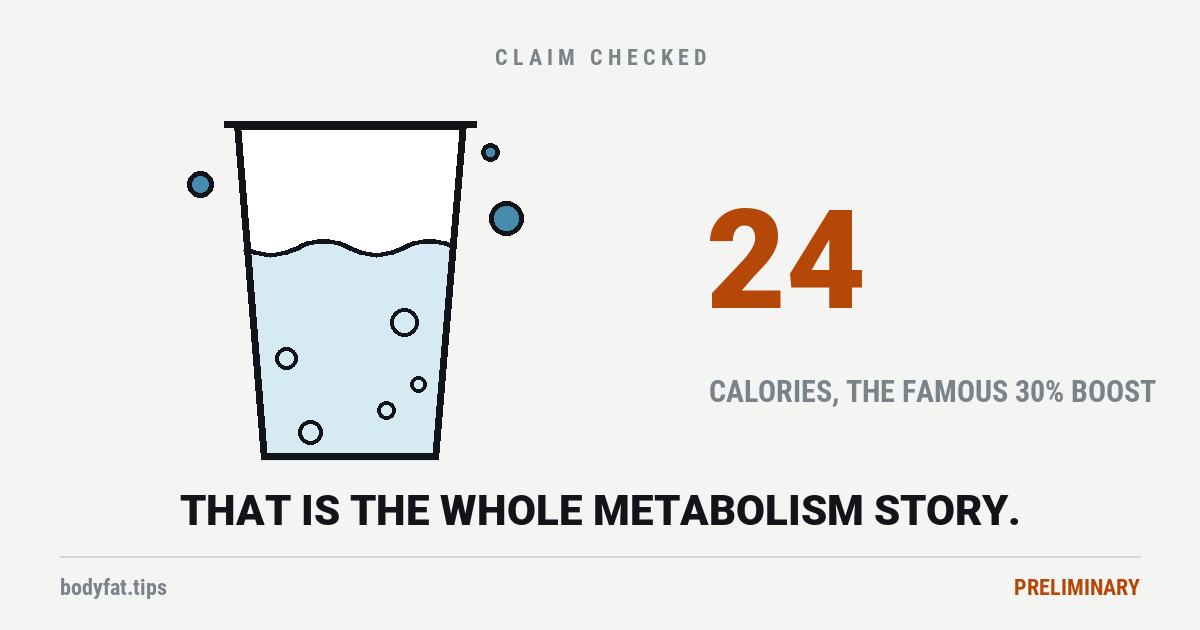
The 30% metabolism boost is 24 calories
In 2003 researchers gave fourteen people 500 ml of water and measured them in a metabolic chamber. Metabolic rate rose 30%, starting within ten minutes and peaking around forty [1].
Thirty percent sounds enormous. So here is the base it is a percentage of: the total extra energy burned was about 100 kilojoules. Roughly 24 calories. Less than a boiled sweet.
The paper is upfront about something else, too: about 40% of that came simply from warming the water from room temperature to body temperature [1]. Not metabolism doing anything clever. Physics heating a liquid.
The authors then extrapolated: two litres a day would add around 400 kilojoules — about 96 calories [1]. That extrapolation is where the internet got on board.
Then two labs tried to find it again
Three years later a different group ran the careful version: distilled water, saline, and a sugar solution as a positive control, all in a randomised crossover.
Distilled water produced no increase in resting energy expenditure (p = 0.34). Saline, none (p = 0.33). The sugar solution lit up exactly as it should (p < 0.0001), which tells you the equipment was working fine [2].
The only thing that did anything was water chilled to 3°C — and it managed 4.5% over an hour [2]. Not thirty.
Their conclusion, verbatim: the results “cast doubt on water as a thermogenic agent for the management of obesity.”
Learn More:

So the ice-water trick is real and it is worth about as much as standing up slightly more often.
Now the part that might actually work
Forget metabolism. The plausible mechanism was always dumber than that: water takes up room.
Forty-eight adults aged 55 to 75, all on a reduced-calorie diet for twelve weeks. Half drank 500 ml before each meal. That group lost about 4.4 lb (2 kg) more, a 44% steeper rate of loss [3].
A second trial, 84 people in English GP surgeries, same protocol, same twelve weeks: 2.9 lb (1.3 kg) more lost than controls [4].
Two independent trials, both positive, both modest. That is a real signal and we are not going to talk you out of it.
Why this is Preliminary and not Supported
Three things keep it there, and they belong in front of you rather than in a footnote.
The second trial nearly vanished. Its 2.9 lb result cleared the bar researchers use to call a finding unlikely to be chance. Then they accounted for differences between the two groups — age, income, that sort of thing — and the result slipped to just the wrong side of that bar [4].
It did not become nothing. It became a result you would not build on. The authors’ own word for their finding is “preliminary,” and we are taking them at it.
The mechanism was not confirmed. In the first trial, the water group did eat less at the start — but by week twelve that difference was no longer statistically significant [3]. The effect showed up on the scale without the explanation showing up in the food diary.
Pooled together, it disappears. In 2024 researchers combined eight randomised trials. The average came out at a little under a pound lost — but pooling also tells you the range the true answer probably sits in, and that range ran from about four pounds lost to two pounds gained [5].
A range that wide, straddling zero, means the honest summary is “we cannot tell.” The trials disagreed with each other a great deal. The reviewers’ own conclusion: water intake “may not significantly impact adiposity.”
Two decent trials say yes. The pool says maybe not. That is what unresolved looks like, and Preliminary is the tier for unresolved.
One finding we did not expect
In that same analysis, people who replaced sugar-sweetened drinks with water lost a little weight — 1.8 lb (0.81 kg), and even that only just cleared zero [5].
But people who replaced artificially sweetened drinks with water were 4.0 lb (1.82 kg) heavier, with a confidence interval nowhere near zero [5].
Before anyone builds a diet-soda campaign out of that: it is two trials, and the obvious alternative explanation is that people who were already managing their weight with diet drinks did worse when that tool was taken away. We are reporting it because it is in the data and it cuts against the tidy story, not because we think it settles anything.
What to actually do
Drink a glass of water before meals. It costs nothing, two randomised trials found a modest benefit, and the worst case is that you are hydrated.
Do not expect it to raise your metabolism, because the best attempt to reproduce that finding could not. Do not count the 96 calories — that number is an extrapolation from fourteen people that two later labs could not confirm.
And if you are already drinking a diet soda that keeps you off something worse, the evidence for swapping it for water is, at best, not there.
Water is not a fat-loss agent. It is a way of arriving at dinner slightly less hungry. Sold honestly, that is a perfectly good reason to have a glass.