Is Intermittent Fasting Better Than Just Eating Less?

Intermittent fasting works. Start there, because most of what follows is qualification and it would be dishonest to bury the finding.
Pool 99 controlled trials covering 6,582 adults and every fasting pattern beats eating without limits — alternate-day fasting by about 7.5 lb (3.4 kg), time-restricted eating by 3.7 lb (1.7 kg) [1].
Now the part that decides whether it is worth the trouble. In that same analysis, plain daily calorie restriction produced 4.6 lb (2.1 kg). Fasting is not competing with doing nothing. It is competing with eating less — and against that, the picture is much closer than the marketing suggests.
The cleanest test found fasting slightly worse
To know whether fasting does anything beyond the deficit it creates, you have to hold calories equal. One trial did exactly that, with three groups: alternate-day fasting with a real deficit, matched daily restriction, and fasting with no deficit at all.
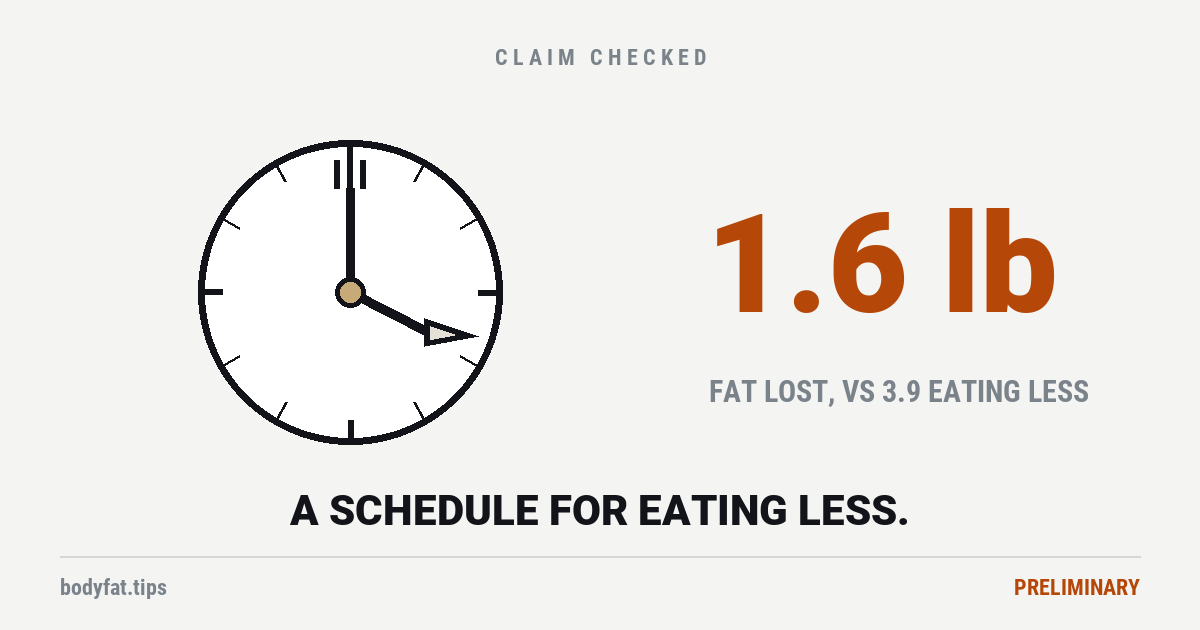
Weight loss was similar between the two deficit groups. Fat loss was not. The fasting group lost 1.6 lb (0.74 kg) of fat; the daily restriction group lost 3.9 lb (1.75 kg) [2].
And the third group is the one to remember: people who fasted but didn’t end up in a deficit lost essentially nothing. Roughly half a kilo of body mass, almost none of it fat. Fasting without eating less does not work, because the fasting was never the mechanism.
At twelve months, no advantage
Short trials are easy. The year-long ones are where diets go to be found out.
A hundred adults, alternate-day fasting versus daily restriction, twelve months: 6.0% versus 5.3% weight loss. No meaningful difference. Dropout was higher in the fasting group — 38% against 29% — and their LDL cholesterol ended up 11.5 mg/dL higher than the daily-restriction group’s [10].
A New England Journal trial of 139 people, both arms calorie-controlled, found time-restricted eating “not more beneficial” for weight, body fat or metabolic markers [11]. Three separate meta-analyses land in the same place: no significant difference in fat mass [3][4][7].
The trial that goes the other way — and why it matters
There is one good study on the other side, and it deserves better than a footnote.
165 adults, twelve months, both groups prescribed the same weekly calorie deficit, both given the same behavioural support. The 4:3 fasting group lost 6.4 lb (2.89 kg) more than the daily-restriction group, and fewer of them quit — 19% dropout against 30% [5]. That is a real result from a well-run trial.
But read what the researchers found when they measured actual intake rather than trusting the prescription: neither group hit the deficit it was given. Over the year the fasting group cut its calories by a measured 9.75 percent and the daily-restriction group by 5.64 percent, against a target of 34.3 percent for both. The deficit wasn’t equal in practice, and it wasn’t what the trial intended either. Fasting won because people stuck to it better, not because skipping meals does something special to fat [5][6].
That is still a genuine reason to choose it. “Two hard days a week” is easier for some people than “count everything, every day,” and a diet you follow beats a better diet you abandon. It is just a different claim from the one on the app.
What happened to the metabolism story
You have been told fasting revs your metabolism. Researchers tested it with food intake and meal frequency held constant, and found early time-restricted eating did not affect 24-hour energy expenditure at all. What it did do was cut hunger hormones. Their conclusion: meal-timing works by reducing appetite, not by burning more [12].
The “fasting boosts metabolism” claim traces back to studies of total starvation — 84 hours without food, in a 2000 study of eleven lean volunteers whose resting energy use rose over the first three days [8]. That is not what anyone is doing at 16:8.
The autophagy claim, and the Nobel that has nothing to do with fasting
This is the strangest part of the whole business.
In 2016 the Nobel Prize in Physiology or Medicine went to Yoshinori Ohsumi for discovering how autophagy — the cell’s recycling process — works. The research was done in baker’s yeast in the early 1990s. The awarding institution’s own announcement makes no mention of human fasting, dieting or weight loss [15].
That prize is now used to sell fasting programmes. One five-day meal kit retails around $215 and describes itself as the only programme that triggers autophagy in humans.
Two problems. First, the sellers cannot agree on the one number that matters — how long you have to fast. We found the same claimed authority attached to thresholds of 12 hours, 16, 18, 24 and 72, depending on who is selling.
Second, and more fundamental: autophagy is extremely difficult to measure in a living person. Doing it properly requires blocking the very process you are measuring, which you cannot do in human tissue. The strongest human evidence anyone cites is a study of eleven people over four days that found a rise in the gene expression of an autophagy marker — and whose authors explicitly warn that gene expression is “not necessarily reflective of changes in protein levels or activation” [13].
We found no study that establishes a 16-hour threshold, and none that set out to test one.
Where the whole thing came from
The chain is short and worth seeing whole.
Yeast genetics won a Nobel that never mentioned diets. A BBC documentary in 2012 introduced fasting to a mass audience. A book turned it into the 5:2. A 2019 review in the New England Journal of Medicine made it respectable to doctors — and then had to publish a correction reducing its central metabolic figure by roughly ten-fold [14]. And at the end of it sits a $215 box of food.
The presenter of that original documentary wrote, in his own companion article the day before it aired, that “the benefits of fasting are unproven” and that “so far there have been few proper human trials.” That caveat did not survive the journey to the checkout page.
The scare story is bad evidence too
We should hold frightening claims to the same standard as flattering ones, so: in 2024 headlines reported that eight-hour eating windows were linked to a 91% higher risk of cardiovascular death.
That came from a conference abstract based on self-reported diet recall, not peer-reviewed, which the American Heart Association itself flagged as preliminary and noted “may not accurately assess typical eating patterns” [18]. It is not evidence that fasting kills you. It is the same failure running in the opposite direction.
Does it cost you muscle? Only if you skip the lifting
This is the question everybody who trains asks first, and until 14 September 2026 this page did not answer it. Here is the whole thing.
Start with the study that started the worry. The TREAT trial put 116 people on 16:8 — eat between noon and 8pm, nothing outside it — for twelve weeks, and measured a subgroup in person [19]. The fasting group lost significantly more appendicular lean mass: the muscle in your arms and legs, which is the part that carries your shopping and gets you off the floor at eighty.
Not a near miss either. P = 0.005, which is well inside what researchers treat as “probably not chance” [19]. That finding is real and it deserves to be taken seriously rather than argued away. It is also small. Three fasting researchers (one of them consults for a fasting app) wrote to the journal to point out that the gap between the groups came to about 1.0 lb (0.47 kg), roughly 1.8 percent, which is about the size of the scanner’s own variation from one reading to the next [9].
So is fasting eating your muscle? Hold on, because the next study changes what that number means.
Twenty-four trials, 2,032 people, all running six months or longer [21]. Against a control diet, intermittent fasting cut fat by 6.7 lb (3.06 kg) — and cut fat-free mass, meaning everything in you that isn’t fat, by 1.8 lb (0.81 kg). There it is again.
Now the comparison that matters. Against ordinary continuous calorie restriction — the normal diet, eating less every day, no clock involved — fasting came out slightly better on fat and showed no difference at all in fat-free mass [21].
Read those two paragraphs together and the answer falls out. The lean mass does not go because you compressed your eating window. It goes because you lost weight, and losing weight has always cost lean tissue. Fasting is not doing anything special to your muscle. Dieting is.
A 2026 analysis of 28 trials and 1,833 people confirms the loss is there, and adds one thing worth knowing: it showed up in the young cohort as well as the older one [22]. This gets framed as a problem for people over sixty. It is not only that.
Which leaves the useful question: can you stop it?
Yes, and the answer is unglamorous. Eight studies pooled 221 people doing intermittent fasting while resistance training [20]. Compared with lifters eating on a normal schedule, the fasting lifters ended up 4.6 lb (2.08 kg) lighter and 3.0 lb (1.36 kg) lower in fat, with body-fat percentage 1.49 points lower — differences between the two groups, not amounts lost.
And fat-free mass? The gap between the groups came out at 0.6 lb (0.27 kg) against the fasters, with a range of plausible answers running from −1.8 lb to plus 0.6 lb [20]. That range contains zero, which is the statistician’s way of saying we cannot rule out that nothing happened. Next to lifters who were not fasting, the fasting lifters lost nothing the studies could detect.
So the practical version, and it is short: if you are going to do intermittent fasting, lift while you do it. The eating window is not protecting your muscle, and against ordinary calorie restriction it is costing you little if any: the six-month-plus review found no difference in fat-free mass [21], and a 28-trial review found fasters lost about 0.4 lb (0.20 kg) more than daily dieters, a result just on the significant side of the line [4]. That the training is the variable is this desk’s reading, and it is labelled as such: it comes from setting a review of lifters beside a review of dieters, with different comparison groups, populations and trial lengths, and no trial on this page randomised lifting against not lifting during a fast. And you will want enough protein to go with it — though probably less than you have been told.
Two things this does not mean. It does not mean fasting is a muscle-building strategy; nothing here says that. And it does not mean the TREAT finding was wrong — that trial did not require its participants to train, which is precisely why it found what it found [19].
Related: what lifting actually does to your fat, and why soreness is not the progress gauge you think it is.
Who should be careful
Two groups genuinely should.
Anyone on insulin or sulfonylureas. A trial in people with type 2 diabetes found fasting roughly doubled the risk of hypoglycaemia even with medication reduced [16]. Manageable with a doctor adjusting doses; not something to try alone.
Anyone with a history of disordered eating. Survey and follow-up studies link fasting with eating-disorder psychopathology. Those are observational and cannot show cause — and notably, in the supervised 4:3 trial, binge-eating scores actually improved [6]. The fair statement is that unsupervised fasting and disordered eating travel together, not that one causes the other.
Worth adding: a Cochrane review, searching to December 2019, found no trial had reported a hard cardiovascular outcome — no heart attacks, no deaths, no strokes measured [17]. The longevity talk is running well ahead of the evidence.
The bottom line
If fasting suits how you live — if skipping breakfast is easier than weighing dinner — it is a perfectly good way to eat less, and one decent trial suggests you may stick with it better. That is a real advantage and we are not taking it away from you.
What it is not is a metabolic shortcut. At matched calories it does not remove more fat, it does not raise your metabolism, and the cellular renewal being sold at $215 a box has never been measured in a person the way the marketing implies.
Fasting is a schedule for eating less. Sold honestly, that is enough.
Five things were corrected on 15 September 2026 after an independent editorial review. The sentence explaining why 4:3 fasting won its 12-month trial had the mechanism backwards: it said the fasting group ate less than it was told to, when the trial’s own intake measurements show neither group reached its 34.3 percent target — the fasters cut 9.75 percent, the daily dieters 5.64 percent — and the fasters simply came closer. The evidence panel gave a longest follow-up of 18 months that no source on this page supports; the longest trials cited run 12 months, and the field now says so. The headline source’s DOI pointed at the BMJ’s August 2025 affiliation correction rather than the paper; it now points at the paper. The lifting review’s figures were written as amounts lost when they are differences between fasting and non-fasting lifters, and “the training is the variable” is now labelled as the desk’s own reading across two reviews rather than a result either delivered. And the page said four meta-analyses found no fat-mass difference; three are cited, and the 28-trial review’s small extra fat-free-mass loss with intermittent restriction is now on the panel too.
Also changed: the funding row now covers every major source, including the network meta-analysis’s commissioning body and its authors’ industry declarations, a TREAT author’s stake in Keyto, Inc. and a Danone-linked grant behind the 2026 review; a duplicate listing of the TREAT trial has been replaced by the 84-hour starvation study the metabolism section leaned on without citing; the letter cautioning against over-reading TREAT’s lean-mass result is now cited where that result is discussed; the muscle section is dated to its addition on 14 September 2026; the provenance chain’s framing step now reads 2012–13, because the 5:2 book followed the 2012 documentary the next year; and two sentences were softened from universal negatives to what we found. The Preliminary tier rates the claim that intermittent fasting beats ordinary calorie restriction: three meta-analyses find no difference in fat at matched calories, and one well-run 12-month trial found a modest advantage that its authors credit to adherence. The rating is unchanged.
- Does Food Combining Work? One Real Trial in Ninety Years Says No
unsupported - The No-Sugar Diet: Cutting Sugar Lost 1.8 lb in the Trials Pooled for the WHO. Swapping It for the Same Calories Changed Nothing. The Sugar Was Never the Point.
supported - A Vegan Diet Cost Older Adults 2.5 lb of Muscle in 12 Weeks. The Protein They Stopped Eating Is Most of the Story.
preliminary