Does Spinach Have Iron? More Than Beef, by Weight. In a 1983 Test, People Absorbed 1.4% of It

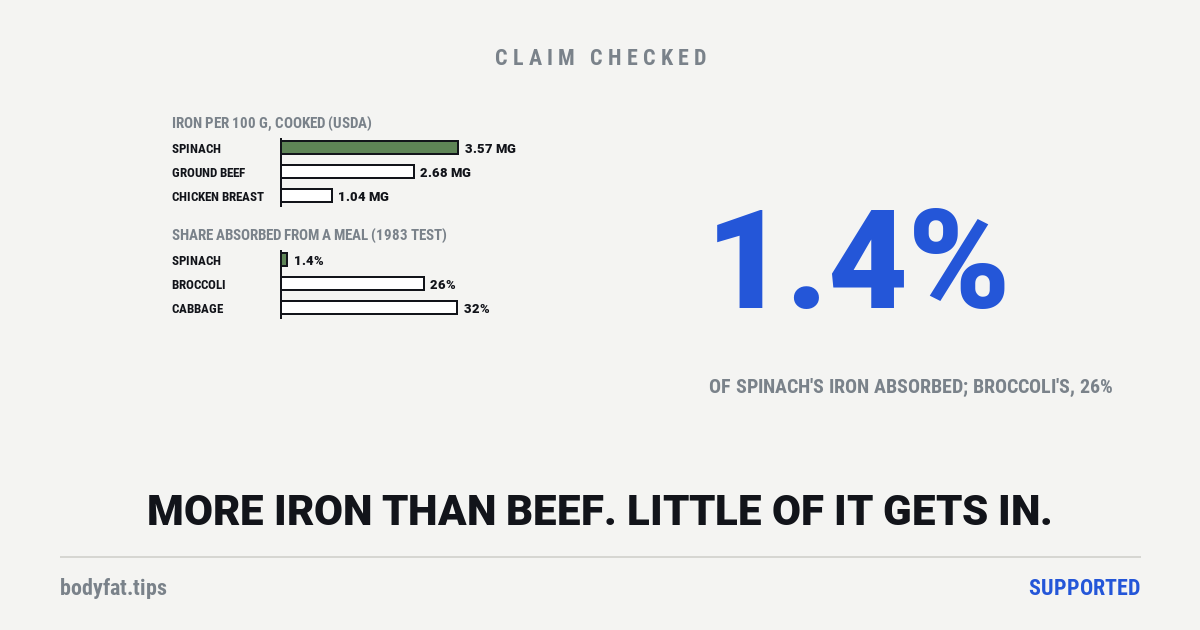
Does spinach have iron? Yes, plenty. Cooked spinach carries 3.57 mg of iron per 100 g, about 3.5 oz, against 2.68 mg in a cooked patty of 85% lean ground beef and 1.04 mg in roast chicken breast [1]. Half a cup of boiled spinach gives about 3 mg, 17% of the daily value [2], which sits in the range the FDA uses for a “good source” label: 10% to 19% per serving [3].
So is spinach good for your iron? Less than the number says. In a 1983 test with radioactive iron, women absorbed 1.4% of the iron in a spinach meal, about 1 milligram in every 70. From broccoli they absorbed 26% [4]. The US government’s iron fact sheet puts it plainly: spinach is a good source with low bioavailability, the share your gut actually takes in [2].
So the claim this page rates, that spinach is a good source of iron, is Supported: the iron is measured, and it is there. That spinach is as good for your iron as meat is a different claim, and it fails.
Is it the oxalate? That is the usual answer, and the evidence is split. Adding oxalate to cabbage cut absorption in the 1983 test [4]. Adding the same amount spinach carries to kale made no difference in a 2008 Zurich study [5]. The stronger lead is something else: polyphenols, the plant compounds that also make tea bitter [4] [2].
And the vitamin C trick? A video watched 5.9 million times since October says chicken’s iron is absorbed better than spinach’s and that vitamin C helps; it is right on both counts for a single meal [6] [2]. Across a whole diet, the vitamin C boost is far smaller [7] [8].
And Popeye? The story that his spinach rested on a misplaced decimal point is itself the myth. The people who traced it found no sign the error was ever made [9].
How much iron is in spinach, and how much do you get?
By weight, cooked spinach out-ranks ground beef and chicken. Boiling drives water out, so 100 g of cooked spinach holds more leaf than 100 g of raw: 3.57 mg against 2.71 [1]. Boiled lentils carry 3.33 mg [1].
What matters is what crosses the gut wall. Iron from meat and fish, called heme iron, is absorbed far better than the iron in plants, and meat also helps the body take in plant iron eaten with it [2]. The NIH puts the share of iron absorbed at about 14% to 18% from mixed diets with meat and seafood, and 5% to 12% from vegetarian diets; it sets vegetarians’ iron target 1.8 times higher for that reason [2].
Spinach sits near the bottom even among plants. The 1983 study gave women meals of 17 vegetables, each with a little iron added and tagged with a radioactive marker, and measured how much reached their blood. Spinach came in at 1.4%. Only wheat germ, aubergine and butter beans did worse. Cabbage, turnip and sauerkraut came in around 32% to 33% [4].
If not oxalate, what?
Oxalate is a real blocker, just of a different mineral. It binds calcium: our calcium page reports, from the NIH’s calcium fact sheet, that about 5% of spinach’s calcium is absorbed, against 27% from milk. The iron story borrowed that explanation, and the tests do not agree on it.
In the 1983 study, 1 g of calcium oxalate added to cabbage cut iron absorption from 32% to 19.5%, which the authors called “some depression” [4]. In Zurich in 2008, 1.26 g of oxalate added to kale, the amount in the spinach meal, left absorption at 11.5% against 10.7% without it, no difference [5]. The spinach meal itself came out 24% lower than kale, a gap that did not reach statistical significance, and the authors noted spinach carried more calcium and polyphenols [5].
The polyphenol case is stronger. Across the 1983 study’s 17 vegetables, the more polyphenols a vegetable held, the less iron got through, a correlation of 0.86 on a scale where 1 is perfect [4]. Adding 500 mg of tannic acid, a polyphenol, to a broccoli meal dropped absorption from about 30% to 1.5% [4]. The NIH names polyphenols as the reason for spinach’s low figure [2].
Does vitamin C fix it?
For one meal, yes. In the 1983 study, 15 mg of vitamin C more than doubled absorption from a rice meal [4]. That is the effect the video describes [6].
Over a diet, much less. When 12 people ate their usual food for five-day stretches with low, normal or high vitamin C, from 51 to 247 mg a day, their iron absorption did not differ significantly [7]. Women with low iron stores given 1,500 mg a day for five weeks saw most measures of iron status unchanged; their ferritin, the body’s iron reserve, came out at 11.9 against 10.7 µg/L, just short of the line researchers use for “probably not chance” [8]. An earlier study of 11 women made deliberately low in iron did find more absorbed, 38% against 27%, and a rise in hemoglobin [10]. And in 440 patients with anemia taking iron pills, adding vitamin C made no meaningful difference [11].
If spinach has more iron than beef, why does it do so little for yours?
This section is the desk’s own reasoning, and it is labelled as such.
Answer one: the leaf hangs on to it. Polyphenols, by the strongest evidence here: a tight correlation across 17 vegetables and a sharp drop when one was added [4]. Oxalate may play a part; two tests disagree [4] [5]. Rated: measured, in small studies, and the polyphenol link is a correlation.
Answer two: one meal is not a diet. Vitamin C’s boost shrinks when it is spread across a whole diet [7] [8], and the NIH says the effects of boosters and blockers alike are blunted in a typical Western diet [2]. So spinach’s handicap probably shrinks too when it is one food among many. The vitamin C half is measured; the spinach half is our inference.
Answer three: the decimal point was a better story. A misplaced dot and a cartoon sailor travel further than a polyphenol. That would explain why a debunking with no source ran for decades in textbooks and journals [9]. This one is a hunch.
The derived line: spinach has the iron, your gut takes little of it, and the tricks that rescue one meal do far less across a week of eating.
What we could not find, and would like to: a trial that fed people low in iron spinach most days for months and measured their iron stores against people who ate none. The nearest we found ran three weeks, used mixed leafy greens, and its comparison group’s hemoglobin rose as well [12]; another fed spinach for 11 days against a duckweed vegetable rather than against nothing [13] [14]. If one exists and we missed it, tell us and we will correct this page.
Who these studies were done on
The 1983 test: Indian women in South Africa who had borne children [4]. Zurich: healthy women aged 18 to 45 under 60 kg (132 lb) [5]. The vitamin C studies: 12 adults [7], American women with low or depleted iron stores [8] [10], and Chinese patients with anemia, 97% of them women [11]. Single-meal tests measure what one plate does; they say less about months of eating. If you are tired and wondering about iron, our page on vitamin D and tiredness covers a nutrient that gets blamed for the same thing.
Where the Popeye decimal point came from
Spinach’s reputation for iron goes back to 19th-century measurements [9]. Popeye’s is not about iron at all. His creator, Elzie Segar, had vitamin A in mind, according to a criminologist, Mike Sutton, who went looking in 2010 [9].
The decimal point arrived later. In 1972 a London nutrition professor said in a lecture that spinach’s fame “may well have grown” from a misplaced decimal point, and repeated it in print [9]. In 1981 the BMJ‘s Christmas issue ran a piece saying German chemists had found the error in the 1930s, a tenfold overestimate, and that Popeye “would have been better off chewing the cans” [15] [9]. It gave no source. Asked by Sutton, its author said he could not remember where he had read it, but was sure he had not made it up [9]. A 1982 textbook then dated the error to 1870 [9].
A social scientist in Norway, Ole Bjørn Rekdal, traced the chain in 2014 and found no sign the error was ever made. The high 19th-century figures more likely came from contamination or from confusing dried spinach with fresh, Sutton argued [9]. The myth-busting became the myth, and it spread through journals, textbooks and a 1988 Reader’s Digest book [9].
“Does spinach have iron” is searched about 4,400 times a month in the United States and “spinach iron” about 3,600 (from a paid keyword database, pulled 16 November 2026) [16]. Those are the database’s averages over the past year. None of this is aimed at anyone who believed either story.
What this is rated, and what the rating covers
Supported — for the claim that spinach is a good source of iron.
Supported rather than Established because the content is measured and sits in the label’s good-source range [1] [2] [3], but a source you absorb 1.4% of, in the one radioactive-iron test of a spinach meal we read, is a weak one in practice [4].
The other parts, rated alone, in words. That spinach is as good for your iron as meat: Unsupported, by the absorption figures above [4] [2]. That a misplaced decimal point made spinach famous: Unsupported; the people who traced the story found no sign the error was made [9]. That oxalate is the reason: Preliminary, two small tests that disagree [4] [5]. That vitamin C fixes it: true for one meal, small across a diet [7] [8].
This is journalism, not medical advice. If you think you are low in iron, a blood test, not a salad, is the way to know; ask a clinician. How we read a study, and what each tier means, is set out here. This page’s derived section is the desk’s reasoning from the evidence rather than a result the evidence delivered.
- Natto Benefits: Linked to Fewer Heart and Stroke Deaths. No Trial We Found Has Tested It
preliminary - Hydrogen Water Benefits: Small, Mixed Shifts in Blood Markers, and No Significant Win in the Three Biggest Trials
preliminary - Does Seed Cycling Work? A Few Small Studies, Mostly in PCOS, Lean Its Way. None We Found Tested the Timing.
preliminary