Are Emulsifiers Bad for You? They Inflamed Mouse Guts. In People, the Trials Are Small, Short and Split.

“What if your gut already has everything it needs to heal itself? The problem isn’t that you’re missing the latest supplement or cleanse.” That is how a physician’s health-video channel opens the description of “Gut Detox: The Fastest Way To Repair Your Gut Naturally (Backed by Science)”, posted on 17 July 2026. It had 1,396,395 views when we read its numbers on 10 October 2026 [1].
The description does not spell the emulsifier claim out. Its chapter list puts “Emulsifiers and Sweeteners” among the things that stand between you and a gut that repairs itself, its tags include “gut health emulsifiers” and “polysorbate 80”, and its references include a 2022 trial whose title says a common emulsifier has “Detrimental Impacts on the Gut Microbiota and Metabolome” [1] [2]. We read the description and its references, not the video’s audio [1].
Plenty of people want to know. In the United States, “carrageenan” is searched about 74,000 times a month, “emulsifiers” about 27,100 times, “polysorbate 80” about 22,200, “carboxymethylcellulose” about 12,100, “emulsifiers in food” and “food emulsifiers” about 2,400 each, “what are emulsifiers” about 880 and “are emulsifiers bad for you” about 390 times a month (from a paid keyword database, pulled 10 October 2026) [3].
An emulsifier is an additive that keeps oil and water mixed, and the research lumps in thickeners that do a similar job for texture, such as carboxymethylcellulose (CMC) and carrageenan [4]. Some occur in ordinary food; egg is one, which is why a trial below kept eggs out of its low-emulsifier diet [5]. This page rates the claim the video’s chapter title, tags and references point to, that the emulsifiers in food damage your gut, and weighs the five people search for by name: CMC, polysorbate 80, carrageenan, lecithin and mono- and diglycerides (E 471).
Emulsifiers inflamed the guts of mice. In 2015, mice given CMC or polysorbate 80 in their drinking water for 12 weeks developed low-grade gut inflammation and put on weight, and mice bred to be prone to colitis developed it badly [6].
In people, the trials are small, short and split. In healthy adults, CMC changed gut bacteria within days and carrageenan made the gut leakier in one trial; none of the four trials in healthy people on this page found more inflammation on the emulsifier overall [2] [7] [5] [8]. In Crohn’s disease, a 154-person trial reported so far only in conference abstracts found people did better when emulsifiers were cut, and a 24-person trial found no difference [9] [10].
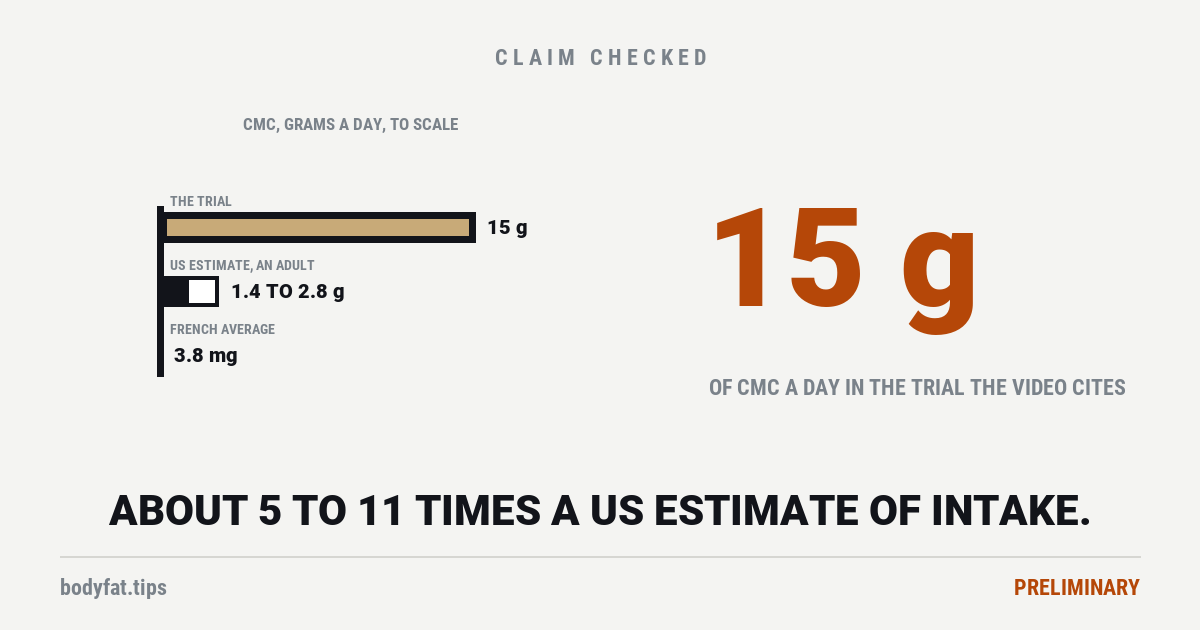
The doses behind the alarm are above what people eat, though not always far above. The trial the video cites gave 15 g of CMC a day [2]. In a cohort of 92,000 French adults, the average was 3.8 mg, and about nine in ten ate none [4]. A US Food and Drug Administration team’s estimate, built on the highest levels at which CMC is used in food, comes to about 1.4 to 2.8 g a day for a 154 lb (70 kg) adult, by our arithmetic from its figures, which are averages per kilogram of body weight across everyone aged 2 and over, at the highest use levels, so for an adult this is a generous estimate, not a measured intake. The trial’s dose is about 5 to 11 times that [11]. A second trial’s CMC dose, 2.75 g a day, sits at the top of that range [7].
What did the mouse studies find?
The idea has a clear starting point. In a 2015 study in Nature, mice drank water containing 1% CMC or 1% polysorbate 80 for 12 weeks [6]. Ordinary mice developed low-grade inflammation and gained weight; two strains engineered to be prone to gut inflammation developed colitis, inflammation of the colon; and some effects showed up at a tenth of that strength [6]. The gut is lined with mucus that keeps its bacteria at a distance from the wall. In these mice the bacteria got closer, and moving their gut bacteria into germ-free mice moved the problem with them [6].
Laboratory work followed with human gut bacteria grown outside the body. CMC and polysorbate 80 changed the bacteria in ways that raised their potential to trigger inflammation [12]. A 2021 test of 20 emulsifiers found that many of the others had effects of a similar size, “various carrageenans and gums” particularly stark ones, and that some, “such as lecithin”, had no significant effect [13].
Two cautions travel with all of this. Mice and dishes are not people. And the dose: the European Food Safety Authority (EFSA), the EU’s food-safety regulator, worked out that 1% polysorbate 80 in a mouse’s drinking water comes to about 1,500 mg per kilogram of body weight a day [14]. For a 154 lb (70 kg) adult that would be about 105 g a day, by our arithmetic. The French adults averaged 0.3 mg [4], and the FDA team’s US estimate comes to about 0.7 to 1.4 g a day for the same adult, by our arithmetic [11]. The 2015 authors made the other side of the argument: many foods contain more than 1% of an emulsifier, so the strength was not unusual [6]. Both are true. A mouse drinking it all day takes in far more per pound of body weight than a person eating a few foods that contain it; that is our reading of the two numbers.
Are emulsifiers bad for your gut? What the trials in people found
Eight trials of food emulsifiers in people carry this page. Here they are, healthy volunteers first; trials of lecithin given as a medicine for colitis come in lecithin’s own section below.
| Trial | What it gave | What it found | Who paid |
|---|---|---|---|
| Philadelphia, 2022; 16 healthy adults on a hospital research ward, 11 days [2] | 15 g of CMC a day in brownies and sorbet, or the same food without it | Gut bacteria shifted and made less of what they produce; a little more stomach pain after meals; no change in inflammation markers [2] | US National Institutes of Health and others; one author consults for drug and nutrition companies [2] |
| Leuven, 2026; about 60 healthy adults, four weeks after two weeks emulsifier-free [7] | CMC, polysorbate 80, carrageenan or soy lecithin in brownies; or a plain starch; or nothing | Fewer bacterial products on CMC than on the dummy; no difference in gut or blood inflammation markers [7] | Indexes list the Leuven university hospital and university; we could not read its funding statement [7] |
| Melbourne, 2024; 20 healthy adults randomised, 18 finished; four weeks of each diet [5] | A supermarket diet full of emulsifiers, or one free of them | Gut less leaky at rest on the high-emulsifier diet, more leaky after an injected stress hormone; no inflammation either way [5] | A private foundation, an Australian government research grant, and Australian and US patient bodies; two authors report fees or grants from drug and health companies [5] |
| Tübingen, 2024; 20 young men, two weeks of each [8] | 500 mg of carrageenan a day, or dummy capsules | Gut leakier on carrageenan; insulin response, the main measure, unchanged; no inflammation difference overall [8] | The German government; authors’ fees from drug companies [8] |
| UK, 19 hospitals; 154 adults with active Crohn’s disease, eight weeks [9] | A low-emulsifier diet, with or without snacks containing carrageenan, CMC and polysorbate 80 | More improvement without the emulsifiers; reported only in conference abstracts [9] | A US charitable trust [9] |
| Melbourne, 2025; 24 adults with active Crohn’s disease, four weeks [10] | A high- or low-emulsifier supermarket diet | Both groups improved; no difference between the diets [10] | A private foundation, an Australian government research grant, and Australian and US patient bodies; the first author reports speaker fees from a snack and drink company among others [10] |
| Chicago, 2017; 12 adults with ulcerative colitis in remission, up to a year [15] | 200 mg of carrageenan a day in capsules, or dextrose, on a carrageenan-free diet | 3 of 5 on carrageenan relapsed, 0 of 7 on the dummy; stopped early [15] | A private foundation’s medical research programme; no conflicts declared [15] |
| Helsinki, 2023; 7 women with ulcerative colitis in remission, one week of each [16] | 2,000 mg of carrageenan a day in a shake, or oat fibre | No difference in symptoms or inflammation markers [16] | Finnish foundations and a Danish one; no conflicts declared [16] |
The trial the video cites is the most carefully controlled of the eight, and worth reading line by line. Sixteen healthy adults aged 18 to 60, nine women and seven men, lived on a hospital research ward and ate identical food [2]. Chance decided who got 15 g of CMC a day, baked into three brownies and three sorbets, and neither they nor the researchers knew who had it, which is what double-blind means [2]. Seven got CMC; nine got the same food without it, for 11 days [2].
What CMC did: the mix of gut bacteria, the microbiota, shifted; the variety among them fell a little; and the stool held fewer short-chain fatty acids, compounds gut bacteria make from fibre that feed the cells lining the colon [2]. The drop in what the bacteria made had gone a month after the trial [2]. People on CMC also reported a little more stomach pain after meals [2].
What it did not do: inflammation markers in the blood and stool did not move, and neither did two antibody tests used as a rough sign of a leaky gut [2]. The headline worry was bacteria creeping through the mucus to the gut wall, which is what happened to the mice. On average it did not happen [2]. In two of the seven CMC eaters it did, and in none of the nine others, a split the authors tested and found short of the line researchers use for “probably not chance” (P = 0.175), though they read it as a reasonable likelihood that CMC was the cause [2]. Both were men, and older than the rest of their group [2].
Two more things, from the paper and its registry record. The paper says the study had “no pre-specified efficacy or safety endpoints”; its registry record names one main measure, that bacteria-to-wall distance, and its posted results give 17.1 micrometres (thousandths of a millimetre) on the plain diet and 14.1 on CMC, with no comparison reported [2]. And the dose: the authors write that 15 g “likely exceeds CMC intake of most individuals”, but might approach the total emulsifier intake of people who eat mostly highly processed food [2].
A 2025 follow-up grew volunteers’ gut bacteria in the laboratory and found the same split: some people’s bacteria were badly disturbed by CMC and some were not, among them some who had been on the plain diet in the trial, and bacteria from the sensitive donors gave colitis to mice bred to be prone to it [17]. That suggests people differ. It is a hypothesis about people, tested in dishes and mice.
The largest trial in healthy people came from Leuven in Belgium in 2026 [7]. About 60 adults ate an emulsifier-free diet for two weeks, then kept to it for four more while eating three brownies a day containing CMC, polysorbate 80, carrageenan, soy lecithin, a plain rice starch, or nothing added; each group had nine or ten people [7]. The doses, by the trial’s registry record, were 2.75 g of CMC, 375 mg of carrageenan and 3.55 g of soy lecithin a day [7].
At the end there was no difference between any emulsifier group and the dummy group in calprotectin, a protein in stool that rises when the gut wall is inflamed; in C-reactive protein (CRP), a blood marker of inflammation; or in a blood marker of gut leakiness [7]. The CMC group’s stool held fewer short-chain fatty acids than the dummy group’s, and the other emulsifier groups leaned the same way, not all far enough to count [7]. On the trial’s chart, the group marked as significantly lower than the dummy group on one of the three acids, propionic acid, is polysorbate 80’s; CMC’s is marked on the other two. We read that from the figure, as we could not read the paper’s text or tables [7]. In the carrageenan group the leakiness marker rose over the four weeks on carrageenan (P = 0.04), compared with the same group’s own earlier reading rather than with the dummy group [7].
One detail from the trial’s own charts, in our reading: part of the short-chain gap at the end is the dummy group’s levels rising over the six weeks, which its figure marks as a significant rise, while the CMC group’s did not rise [7]. And two notes on the record. The trial was registered in August 2024, 14 months after it finished. We could read its summary, its figures and its registry record, not the full paper [7].
A Melbourne team tried the opposite approach: no added doses, just food [5]. Twenty healthy adults, three in four of them women, were set to eat four weeks of a supermarket diet chosen to carry as many emulsifiers as possible and four weeks of a matched diet free of them, in random order, and 18 finished both [5]. To measure leakiness they used a sugar test: you drink two sugars, and the ratio of the two that turns up in your urine shows how leaky the gut wall is [5].
At rest, the gut was less leaky on the high-emulsifier diet [5]. After an injection of a stress hormone, leakiness rose by a median of 89% on the high-emulsifier diet and fell by 39% on the low one [5]. Neither diet changed markers of gut injury or inflammation [5]. The high-emulsifier diet also carried more sugar, 107 g a day against 86 g, and more ultra-processed food, so emulsifiers were not the only difference [5].
In Tübingen, Germany, 20 healthy young men took carrageenan capsules, 250 mg twice a day, for two weeks, and dummy capsules for two weeks, in random order and without knowing which was which [8]. The main question was insulin sensitivity, how well the body responds to insulin, and the answer was no difference [8]. But a sugar test showed a leakier gut on carrageenan (P = 0.03), and a second leakiness marker, added after the fact, leaned the same way [8]. Blood markers of inflammation did not differ overall; the authors found higher ones in the heavier men, a split they examined after seeing the data [8]. The trial ran in 2015 and 2016 and was published in 2024 [8].
What about people with Crohn’s disease or colitis?
Crohn’s disease and ulcerative colitis are the two main kinds of inflammatory bowel disease, in which the immune system keeps the gut wall inflamed. This is where the mouse findings pointed, and where the human evidence pulls two ways.
The biggest trial is British. In ADDapt, 154 adults with mild to moderately active Crohn’s disease at 19 hospitals all followed a low-emulsifier diet for eight weeks; half were secretly given emulsifiers back, in supermarket foods and in three snacks a day containing carrageenan, CMC and polysorbate 80 [9]. Symptom scores improved by the trial’s chosen margin, a fall of at least 70 points on a standard Crohn’s activity score, in 49% of the low-emulsifier group and 31% of the group given emulsifiers back, and more of the low-emulsifier group saw calprotectin halve [9]. The abstract reports the low-emulsifier group as 3.1 times as likely to improve after adjusting for other factors; the raw percentages make it about 1.6 times, by our arithmetic, and the abstract does not say what was adjusted for [9].
That result has been published only in conference abstracts, in January, May and June 2025; we read the first, and know the other two by their titles in the publishers’ records [9]. The abstract says 113 of the 154 finished the eight weeks; its main result counts everyone who started, and the abstract says it held among those who finished [9]. We found no full paper in PubMed, Europe PMC, the trial’s registry record or an ordinary web search [18]. Until it appears, nobody outside the team can check the numbers; an abstract is a summary of a study, not the study.
A smaller Australian trial points the other way. Twenty-four adults with active Crohn’s ate four weeks of a high- or a low-emulsifier diet from supermarket food, without knowing which [10]. Both groups improved, 9 of 12 and 7 of 12 reaching remission, and the authors found no difference between the diets; their conclusion was that recommendations to avoid emulsifiers in active Crohn’s “are not supported” [10]. It was small and short, by its own account [10]. The designs differ in a way that matters: the British control group got carrageenan, CMC and polysorbate 80 in snacks, while the Australian high-emulsifier diet used ordinary food, in which those three were rare [10] [9].
For ulcerative colitis there are two tiny carrageenan trials, and their results point opposite ways. In Chicago, 12 people in remission followed a carrageenan-free diet and took capsules for up to a year: three of the five given 200 mg of carrageenan a day relapsed, none of the seven given dummy capsules did, and the trial was stopped as soon as that gap crossed the line for statistical significance [15]. The authors themselves wrote that the result “may be attributable to a type I error”, a false alarm [15]. In Helsinki, seven women in remission drank a shake with 2,000 mg of carrageenan a day for a week and took an oat-fibre product for a week: no difference in symptoms or inflammation markers [16]. The Finnish team, which had planned for 14, wrote that taking part in any carrageenan study had been openly discouraged on social media in the channels it recruited through [16].
CMC and polysorbate 80: the two the mouse study made famous
CMC (carboxymethylcellulose, E 466) is cellulose, the stuff of plant cell walls, modified so that it thickens; it is not absorbed, and passes out in stool [19] [2]. Two trials on this page gave it to healthy people on its own, and both found changes in gut bacteria and what they make, with no rise in inflammation [2] [7]. In two studies of one French cohort, CMC, eaten by about one in ten, showed no clear link with cancer or type 2 diabetes, and a third study of the same cohort linked it with slightly higher rates of heart disease: a link of the kind that shows what goes with what, not what causes what, covered below [4] [20] [21]. Rated alone, the claim that CMC damages your gut: Preliminary. The evidence in its favour is real and early: two small, short trials of changes whose meaning for health EFSA calls “currently not clear” [22], and the mice.
Polysorbate 80 (E 433) is a synthetic emulsifier; its chemical name is polyoxyethylene sorbitan monooleate [14]. In the Leuven trial nine healthy people took it on its own for four weeks, with no difference in inflammation markers from the dummy group; on the trial’s chart their stool held less propionic acid, one of the short-chain fatty acids gut bacteria make, than the dummy group’s at the end, which we read from the figure, not the paper’s text or tables [7]; in ADDapt it was one of three in the snacks [9]. It is also rare in food: a survey of 12,844 UK supermarket products found it in eight [23], and the French adults averaged 0.3 mg a day [4]. Rated alone, the claim that polysorbate 80 damages your gut: Preliminary, on mouse and laboratory evidence, with one small human group that showed no difference in inflammation and less of one bacterial product.
Is carrageenan bad for you?
Carrageenan (E 407) is extracted from red seaweeds, among them Chondrus crispus, the Irish moss that our sea moss verdict covers; a close relative, processed Eucheuma seaweed (E 407a), is assessed with it [24]. It was in 42.5% of the ice creams in an Australian supermarket audit [25] and 63.1% of the milk-based drinks in the UK survey [23].
Much of the alarm traces to a different substance. Degraded carrageenan, of which poligeenan is one form, caused colitis and then tumours in rats and ulcers in monkeys, and EFSA says poligeenan is not authorised as a food additive and not used in food [24]. The open question for the food additive is how much of a small-molecule fraction it carries [24] [26].
In people, the trials are the ones above: two tiny colitis trials that point opposite ways, a leakier gut in 20 young men, a rise in a leakiness marker within the Leuven carrageenan group, and the mixed snacks in ADDapt [15] [16] [8] [7] [9]. The acceptable daily intake is the amount a regulator judges safe to eat every day for a lifetime. EFSA’s 2018 review kept carrageenan’s at 75 mg per kilogram of body weight a day but made it temporary, and asked for better data within five years; among the gaps it named was “inadequate data on the possible relevance of carrageenan exposure for existing inflammatory bowel diseases in humans” [24]. In March 2024 its food-additives panel was still working on the follow-up, its minutes say, and in July 2026 a slide presented to that panel still listed the carrageenan follow-up as ongoing work [26] [27]. The five years EFSA gave in 2018 for better data ran out in April 2023 [24]. We did not find a published follow-up opinion [18].
Rated alone, the claim that carrageenan damages your gut: Preliminary. Of the five, it has the most human trials and the most mixed results.
Is emulsifier lecithin bad for you?
Lecithin (E 322) occurs naturally in foods [2] and is the commonest emulsifier in UK supermarket food, in 23.4% of the products surveyed [23]. In the 2021 dish test it was one of the few with no significant effect on gut bacteria [13]. In mice it changed the bacteria but did not bring them closer to the gut wall [28]; in a 2026 study using gut tissue grown on chips and in organoids, and mice, soy lecithin damaged the lining at what the authors call daily-exposure doses [29].
In people, ten healthy adults took 3.55 g of soy lecithin a day for four weeks in the Leuven trial, and their inflammation markers did not differ from the dummy group’s [7]. A trial of soy lecithin in 20 volunteers at the University of Aberdeen finished in March 2020; its registry record has no results, and we found no paper [30] [31] [18]. EFSA’s 2017 review found no safety concern at the uses reported [32].
Lecithin has also been given, as a medicine, to people whose guts were already inflamed. At one German university hospital, three small trials gave people with active ulcerative colitis soy lecithin rich in phosphatidylcholine, one of the substances lecithin is made of, coated to be released at the far end of the small intestine, so that less of it was digested and absorbed on the way, as lecithin in food is [33] [34] [32]. As each paper gives its dose, one gave 6 g a day of the coated granules for three months, 30 people against 30 on a dummy; one gave 2 g a day for 12 weeks, again 30 against 30; one gave four doses, from half a gram to 4 g a day, to 40 people, with the half gram as the comparison [35] [36] [37]. More people improved on lecithin than on the dummy, or on the higher doses than on the half gram, each time [35] [36] [37]. In the first, nine people on the dummy left the trial, four of them after their colitis flared, against one on lecithin [35]. Pooled, the 160 people’s side effects matched the comparison groups’, and bloating, the commonest complaint, was about as common in both [34].
All three were led by one investigator, who also wrote the pooling and declared as much; the pooling itself says that a single centre “makes the analysis prone to bias” [34]. A 2014 trial names the same investigator as the inventor of this slow-release form, and says the patent is held by the investigator’s adult children [33].
A purer form, more than 94% phosphatidylcholine, was then tested in trials sponsored and paid for by companies [33] [38]. In the first, 156 people with ulcerative colitis took one of three doses or a dummy for 12 weeks, and disease activity fell further than on the dummy at the highest dose, 3.2 g a day [33]. Four flares of colitis on the purer form, and none on the dummy, were recorded as serious adverse events, three of them at the lowest dose and none at the highest; the investigators judged none of them related to the treatment, and the only serious event they judged possibly related was in the dummy group [33]. The largest trial gave 3.2 g a day, on two schedules, or a dummy, and was stopped after 466 people had been randomised, when a planned interim analysis found it was unlikely to show a benefit; a follow-on trial in 150 people who had gone into remission found no significant difference after 48 weeks. The authors report that it “was safe and well-tolerated” [38]. A seventh randomised trial of the purer form, 3.2 g a day or a dummy for 12 weeks at US clinics, was sponsored by a US company that sold diagnostic tests and specialty drugs for gut disease and cancer, with a food company’s health-science arm directing it. It was stopped after 25 people had enrolled, its registry record says because the product “did not appear to help”, and it has posted no results; we found no paper reporting it [39] [18].
What do those trials say about the claim? They were medicines, not food, and they asked whether lecithin heals an inflamed colon, not whether it harms one. But they gave grams a day, for 12 to 48 weeks, to people with ulcerative colitis, in five of the six published trials while it was active, which is where harm should have shown. None of the published trials found the people on lecithin doing worse than the comparison group by more than chance could explain, and in four of the five in active colitis more of them improved [34] [33] [38]. In the two largest, some measures came out behind the dummy and others ahead. On the first trial’s main measure, which it called deep remission, 9.7% of people on one lecithin schedule reached it after 12 weeks, against 14.2% on the other schedule and 13.5% on the dummy. In the follow-on trial, remission judged by endoscopy, a camera look at the bowel lining, was 49.3% on lecithin after 48 weeks against 59.5% on the dummy, while on its main measure, remission by the trial’s clinical score, lecithin was ahead, 49.3% against 43.2%. None of those gaps was large enough to tell apart from chance [38]. Those are grams a day, the order of the FDA team’s US estimate for lecithin, about 4 g a day for a 154 lb adult, by our arithmetic, while the French adults averaged 61.1 mg [11] [4].
Rated alone, the claim that lecithin damages your gut: Unsupported, of the tested kind. In people with ulcerative colitis, most of them during a flare, coated lecithin at grams a day was tested in six published randomised trials, and none found them doing worse than the comparison group by more than chance could explain; a seventh, stopped early, has posted no results [34] [33] [38] [39]. In healthy people the test is one ten-person group for four weeks [7]. What it was tested as was a medicine, a coated form released low in the gut, not lecithin as it comes in food [35] [33]. What points the other way is laboratory and mouse work: soy lecithin damaged the lining of gut tissue grown in the laboratory [29], and lecithin changed gut bacteria in mice [28]. Those results are why the question is worth asking; in people, so far, the harm has not shown up.
Is emulsifier E471 bad for you?
Mono- and diglycerides of fatty acids (E 471) are fats carrying one or two fatty-acid chains instead of the usual three; EFSA’s review says the gut very likely breaks them down into glycerol and fatty acids [40]. They are common: in the UK survey, 187 of 640 packaged breads listed E 471 [23], and 81.5% of the French adults ate some, 162 mg a day on average [4].
We found no trial in people that tested E 471 by itself on the gut [18]; EFSA’s 2021 follow-up said there were “no specific studies on mono- and diglycerides of fatty acids and effects on the microbiota itself” [41]. It was one of the commonest additives in the Melbourne team’s high-emulsifier diet, in 27% of that diet’s packaged products and about 98 mg a day by the team’s estimate [25]; tested as a whole, that diet made healthy adults’ guts less leaky at rest and leakier under a stress hormone, without inflammation, and in people with Crohn’s the trial found no difference between it and the emulsifier-free diet [5] [10]. In mice, it changed gut bacteria and tended to bring them closer to the gut wall [28]. In the French cohort, the people who ate the most had higher rates of cancer, and in a third study of the cohort the group of mono- and diglycerides it belongs to went with more heart disease, associations covered below [4] [21]. Rated alone, the claim that E 471 damages your gut: Preliminary. It is untested on its own in people’s guts, with one mouse study in its favour.
What the regulators settled, and what they did not
On a regulated additive, the regulator’s own opinion is a primary source, so we read EFSA’s for all five [19] [14] [24] [32] [40]. For CMC, lecithin and E 471 it found no safety concern at the uses reported and no need for a numerical limit; for the polysorbates it set an acceptable daily intake of 25 mg per kilogram of body weight; for carrageenan it kept a limit but made it temporary [19] [32] [40] [14] [24]. In the United States, a team at the Food and Drug Administration, working from the highest levels at which each additive is used in food, put average exposure across Americans aged 2 and over to lecithin and E 471 at about 60 and 80 mg per kilogram of body weight a day, CMC at a half to a third of those, and polysorbate 80 at about half of CMC’s, and found no safety concern [11]. For a 154 lb (70 kg) adult that is, by our arithmetic, about 4.2 g of lecithin, 5.6 g of E 471, 1.4 to 2.8 g of CMC and 0.7 to 1.4 g of polysorbate 80 a day. Those are estimates built on the highest use levels, not measurements of what anyone ate; the French figures on this page are averages from what people logged eating [11] [4].
Those are judgements about toxicity: what large doses do to animals’ organs over long periods, and how far below that people stay. They are not trials of gut inflammation, and EFSA says so. Its 2018 cellulose review noted that some of the effects linked to emulsifiers are “not systematically studied as specific endpoints in toxicity studies” [19]. Its 2022 follow-up on CMC read the human trial and concluded that “the preliminary results do not allow identifying specific health concerns” and that “the whole field needs further investigation on a large scale” [22]. Of the 2015 mouse study, its polysorbate review said “the relevance of the observed effects remains unclear” [14].
Do emulsifiers cause cancer or diabetes?
The two large studies people quote here followed French volunteers, about four in five of them women, who logged what they ate brand by brand [4] [20]. They are cohort studies: they follow people and look for patterns, which can show what goes with what, not what causes what.
In 92,000 adults followed for an average of 6.7 years, those in the highest intake group for E 471 had a 15% higher rate of cancer than those in the lowest, with higher rates of breast and prostate cancer in particular; carrageenans went with more breast cancer; and no emulsifier went with colorectal (bowel) cancer [4]. That 15% is a hazard ratio of 1.15: the rate in one group divided by the rate in the other [4]. In 104,139 adults followed for 6.8 years, each extra 100 mg of carrageenans a day went with a 3% higher rate of type 2 diabetes, and several gums went with higher rates too: guar, xanthan and gum arabic [20]. That study’s authors wrote that a single observational study “is not sufficient per se to establish causality” [20]. Polysorbate 80 was eaten too rarely in France, by about 1% of the adults, to be tested on its own in either study [4] [20]. CMC, eaten by about one in ten, was tested on its own in both, and showed no clear link. In the cancer study, the people who ate a little had an 11% higher cancer rate than those who ate none (a hazard ratio of 1.11) and those who ate more an 18% lower one (0.82), with no steady trend from none to more; for breast cancer after menopause the two figures were 1.26 and 0.81, and for bowel cancer 1.20 and 0.80, none of those four clear of chance [4]. In the diabetes study, each extra 500 mg a day went with a hazard ratio of 0.77, and the range the true answer probably sits in, 0.40 to 1.47, includes no difference at all [20]. The cancer study’s authors say intakes that low might explain the lack of a link [4]. A third study of the same cohort, 95,442 adults followed for a median of 7.4 years, the middle person’s figure, looked at heart disease and stroke. Each extra 30 mg or so of CMC a day, the step the paper measured in, went with a 3% higher rate of cardiovascular disease, heart and blood-vessel disease together, and a 4% higher rate of coronary heart disease; the group of mono- and diglycerides that E 471 belongs to went with higher rates of all three outcomes the study counted, cerebrovascular disease, which includes stroke, among them [21]. Its authors adjusted for how much ultra-processed food, sugar, salt and saturated fat people ate, wrote that other differences between the people “cannot be entirely ruled out”, and said the design left them “unable to confirm that emulsifiers are causally related” to heart disease [21]. Our maltodextrin verdict reports a fourth paper from the same cohort, on mixtures of additives and diabetes.
Which foods contain emulsifiers?
In the UK, most packaged cakes, desserts, sweets and milk drinks. A 2023 survey of 12,844 products in the UK’s four biggest supermarkets, in the 15 food groups that supply the most ultra-processed calories in Britain, found emulsifiers in 51.7% of them: 95.0% of pastries, buns and cakes, 81.9% of milk-based drinks, 81.0% of industrial desserts, 77.5% of confectionery and 62.3% of packaged breads [23]. The commonest were lecithin and E 471 [23]. The three the mouse work focused on were much rarer: carrageenan in 4.4% of products, CMC in 1.4% and polysorbate 80 in eight, though 63.1% of milk-based drinks had carrageenan and 40.0% had CMC [23]. In the French cohort, the biggest sources were ultra-processed fruit and vegetables, cakes and biscuits, and dairy products [20].
Does Greek yogurt have emulsifiers?
The sources on this page give no count for Greek yogurt. The UK survey filed flavoured yogurts with industrial desserts, 81.0% of which carried an emulsifier, and left plain yogurt out of its count [23]. For a given tub, the ingredient list is where to look.
What are the worst emulsifiers, and which should you avoid?
Ranked by the evidence, not by how alarming the name sounds: CMC, polysorbate 80 and carrageenan have the most mouse and laboratory evidence against them, and most of the human trials [6] [2] [7] [8]. Lecithin has the least, and in people with inflamed colons, given as a medicine at grams a day, none of the published trials found people doing worse on it by more than chance could explain [13] [7] [34] [38]. Google’s AI answer splits them into synthetic ones to watch and natural ones that are fine, calling gum arabic a prebiotic, food for helpful bacteria [3]. The evidence does not split that way. In the 2021 dish test some of the starkest effects came from carrageenans and gums [13], and in the French diabetes study guar gum, xanthan gum and gum arabic went with higher rates [20].
Whether to avoid them depends on who you are. For people with Crohn’s disease, a 154-person trial reported only in conference abstracts says cutting them helped, and a 24-person trial says it did not [9] [10]; that is a question for your gastroenterologist or dietitian. For healthy people, two weeks of an emulsifier-free diet in the Leuven trial lowered cholesterol, its charts show no significant change in CRP or calprotectin, and the whole diet changed, not only the emulsifiers [7].
If emulsifiers inflame mouse guts, why didn’t the healthy volunteers’ guts inflame?
This section is the desk’s own reasoning, and it is labelled as such. Four trials on this page gave healthy people an emulsifier, or a diet full of them, and none found more inflammation on the emulsifier overall [2] [7] [5] [8]. The mice got colitis. Here are three reasons both can be true, with the evidence for each.
Answer one: the dose. The mice drank 1% of the additive in all their water, which EFSA put at about 1,500 mg per kilogram of body weight a day for polysorbate 80 [14]. The French adults averaged 0.3 mg of polysorbate 80 a day and 3.8 mg of CMC, and only about one in ten ate any CMC at all [4]. The human trial the video cites gave 15 g of CMC a day, about 4,000 times the French average, by our arithmetic [2]; an Australian team, working from its own food audit, put that dose at 583 times the most its deliberately emulsifier-heavy diet supplied [25]. The American figure is far higher than the French one: the FDA team’s estimate comes to about 1.4 to 2.8 g of CMC a day for a 154 lb adult, by our arithmetic, which makes the 15 g about 5 to 11 times it, and puts the Leuven trial’s 2.75 g at the top of it [11] [7]. Carrageenan is closer: the German trial’s 500 mg a day was about nine times the French average of 57.6 mg, by our arithmetic [8] [4], and twice the 250 mg the Chicago team gives as the average American adult’s intake [15]; the German trial is the one that found a leakier gut. This is arithmetic on figures in the papers: the doses were measured, and the intakes are estimates, the French ones from what people logged eating and the American ones from the highest levels at which each additive is used.
Answer two: the mice were built to get sick, and some people may be too. The 2015 colitis appeared in mice engineered to be prone to it; ordinary mice got a milder, low-grade version [6]. In the CMC trial, two of seven people showed the mouse-like change and five did not [2], and in the laboratory, bacteria from some donors were disturbed by CMC and bacteria from others were not [17]. The largest trial, the one that found a benefit from cutting emulsifiers, was in people whose guts were already inflamed [9]. That the risk sits with a vulnerable minority is a surmise, with mouse, laboratory and one conference abstract on its side, and a 12-person colitis trial that stopped early; against it are a 24-person Crohn’s trial, a 7-person colitis trial and, for lecithin, the colitis trials above [15] [10] [16] [34] [38].
Answer three: what the human trials measured was change, not damage. CMC changed the bacteria and cut the short-chain fatty acids they make, and the drop was gone a month after it stopped [2]. Whether a change like that, kept up for years, becomes harm is what no trial on this page measured; EFSA called its meaning for health “currently not clear” [22]. Calling it damage is a hunch, and so is calling it harmless.
Put the three together and here is what we think is true, stated plainly so you can disagree with it: emulsifiers have been shown to change a healthy human gut, at doses from about the top of a generous US estimate of intake to well above it, not to damage one, and the people with most reason to watch this research are those whose guts are already inflamed.
What we could not find, and would like to: a trial that gives healthy people emulsifiers at the doses an ordinary diet supplies, for months, and measures gut inflammation and disease, not only bacteria. Three things would help sooner: the full ADDapt paper [9]; the results of the Aberdeen lecithin trial, finished in 2020 [30]; and a University of Reading trial of carrageenan and gut bacteria, whose registry record still says recruiting, with a completion date that has passed [42]. A Swedish trial of cutting emulsifiers in ulcerative colitis is due to finish in 2029 [43]. If you know of the long trial, the corrections line on this site is open.
Does the gut repair itself without a cleanse?
The video’s other half is that the gut has a “Hidden cleaning system that needs to be turned back on” and needs no cleanse or supplement [1]. Part of that we have already checked. Our detox tea verdict found no randomised trial of a tea sold as a detox, traces the idea of a gut that poisons you back to 1887, and rates detox teas Unsupported. Whether meal timing and fasting switch on a repair system, as the chapter list suggests, is not rated here [1].
The chapter’s other topic, sweeteners, has its own pages: the 2022 sweetener trial in the video’s reference list is a source on our sucralose verdict, and our artificial sweeteners verdict covers the rest.
Who these studies were done on
The healthy-volunteer trials were in adults: the CMC trial nine women and seven men aged 18 to 60, the Melbourne trial three in four women, the German trial young men only [2] [5] [8]. The Leuven trial took about 60 healthy adults [7]. The Crohn’s and colitis trials were in adults with those diseases, and so were the trials of lecithin as a medicine [9] [10] [15] [16] [34] [38]. The cohorts were French volunteers, about four in five of them women [4] [20]. No trial on this page was in children, in pregnancy or in people over 65 specifically. None of the eight in the table lasted longer than eight weeks except the 12-person colitis trial, which followed people for up to a year [15]; the lecithin medicine trials ran about three months, and one of them 48 weeks [35] [34] [33] [38].
Where “emulsifiers wreck your gut” came from
The research came first, in mice: the 2015 study above, whose authors suggested that “the broad use of emulsifying agents might be contributing to an increased societal incidence of obesity/metabolic syndrome and other chronic inflammatory diseases” [6]. That was a hypothesis, and they worded it as one.
The framing hardened in the human trial’s title. The 2022 paper is called “Randomized Controlled-Feeding Study of Dietary Emulsifier Carboxymethylcellulose Reveals Detrimental Impacts on the Gut Microbiota and Metabolome” [2]. What it showed, in 16 people over 11 days, was changed bacteria and fewer bacterial products, at a dose its own authors think most people never reach, with no change in inflammation [2]. “Detrimental” is the authors’ reading of those changes, and the word, not the numbers, is what travels.
By October 2026 the word had travelled. The video lists that paper among its five references [1]. Its references also include a 2025 review that lists emulsifiers among the parts of a diet that harm the gut barrier, while noting that the data “are not exclusively from human studies” [44]. And Google’s AI answer to “are emulsifiers bad for you” says CMC and polysorbate 80 are “linked in clinical and laboratory studies to gut microbiome disruption, low-grade inflammation, and a thinning of the protective mucus layer in the intestines” [3]. The human trials on this page showed the first. The second turned up in healthy people only in a subgroup examined after the fact [8]; in people with colitis or Crohn’s, inflammation markers moved with emulsifiers in two trials: IL-6, a signalling protein in the blood that rises with inflammation, rose within the five people given carrageenan in Chicago, compared with their own starting levels, and in ADDapt’s abstract more people’s calprotectin halved when emulsifiers were cut [15] [9]. The third was measured in mice [6] [14].
And the product. Under a promise of gut repair “without any supplements or medications”, the video’s description lists “Supplements I personally take”, with affiliate links for magnesium, vitamin D, fish oil and psyllium husk [1]. None of this is aimed at anyone reading an ingredient list for E numbers. The worry is reasonable; the evidence just does not yet show that a healthy gut needs protecting from these additives at the amounts in food.
What this is rated, and what the rating covers
Preliminary — for the claim that the emulsifiers in food damage your gut.
It is rated Preliminary because the evidence in its favour is real and early: mouse studies from more than one laboratory, laboratory work with human gut bacteria, two small trials in which CMC changed healthy people’s gut bacteria within days, a leakier gut on carrageenan in 20 young men, and a 154-person Crohn’s trial that has so far appeared only in conference abstracts [6] [13] [2] [7] [8] [9]. It is not Supported because none of the four trials in healthy people found more inflammation on the emulsifier overall, a 24-person Crohn’s trial and a 7-person colitis trial found no difference, the doses that harmed mice are far above what people eat, and the 15 g CMC dose is about 5 to 11 times even the FDA team’s US estimate [5] [10] [16] [4] [11]. What could move it: the full ADDapt paper, and a long trial at everyday doses in healthy people. Rated alone, four of the five additives are also Preliminary, for the reasons in their sections above; the claim that lecithin damages your gut is Unsupported, of the tested kind, because it was tested in people whose guts were already inflamed and no trial found them doing significantly worse.
What is not rated here: whether emulsifiers cause cancer, diabetes or heart disease, which three studies of one French cohort associate with some of them but cannot show to be caused by them; whether the gut repairs itself through fasting; the sweeteners; and the frame above, which is this desk’s reasoning from the evidence rather than a result the evidence delivered. It is marked as ours so that you can weigh it as ours. This is journalism, not medical advice; if you have Crohn’s disease or colitis, take the diet question to your gastroenterologist or dietitian. How we read a study, and what each tier means, is set out here.
- Is Maltodextrin Bad for You? Gram for Gram, It Does Spike Blood Sugar More Than Table Sugar. “Worse Than Sugar” for Your Liver and Belly Fat Is Not What the Trials Found.
established - Are Sugar Alcohols Bad For You? The Real Problem Is Digestive
supported - Is Erythritol Bad For You? A Sweetener Worth Watching
preliminary