Vagus Nerve Reset: The Neck Device’s 56% Drop in “Stress Symptoms” Was a Depression Score, From a Study With No Sham Group

“Clinical study participants saw: Stress symptoms decrease by 39% after 2 weeks and 56% after 4 weeks.” That line is from the description of a video posted on 27 July 2025 by a food-as-medicine physician’s health-video channel. The video had 696,647 views when we read it on 10 October 2026, and its title ends in a referral link to a stimulator worn around the neck; the description offers 10% off through the same link [1]. The same description says anxiety “dropped by 31% after 2 weeks and 45% after 4 weeks”, that “70% of users saw a drop in cortisol, the body’s main stress hormone, in just 4 weeks”, and that “It’s backed by science” [1].
The channel came back to the idea in “How to Reset Your Vagus Nerve – This Will Change Your Life!”, posted on 16 May 2026 and watched 555,682 times. Its description promises to “REPAIR The Gut & Stops Inflammation” with “Cold water exposure (activates the vagus nerve instantly)”, “Slow breathing” and “Gut-supporting foods”, and a link to the same device sits at the top of it [1].
Plenty of people are asking. In the United States, “vagus nerve reset” is searched about 33,100 times a month and “how to reset vagus nerve” about 2,400 times a month (from a paid keyword database, pulled 10 October 2026) [2].
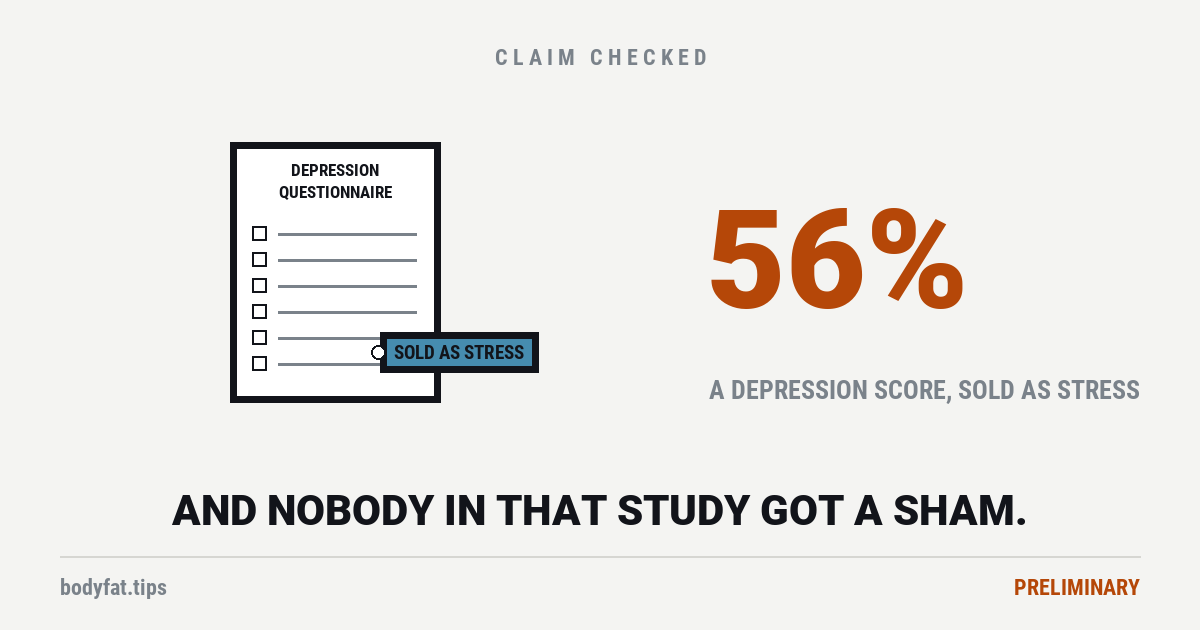
The device’s numbers come from a study with no fake device and no untreated group. The 56% was the fall on a depression questionnaire, not a stress score, and the study was paid for by the seller [3] [4].
The fair tests of neck stimulation on stress and anxiety are few, small and mostly in PTSD. In the ones that measured anxiety, none found people on the real device significantly less anxious than people on a sham; where the numbers leaned the device’s way, it was by margins chance could explain [5] [6]. On the heart-rhythm measure people call “vagal tone”, they found short-lived rises during stimulation in PTSD and no lasting change in a larger trial [7] [8].
Cold water on the face and slow breathing do raise the heart-rhythm measure of vagal activity, while you do them. That is measured. That it “resets” a nerve, repairs a gut or stops inflammation is not [9] [10].
What does “resetting your vagus nerve” actually mean?
The vagus nerve is a pair of long nerves running from the brainstem through the neck to the heart, lungs and gut [11]. It is the main wire of the parasympathetic nervous system, the “rest and digest” side of the body’s automatic controls. “Reset” is not a medical term, and no test measures whether a vagus nerve has been reset. Two things near the claim can be measured, and the trials below use them.
The first is heart rate variability, or HRV: the small changes in the gap between one heartbeat and the next. Your heart speeds up a little as you breathe in and slows as you breathe out, and the vagus nerve does the slowing. Some HRV measures, such as one called RMSSD, are read as a sign of vagal activity, which researchers call vagal tone [12]. HRV is also easy to nudge: the same guidance warns that it is very sensitive to things like the position your body is in when it is measured [12]. The second is the blood’s inflammation markers, the chemical signals the immune system sends, such as interleukin-6 and C-reactive protein.
Can stress affect the vagus nerve?
Stress shows up in the heart’s rhythm. A review of studies that measured HRV while people were put under stress found that, in most of them, the measures linked to the vagus nerve fell [13]. So a stressed body does read as “less vagal” on a heart monitor. That is a reading of the moment, not damage to a nerve, and it is why a device that claims to raise vagal activity can sound so plausible.
Where the 39%, 56% and 70% came from
We went looking for the “clinical study”. It exists, though not where the seller said. It is a congress abstract: a short summary of a poster shown at the 34th European Congress of Psychiatry, printed in a supplement of European Psychiatry on 31 July 2026, a year after the video [3]. The abstract names the device: Pulsetto. Its first author gives the seller as their affiliation, and the seller’s press release calls that author its medical and science lead [3] [14]. The seller’s own study page says the work was “funded by UAB Pulsetto”, the company, through an EU-supported project [4]. The abstract’s conflict-of-interest line reads “None Declared” [3].
Here is what the study did. Forty healthy adults were enrolled and 37 finished, 8 men and 29 women aged 21 to 64. They used the device twice a day for eight minutes a session for four weeks. They were split by chance into two groups: one stimulated one side of the neck, the other both sides [3]. That is the whole comparison. Nobody got a sham, a device that looks and tingles like the real one but delivers nothing, and nobody went without. The seller’s own page calls the design “open-label”: everyone knew what they were using [4].
The scores came from three questionnaires filled in at the start, at two weeks and at four weeks: the PHQ-9, a nine-question depression questionnaire; the GAD-7, a seven-question anxiety questionnaire; and a sleep-quality index [3]. The abstract’s own words: “depressive symptoms dropped by 56%, anxiety by 45%, and sleep disturbances by 41% within 4 weeks” [3]. So the 56% the video calls “stress symptoms” is the fall on the depression questionnaire. The seller’s home page puts it the same way as the video, “Stress dropped 56%” [15]. The 45% for anxiety matches the abstract. On cortisol, the abstract reports that hair cortisol fell in the two-sided group, by a test result rather than a percentage, and did not fall significantly in the one-sided group [3].
Where did the other figures come from? From the seller. Its press release dated 4 July 2025, three weeks before the video, says “Cortisol levels decreased in 70.3% of users, with an average 40% drop”, and calls the depression result “Psychological stress symptoms dropped by 55.9%” [16]. So the relabelling of a depression score as stress was the seller’s own, in its own release, before the video. The 31% is on the seller’s landing page linked at the top of the channel’s 2026 video descriptions, where it is the anxiety questionnaire at two weeks, beside the line “Exploratory pilot data (n=40), no placebo control” [17]. We found the video’s 39%, a two-week figure for “stress symptoms”, in none of the seller’s own pages or its press release. The one place we saw it was a study summary from the seller, posted by a distributor and marked confidential, which an ordinary web search returns; we have not quoted or relied on it [18]. An ordinary web search for the figure also returns the seller’s own page on stress, which prints a different 39%: “39% Less anxiety (GAD-7)”, after four weeks, credited to an “internal pilot” from 2023. That is the anxiety questionnaire, not the video’s “stress”, at four weeks, not two, and it is not the 45% the landing page gives for the same questionnaire at four weeks [17] [18]. Whether that pilot is the study in the abstract we cannot tell: its 41% for sleep matches the abstract, its anxiety figure does not [3]. Other pages on the seller’s site credit pilots and studies of its own with still other figures, among them a 42% fall on the same anxiety questionnaire and falls in hair cortisol of 28%, 32% and 37% [18].
The seller’s cortisol figures for the study do not agree with each other. The press release says 70.3% of users, with an average drop of 40% [16]; the landing page says “73% of participants reduced cortisol”, by 27% on average [17]; the home page says “27% Lower Cortisol Level (Week 4)” [15]; and a post on the seller’s blog gives a fall of 47.5% with two-sided stimulation against 31.0% with one-sided [17]. None of them is in the published abstract, which reports cortisol only as a test result [3]. The seller’s science page also lists an “Independent study” that set the device against a sham and read brain waves for signs of relaxation, with no link to a paper [19]; a search of PubMed and Europe PMC for its title found none [18].
Why does a missing sham matter so much here? Because people who start a twice-daily calming routine, with a device they chose and a questionnaire asking how they feel, tend to report feeling better, whatever the device does. The size of that effect is visible in the Danish sham-controlled trial of neck stimulation below, where the fake device did about as well as the real one [8]. A study with no sham cannot tell the current from the routine.
What the American Journal of Physiology study actually found
In May 2026 the seller’s press release said “A randomized controlled pilot study, published in the American Journal of Physiology, found that four weeks of daily use reduced anxiety by 45%, depressive symptoms by 56%, and sleep disturbances by 41%” [14]. Those are the congress abstract’s figures. The American Journal of Physiology paper the seller lists on its study page is a different study [20] [4].
A US medical school randomised 35 young, healthy adults, by rolling a die, to lie still for 18 minutes with no stimulation, or to have their ear or their neck stimulated. Nine had the seller’s device on the neck, once [20]. During stimulation their top blood-pressure number fell from 134 to 120 mmHg (millimetres of mercury), and returned to the level of the still group once the device was off. Heart rate did not change. Brain waves of the kind linked to relaxing rose afterwards [20].
And the heart’s rhythm? Heart rate variability went down during neck stimulation, not up, including RMSSD, the measure read as vagal activity; the authors write that “cervical VNS reduced HRV” [20]. No questionnaire was used: “We did not record perceptual measures,” the authors write, and the calming effect is reported only “anecdotally” [20]. There was no sham, because, the authors say, the device’s design “did not allow safe stimulation at an alternative, nonvagal site” [20]. The seller supplied two devices free; none of the authors works for it [20].
A second study of the device points the other way, and it did use a sham. In a 2024 master’s thesis at Delft University of Technology, supervised at Erasmus MC, a hospital in Rotterdam, 40 healthy adults were split by chance: 30 had ten minutes of stimulation, and 10 had the device placed and then switched off without being told [21]. In the stimulated group, heart rate fell and RMSSD rose during stimulation; in the sham group neither moved; each group was compared only with its own starting point, and nothing lasted once the device was off [21]. A thesis is not peer-reviewed: no journal’s reviewers have checked it. It also reports that a neurologist at the hospital tested the device’s output and found no difference between its settings, and a current of 1.5 to 3.5 milliamps (mA, a measure of electric current), against the 65 mA the company gives as its maximum [21]. The seller listed the thesis on its science page in July 2025 [21].
| Study | Compared with | What it found |
|---|---|---|
| The seller’s own study: 37 healthy adults, four weeks, the device the videos sell [3] [4] | Nothing. One group stimulated one side of the neck, the other both sides | Depression, anxiety and sleep scores fell in both groups; hair cortisol fell in the two-sided group [3] |
| One 18-minute session, 9 young adults on the same device [20] | 10 people who lay still with no stimulation; no fake device | Top blood-pressure number lower during stimulation, back up afterwards; heart rate variability went down; no mood measured [20] |
| 40 healthy adults, one 10-minute session, the same device; a master’s thesis, not peer-reviewed [21] | 10 people whose device was placed and then switched off without their knowing | Heart rate fell and RMSSD, the vagal measure, rose during stimulation; neither moved in the sham group [21] |
| 20 people with PTSD, three months, a prescription neck stimulator [5] | A sham device, double-blind | Self-reported PTSD symptoms fell in both groups and ended at the same score; overall anxiety fell a little further on the sham [5] |
| 19 men with alcohol use disorder, one week, the same prescription stimulator [6] | A sham device, double-blind | Anxiety fell a little further on the real device on both questionnaires, by margins chance could explain; depression scores fell significantly further [6] |
| 131 adults with diabetes, nine weeks, the same prescription stimulator [8] | A sham device, double-blind | Gut symptoms improved as much on the sham; a measure of the heart’s vagal tone did not change [8] |
| 16 studies of ear stimulation in healthy people [22] | A sham, usually stimulation of the earlobe | No effect on the heart-rhythm measure of vagal activity [22] |
Does a vagus nerve stimulator work for anxiety? What the sham-controlled trials found
The fair test of a stimulator is against a sham. For devices worn on the neck, most of the sham-controlled tests on stress and anxiety come from one program at a US university, using a prescription device cleared for headaches, in people with post-traumatic stress disorder (PTSD) [7] [5]. A 2025 systematic review, a study that gathers every trial on a question, found seven reports, all sham-controlled. Six came from one US trial of the neck device, which enrolled 56 people [7] [23]; the seventh was a single visit by 22 veterans, and it stimulated the ear, not the neck [24]. The review’s total of 137 patients adds up the patients in each report, so people from the one trial are counted more than once [7]. It graded the certainty of every outcome “very low”, the bottom of the four grades reviewers use [7]. In five of the seven, an author had funding from a device maker or the devices came free from one [7].
Only one of those trials measured symptoms over weeks. Twenty people with PTSD used a real or sham device twice a day for three months. On the PTSD questionnaire they filled in themselves, both groups ended on the same score, 51: the real-device group fell from 62 and the sham group from 59 [5]. The paper’s headline, a “31% greater decrease” on the real device, compares how far each group fell, 17% against 13%, from different starting points, and its tests compared each group only with its own starting point; it reports no test of one group against the other on that questionnaire [5]. On a structured interview by a clinician, both groups improved, by 31% and 23%, again each tested only against itself [5]. Overall anxiety, rated by a clinician, fell a little further on the sham, from 21 to 16, than on the real device, from 23 to 20; anxiety felt in the body fell further on the real device, though the sham group still finished lower [5]. Other papers from the same trial measured the body, not the mind: lower levels of ghrelin, a hormone proposed as a marker of stress, after stressful tasks, in 55 people [25], and, in a later paper read as its abstract, a heart rate about 5% below its starting level by the end of a three-hour session in people with PTSD on the real device [26].
Three other small sham-controlled tests of the neck device, one of them a single session inside the same US trial, asked people how anxious they felt, and none found the real device significantly ahead on an anxiety scale. In 19 male veterans with alcohol use disorder, a week of the same prescription device lowered scores on two anxiety questionnaires a little more than a sham did, by margins chance could explain: on the Beck Anxiety Inventory, a standard anxiety questionnaire, from 16.8 to 12.5 on the real device and from 17.0 to 14.9 on the sham. Depression scores fell significantly further [6]. In 22 people with PTSD, one session left distress an average of 3.4 points lower with the real device than with the sham, a gap chance could easily explain, and the paper reports self-rated anxiousness only as following “a similar pattern” [27]. In 21 people going through opioid withdrawal, one session lowered self-rated anxiety more than the sham did, by 1.9 points against 0.1 on a scale of 0 to 10, but not by more than chance could explain; it did significantly lower a separate distress score and a clinician’s rating of anxiety or irritability, and the authors write that people may have confused the distress and anxiety scales [28]. And in a 30-day trial of a different kind of neckband, one that sends magnetic pulses rather than electric current, the paper’s summary reports less anxiety, but its results show the placebo group’s anxiety fell about as much as on the best setting, and further than on the worst [29]. That trial was funded mainly by the company that sells the neckband, and its volunteers were people who already used it; 321 gave a first rating and 213 were still answering on day 30 [29].
The largest sham-controlled trial of neck stimulation we read outside headache was not about stress at all; the device’s headache trials are bigger, one of them 248 people with migraine [30]. In Denmark, 131 adults with diabetes and nerve damage used the same prescription neck device or a sham, four times a day for a week and then twice a day for eight weeks [8]. A responder was anyone whose score on either of two gut-symptom scales fell by at least 30%. In the first week, one in three on each device responded, 33.3% on the real device and 33.8% on the sham; over the next eight weeks, 41.9% against 38.7%, too close to tell apart [8]. And the trial measured the heart’s vagal tone directly: “Neither acute nor long-term changes” [8].
Ear stimulation has more trials. A 2021 meta-analysis, a pooling of trials into one estimate, took 16 studies in healthy people that set a session of ear stimulation against a sham and found no effect on the HRV measures of vagal activity: an effect size of 0.014, where 0.2 is what researchers call small [22]. Its statistics put the data about 25 times likelier if the stimulation did nothing to that measure than if it did something [22]. A 2026 review of six randomised trials of stimulation through the skin found no significant effect on HRV either [31]. The evidence leaning the other way is in people with sleep problems: a 2026 review of 14 randomised trials of ear stimulation for sleep disorders, 11 of them pooled, reports lower anxiety scores, by an amount researchers call moderate, and its authors call the finding preliminary [32]. We read it as an abstract, so we cannot say how many of its trials used a sham. An earlier pooling of six studies in insomnia found better sleep scores, rated low-certainty [33]. How the stimulation works, a 2020 critical review concluded, “remains predominantly hypothetical” [34].
Is a vagus nerve stimulator FDA-approved?
One neck stimulator has been through the FDA. In 2017 the agency granted gammaCore, from electroCore, a De Novo classification, its route for a new kind of device with no earlier equivalent on the market, for “the acute treatment of pain associated with episodic cluster headache in adult patients”, “For prescription use only” [35]. The same summary warns that “The long-term effects of the chronic use of the device have not been evaluated” [35]. Later clearances added migraine from age 12, prevention of cluster headache alongside other treatment, and two rarer headache disorders, still on prescription, under a regulation named “External Vagal Nerve Stimulator For Headache” [36]. Stress and anxiety are not on the list. That device, not the one the videos sell, is the one in the US PTSD pilot and the Danish diabetes trial above [5] [8]. Implanted stimulators, wired to the nerve in surgery, are approved for epilepsy and depression [34], and in 2025 one was approved for rheumatoid arthritis [37].
The device the videos sell is in a different category. Its seller calls it “a general wellness product” that “is not intended to diagnose, treat, cure, or prevent any disease or medical condition” [15]. The FDA’s general-wellness guidance lets low-risk products make claims about “relaxation or stress management” without review, but not “A claim that a product helps treat an anxiety disorder” [38]. The guidance adds that being treated as a wellness product “does not establish that it has been shown to be safe and/or effective”, and it gives “A neurostimulation product that claims to improve memory” as an example of something that is not low risk, “due to the risks to a user’s safety from electrical stimulation” [38]. Whether a given stimulator fits inside that policy is the FDA’s call, not ours. What we can say is that the agency’s device databases hold no clearance, approval or De Novo grant for the device the videos sell; the only record under its name is a listing for a conductive gel, made by a gel manufacturer [39].
Does cold water on your face reset the vagus nerve?
Cold water on the face sets off the diving reflex, found in every air-breathing animal with a backbone: the heart slows [40]. That part is real and measured. A 2023 meta-analysis of 17 studies, 311 people, found that the HRV measure of vagal activity rose during cold on the face, cold-water immersion or diving, by an effect size of 0.59, where 0.5 is what researchers call moderate [9]. Afterwards, the effect was 0.11, and the range the true answer probably sits in still included no effect at all [9]. The reviewers rate the evidence low quality [9].
A randomised trial from Luxembourg tested cold without water. There, 61 volunteers had a cooling plate about 1.2 inches (3 cm) square held for 16 seconds at a time on the neck, the cheek and the forearm, against the same plate held at 88°F (31°C) [41]. On the side of the neck, HRV rose and the heart slowed. On the cheek, which the authors chose because it is central to the diving reflex, HRV rose a little and the heart rate did not change; on the forearm, nothing [41]. Nobody was stressed during the test, and nobody was asked how they felt [41].
One trial did test cold on the face against stress. In Germany, 25 young adults sat through a stressful arithmetic task; 12 had a cooling mask at 30°F (−1°C) on their face for two minutes before each round, and 13 rested instead [40]. Heart rate recovered better with the mask, and the peak rise in the stress hormone cortisol was smaller [40]. The paper’s summary also claims “less overall cortisol secretion”; its results section says the total was lower “but the differences were not statistically significant” [40]. In 15 people with panic disorder, a cold-water face dip did not change their bodies’ response to a carbon dioxide challenge, though they reported fewer panic symptoms afterwards, in a study whose conditions were not randomly assigned [42]. None of the cold-water studies we read measured the gut.
For full-body cold, this site has two verdicts: whether cold plunges burn fat and what ice baths do for recovery.
Does slow breathing stimulate the vagus nerve?
Slowing your breathing raises HRV while you do it. A 2022 meta-analysis gathered 223 studies and found vagal HRV rose during slow breathing, straight after a session, and after programmes of several sessions [10]. That is one of the better-measured effects on this page. Whether it lowers stress is a separate question, and this site has answered it for the best-known technique: our box-breathing verdict found breathing practices in general cut self-reported stress by a modest amount, and rates box breathing itself Preliminary. Nothing here changes that.
Does stimulating the vagus nerve stop inflammation?
The idea comes from animal research: in rodents, stimulating the vagus nerve dampens the immune system’s inflammation signals [43]. In people, the evidence is mixed. A 2024 review of 36 studies, 1,135 people, pooled 26 of them and found that “the current evidence does not substantiate the claim that VNS impacts inflammatory cytokines in humans”; only in four longer studies of acute inflammation did C-reactive protein fall more than on a sham [43]. A 2025 review of 27 randomised trials of ear stimulation, which counted acupuncture and acupressure as well as electrical devices, found lower C-reactive protein, TNF-alpha and interleukin-6 [44]. The Danish neck trial measured five of these signals in people with diabetes and found no difference from the sham [45]. In the US PTSD trial, stimulation blocked the rise in interleukin-6 that followed recalling a trauma [5].
The strongest evidence that the nerve can calm an inflammatory disease is from a device you cannot buy online. In July 2025 the FDA approved an implant fitted around the vagus nerve in the neck for adults with rheumatoid arthritis whose disease has not responded to, has stopped responding to, or could not tolerate at least one of the advanced arthritis drugs. In its pivotal trial, 242 patients, 35.2% on the implant and 24.2% on a sham improved by at least 20% on a standard arthritis score after 12 weeks [37]. That is surgery, in a disease, under a doctor. It says nothing about a neckband.
Can it repair your gut?
“Repair the gut” is not a measure, so we looked for what was measured. For stimulation, a 2026 review of seven randomised trials in people with digestive and abdominal disorders pooled two of them and found symptoms improved slightly more than on a sham, by an amount its authors call modest [11]. One of the two, the Danish neck trial, found no difference on its own [8] [11]. In 16 healthy volunteers given a stress hormone by injection, ten minutes of ear stimulation a side left the gut wall 53% less leaky than a sham did, on a sugar-absorption test, while a second marker of gut damage did not change [46]. That was one session, in a laboratory.
For the foods: prebiotics, the fibres that feed gut bacteria, do change the bacteria. A meta-analysis of 11 trials, 729 people with irritable bowel syndrome, found they raised bifidobacteria but did not improve symptoms, bloating or quality of life compared with a dummy [47]. On mood, the poolings disagree: one found prebiotics no better than a dummy for depression or anxiety [48]; a 2026 one found they did not help depression but did help anxiety [49]; a 2025 one found they helped both [50]. None of the three abstracts mentions the vagus nerve. And the trials compared prebiotics with a dummy, which means supplements, not the “Fruits & vegetables” the video lists [1].
For breathing, the pooled gut evidence we found is about reflux. A 2026 meta-analysis of ten randomised trials, 476 people, found diaphragmatic breathing eased reflux symptoms, though 79.7% of the spread between the trials’ results was more than chance would produce, which the reviewers call substantial; the reviewers describe it as aimed at the muscle ring at the bottom of the gullet, and their summary does not mention the vagus nerve [51].
Does heat help the vagus nerve?
It depends on the heat. A review of 27 studies in healthy adults, covering local heat and sauna bathing as well as heating the whole body, found that heating the whole body lowered vagal activity in 14 of them, while local heat and sauna bathing “seem to increase” it. Its summary does not say how many of the 27 heated the whole body, and the summary is all of the review we could read [52]. In a randomised trial of 38 sedentary adults, adding 15 minutes of sauna after exercise for eight weeks did nothing for HRV beyond what the exercise did [53].
Where do you rub to stimulate the vagus nerve?
The stimulation trials on this page used electrical devices, not hands. Pressing or rubbing the side of the neck, where the vagus nerve runs in a sheath beside the carotid artery [5], is a doctor’s manoeuvre called carotid sinus massage, used to stop some fast heart rhythms, and a review of it found its benefit “modest at best” and its rare harms “potentially devastating” [54]. A 2021 case report describes a second stroke in a 58-year-old man, in hospital after a first, when he massaged his own neck; he had a narrowing in a neck artery nobody knew about, and the authors conclude that neck massage “should therefore not be performed by patients” [55]. Don’t.
How do you know if your vagus nerve is messed up?
Not from a smartwatch. HRV moves with breathing, posture and the moment you measure it [12], and it drops under ordinary stress [13]. A low reading is not a diagnosis. Real damage to the nerves that run the body’s automatic functions is measured with standard tests: in the Danish trial, nerve damage from diabetes was checked by how the heart rate responds to standing up, to deep breathing and to straining against a closed throat [8]. If you have symptoms that worry you, that is a conversation for a clinician.
What about vagus nerve reset exercises and the book?
The first ordinary result Google gives for “vagus nerve reset”, under its AI answer, is a two-page hospital behavioral-health handout. It teaches eye and neck movements it credits to a self-help book, Accessing the Healing Power of the Vagus Nerve [56] [57]. The “Vagus Nerve Reset” book in Google’s related searches is a 2023 title from a Penguin Random House imprint, Vagus Nerve Reset: Train Your Body to Overcome Stress, Trauma and Anxiety [57]. We have not read either book. The one randomised trial of exercises in this family that we found added “polyvagal theory-based” relaxation exercises to knee strengthening in 60 women with knee arthritis: the extra exercises brought more pain relief and a higher vagal HRV reading after six weeks, but the comparison group got nothing in place of them, and the paper reports no blinding [58].
Who these studies were done on
Before any of these numbers applies to you, check who they came from. The seller’s study was 37 healthy adults, 29 of them women, aged 21 to 64 [3]. The study of the device on the neck was nine young, healthy adults averaging 28, in one sitting [20], and the thesis that set it against a sham was 40 healthy adults in their late twenties on average, also in one sitting [21]. The sham-controlled neck trials that measured anxiety or distress were in people with PTSD, alcohol use disorder or opioid withdrawal [7] [6] [28]; the largest neck trial we read outside headache was in people with diabetes and nerve damage, aged 20 to 86 [8]. The cold-face trials were mostly young volunteers: 61 with an average age of 27 [41], and 28 recruited for the stress trial, 82% of them women [40]. The arthritis implant was tested in adults whose disease had beaten the drugs [37]. If you are a healthy, stressed adult wondering about a neckband, the trials of electrical neck stimulation with a sham and weeks of use were done on people with an illness: PTSD, diabetes, Sjögren’s syndrome, Parkinson’s disease, chronic pancreatitis and Gulf War illness, and for one week alcohol use disorder [5] [8] [59] [60] [61] [62] [6]. None was in people like you. The nearest we found in healthy people lasted days, not weeks: four days of the prescription device or a sham in 34 adults in the Netherlands, which found no effect on mood, learning or sleep [63], and three days in 36 students at a US military language school, which measured vocabulary, fatigue and focus [64].
If the trials are this thin, why do so many users say they feel calmer?
This section is the desk’s own reasoning, and it is labelled as such. Plenty of people say a stimulator calms them, and some trials agree on questionnaires. So where does the calm come from, if not clearly from the current? Three answers, with what each rests on.
Answer one: the routine works without the current. In the Danish trial, the sham device produced as many responders in the first week as the real one, 33.8% against 33.3% [8]. In the US PTSD pilot, the sham group’s own PTSD questionnaire fell to the same score as the real device’s, and its anxiety fell a little further [5]. And in Lithuania, 18 youth footballers were told the seller’s device would help them recover after a match, then wore it for 20 minutes switched on but delivering no current; against sitting quietly, it did nothing for their sprints, jumps or heart rhythm, and they reported less fatigue and soreness, by margins the authors call moderate but which did not reach statistical significance [65]. This is measured: the sham arms show it.
Answer two: the tingle tells you it is working. A neck stimulator is felt. The American Journal of Physiology team note that the tingling and vibration “make complete participant blinding challenging”, and in the one-minute pauses between bursts of stimulation they measured faster brain waves, which they put down to “a state of arousal” caused by the sensation [20]. That a felt sensation makes people expect calm, and report it, is a surmise with one paper’s caution on its side.
Answer three: sitting still twice a day is the active ingredient. The seller’s study had people stop twice a day for eight minutes [3]. The site’s box-breathing verdict reports a trial in which meditation did as well as box breathing on anxiety. That the quiet minutes, not the device, do the work is a hunch: the one study that set the neckband against lying still measured blood pressure, heart rhythm and brain waves, not calm [20].
Put the three together and here is what we think is true, stated plainly so you can disagree with it: without a sham, a stimulator’s study measures the ritual, not the current.
What we could not find, and would like to: a trial of a consumer electrical neck stimulator in stressed but healthy adults, against a sham that tingles too, measuring anxiety over weeks. The nearest is the magnetic neckband trial above, whose placebo group did about as well [29]. The only sham-controlled study of the seller’s device we found in the trial registry was registered by a university researcher in December 2025, measures heart rate variability, not anxiety, and has not started recruiting [66]. If you know of the trial we describe, the corrections line on this site is open.
Where “reset your vagus nerve” came from
The science was an idea before it was a product. In 1995 a physiology paper proposed “cardiac vagal tone”, read from the rhythm of the heartbeat, as “a novel index of stress” [67]. That paper is still listed among the references on the seller’s science page today [67]. Self-help books turned the theory into exercises, one of them the source of the hospital handout, and in 2023 into a book called Vagus Nerve Reset [57] [56].
Then the phrase met a product. In July 2025 a health-video channel put a referral link to a neck stimulator in a video title and quoted a “clinical study” whose published version, a year later, turned out to have no sham and a depression score where the video said stress [1] [3]. The relabelling was the seller’s before it was the channel’s: its press release three weeks earlier called the same score “Psychological stress symptoms” [16]. In 2026 the same channel’s “reset” videos added cold water, breathing and gut repair, and Google’s AI answer for “vagus nerve reset” now cites one of them [1] [2].
None of this is aimed at anyone who has bought one. The vagus nerve is real, the diving reflex is real, and slowing your breathing really does change your heart’s rhythm. The problem is a seller quoting a depression score as a stress score from a study with nothing to compare against, and a video passing it on with 10% off.
What this is rated, and what the rating covers
Preliminary — for the claim that a vagus nerve stimulator worn on the neck lowers stress and anxiety.
It is rated Preliminary, at the bottom of the tier. The device the videos sell has been tested on stress and anxiety only without a sham, in any study we could read: the seller’s own open-label study, in which scores fell in both its groups [3] [4]. That is early, small evidence on its side, and it cannot separate the device from the routine. It is not rated higher because, for neck stimulation in general, the small sham-controlled tests that measured anxiety found the real device not significantly better than the sham, though the numbers mostly leaned its way [5] [6] [27] [28]; because in the US PTSD pilot both groups ended on the same score on their own questionnaire [5]; and because, on the device sold, the two studies of the heart’s rhythm point opposite ways [20] [21]. It is not rated Unsupported because that device itself has not, in any study we could read, been put against a sham on stress or anxiety, and the little evidence there is points its way. The seller’s 56% is not a finding about stress.
Rated alone, the other claims around it. That neck stimulation lowers anxiety: Preliminary, at the bottom of the tier; four small sham-controlled tests of 19 to 22 people each, none significant on an anxiety scale. In three the numbers leaned the device’s way (in the single PTSD session, on distress, the one figure that paper gives), and in the three-month PTSD pilot overall anxiety fell further on the sham [5] [6] [27] [28]. The one significant result was a single clinician-rated item for anxiety or irritability, in one session, in opioid withdrawal [28]. Tests this small can miss a modest effect, which is why this is not rated as tested and failed. That neck stimulation dampens the body’s response to stress during a session: Preliminary; in single sham-controlled sessions in people with PTSD or past trauma, it blocked a rise in interleukin-6 after recalling a trauma, lowered ghrelin after stressful tasks and slowed the heart over three hours, and in opioid withdrawal it lowered distress, though in another single session, in PTSD, it did not [27]; all small and from one US program [5] [25] [26] [28]. That a single session of ear stimulation raises vagal tone in healthy people: Unsupported, of the tested kind; 16 sham-controlled studies found no effect, and repeated use was not what they tested [22]. That neck stimulation raises it: Preliminary; short-lived rises during stimulation in PTSD [7], no lasting change in the Danish trial [8], and on the device sold, one single-session study found HRV fell during stimulation [20] while an unpublished sham-controlled thesis found it rose [21]. That the device lowers cortisol: Preliminary; the one study of it had no sham [3], the seller’s own figures for it disagree [16] [17], and pooled randomised trials of ear stimulation found no change in cortisol [44]. That cold water on the face slows the heart and raises HRV while the cold lasts: Supported [9] [40]. That it brings lasting calm: Preliminary, on one small stress trial [40]. That slow breathing raises HRV: Supported [10].
That stimulating the vagus nerve “stops inflammation”: Preliminary, because the poolings conflict [43] [44]; an implant in rheumatoid arthritis is a different device and a different claim [37]. That it repairs the gut: Preliminary, a modest pooled effect in gut disorders and a null result in the Danish neck trial [11] [8]. That prebiotic supplements ease gut symptoms in irritable bowel syndrome: Unsupported, of the tested kind; prebiotic foods, the video’s advice, were not what those trials gave [47]. That prebiotics calm the mind: Preliminary, the poolings disagree [48] [49] [50]. That heating the whole body helps the vagus nerve: Unsupported, of the tested kind, on the one review we could read only in summary; a review’s summary reports whole-body heating lowering vagal activity in 14 of its 27 studies, which also covered local heat and sauna, and names none in which it rose. How many of the 27 heated the whole body, and what the rest found, we could not read; the full review could change this rating [52]. That local heat or a sauna does: Preliminary; the same review’s summary says they “seem to increase” it, and a sauna trial found nothing added to exercise [52] [53]. That the “reset” exercises work: Preliminary, one trial in knee arthritis that reports no blinding [58]. Unsupported means we looked and the evidence does not back the claim; all three claims rated Unsupported here were tested and did not hold up.
What is not rated here: cortisol in general, which has its own verdict on how to lower it and one on the cortisol detox; prescription stimulators for headache; and the section above, which is this desk’s reasoning from the evidence rather than a result the evidence delivered. It is marked as ours so that you can weigh it as ours. This is journalism, not medical advice. None of this is a reason to stop a treatment a doctor prescribed, including a prescription stimulator for headache; personal health questions belong with a clinician. How we read a study, and what each tier means, is set out here.