Is Maltodextrin Bad for You? Gram for Gram, It Does Spike Blood Sugar More Than Table Sugar. “Worse Than Sugar” for Your Liver and Belly Fat Is Not What the Trials Found.

“It spikes blood sugar higher than sugar itself.” That line is from the description of “This Carb Spikes Blood Sugar WORSE Than Sugar”, posted on 2 February 2026 by a chiropractor’s health-video channel whose creator directs a supplement company. It had 13,312,221 views when we read it on 10 October 2026. Its companion, “The #1 MOST Dangerous Carbohydrate in the World!”, posted on 10 November 2025, had 14,096,520, and says the same carb “can lead to insulin resistance, weight gain, and even type 2 diabetes over time” [1].
Neither description names the carb. The second video’s own tags do: “maltodextrin”. So do the channel’s later descriptions, which list it beside modified food starch and modified cornstarch, and so did a UK regional news site’s report of the claim in January 2026 [1] [2].
It is a busy question. “Maltodextrin” is searched about 90,500 times a month in the United States, and “is maltodextrin bad for you” about 6,600 (from a paid keyword database, pulled 10 October 2026) [3]. So we read the research. Here is the short version; the rest of the page is the working.
The spike half is true. Gram for gram, maltodextrin raises blood sugar about as much as pure glucose does, and more than table sugar [4] [5].
“Worse than sugar” is where it comes apart. On the harms the videos list, insulin resistance, belly fat and a fatty liver, trials that pitted glucose, which is what maltodextrin becomes in your gut, against fructose, the other half of table sugar, found glucose no worse on those, and on several measures better. So did trials of glucose against table sugar itself, and the one trial we found of maltodextrin itself against table sugar found the liver making more fat from the sugar [6] [7] [33] [34] [8]. Trials that have given people maltodextrin for months, mostly as a dummy or as the comparison for something else, have not shown those harms clearly; in one that ran 18 months, insulin resistance did not change [9] [35].
The “65–250 pounds per year” traces to nothing we could find. Its top end is about twice what the US Department of Agriculture counts per person for every sugar and syrup combined, by our arithmetic [10] [9].
What is maltodextrin made from?
Starch, cut into short pieces. The US Food and Drug Administration defines maltodextrin as a “nonsweet nutritive saccharide polymer”, chains of glucose made “by partial hydrolysis of corn starch, potato starch, or rice starch with safe and suitable acids and enzymes” [11]. Partial hydrolysis means the long starch chains are snapped into shorter ones. How far is measured by the dextrose equivalent, a scale on which pure glucose scores 100; maltodextrin is anything under 20, which is to say mostly chains rather than loose sugar [11] [12].
One maltodextrin-type powder used in medical research, for example, was 3% glucose, 7% maltose (two glucose units joined), 5% three-unit chains and 85% chains of 4 to 15 glucose units [13]. Every piece of it is glucose.
Is maltodextrin vegan? By its raw materials, yes. The US definition names only plant starches as the raw material: corn, potato and rice [11]. Other starches, wheat among them, can be used if the result is the same substance [12].
And it is in the foods the videos list, for reasons. In sports drinks it carries the same glucose as a glucose drink but pulls less water into the gut, which is easier on a runner’s stomach; in infant formula it stands in for lactose, the sugar in milk, in formulas made for babies who cannot digest lactose or need a soy or hypoallergenic formula [12]. “Baby formula” is accurate. It is not a secret.
Does maltodextrin spike blood sugar more than sugar?
Yes, if “sugar” means table sugar. The tool for this is the glycemic index, which scores how sharply a food raises blood sugar against pure glucose, set at 100. It compares portions holding the same amount of digestible carbohydrate, not the same bowl or the same calories, and it measures blood sugar, not weight. In the international tables, pure glucose averages 103 across seven studies; table sugar averages 65 across six, which ranged from 58 to 84 [5].
Why the gap? Table sugar is half glucose and half fructose, and fructose barely moves blood glucose: it scores 15 [5]. Maltodextrin is all glucose once it is digested, and it is digested fast. A review of its digestion calls the idea that it absorbs slowly “a misconception” and puts its absorption rate at “not being different from absorption after ingestion of pure glucose” [12].
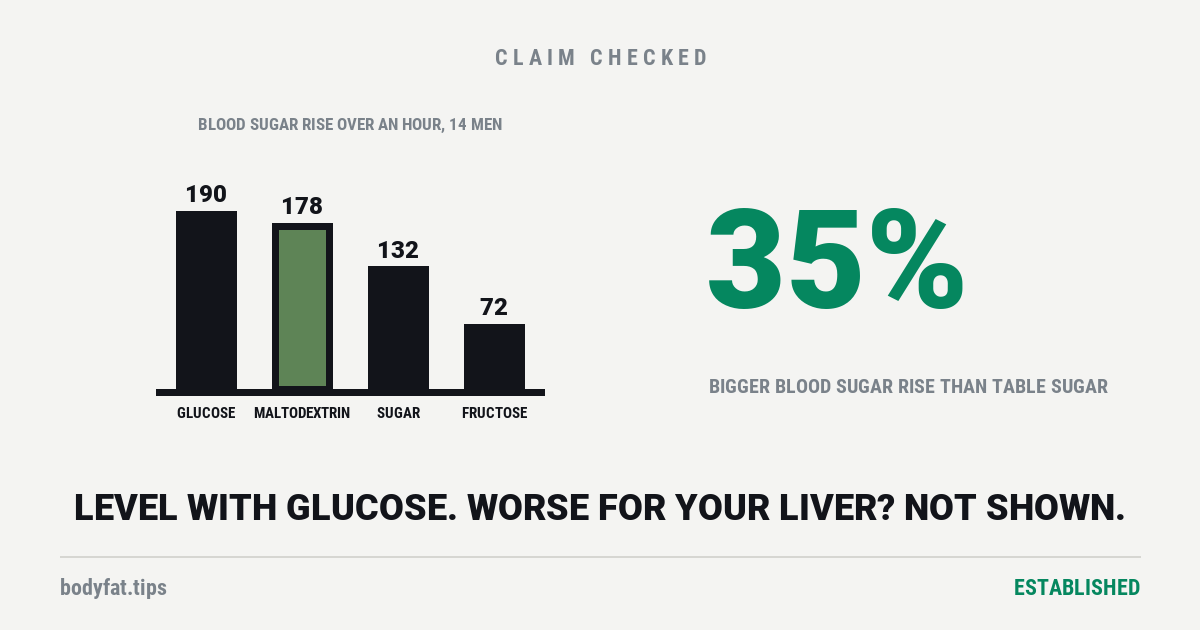
That is the chemistry. Has anyone put the two in a glass side by side? Yes. In 2002 a Toronto lab gave 14 healthy young men five drinks on five different mornings, four of them holding 75 g of carbohydrate and one sweetened with sucralose and holding none, and measured their blood sugar over the next hour [4]. The number below is the area under the curve: how high blood sugar rose and for how long, added up into one figure.
| What was in the drink | Rise in blood sugar over the hour (area under the curve, mmol·min/L) |
|---|---|
| 75 g of pure glucose | 190.5 |
| 75 g of a maltodextrin-type glucose polymer | 177.5 |
| 75 g of table sugar (sucrose) | 131.6 |
| 75 g of 80% fructose, 20% glucose | 71.5 |
| Water sweetened with sucralose, no carbohydrate | 8.0 |
The glucose polymer and pure glucose came out level; both rose higher than table sugar, by more than chance would explain [4]. By our arithmetic the polymer’s rise was about 35% bigger than table sugar’s. An earlier experiment in the same paper, with 8 men, pointed the same way, 156.6 against 117.7, by a margin that could have been chance [4]. The polymer was a maltodextrin by its makeup: a 1989 study of the same product describes it as mostly short glucose chains [13].
Toronto is not the only lab to have tried it. In Bath, England, 24 adults without obesity, half of them women, drank 100 g of maltodextrin one day and 100 g of table sugar another, each with 50 g of fat; blood sugar and insulin rose less after the sugar, by a margin chance would rarely produce [8]. That result is in the trial’s preprint, its early public version; the published abstract leaves it out. In the Netherlands, 48 overweight adults with raised blood pressure, average age 58, took the same weight of each, scaled to their body weight, and blood sugar was higher one to two hours after the maltodextrin [36]. Three other studies are mixed. At Cornell, a pilot study of 10 adults found a higher reading 45 minutes after about 14 g of maltodextrin than after the same calories of table sugar in the five men, and no difference in the five women [37]. In Manchester, 20 adults’ blood sugar over an hour added up to 441 after 40 g of maltodextrin and 425 after 40 g of table sugar, a difference the researchers’ own tests did not find significant; at the last reading, an hour after the drink and half an hour after lunch was served, it was higher on the maltodextrin day than on the table-sugar day [38]. In Paris, 24 men were each served three 900-calorie lunches of soft white cheese, in random order: one with maltodextrin and aspartame, a low-calorie sweetener; one with table sugar; and one with maltodextrin alone. Insulin was lower after the table-sugar lunch than after either maltodextrin lunch. Blood sugar was lower after it than after the lunch with the sweetener; against the plain maltodextrin lunch, the abstract, which is all we found of the paper, reports no blood-sugar result [39].
Where the comparison was run after exercise, it came out level. Forty people who lift weights were split into four groups. Three drank 120 g of maltodextrin, table sugar or a honey powder, each with 40 g of whey protein, straight after a workout; the fourth drank nothing. Blood sugar over the next two hours did not differ between the three drinks, or between any of them and drinking nothing [40]. That is a different test: after a hard workout the body is restocking the sugar stored in its muscles, and protein taken with carbohydrate raises insulin, as the trial’s own authors note [40]. It also put different people in each group, where the comparisons above gave the same people each drink. It was paid for by a honey industry board.
The same equivalence was checked in pregnancy, where glucose polymer drinks were tested as a gentler stand-in for the glucose drink in the screening test for diabetes: one study found no difference in blood sugar or insulin between the two [14], and a randomised trial of 76 pregnant women found the same one-hour reading, 107 mg/dL (5.94 mmol/L) on glucose against 104 mg/dL (5.76 mmol/L) on the polymer [15]. We read the first as an abstract and the second in full. A third study, at Yale, gave 48 pregnant women both drinks a few days apart and found that their test results agreed only moderately [13].
Is there a single “glycemic index of maltodextrin”, the number people search for? “Maltodextrin glycemic index” gets about 880 searches a month (from a paid keyword database, pulled 10 October 2026) [3]. Not in the international tables: neither the 2002 nor the 2008 edition lists plain maltodextrin [16] [5]. A 2021 edition lists more than 4,000 items [41]; its tables are published as supplementary files that we could not open, so the figures on this page are the 2008 edition’s. In the University of Sydney’s online database, the 14 entries that name maltodextrin are all foods, formulas, bars, drinks or blends that contain it: a strawberry drink made with it scored 100, a bar made with it and corn syrup 93 [17]. At the other end, infant formulas and soy milks that contain some maltodextrin, alongside milk sugar, fat or protein, scored between 18 and 60 [17]. The highest, 163, is a blend of 78% maltodextrin and 22% table sugar tested once in each of 12 adults. That 163 is an average; the middle reading was 106, and the authors write that testing each person once may have made their values much more variable, and that the result cannot be put down to maltodextrin alone [18]. A range repeated on consumer health sites, 106 to 136, is in neither of the two international tables we read nor the Sydney database, and we could not trace it to a study [9]. So treat any single figure you see quoted with care; the measurements we read put maltodextrin drinks about level with glucose.
The video’s sentence holds, then, against table sugar. Against glucose, which is also a sugar, it is a tie.
Maltodextrin or dextrose: which is better?
For blood sugar, neither. Dextrose is the food industry’s name for glucose, the reference point of the dextrose-equivalent scale [12], and the glucose polymer matched it in the Toronto trial and the pregnancy tests [4] [14] [15]. The difference is in the gut. A maltodextrin drink draws less water into the intestine than a glucose drink carrying the same carbohydrate, which is why sports drinks use it [12], and in the pregnancy trial 27% of women had gut symptoms after the polymer against 51% after glucose [15].
What is the #1 worst food for blood sugar?
There is no single answer, because the glycemic index ranks carbohydrates gram for gram, and nobody eats a food gram for gram. The fix is the glycemic load: the glycemic index multiplied by the grams of digestible carbohydrate in a serving, divided by 100 [5]. Pure glucose and maltose, two glucose units joined, sit at the top of the index, at 103 and 105 [5], and maltodextrin behaves like glucose in the tests above. Whether a food spikes you depends on how much of that carbohydrate the serving holds, and in most foods maltodextrin is an ingredient, not the meal. What blunts a rise after a meal has its own verdict, and the oatmeal verdict shows how far one food’s glycemic index moves with how it is made.
Is it really sold as “zero sugar”?
It can be, legally, and here the videos have a point. On a US nutrition label, “Total sugars” means “the sum of all free mono- and disaccharides”, single and double sugar molecules [19]. Maltodextrin’s chains are longer, so most of it is not counted as sugar; only its small share of loose glucose and maltose is [19] [13]. It is counted, with everything else, in total carbohydrate, and a serving with less than 0.5 g of sugars may say zero [19]. The words “zero sugar” on the front of a pack have a rule of their own, in three parts: under 0.5 g of sugars a serving; no ingredient that is a sugar, or that consumers generally understand to contain sugars, unless the ingredient list marks it with an asterisk and a note that it adds a trivial, negligible or dietarily insignificant amount of sugar; and either a low- or reduced-calorie claim or, each time the words appear, a statement such as “not a reduced calorie food” [42]. The rule does not name maltodextrin, and an ingredient it does cover can stay in with the asterisk. So a food can carry a “zero sugar” label and still hold an ingredient your body turns into glucose. A review lists maltodextrin in a brand-name zero-calorie sweetener, sports drinks, baked goods and fiber supplements [20]; what that sweetener’s sweetening ingredient does is a separate verdict, and so are sugar alcohols, the other ingredient behind many “sugar-free” labels.
Does maltodextrin cause insulin resistance, weight gain or diabetes?
Here is where the claim gets ahead of the research. We found no study that measured how much maltodextrin people eat, in grams, and followed them to see who developed diabetes [9]. Trials that have given people maltodextrin for weeks or months mostly used it as a dummy or as the comparison for something else, and what they saw is small and points both ways.
In 46 older women who took a maltodextrin supplement every day for 18 months, as the comparison in a trial of whey protein, the glycemic load of their diets rose by about a third, and a standard insulin-resistance score ended where it began, 1.6 and then 1.5; their body fat rose 4.7%, a change that could have been chance, and they ended with less lean tissue than the women on protein [35]. In a 12-week trial of 60 men aged 65 to 79 with type 2 diabetes, split into three groups, the group given 20 g of maltodextrin after each of their two weekly workouts “showed no metabolic effect”, in the researchers’ words; the other two groups took whey protein or colored water [43]. People on kidney dialysis who added 100 to 150 g of a glucose polymer to their food every day for six months, as an energy supplement, ate about 390 calories a day more (1,630 kJ) and gained an average of 6.8 lb (3.1 kg), 4.0 lb (1.8 kg) of it fat [44]. And in trials that used it as a dummy, blood sugar after a glucose-tolerance test rose in 15 obese women given 16 g a day for three months, and weight rose in 8 older adults given it for three months [20]. A change in a dummy group over time is not proof that the dummy caused it.
The clearest signal comes from a short, heavy dose. In a German trial, 13 healthy young men spent a week barely moving, twice, drinking sweetened drinks that supplied a fifth of their calories, 139 g of carbohydrate a day [21]. One week the drinks were 75% maltodextrin and 25% table sugar; the other, a slowly absorbed sugar called isomaltulose. Insulin sensitivity, how readily the body’s cells answer insulin, fell in both weeks, because sitting still does that. It fell further on the maltodextrin drinks: one standard measure dropped by 9.6 points against 5.1 [21]. When insulin sensitivity falls far enough, the pancreas has to make more insulin to do the same job, and that state is called insulin resistance.
Read that carefully. It was one week, 13 men, about 104 g of maltodextrin a day by our arithmetic, which is far more than any food adds, and the comparison was a slow sugar, not table sugar. The slow sugar’s maker supplied it free [21].
The other measurement is a big observational one. Among 186,744 British adults aged 40 to 75, followed for about 11 years, those who ate more foods containing maltodextrin, as a share of everything they ate, died at higher rates [22]. So did those who ate more foods containing fructose, inverted sugar or lactose, the sugar in milk [22]. The study counted foods that contain the ingredient, not grams of it, and its authors call it exploratory and call these ingredients “markers of ultra-processing”; in our reading, what it measured is processed food, with maltodextrin as one sign of it. The newest review we found of food additives and diabetes, its search run to July 2026, does not mention maltodextrin at all, and concludes that no human trial has shown the full path from any additive to insulin resistance or diabetes [23].
Rated alone: Preliminary, that maltodextrin causes insulin resistance, weight gain or type 2 diabetes. In its favour: one week-long trial in 13 men at a dose no food supplies; two small dummy groups whose measures rose; and the 18-month trial’s body composition, which its authors called “unfavorable” next to the women on whey protein. Against it: the 18-month and 12-week trials, where insulin resistance did not move. Weight went up in the trial that used it to add about 390 calories a day. None of these trials was built to answer the question at the amounts people eat.
If it spikes higher than sugar, why isn’t it worse than sugar?
This section is the desk’s own reasoning, and it is labelled as such. The spike is real. The videos then go from the spike to the harms: insulin resistance, a fatty liver, belly fat, and, in the January news report, small dense LDL, a smaller, denser form of the particles that carry LDL cholesterol [1] [2]. That step, from a faster rise in blood sugar to a worse outcome than sugar, is the question the evidence leaves open. Three answers, each rated.
Answer one: on the harms the videos list, the trials point at sugar’s other half, or at calories, not at glucose. In a 10-week Californian trial, overweight and obese adults aged 40 to 72 got a quarter of their calories from drinks sweetened with either glucose or fructose [6]. Both groups gained about the same weight. Fat around the organs, the visceral kind, grew only on fructose; insulin sensitivity fell and small dense LDL rose on fructose, not glucose [6]. To be fair to the other side, fasting blood fats rose about 10% on glucose and not on fructose [6]. A British trial of 32 overweight men found fructose raised a standard insulin-resistance score by 0.8 against 0.1 for glucose at the same calories, and that when the men were overfed, liver fat rose about the same on either [7]. Closer to the videos’ comparison, two trials in Zurich gave healthy young men drinks with 80 g a day of glucose, table sugar or fructose, among other doses. In the first, over three weeks on each, LDL particles got smaller, the shift toward small dense LDL, on table sugar and on fructose but not on glucose; fasting blood sugar and a marker of inflammation rose on all of them, and leptin, a hormone made by fat tissue, rose only on glucose [33]. In a smaller group from the same trial, nine men, LDL cholesterol was higher after table sugar than after glucose [45]. In the second, 94 men over seven weeks, table sugar and fructose doubled the rate at which the liver turned out newly made fat, compared with men drinking none; the same amount of glucose did not change it [34]. And in the one study we found that put maltodextrin itself against table sugar on the liver, a single meal in 24 adults, the liver’s conversion of sugar into fat (de novo lipogenesis) peaked at 11% after maltodextrin and 23% after table sugar, and the rise in blood fats over six hours, measured as an area under the curve, was 1.50 after sugar against 0.85 after maltodextrin [8]. This answer is measured, in trials of glucose against fructose or table sugar rather than of maltodextrin itself, apart from that one meal; that maltodextrin behaves like the glucose in them is a surmise resting on how it is digested, and the overfeeding result says calories count against both.
Answer two: the spike depends on the dose, and the dose is the part we could not find measured. A US study of 138 children and young adults aged 8 to 21 with Crohn’s disease, an inflammatory bowel disease, counted how often they ate a food containing maltodextrin: 0.95 times a day on average [24]. It counted foods, not grams, and its authors write that counting amounts would need information from food manufacturers [24]. Sugar, meanwhile, is a food group: the USDA counts 123.5 lb (56 kg) of caloric sweeteners available per American in 2023 [10]. Our surmise is that for most people the grams of maltodextrin are a small fraction of the grams of sugar. We found no measurement of either the grams or the fraction [9], so this is a surmise and nothing more.
Answer three: it is the substance trials use to mean nothing. A 2022 review collected 70 randomised trials that gave maltodextrin as the dummy treatment, from 0.3 g to 42 g a day, for 1 to 168 days [20]. The site’s creatine and hair loss verdict rests on a trial of this kind, with 5 g of maltodextrin a day for twelve weeks as its dummy. If maltodextrin did dramatic harm at those doses, a great many placebo groups would be showing it. The review itself draws the opposite lesson: in 42 of the 70 trials something measured changed in the maltodextrin group between start and finish, gut bacteria most often, in both directions [20]. A change in a placebo group over time is not proof the placebo caused it. This answer is a hunch, and the review it leans on can be read both ways.
Put the three together and here is what we think is true, stated plainly so you can disagree with it: maltodextrin spikes like glucose because it is glucose, and the harms the videos hang on that spike are ones the trials pin on fructose or on eating too much, not on glucose. The site’s no-sugar verdict is the companion piece: in the trials it reports, swapping sugar for the same calories of other carbohydrates left weight effectively unchanged.
What we could not find, and would like to. A trial that swaps maltodextrin for table sugar, gram for gram, at amounts people actually eat, for months, and measures liver fat and insulin sensitivity; and a count, in grams, of how much maltodextrin Americans eat. We found neither [9]. If you know of either, the corrections line on this site is open.
Where did “65 to 250 pounds a year” come from?
We could not trace it. The February 2026 description gives “65–250 pounds” with no source; a July 2026 description from the same channel says “about 250 pounds” [1]. Our searches turned up neither figure for starch or maltodextrin [9].
Here is what the USDA counts. In 2023, 123.5 lb of all caloric sweeteners were available per person: refined cane and beet sugar 68.4 lb, corn sweeteners such as high-fructose corn syrup, glucose syrup and dextrose 53.0 lb [10]. In 2022, all corn products together, flour, meal, grits and food starch, came to 35.5 lb per person [10]. These are amounts available, before waste, not amounts eaten [10].
The low end of the range sits close to the USDA’s refined-sugar figure; whether that is where it came from we cannot say. The top end, 250 lb, is about twice the USDA’s total for every sugar and syrup combined, by our arithmetic. Rated alone: Unsupported. We could not trace it, and the USDA’s own totals cannot hold it.
Is modified food starch the same thing?
Mostly not. In US law, “food starch-modified” covers starch treated in any of nine listed ways: with acids, bleaches or oxidizers, by chemically bonding other groups onto it, by combinations of those, or with enzymes [25]. Only the enzyme branch overlaps: starch thinned with enzymes into a “nonsweet nutritive saccharide polymer” with a dextrose equivalent under 20, which is maltodextrin’s own description [25] [11]. Modified starches are applied largely as thickeners and gelling agents [26]. So the words on a label can cover something maltodextrin-like, but they cover a good deal else.
Europe draws the line more cleanly. Its modified starches, E 1404 to E 1452, are food additives, and the European Food Safety Authority re-evaluated them in 2017: no safety concern at the reported uses, and no need for a numerical acceptable daily intake, the amount a regulator says can be eaten every day for life without appreciable risk [26]. It found they are broken down by digestive enzymes and fermented by gut bacteria rather than absorbed intact [26]. Starch treated with enzymes, which is how maltodextrin is made, is not a food additive under EU law at all [26], and the UK’s food regulator, according to the January news report, treats maltodextrin as an ordinary ingredient [2]. That is a safety judgement, not a statement about blood sugar.
One observational finding touches modified starch. In 108,643 French adults followed for about 7.7 years, one of five common patterns of additives the study identified, the one led by modified starches with pectin, guar gum, carrageenan and others, went with an 8% higher rate of type 2 diabetes for each step up the scale of how much of it people ate (a step of one standard deviation, the statistician’s usual unit of spread) [27]. It is a mixture, found mostly in broths, dairy desserts and sauces [23]; the authors say causality cannot be established from a single observational study, and the paper does not mention maltodextrin [27].
Rated alone, that modified food starch is the same thing as maltodextrin: Unsupported. The US rule lists nine kinds of treatment, and only one makes something like maltodextrin.
What does maltodextrin do to your gut?
The worrying findings are real, and they are in dishes and mice. In a 2012 laboratory study, maltodextrin made a strain of E. coli linked to Crohn’s disease form sticky films and cling better to human gut cells grown in a dish, and 75% of a panel of E. coli strains formed more film on maltodextrin than on glucose [28]. In a 2019 mouse study, maltodextrin added to drinking water at 5% caused no gut inflammation on its own, but when the mice’s guts were then injured with a chemical or an anti-inflammatory painkiller, the inflammation was worse, with less of the protective mucus that lines the gut [29]. Colitis is that inflammation of the colon.
In people, the evidence is thin, and where it exists it does not show harm. A December 2025 review of ultra-processed food and inflammatory bowel disease cites, for maltodextrin, only laboratory and mouse studies, and says of one strand of that work, on how cells break down and recycle their own parts, that it remains “primarily experimental” and needs “human validation” [30]. We found no trial in people that tested whether maltodextrin causes or worsens Crohn’s disease or colitis [9]. And the liquid-only formula diets used to bring active Crohn’s disease into remission are mostly built on it: maltodextrin was the carbohydrate in 47 of 60 such formulas, and among 24 with separately reported results, the median remission rate, the middle value, was about the same with it as without, 72% against 69% [31]. That analysis was part-funded by a formula maker [31].
Rated alone, that maltodextrin feeds harmful gut bacteria and inflames the gut: Preliminary. The evidence in its favour comes from cells and mice; in people with Crohn’s disease, maltodextrin-based formulas worked about as well as the rest.
Maltodextrin’s other job: playing “nothing” in trials
If you read supplement research, you have met maltodextrin already. It is the dummy powder in a great many placebo-controlled trials: a white, tasteless powder that is easy to put in a capsule or a scoop [20]. The 2022 review of 70 of those trials found that only 14 cited any published reason for treating it as harmless [20]. On the site’s greens powder verdict, a trial’s own authors say their maltodextrin placebo “is not entirely inert”. Which is a fair warning about reading placebo-controlled trials, and a small one about maltodextrin: whatever it does in those doses, it does quietly enough that it has served as the baseline in a great many trials.
Who these studies were done on
The spike measurements come from healthy young men in Toronto, aged 18 to 35 and of ordinary weight; from 24 adults without obesity in Bath, half of them women; from 48 overweight Dutch adults with raised blood pressure, mostly men, average age 58; from a pilot of five men and five women at Cornell, where only the men’s readings differed; and from pregnant women being screened for diabetes [4] [8] [36] [37] [14] [15]. The week-long drinks trial was 13 young men [21]; the glucose-and-fructose trials were overweight adults aged 40 to 72, men and women past the menopause, and overweight men [6] [7]; the glucose-against-table-sugar trials, healthy young men [33] [34]; the trials that gave maltodextrin for months, older women and older men with type 2 diabetes [35] [43]; the single-meal liver study was the Bath group [8]. The gut findings come from cells and mice [28] [29].
If you have diabetes, maltodextrin is carbohydrate, it sits in the total carbohydrate line on a US label [19], and the evidence above says it raises blood sugar about as fast as glucose. This is journalism, not medical advice: how to count it belongs with the clinician who manages your diabetes. The site’s fatty liver verdict covers what does and does not reverse a fatty liver.
How much maltodextrin is safe?
In the United States it is affirmed as generally recognized as safe and may be used “with no limitation other than current good manufacturing practice” [11]; in the EU it is not even classed as an additive [26], so neither rule sets a daily limit for it. Those are safety judgements about eating it, not findings about blood sugar. As for side effects, among the 70 placebo trials, one reported more diarrhea at 20 g a day [20]. This page did not look at kidneys.
Where “worse than sugar” came from
The research the coverage leaned on was cautious. A 2015 review from Maastricht University, the paper the January news report quoted, wrote that swapping unprocessed starch for maltodextrin “may lead to an increased glycemic load” [12] [2]. The same review also wrote this: “Although no causal relationship between the consumption of MDs and negative health effects has been reported, this does not mean that overconsumption of foods containing MDs will have no effect” [12]. MDs is its shorthand for maltodextrins. The news report quoted the first passage, not the second [2]. The review weighed both; the coverage kept one.
The framing came from laboratories, some of it before that review and some after. A 2012 laboratory paper called it “the ubiquitous dietary polysaccharide maltodextrin”, and a 2019 mouse paper put “The Food Additive Maltodextrin” at the head of its title [28] [29], a word EU law does not apply to it [26]. The findings were about gut bacteria and mouse colons; the words travelled further than the findings.
Then the spread. The channel’s one-minute short in March 2024, the November 2025 video, the February 2026 one, more than 32 million views between the three by 10 October 2026, by our arithmetic, and later videos naming it outright [1]. Ask Google whether maltodextrin is bad for you and its AI answer cites consumer health sites, an integrative-medicine clinic, a bone-broth seller, a YouTube video and one page on PubMed Central, the US government’s library of research papers [3].
And the product. All three descriptions tell viewers that the creator’s line of supplements is sold on a large online retailer [1]. There, the company’s electrolyte powder is described as “No Maltodextrin”, and one listing adds “ZERO SUGAR, NO MALTODEXTRIN” [46]. The company’s own online shop mentions maltodextrin in none of its 111 product descriptions [32]. So the business behind the warning sells a powder that, where the videos send their viewers, is marketed as free of the carb they warn about.
None of this is aimed at anyone who has turned a packet over and wondered what maltodextrin is doing in it. That is a good question, and the label point in the videos is a fair one. It is the jump from “spikes faster” to “the most dangerous carb in the world” that the evidence does not carry.
What this is rated, and what the rating covers
Established — for the claim that maltodextrin spikes blood sugar higher than sugar, read as gram for gram against table sugar.
It is rated Established because three labs have given the same people maltodextrin and table sugar at rest, measured their blood sugar, and found it higher after the maltodextrin by a margin unlikely to be chance: in Toronto, 14 young men, with a smaller experiment in 8 pointing the same way by a margin that could have been chance [4]; in Bath, 24 adults, half of them women [8]; and in the Netherlands, 48 overweight adults with raised blood pressure [36]. Three other studies are mixed: at Cornell the difference showed in the five men of a 10-person pilot and not in the five women [37]; in Manchester, 20 adults’ blood sugar over the hour was not significantly different, though one reading was higher after the maltodextrin [38]; and in Paris the abstract reports lower blood sugar after table sugar only against a maltodextrin lunch that also carried a low-calorie sweetener [39]. The comparison run after exercise, in separate groups with protein in the drinks, found no difference [40]. Behind them sit the two halves of the comparison, each measured many times, pure glucose at 103 across seven studies and table sugar at 65 across six [5]; glucose polymers matching pure glucose in three studies in people [4] [14] [15]; and the chemistry: table sugar is half fructose, and fructose scores 15 [5]. The limits: the studies are small, most gave a single drink to healthy adults, and three of them are mixed.
Rated alone, in words. That maltodextrin is worse than sugar for insulin resistance, a fatty liver, belly fat or small dense LDL: Unsupported; trials of glucose against fructose and against table sugar, and one meal of maltodextrin against table sugar, tested it in effect and found the glucose side no worse [6] [7] [33] [34] [8]. That maltodextrin causes insulin resistance, weight gain or type 2 diabetes: Preliminary: a week-long trial at a dose no food supplies points that way, and longer trials that gave it as a comparison mostly did not, though the 18-month trial’s authors called its body-composition results “unfavorable” next to whey protein [21] [35] [43]. That it harms the gut: Preliminary, cells and mice [28] [29]. The 65 to 250 pounds: Unsupported. That modified food starch is the same thing: Unsupported. That it is “the most dangerous carb in the world”: Unsupported, of the untested kind; it is a ranking no study we found makes [9]. An untested claim is not a disproven one.
What is not rated here: kidneys; resistant maltodextrin, a fiber made to resist digestion, which is a different ingredient with its own research [20]; and the frame above, which is this desk’s reasoning from the evidence rather than a result the evidence delivered. It is marked as ours so that you can weigh it as ours. This is journalism, not medical advice. How we read a study, and what each tier means, is set out here.
Corrected on 10 October 2026. Source [14], a 1992 pregnancy study, linked to a one-page reprint of its abstract in another journal rather than to the paper. The paper has no DOI we could find, so the link has been removed and the entry says why. The study and the figures we took from it are unchanged.