How to Prevent Dementia: The “Never” Habit Is Untested; Habit Trials Fell Short

The most-watched video on one large health channel runs just over a minute. It is called “What people who NEVER get dementia do EVERY morning,” it went up on 14 May 2026, and by 7 October it had been viewed 4,305,192 times [24]. The habit turns out to be daylight: about ten minutes outdoors in the first half hour after waking, instead of reaching for a phone. Skip it for years, the on-screen caption warns, and “the proteins will start building up” [24].
Under it, the channel pinned its own clarification: the video “is about REDUCING RISK, not a guarantee.” For anyone up before sunrise, the same comment suggests a 10,000-lux light therapy lamp [24]. The title still says never. So does the channel’s second most-watched video, “How some people NEVER get dementia. What doctors discovered.” (2,716,093 views), and five more in its top 60 sell a diet, a lifestyle protocol, strong legs, brushing your teeth with the wrong hand and the right nap length, 2,496,192 views between them [24].
So can a habit prevent dementia? This is one question researchers have put to randomised trials, experiments that assign people to a habit or not by chance so that the two groups differ only in the habit. The trials gave a more interesting answer than either the videos or the sceptics.
Can you prevent dementia?
Three answers, from the weakest evidence to the strongest.
A morning habit that means you never get dementia: nobody has tested it, and nothing on this page backs it [20] [26]. That is the claim this verdict rates, and it rates Unsupported.
Habit programmes, with exercise, diet, brain training and health checks bundled together: they lift scores on memory and thinking tests a little, over two years, in several large trials [3] [4] [5] [6]. In the trials that ran long enough to count who was actually diagnosed with dementia, the programmes did not produce clearly fewer cases [2] [3] [8].
Treating high blood pressure: in a trial of 33,995 people in rural China it cut dementia diagnoses by about 15% over four years [13], and a pooling of 12 earlier trials points the same way [15]. That is the clearest cut in diagnoses of any trial on this page, and it came from medicine.
And the number you may have seen, that up to 45% of dementia could be prevented? The AI answer at the top of a search for “how to prevent dementia” opens with it, then lists blood-pressure control first among its steps [25]. It comes from the 2024 Lancet Commission, which estimated that 14 risk factors account for 45.3% of dementia worldwide [1]. That is a population attributable fraction: the share of cases that would disappear if every one of those risk factors disappeared, worked out on the assumption that each one causes dementia. The Commission says so itself: “We have assumed risk factors cause dementia” [1]. It is a model of what might be possible across whole populations, not a result anyone has achieved, and not a promise about what you do tomorrow morning.
Ten years of a healthier-habits programme: 11.6% against 11.9%
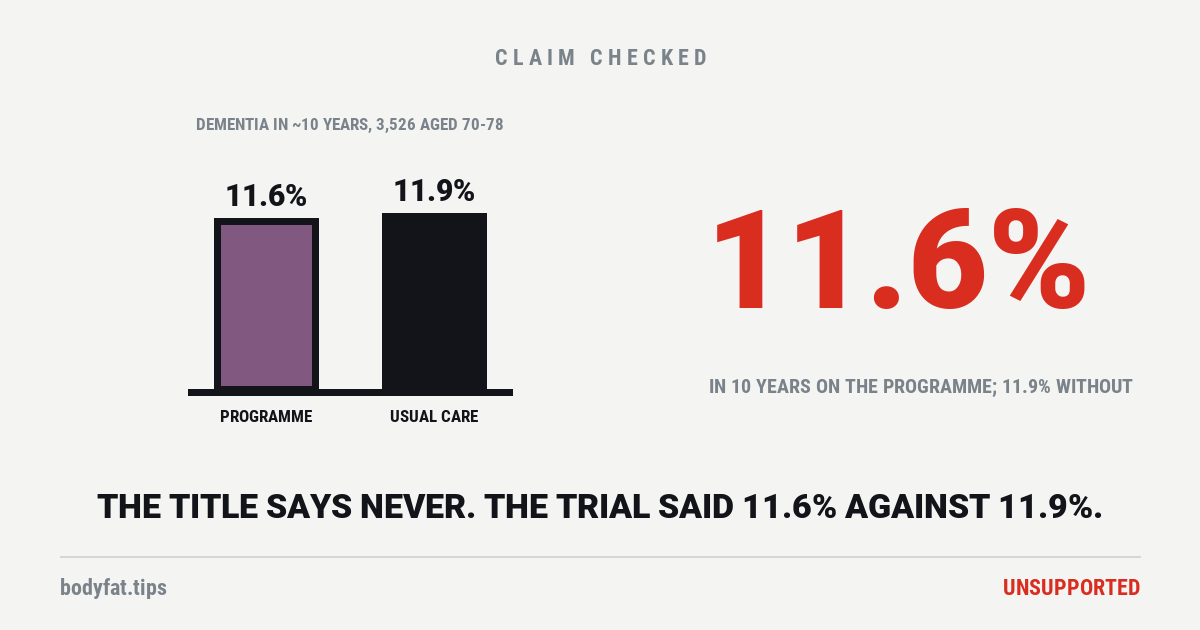
One of the most patient tests of a habit programme started in the Netherlands in 2006. Its name, preDIVA, stands for prevention of dementia by intensive vascular care. 3,526 people aged 70 to 78 were split by their family doctor’s practice: half got a practice nurse who worked on their smoking, diet, exercise, weight, blood pressure, blood sugar and cholesterol for six to eight years, and half got usual care [2].
Then the researchers kept counting. After a median of 10.3 years, dementia had been diagnosed in 11.6% of the people in the programme and 11.9% of those without it [2]. The hazard ratio, the rate of new cases in one group divided by the rate in the other, where 1.00 means no difference at all, was 0.99 [2]. The authors’ own reading was that the benefit of such programmes “may be less than projected from cohort studies” [2], the studies that watch people’s habits rather than assign them.
It is not alone. A 2021 Cochrane review found nine randomised trials of these bundled programmes, with 18,452 people; two of them counted dementia [3]. Pooled, 155 of 3,771 people on the programmes were diagnosed (4%), against 146 of 3,485 controls (4%) [3]. The second of those trials was a weight-loss programme in people with type 2 diabetes, followed for 10 to 13 years [3]. Its own team kept checking the same people for 12 to 14 years after the programme ended, counting memory impairment and dementia together. By about 24 years after they joined, the estimated share with one or the other was 37.4% among those given the programme and 38.9% among the rest: no overall difference, a hazard ratio of 0.97 [30]. Split by starting weight, the programme went with fewer cases among people who were overweight but not obese (0.64), no difference in the middle band, and more cases among the heaviest (1.40), a split the team’s earlier reports had pointed to [30].
That pooled result has a range, and the range matters. Its confidence interval, the band the true answer probably sits in, runs from 24% fewer cases to 18% more [3]. A modest benefit is still on the table. A big one, the kind a title with “never” in it implies, is not.
What the programmes did change: test scores
The trials that found something measured something else: scores on batteries of memory and thinking tests. The landmark one, FINGER in Finland, gave 1,260 people aged 60 to 77 with above-average risk two years of diet advice, exercise, brain training and monitoring of heart and blood-vessel risk factors [4]. Their scores rose by 0.022 of a standard deviation a year more than the control group’s [4].
That unit needs a gloss. A standard deviation is the usual spread of scores between people, and researchers call a difference of 0.2 of one small and 0.8 large. On that scale FINGER’s two-year gain adds up to about 0.04, a fifth of small. That is our arithmetic, not the paper’s.
The American version, US POINTER, tried the same idea on 2,111 sedentary people aged 60 to 79, 69% of them women [5]. The structured group was asked to exercise four days a week, follow the MIND diet and do online brain training three times a week, with trained staff supporting them; the comparison group got public education materials and six team meetings over two years [5]. Both groups’ scores rose. The structured group’s rose faster, by 0.029 of a standard deviation a year [5]: over two years, under a third of small, by the same arithmetic. A Latin American trial reported in 2026 found a bigger edge, 0.11 a year, in 1,065 people, three in four of them women [6]. The Cochrane pooling of the three trials that used the same kind of test battery put the difference at 0.03 [3].
Two caveats come from the trials themselves. POINTER had no group that did nothing, so its authors write that they cannot rule out “practice effects and general benefits of trial participation” [5]: people get better at a test by taking it again and again. And the Cochrane authors note that the benefit was strongest in trials that included brain training, which makes a learning effect hard to rule out [3]. POINTER was also not designed to count dementia; its authors say it was not powered for that [5].
Watch one phrase on the way out. A 2022 review reports that these programmes cut “the risk of dementia” with high certainty [7]. Its forest plot, the chart that lists each pooled trial, pools six trials with FINGER and a European online-coaching trial among them [7], and the Cochrane review lists neither as having counted dementia cases [3]. Read together, the review’s “risk of dementia” is a risk score, a points tally built from things like blood pressure, weight and cholesterol, not a count of people diagnosed. That reading is ours, from the two papers’ own lists.
Exercises to prevent dementia: what the trials counted
Exercise has a great deal of observational support. The Lancet Commission cites a meta-analysis of 58 studies in which physically active people had about 20% lower dementia risk (a relative figure: a fifth fewer cases than among less active people, not 20 fewer in every 100), including in studies that followed people for 20 years or more [1]. The Commission has concluded that the link is “likely to be bidirectional” [1]: dementia makes people less active, as well as the other way round. Our verdict on daily steps covers the cohort numbers for walking.
When trials assigned exercise and counted diagnoses, the picture blurred. A 2024 review found four such trials [8]. Added up from its forest plot, 43 of 2,023 exercisers were diagnosed against 74 of 2,091 controls; that sum is ours. The review’s pooled estimate was 39% lower risk, with a range running from 75% lower to 52% higher, and it reported exercise as not altering dementia onset [8]. Pooled the other ways the review also reports, with or without a fifth small trial, the estimate sometimes clears the line for “probably not chance” and sometimes just misses it; the review’s own check on the three trials it judged least open to bias in how they were run, which leaves out the Hong Kong trial described below, came out at 15% lower, with a range from 45% lower to 29% higher [8]. LIFE, the trial that carries the most weight in the pooling, put 1,635 sedentary Americans aged 70 to 89 on two years of walking, strength and flexibility training or on health education: 28 exercisers and 29 controls developed dementia [8], and none of the memory and thinking tests differed [9].
The strongest result in that pool came from one small trial in Hong Kong, and it is worth knowing why it looked so good. Its 389 participants already had early memory trouble; it compared tai chi with stretching for a year; and only 92 of the 171 assigned to tai chi finished, against 169 of 218 on stretching. Its dementia count, 4 cases against 28, includes only the people who finished [10] [8]. A trial that loses nearly half of one group can make that group look healthier than it was.
None of this says exercise does nothing for the brain. In the trial behind our exercise-and-brain verdict, a year of walking grew part of the hippocampus, a memory centre deep in the brain, by about 2%, although memory improved as much in the stretching group; that verdict also reports that later poolings of exercise trials have not clearly shown even a slowing of the hippocampus’s age-related shrinkage in healthy older adults. What this page says is that in the four trials that counted diagnoses, exercise did not clearly prevent dementia.
Brain exercises to prevent Alzheimer’s
The most interesting dementia result on this page that came without a pill comes from brain training, and it needs reading closely. ACTIVE, an American trial, randomly assigned 2,802 people aged 65 and over in 1998 and 1999 to ten sessions of memory, reasoning or speed-of-processing training, or to none [11]. Twenty years later, researchers linked 2,021 of them to Medicare records. In the untrained group 48.7% had been diagnosed with dementia; in the speed-training group, 43.6% [11]. That difference fell just short of the line researchers use for “probably not chance” [11].
The headline result is a subgroup. Booster sessions were offered at random, and only to people who had finished at least eight of the first ten. Among speed-trained people who went on to complete at least one booster, 39.8% were diagnosed, and the hazard ratio was 0.75 [11]. Speed-trained people without boosters did no better than the untrained [11]. A 2026 reanalysis pointed out that once the paper’s many comparisons are corrected for, every one of them is compatible with no effect, but that 29 of its 30 hazard ratios lean towards training, which hints at a small benefit from all three kinds [12]. One of the original paper’s authors consults for and owns stock in the company that markets the speed-training software, and the paper says so [11].
Read alone, brain training as dementia prevention rates Preliminary: one trial, a long and careful follow-up, and a result that rests on a subgroup.
The clearest cut in diagnoses: blood pressure
High blood pressure is one of the Lancet Commission’s 14 risk factors [1], and the largest blood-pressure trial on this page tested it. In rural China, 326 villages were randomly assigned either to usual care or to a scheme in which village health workers, supervised by doctors, started and adjusted blood-pressure medicines towards a target below 130/80 [13]. Whole villages were assigned, not individuals, and the 33,995 people in them were aged 40 and over with uncontrolled high blood pressure [13].
Over four years, systolic blood pressure, the top number, fell 22 mmHg more in the scheme’s villages. Dementia was diagnosed at a rate of about 1.1 per 100 people a year there, against 1.3 in the usual-care villages: a 15% lower risk, with a range from 5% to 24% lower [13]. Everyone knew which group they were in; the diagnoses were made by an expert panel that did not [13].
The American trial SPRINT MIND treated 9,361 people with high blood pressure to a systolic target below 120 or below 140. For dementia it found 7.2 against 8.6 cases per 1,000 people a year, a difference that fell short of the line; the trial was stopped early, and its authors say it may have been too small for that question [14]. Mild cognitive impairment, memory or thinking trouble short of dementia, was clearly reduced [14]. A 2020 pooling of 12 blood-pressure trials and 92,135 people found dementia or cognitive impairment in 7.0% of treated people against 7.5% of controls, over about four years [15].
Rated alone, “treating high blood pressure lowers the risk of dementia” would be Supported. Two cautions. These were trials of medicine, not of habits; whether blood pressure lowered by exercise or less salt does the same is a fair guess these trials were not built to test. And this is journalism, not medical advice: whether you should take a blood-pressure drug is a conversation with a doctor.
Does the MIND diet prevent dementia?
The MIND diet, a hybrid of the Mediterranean diet and the blood-pressure diet known as DASH, leans on leafy greens, berries, nuts, olive oil and fish. Its first evidence came from a cohort. In 2015 its designers reported that among 923 Chicago retirement-community volunteers followed for four and a half years, the third whose diets matched it best had about half the rate of Alzheimer’s disease of the third that matched it least (hazard ratio 0.47) [16]. That is an association in volunteers who chose their own diets.
Then it was tested. In a three-year trial in Chicago and Boston, 604 people aged 65 and over, overweight and with a family history of dementia, were assigned the MIND diet or their usual diet, both with a small calorie cut [17]. The MIND group was supplied blueberries, mixed nuts and extra-virgin olive oil, donated by nonprofit grower organisations [17]. Both groups lost about the same weight, 11.0 lb (5.0 kg) against 10.6 lb (4.8 kg). Both groups’ test scores rose. The difference between them, 0.035 of a standard deviation, could easily have been chance: its range ran from slightly worse to slightly better [17]. Brain scans did not differ either [17].
Rated alone, “the MIND diet prevents cognitive decline” is Unsupported: it was tested against a control diet with the same weight loss and did not hold up. What the trial cannot say is whether it beats a poor diet, since the control group’s diet improved a little too [17]. The oil at the centre of it has its own verdict.
Why “bad cooks” were said to have lower dementia risk
The channel’s video of 20 May 2026, “Why BAD cooks have LOWER dementia risk according to research” (1,241,742 views), cites a real study [24]. A Japanese cohort followed 10,978 people aged 65 and over for six years, counting dementia from long-term-care insurance records, which means dementia bad enough to need care [18]. People who cooked at home at least once a week were matched with similar people who cooked less often than that. The weekly cooks had a 23% lower rate among men and a 27% lower rate among women [18]. In plain numbers, 1,195 of the 10,978 (11%) developed dementia over the six years. Before the matching, 9.3% of men who cooked weekly and 11.0% of men who rarely cooked were diagnosed. Among women, only 332 cooked less than once a week, and 103 of them (31%) were diagnosed, against 10.1% of the 5,650 who cooked weekly; the matched comparison rests on 321 of those 332 women [18]. The authors write that reverse causation, early dementia making people stop cooking, “cannot be ruled out”; leaving out people with memory complaints at the start weakened the link, though it still pointed the same way [18].
Here is how it travelled. The rounding started in the paper itself. Its summary box, headed “What this study adds”, says cooking at least once a week “was associated with a 30% reduction in dementia risk”, and a 70% reduction for novice cooks; its results say 23% for men and 27% for women [18]. The journal’s publisher then put the rounded figures in the headline of its press release on 25 March 2026, that cooking at least once a week “may cut older people’s dementia risk by 30%,” with a subhead saying the risk “may be 70% lower in novice cooks”; the release’s own text gives 23%, 27% and 67% [19]. The 70% is a subgroup: among people with few cooking skills, those who cooked weekly had a 67% lower rate than those who rarely cooked, with a range from 16% to 87% lower [18].
Then the video turned the subgroup into a title. The study did not find that bad cooks have lower dementia risk than good ones. The press release points the other way: a high level of cooking skill was itself linked to lower risk, and for skilled cooks, cooking more often added nothing on top [19]. What it found is that among poor cooks, the ones who cooked anyway did better than the ones who did not, in an observational study, as the press release itself labels it [19]. Rated alone, “cooking at home lowers dementia risk” is Preliminary: one cohort, and an association.
The channel’s habits, one at a time
The top video’s habit, morning daylight, has a cohort behind it but not a trial. The study we read, published in 2026, fitted 87,577 people in the UK Biobank with wrist light sensors for a week and followed them for eight years. Those whose days averaged above 1,000 lux, a cut-off the authors chose from the same data, had a 16% lower dementia rate once age, health and habits were allowed for [20]. In both groups fewer than 1 in 100 people were diagnosed: 353 of 40,553 below the cut-off and 388 of 47,024 above it, or 0.87% and 0.83% by our arithmetic [20]. Whether most of their light came before or after noon made no detectable difference [20]. When the authors also allowed for depression and time spent outdoors, some of the links weakened enough to slip below the line for “probably not chance” [20]. We found no trial that gave people without memory problems morning light and counted dementia [26]. Most light trials we found were in people who already had dementia or early memory trouble, and treated sleep, mood or agitation; a few measured memory and thinking. The newest put a lamp in the homes of 61 people with mild cognitive impairment, timed to switch on at waking, for 24 weeks: those given the real light improved more than those given a placebo light on the memory part of a standard test, though not on the test as a whole [28]. For sleep itself, our sleep hygiene verdict is the place to start.
Here is the rest of the list, each habit rated on its own evidence. Purpose and belonging have their own verdict too.
| Habit | The best evidence we found | Rated alone |
|---|---|---|
| Ten minutes of morning daylight (the top video) | One large cohort: brighter days went with less dementia, and mornings did no better than afternoons [20]. We found no trial that counted dementia [26]; in 61 people with early memory trouble, home light beat a placebo light on one memory score [28]. | Unsupported for mornings; daylight in general, Preliminary |
| Staying social | Social isolation is one of the Lancet Commission’s 14 risk factors, from cohorts; the Commission calls the trials too small and too short to show an effect on dementia [1]. | Preliminary |
| The MIND diet | One three-year trial of 604 people: no difference from a control diet with the same weight loss [17]. | Unsupported |
| Cooking at home | One cohort of 10,978; the “bad cooks” figure is a subgroup [18]. | Preliminary |
| Strong legs | One cohort of 324 female twins: stronger legs went with better test scores ten years later. It counted no dementia and measured no muscle proteins [23]. | Preliminary |
| Brushing your teeth with the other hand | We found no study of it [26]. | Unsupported |
| Short naps | One cohort of 1,401 people averaging 81 years old, in which 290 of the 1,203 free of Alzheimer’s at the start developed it over about six years: naps of an hour or more went with 40% more Alzheimer’s, and Alzheimer’s itself made naps lengthen faster [22]. | Preliminary as a warning sign; Unsupported as protection |
| Exercise | Four trials counted diagnoses: no clear difference [8]. | Preliminary |
| Brain training | One trial followed for 20 years: a hint, resting on a subgroup [11] [12]. | Preliminary |
| Treating high blood pressure | A 33,995-person trial and a pooling of 12 trials: fewer diagnoses [13] [15]. | Supported |
Then why do the people who never get dementia have the habits?
This section is the desk’s own reasoning, and it is labelled as such. The cohorts say active, social, well-fed people get dementia less. The trials that assigned those habits mostly did not find fewer diagnoses. Both can be true at once, and here are three ways, with the evidence for each.
Answer one: the disease changes the habit first. Dementia starts in the brain years before anyone diagnoses it, and it changes how people live. Pooling 19 cohorts and 404,840 people, 2,044 of whom developed dementia, researchers found that inactivity measured in the ten years before a diagnosis went with 40% more dementia, a relative figure, while inactivity measured ten years or more before went with no difference [21]. In a Chicago study of 1,401 older people wearing activity watches, Alzheimer’s more than doubled the yearly increase in napping [22]. So some of what looks like a habit preventing dementia is dementia preventing the habit. This is measured, in cohorts. It is not the whole story: the Commission’s 58-study pooling found the activity link in studies with 20-year follow-up too [1].
Answer two: the trials could miss a modest effect. The pooled habit-programme trials leave a range running from 24% fewer cases to 18% more [3]. They mostly started people in their sixties and seventies and ran for one to ten years [3]; the cohorts measure habits held for decades. A real benefit of the size the cohorts suggest could hide inside that range. The range is measured; that a benefit hides in it is a surmise. The Commission makes the same point about trials of social activity, which it calls “too small and follow-up too short” to tell [1].
Answer three: “never get dementia” is a backward look. The channel’s second video credits researchers who studied “super agers” [24], people who reached old age with unusually sharp memories. Start from the people who stayed sharp and you will find things they share; you will not find out which of them caused it, because luck, genes and the people who did the same things and declined anyway are not in the room. It is the same backward logic as the Blue Zones. This is reasoning, not a measurement.
Put the three together and here is what we think is true, stated plainly so you can disagree with it: the dementia prevention a trial can vouch for is mostly blood-pressure treatment; the morning daylight habit is a reasonable bet that nobody has tested.
What we could not find, and would like to: a habit programme started in midlife that counts every dementia diagnosis, in everyone who joined, decades later. Three trials come close, and none found a clear benefit overall. One is the diabetes weight-loss trial above, which took people from age 45 and kept checking them for 12 to 14 years after it ended [30]. In the American Diabetes Prevention Program, adults at high risk of diabetes were randomly assigned in 1996 to 1999 to an intensive weight-loss and exercise programme, to the diabetes drug metformin or to a placebo, for about three years; from 2002 everyone was offered a group lifestyle programme. In 2022 to 2024, 1,483 of them, who had joined at a median age of 48, were assessed: dementia was found in 21 of 495 from the lifestyle group (4.2%) and 18 of 513 from the placebo group (3.5%), and the authors report “no evidence of differences” between those two [27]. The report’s headline is about the drug group, with 9 cases in 475, and its authors call their estimates imprecise; it is a preprint, not yet checked by other scientists, and it counts only the people still alive and taking part, at one visit [27]. In an American trial of a low-fat eating pattern in 48,835 women aged 50 to 79, followed for 20 years, 1,386 died of dementia, and the diet made no clear difference: a hazard ratio of 0.94, with a range from 15% fewer deaths to 5% more [29]. Women who joined in their fifties leaned towards fewer such deaths, in one of 13 subgroups the authors looked at, and an earlier analysis found fewer failed memory screenings on the diet among women aged 65 and over [29]. We would also like a long trial that gives people without memory problems more morning light and counts dementia. The light trials registered in older adults without memory problems are built around sleep and include thinking tests; we found no published results from them, and none counts dementia [26]. POINTER’s authors say longer follow-up is planned [5]. If you know of a trial we missed, the corrections line on this site is open.
Who these trials were done on
If you are wondering whether any of this applies to you: most of the people in the recent habit trials were women. POINTER was 69% women, aged 60 to 79 and sedentary [5]; the MIND diet trial was 65% women aged 65 and over, overweight, mostly white and with about 17 years of schooling [17]; the Latin American trial was 75% women [6]; the brain-training analysis was 76% women [11]. So if you searched for how to prevent Alzheimer’s in women, the habit-trial evidence covers women at least as well as men. The blood-pressure trial was rural Chinese adults aged 40 and over with uncontrolled high blood pressure [13], and SPRINT MIND left out people with diabetes or a past stroke [14]. None of the trials in this paragraph enrolled anyone under 40.
What this is rated, and what the rating covers
Unsupported — for the claim as the channel sells it: that people who never get dementia share a daily habit, and that doing it, ten minutes of morning daylight in the top video, prevents dementia.
It is Unsupported in both of the ways the rating allows. Habit programmes were tested against dementia diagnoses and did not hold up in the trials that counted them [2] [3]; the exercise trials did not clearly hold up either [8], and nor, in a preprint, did a lifestyle programme started in midlife and checked about 25 years later [27], or, overall, a diabetes weight-loss programme followed for about 24 years [30]. And the specific habit sold, morning daylight, has not been tested at all; the closest evidence, a cohort, found mornings no different from afternoons [20] [26]. An untested claim is not a disproven one, and daylight may yet turn out to matter.
The other parts, rated alone: structured habit programmes lifting test scores a little, Supported [3] [4] [5] [6]; treating high blood pressure to lower dementia diagnoses, Supported [13] [15]; exercise or brain training as dementia prevention, Preliminary [8] [11]; the MIND diet, Unsupported [17]; the rest of the channel’s list as in the table above.
None of this is aimed at anyone who takes a morning walk. It is aimed at the word “never” in a title. This page is journalism, not medical advice, and a change in your memory is a reason to see a doctor, not to change your morning routine.
What is not rated here: whether these habits are good for you for other reasons, which is a different question with different evidence; and the frame in the section above, which is this desk’s reasoning from the evidence rather than a result the evidence delivered. It is marked as ours so that you can weigh it as ours. How we read a study, and what each tier means, is set out here.